 Electric field lines of a
point charged particle is shown in the following figure. By looking
at the field lines, what can you conclude about this particle?
Electric field lines of a
point charged particle is shown in the following figure. By looking
at the field lines, what can you conclude about this particle?
it is neutral
it has positive charge
it has negetive charge
Homework Answers
As we know that electric field lines start from positive charge and end with negative charge.As we can say from figure that electric field lines are coming or ending at thia point charge so this charge is negative charge .
Add Answer to:
Electric field lines of a
point charged particle is shown in the following figure. By looking...
Consider the electric field characterized by the field lines shown in the Figure, which is rotationally...
 Consider the electric field characterized by the field lines shown in the Figure, which is rotationally symmetric about the x axis. If a charge -q is placed at point A and released we can conclude: It will be accelerated in the direction It will be accelerated in the +x direction It will be accelerated in the +y direction Since the charge + will influence the electric field around it, this question cannot be answered without knowing the magnitude of this...
A gray conductor shown in Figure 7-8 is charged, and generates an electric field corresponding to...
 A gray conductor shown in Figure 7-8 is charged, and generates an electric field corresponding to the following equipotential lines: VA-3.0 V and Va-1.0v a. On this diagram, sketch some of the electric field lines resulting from the charge distribution. Is the charge distribution positive or negative? (Yes you have enough information to tell.) The chorg dastribwbon is b. Where is the electric field strongest? Explain. C. How much work would it take to move a Q = 0.50 C...
Which of the following statements about electric field lines are true? (choose all that are true)...
Which of the following statements about electric field lines are true? (choose all that are true) a) They are only defined for positive charges. b) They are always tangent to electric field vectors. c) They are always perpendicular to charged surfaces. d) They are a simple way to visualize the electric field vectors. e) None of the above. If a negative charge is placed in an electric field, what direction will it be accelerated? a) In the direction of the...
The figure shows the path of a charged particle moving in a magnetic field directed into...
 The figure shows the path of a charged particle moving in a magnetic field directed into the screen. What is the particle's charge? neutral positive negative
Two point charges Q and +q (where q is positive) produce the net electric field shown at point P in the figure (Figure 1...
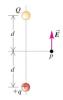 Two point charges Q and +q (where q is positive) produce the net
electric field shown at point P in the figure (Figure 1). The field
points parallel to the line connecting the two charges. What can
you conclude about the magnitude of Q?
Two point charges Q and +q (where q is positive) produce the net
electric field shown at point P in the figure (Figure 1). The field
points parallel to the line connecting the two charges. What can
you conclude about the magnitude of Q?
3.2 Electric Field of a Charged Particle The four properties of the electric field of a...
 3.2 Electric Field of a Charged Particle The four properties of the electric field of a charged particle are captured by the vector field where the particle has charges and the source-to-target radial vector field and its associated unit vector field are defined as Psr (x,y) = (x - 1s)i + (- ) Pris(z,y) STIFT IFs (2.y) and k = 8.99 x 10°N C/ mºis Coulomb's constant. Question 3.3) Consider a 2 C source particle, located at the position (1,3)...
10. Looking at the Electric Field lines for a Dipole, where is the electric field the...
 10. Looking at the Electric Field lines for a Dipole, where is the electric field the hen is closest strongest? The eiecetic fied to te difore Ses 11. How are the electric field lines of the dipole different from those of a single point charge?
Question 9 of 17> Select the options that best complete the statement. follow electric field lines,...
 Question 9 of 17> Select the options that best complete the statement. follow electric field lines, because never Positively charged particle trajectories never can but do not have to always electric field lines are de ist charges travel. about us careers privacy poliky erms ofuse contactus hetp ion 9 of 17> Select the options that best complete the statement. Positively charged particle trajectories never follow electric field lines, because electric field lines are defined by the path positive test charges...
3.1 Pre-lab In the lab on electric potential and electric field lines, you noted that charged...
 3.1 Pre-lab In the lab on electric potential and electric field lines, you noted that charged par- ticles produce electric fields and these electric fields, in turn, act on charged par- ticles. However, you then proceeded to produce an electric field geometry using conductors held at a particular electric potential. What happened to the electric charges? Electric charge and electric potential are closely related to each other. Putting charge on a conductor raises its electric potential. It is usually much...
Electric Field Lines and Potential The figure shows the E-field in the plane of two point...
 Electric Field Lines and Potential The figure shows the E-field in the plane of two point charges. Determine for each of the following statements whether it is correct or incorrect. 2 Incorrect The electric potential (volts) is larger at 'c' than 'e'. Incorrect The net charge Q1+Q2 is negative. Correct The E-field at 'b' points north. Incorrect The E-field at 'c is zero. Correct The E-field at 'b' points directly toward Q2. Incorrect The magnitude of the E-field at 'a'...
 Consider the electric field characterized by the field lines shown in the Figure, which is rotationally symmetric about the x axis. If a charge -q is placed at point A and released we can conclude: It will be accelerated in the direction It will be accelerated in the +x direction It will be accelerated in the +y direction Since the charge + will influence the electric field around it, this question cannot be answered without knowing the magnitude of this...
 A gray conductor shown in Figure 7-8 is charged, and generates an electric field corresponding to the following equipotential lines: VA-3.0 V and Va-1.0v a. On this diagram, sketch some of the electric field lines resulting from the charge distribution. Is the charge distribution positive or negative? (Yes you have enough information to tell.) The chorg dastribwbon is b. Where is the electric field strongest? Explain. C. How much work would it take to move a Q = 0.50 C...
 3.2 Electric Field of a Charged Particle The four properties of the electric field of a charged particle are captured by the vector field where the particle has charges and the source-to-target radial vector field and its associated unit vector field are defined as Psr (x,y) = (x - 1s)i + (- ) Pris(z,y) STIFT IFs (2.y) and k = 8.99 x 10°N C/ mºis Coulomb's constant. Question 3.3) Consider a 2 C source particle, located at the position (1,3)...
 10. Looking at the Electric Field lines for a Dipole, where is the electric field the hen is closest strongest? The eiecetic fied to te difore Ses 11. How are the electric field lines of the dipole different from those of a single point charge?
 Question 9 of 17> Select the options that best complete the statement. follow electric field lines, because never Positively charged particle trajectories never can but do not have to always electric field lines are de ist charges travel. about us careers privacy poliky erms ofuse contactus hetp ion 9 of 17> Select the options that best complete the statement. Positively charged particle trajectories never follow electric field lines, because electric field lines are defined by the path positive test charges...
 3.1 Pre-lab In the lab on electric potential and electric field lines, you noted that charged par- ticles produce electric fields and these electric fields, in turn, act on charged par- ticles. However, you then proceeded to produce an electric field geometry using conductors held at a particular electric potential. What happened to the electric charges? Electric charge and electric potential are closely related to each other. Putting charge on a conductor raises its electric potential. It is usually much...
 Electric Field Lines and Potential The figure shows the E-field in the plane of two point charges. Determine for each of the following statements whether it is correct or incorrect. 2 Incorrect The electric potential (volts) is larger at 'c' than 'e'. Incorrect The net charge Q1+Q2 is negative. Correct The E-field at 'b' points north. Incorrect The E-field at 'c is zero. Correct The E-field at 'b' points directly toward Q2. Incorrect The magnitude of the E-field at 'a'...
Most questions answered within 3 hours.
-
Where is the error in this code sequence?
String s1 = "Hello";
String s2 = "ello";...
asked 11 months ago -
Financial data for Joel de Paris, Inc., for last year
follow:
Joel de Paris, Inc.
Balance...
asked 11 months ago -
Consider this reaction:
Al2(SO4)3 (aq)+ BaCl3
(aq) Al2Cl6 (aq)- +
3BaSO4(s) . What is the...
asked 11 months ago -
Suppose that Savneet is considering increasing her
recent random sample from 20 car rentals to 40...
asked 11 months ago -
Trucks arrive at an unloading terminal at an average rate of 120
per hour.
Trucks arrive...
asked 11 months ago -
Why are methanol and ethanol completely soluble in water while
octanol is not very little soluble....
asked 11 months ago -
A facilities manager at a university reads in a research report
that the mean amount of...
asked 11 months ago -
When the CuSO4 is rehydrated by adding water to the anhydrous
compound, is this an endothermic...
asked 11 months ago -
A ray of sunlight is passing from diamond into crown glass; the
angle of incidence is...
asked 11 months ago -
A block of mass 0.249 kg is placed on top of a light, vertical
spring of...
asked 11 months ago -
how do the kidneys compensate in the presences of acidosis
a) trigger hyperventilate
b) reserve acid...
asked 11 months ago -
Question 501 pts
The rental rate of capital to the firm increases. Which of the
following...
asked 11 months ago