
Homework Answers
Add Answer to:
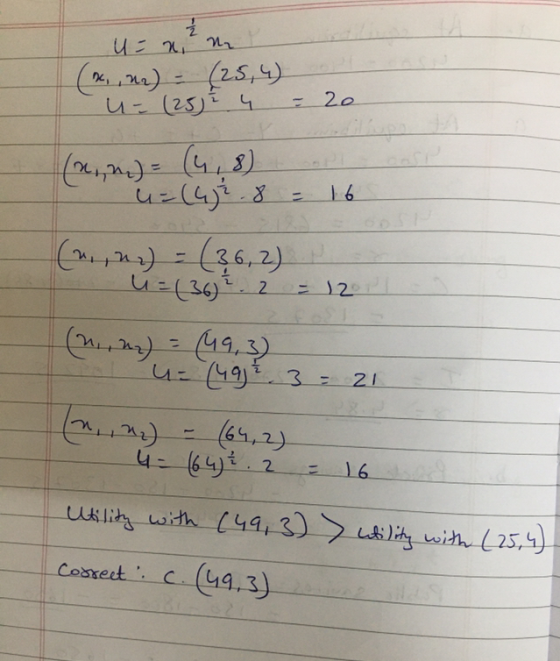
Which of the following combinations of goods 1 and 2 are preferred Suppose an individual has...
4. An individual has preferences over two goods (x and y) that are represented by function...
 4. An individual has preferences over two goods (x and y) that are represented by function U = min{x,y}. The individual has income $60, the price of x is $4 and the price of good y is $2. (a) What kind of goods are these to the individual? (i.e. what "special case” is this?) (b) What is this individual's budget constraint? (c) What is this individual's optimal bundle of x and y? [HINT: You can't take the derivative of this...
An individual has preferences over housing, x (measured in square metres), and other goods, y, represented...
An individual has preferences over housing, x (measured in square metres), and other goods, y, represented by utility function u(x,y) = x4y. Her disposable income is $75000, and the price of housing is $1000/m2, while that of other goods is py = $1. b) [5 marks] The government decides to subsidize housing at a rate of 20%. Find the resulting optimal bundle and utility level.
An individual has preferences over housing, x (measured in square metres), and other goods, y, represented...
An individual has preferences over housing, x (measured in square metres), and other goods, y, represented by utility function u(x,y) = x4y. Her disposable income is $75000, and the price of housing is $1000/m2, while that of other goods is py = $1. a) [5 marks] Find this consumer’s optimal bundle and utility level, given initial prices and income.
Suppose a consumer’s preferences over goods 1 and 2 are represented by the utility function U(x1,...
Suppose a consumer’s preferences over goods 1 and 2 are represented by the utility function U(x1, x2) = (x1 + x2) 3 . Draw an indifference curve for this consumer and indicate its slope.
Utility maximization with more than two goods Suppose that there four goods Q, R, X and...
Utility maximization with more than two goods Suppose that there four goods Q, R, X and Y , available in arbitrary non-negative quantities (so the the consumption set is R 4 +). A typical consumption bundle is therefore a vector (q, r, x, y), where q ≥ 0 is the quantity of good Q, r ≥ 0 is the quantity of good R, x ≥ 0 is the quantity of good X, and y ≥ 0 is the quantity of...
Utility maximization with more than two goods Suppose that there four goods Q, R, X and Y , avail...
Utility maximization with more than two goods Suppose that there four goods Q, R, X and Y , available in arbitrary non-negative quantities (so the the consumption set is R 4 +). A typical consumption bundle is therefore a vector (q, r, x, y), where q ≥ 0 is the quantity of good Q, r ≥ 0 is the quantity of good R, x ≥ 0 is the quantity of good X, and y ≥ 0 is the quantity of...
1. True or False, and explain briefly. 1) The assumption that more is better implies that...
 1. True or False, and explain briefly. 1) The assumption that more is better implies that the indifference curves are upward sloping 2) Convexity of indifference curves implies that consumers are willing to give up more to get an extra the more they have 3) Consider the following three bundles. Bundle Good Goody If Bundles A and B are on the same indifference curve, preferences satisfy all the usual assumptions introduced in the lecture, Bundle Cis preferred to Bundle A...
Question 2. Consider the following 8 bundles of goods x and y: A = (8,4) B...
Question 2. Consider the following 8 bundles of goods x and y: A = (8,4) B = (5,6) C = (5,9) D = (10,3) E =(1,4) F =(6,5) G=(2,8) H =(7,8) (a) Come up with an example of a utility function that will produce the following order of preference for the bundles, where H is most preferred, A and G are equally preferred, and E is least preferred. H , C , B , F , A = G ,...
Question 6: Logan has preferences over olives (x1) and ice creams (x2). He prefers to eat...
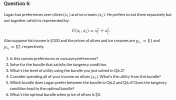 Question 6: Logan has preferences over olives (x1) and ice creams (x2). He prefers to eat them separately but not together, which is represented by: U(X1, X2) = x + xỉ. Also suppose his income is $100 and the prices of olives and ice creames are px, = $1 and Px2 = $2, respectively. 1. Is this convex preferences or concave preferences? 2. Solve for the bundle that satisfis the tangency condition. 3. What's the level of utility using the...
(38pts) Suppose a consumer spends all of her income on only two goods, z and y. Her preferences o...
 (38pts) Suppose a consumer spends all of her income on only two goods, z and y. Her preferences over these two goods are represented by the utility function u(r,y) min(, 4y). The price of good y is given to be S8. Her income and price of z are represented by m and ps, respectively. (a) (10 pts) Find the demand for good z as a function of m and pa. (b) (5 pts) Is good z ordinary or Giffen good?...
 4. An individual has preferences over two goods (x and y) that are represented by function U = min{x,y}. The individual has income $60, the price of x is $4 and the price of good y is $2. (a) What kind of goods are these to the individual? (i.e. what "special case” is this?) (b) What is this individual's budget constraint? (c) What is this individual's optimal bundle of x and y? [HINT: You can't take the derivative of this...
 1. True or False, and explain briefly. 1) The assumption that more is better implies that the indifference curves are upward sloping 2) Convexity of indifference curves implies that consumers are willing to give up more to get an extra the more they have 3) Consider the following three bundles. Bundle Good Goody If Bundles A and B are on the same indifference curve, preferences satisfy all the usual assumptions introduced in the lecture, Bundle Cis preferred to Bundle A...
 Question 6: Logan has preferences over olives (x1) and ice creams (x2). He prefers to eat them separately but not together, which is represented by: U(X1, X2) = x + xỉ. Also suppose his income is $100 and the prices of olives and ice creames are px, = $1 and Px2 = $2, respectively. 1. Is this convex preferences or concave preferences? 2. Solve for the bundle that satisfis the tangency condition. 3. What's the level of utility using the...
 (38pts) Suppose a consumer spends all of her income on only two goods, z and y. Her preferences over these two goods are represented by the utility function u(r,y) min(, 4y). The price of good y is given to be S8. Her income and price of z are represented by m and ps, respectively. (a) (10 pts) Find the demand for good z as a function of m and pa. (b) (5 pts) Is good z ordinary or Giffen good?...
Most questions answered within 3 hours.
-
Where is the error in this code sequence?
String s1 = "Hello";
String s2 = "ello";...
asked 11 months ago -
Financial data for Joel de Paris, Inc., for last year
follow:
Joel de Paris, Inc.
Balance...
asked 11 months ago -
Consider this reaction:
Al2(SO4)3 (aq)+ BaCl3
(aq) Al2Cl6 (aq)- +
3BaSO4(s) . What is the...
asked 11 months ago -
Suppose that Savneet is considering increasing her
recent random sample from 20 car rentals to 40...
asked 11 months ago -
Trucks arrive at an unloading terminal at an average rate of 120
per hour.
Trucks arrive...
asked 11 months ago -
Why are methanol and ethanol completely soluble in water while
octanol is not very little soluble....
asked 11 months ago -
A facilities manager at a university reads in a research report
that the mean amount of...
asked 11 months ago -
When the CuSO4 is rehydrated by adding water to the anhydrous
compound, is this an endothermic...
asked 11 months ago -
A ray of sunlight is passing from diamond into crown glass; the
angle of incidence is...
asked 11 months ago -
A block of mass 0.249 kg is placed on top of a light, vertical
spring of...
asked 11 months ago -
how do the kidneys compensate in the presences of acidosis
a) trigger hyperventilate
b) reserve acid...
asked 11 months ago -
Question 501 pts
The rental rate of capital to the firm increases. Which of the
following...
asked 11 months ago