
Homework Answers
Add Answer to:
A control operates at steady state as shown in the diagram below. For the control volume,...
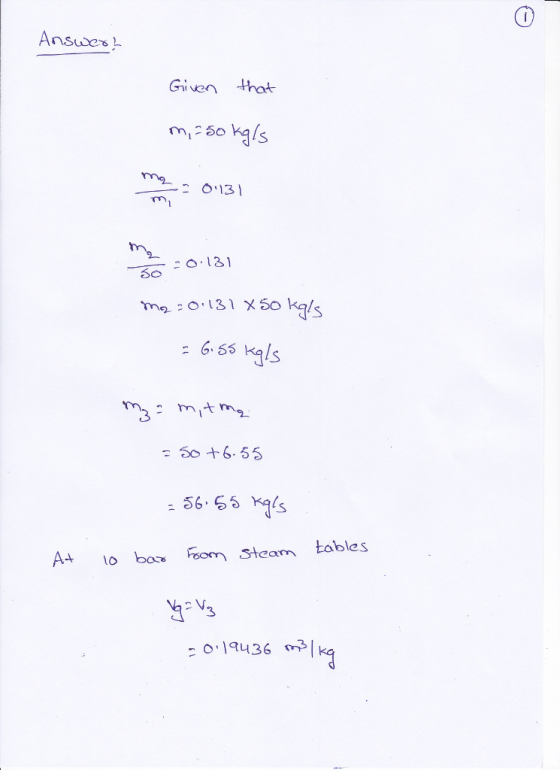
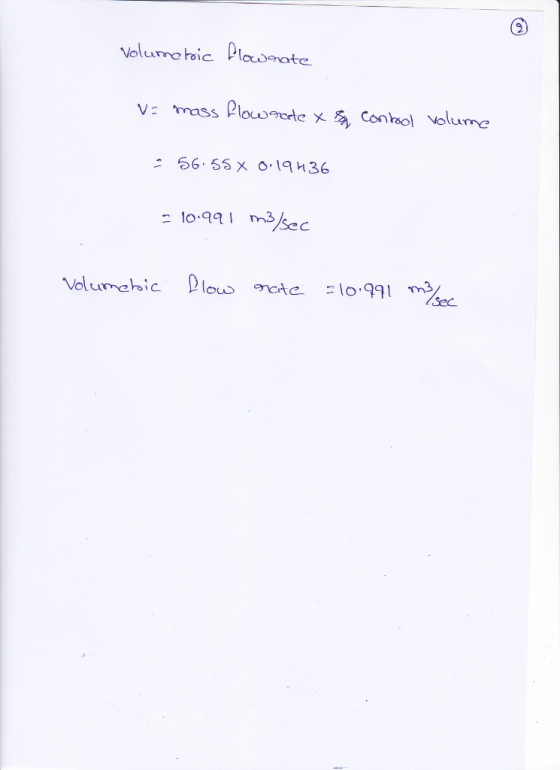
A control volume operating at steady state has one inlet and two exits. Steam enters inlet...
A control volume operating at steady state has one inlet and two exits. Steam enters inlet 1 and sat. vapor at 2 bar exits exit 2 and sat. liquid at 2 bars exits exit 3 Using the data given, determine [a] the mass flow rate at the inlet state 1, in kg/sec, [b] the mass flow rate at exit state 2, in kg/sec, and [c] area required at exit 2 to ensure velocity is same as velocity at inlet 1...
A) Steam enters a horizontal pipe operating at steady state with a specific enthalpy of 2,663 kJ/...
A) Steam enters a horizontal pipe operating at steady state with a specific enthalpy of 2,663 kJ/kg and a mass flow rate of 0.1 kg/s. At the exit, the specific enthalpy is 1,531 kJ/kg. If there is no significant change in kinetic energy from inlet to exit, determine the rate of heat transfer between the pipe and its surroundings, in kW. B) Refrigerant 134a enters a horizontal pipe operating at steady state at 40°C, 3.1 bar and a velocity of...
312: A 35 hp pump operates at steady state and is adiabatic and internally reversible. At...
 312: A 35 hp pump operates at steady state and is adiabatic and internally reversible. At the inlet the pump has a flow area of 0.04 m² and draws in 52 kg/s of liquid water at 1 bar, 20 °C. At the exit the water is at 4 bar, 15 °C with a flow area of 50 cm. What is the maximum elevation, m, of the pump exit compared to the pump inlet?
Steam enters a nozzle operating at steady state at 30 bar, 320 deg C with a...
Steam enters a nozzle operating at steady state at 30 bar, 320 deg C with a velocity of 100 m/sec. The exit pressure and temperature are 10 bar and 200 deg C respectively. The mass rate of flow of steam is 2 kg/sec. Neglect heat transfer and potential energy. Determine, exit velocity in m/sec and inlet and exit flow areas in m2.
A feedwater heater operating at steady state has two inlets and one exit. At inlet 1,...
A feedwater heater operating at steady state has two inlets and one exit. At inlet 1, water vapor enters at p1 = 7 bar, T1 = 200oC with a mass flow rate of 40 kg/s. At inlet 2, liquid water at p2 = 7 bar, T2 = 40oC, density = 992.260 kg/m3 enters through an area A2 = 25 cm2. Liquid water at 7 bar with a density of 902.527 kg/m3 exits at exit 3 with a volumetric flow rate...
A steam turbine, as shown in Figure Q3, operates at steady state with inlet conditions of Pi= 2 M...
 A steam turbine, as shown in Figure Q3, operates at steady state with inlet conditions of Pi= 2 MPa, T1 = 480°C and producing 4000 kW. Saturated steam leaves the turbine at a pressure of 0.1 bar where it is condensed at 45.81 °C in the condenser. There is no significant heat transfer between the turbine and the condenser and their surroundings, and kinetic and potential energy changes between inlet and exit are negligible.
A steam turbine, as shown in...
A steam turbine, as shown in Figure Q3, operates at steady state with inlet conditions of Pi= 2 MPa, T1 = 480°C and producing 4000 kW. Saturated steam leaves the turbine at a pressure of 0.1 bar where it is condensed at 45.81 °C in the condenser. There is no significant heat transfer between the turbine and the condenser and their surroundings, and kinetic and potential energy changes between inlet and exit are negligible.
A steam turbine, as shown in...
Water vapor enters a turbine operating at steady state at 600°C, 40 bar, with a velocity...
Water vapor enters a turbine operating at steady state at 600°C, 40 bar, with a velocity of 200 m/s, and expands adiabatically to the exit, where it is saturated vapor at 0.8 bar, with a velocity of 150 m/s and a volumetric flow rate of 15 m3/s. Determine the power developed by the turbine, in kW.
Steam enters a turbine operating at steady state at 2 MPa, 360 °C with a velocity...
Steam enters a turbine operating at steady state at 2 MPa, 360 °C with a velocity of 52 m/s. Saturated vapor exits at 0.1 MPa and a velocity of 35 m/s. The elevation of the inlet is 1 m higher than at the exit. The mass flow rate of the steam is 21 kg/s, and the power developed is 5 MW. Let g = 9.81 m/s2. Determine the area at the inlet, in m2.
Problem 4.080 A feedwater heater in a vapor power plant operates at steady state with liquid...
 Problem 4.080 A feedwater heater in a vapor power plant operates at steady state with liquid entering at inlet 1 with T45°C and p3.0 bar. Water vapor at T4400C and pz 3.0 bar enters at inlet 2, Saturated liquid water exits with a pressure of pj = 3.0 bar. Ignore heat transfer with the surroundings and all kinetic and potential energy effects. If the mass flow rate of the liquid entering at inlet 1 is mi = 3.2 × 10⁵...
Problem 4.018 SI Air enters a horizontal, constant-diameter heating duct operating at steady state at 300...
 Problem 4.018 SI Air enters a horizontal, constant-diameter heating duct operating at steady state at 300 K, 1 bar, with a volumetric flow rate of 0.25 m3/s, and exits at 325 K, 0.95 bar. The flow area is 0.05 m2 Assuming the ideal gas model with k-1.4 for the air, determine: (a) the mass flow rate, in kg/s, (b) the velocity at the inlet and exit, each in m/s, and (c) the rate of heat transfer to the air, in...
 312: A 35 hp pump operates at steady state and is adiabatic and internally reversible. At the inlet the pump has a flow area of 0.04 m² and draws in 52 kg/s of liquid water at 1 bar, 20 °C. At the exit the water is at 4 bar, 15 °C with a flow area of 50 cm. What is the maximum elevation, m, of the pump exit compared to the pump inlet?
 A steam turbine, as shown in Figure Q3, operates at steady state with inlet conditions of Pi= 2 MPa, T1 = 480°C and producing 4000 kW. Saturated steam leaves the turbine at a pressure of 0.1 bar where it is condensed at 45.81 °C in the condenser. There is no significant heat transfer between the turbine and the condenser and their surroundings, and kinetic and potential energy changes between inlet and exit are negligible.
A steam turbine, as shown in...
A steam turbine, as shown in Figure Q3, operates at steady state with inlet conditions of Pi= 2 MPa, T1 = 480°C and producing 4000 kW. Saturated steam leaves the turbine at a pressure of 0.1 bar where it is condensed at 45.81 °C in the condenser. There is no significant heat transfer between the turbine and the condenser and their surroundings, and kinetic and potential energy changes between inlet and exit are negligible.
A steam turbine, as shown in...
 Problem 4.080 A feedwater heater in a vapor power plant operates at steady state with liquid entering at inlet 1 with T45°C and p3.0 bar. Water vapor at T4400C and pz 3.0 bar enters at inlet 2, Saturated liquid water exits with a pressure of pj = 3.0 bar. Ignore heat transfer with the surroundings and all kinetic and potential energy effects. If the mass flow rate of the liquid entering at inlet 1 is mi = 3.2 × 10⁵...
 Problem 4.018 SI Air enters a horizontal, constant-diameter heating duct operating at steady state at 300 K, 1 bar, with a volumetric flow rate of 0.25 m3/s, and exits at 325 K, 0.95 bar. The flow area is 0.05 m2 Assuming the ideal gas model with k-1.4 for the air, determine: (a) the mass flow rate, in kg/s, (b) the velocity at the inlet and exit, each in m/s, and (c) the rate of heat transfer to the air, in...
Most questions answered within 3 hours.
-
Where is the error in this code sequence?
String s1 = "Hello";
String s2 = "ello";...
asked 11 months ago -
Financial data for Joel de Paris, Inc., for last year
follow:
Joel de Paris, Inc.
Balance...
asked 11 months ago -
Consider this reaction:
Al2(SO4)3 (aq)+ BaCl3
(aq) Al2Cl6 (aq)- +
3BaSO4(s) . What is the...
asked 11 months ago -
Suppose that Savneet is considering increasing her
recent random sample from 20 car rentals to 40...
asked 11 months ago -
Trucks arrive at an unloading terminal at an average rate of 120
per hour.
Trucks arrive...
asked 11 months ago -
Why are methanol and ethanol completely soluble in water while
octanol is not very little soluble....
asked 11 months ago -
A facilities manager at a university reads in a research report
that the mean amount of...
asked 11 months ago -
When the CuSO4 is rehydrated by adding water to the anhydrous
compound, is this an endothermic...
asked 11 months ago -
A ray of sunlight is passing from diamond into crown glass; the
angle of incidence is...
asked 11 months ago -
A block of mass 0.249 kg is placed on top of a light, vertical
spring of...
asked 11 months ago -
how do the kidneys compensate in the presences of acidosis
a) trigger hyperventilate
b) reserve acid...
asked 11 months ago -
Question 501 pts
The rental rate of capital to the firm increases. Which of the
following...
asked 11 months ago