
Homework Answers
Add Answer to:
Please answer and explain following questions.
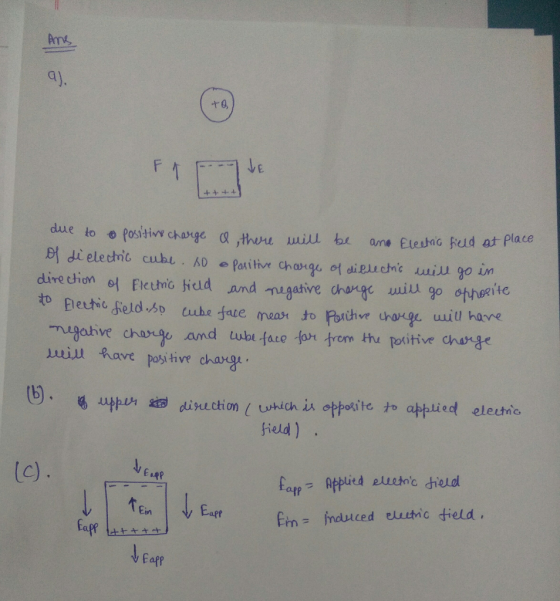
2. A small dielectric cube is placed near a positive...
Can someone carefully explain and answer questions A, B, C, D and E in detail, please!!!...
 Can someone carefully explain and answer questions A, B, C, D
and E in detail, please!!!
Score Name Student ID last first [25 points total] Tutorial question IV An electrically neutral cylinder is made out of a polarizable material. The cylinder is placed in a region of strong electric field that points upward A. [4 pts] Sketch bound charges on the diagram at right. Briefly explain your reasoning B. [6 pts] In what direction is the dipole moment of the...
Can someone carefully explain and answer questions A, B, C, D
and E in detail, please!!!
Score Name Student ID last first [25 points total] Tutorial question IV An electrically neutral cylinder is made out of a polarizable material. The cylinder is placed in a region of strong electric field that points upward A. [4 pts] Sketch bound charges on the diagram at right. Briefly explain your reasoning B. [6 pts] In what direction is the dipole moment of the...
PLEASE HELP THX U A positive charge is placed in an electric field. It starts at...
 PLEASE HELP THX U
A positive charge is placed in an electric field. It starts at rest but is free to move. What does the test charge do? It stays at rest. It moves towards the nearest negative charge only (if there is one). It moves along electric field lines in the opposite direction the arrows point It feels a force pointing tangent to the field lines and moves according to the force. Three charges, -9, +q, and -2q are...
PLEASE HELP THX U
A positive charge is placed in an electric field. It starts at rest but is free to move. What does the test charge do? It stays at rest. It moves towards the nearest negative charge only (if there is one). It moves along electric field lines in the opposite direction the arrows point It feels a force pointing tangent to the field lines and moves according to the force. Three charges, -9, +q, and -2q are...
The top left diagram below shows a 1-C positive charge placed in a uniform external electric...
 The top left diagram below shows a 1-C positive charge placed in a uniform external electric field. The electric field in which the charge is placed is represented by field lines (drawn in red), and the resulting electric force on the charge is represented by the blue vector. Suppose the 1-C charge is removed, and is replaced, in turn, by each of the charges shown in the other three diagrams below. Assuming that the external electric field remains the same,...
The top left diagram below shows a 1-C positive charge placed in a uniform external electric...
 The top left diagram below shows a 1-C positive charge placed in
a uniform external electric field. The electric field in which the
charge is placed is represented by field lines (drawn in red), and
the resulting electric force on the charge is represented by the
blue vector. Suppose the 1-C charge is removed, and is replaced, in
turn, by each of the charges shown in the other three diagrams
below. Assuming that the external electric field remains the same,...
The top left diagram below shows a 1-C positive charge placed in
a uniform external electric field. The electric field in which the
charge is placed is represented by field lines (drawn in red), and
the resulting electric force on the charge is represented by the
blue vector. Suppose the 1-C charge is removed, and is replaced, in
turn, by each of the charges shown in the other three diagrams
below. Assuming that the external electric field remains the same,...
please answer all and explain Review Exam 1 PH 202 Draw electric field lines for the...
 please answer all and explain
Review Exam 1 PH 202 Draw electric field lines for the charge configurations shown below. Draw electric field vectors and equipotential surfaces. a. Positive point charge, b. Negative point-charge, c. Electric dipole, and d. Two negative point charges separated by a distance d point chareye 2. State Coulomb's Law. Des cribes the foru point 3. If you bring a negatively charged insulator near two uncharged metallic spheres that are in contact and then separate the...
please answer all and explain
Review Exam 1 PH 202 Draw electric field lines for the charge configurations shown below. Draw electric field vectors and equipotential surfaces. a. Positive point charge, b. Negative point-charge, c. Electric dipole, and d. Two negative point charges separated by a distance d point chareye 2. State Coulomb's Law. Des cribes the foru point 3. If you bring a negatively charged insulator near two uncharged metallic spheres that are in contact and then separate the...
The top left diagram below shows a 1-C positive charge placed in a uniform external electric field. The electric field...
 The top left diagram below shows a 1-C positive charge placed in
a uniform external electric field. The electric field in which the
charge is placed is represented by field lines (drawn in red), and
the resulting electric force on the charge is represented by the
blue vector. Suppose the 1-C charge is removed, and is replaced, in
turn, by each of the charges shown in the other three diagrams
below. Assuming that the external electric field remains the same,...
The top left diagram below shows a 1-C positive charge placed in
a uniform external electric field. The electric field in which the
charge is placed is represented by field lines (drawn in red), and
the resulting electric force on the charge is represented by the
blue vector. Suppose the 1-C charge is removed, and is replaced, in
turn, by each of the charges shown in the other three diagrams
below. Assuming that the external electric field remains the same,...
answer all parts of both questions, please Use the following values if needed needed1.6 4 TIE...
 answer all parts of both questions, please
Use the following values if needed needed1.6 4 TIE 1. An electric charge is placed near an object whose net charge is zero. Points5) If the object is made of metal, does the charge exert a force on the object? If so, is it attractive or repulsive? If the object is made of plastic, does the charge exert a force on the object? If so, is it attractive or repulsive? а. Attractive b....
answer all parts of both questions, please
Use the following values if needed needed1.6 4 TIE 1. An electric charge is placed near an object whose net charge is zero. Points5) If the object is made of metal, does the charge exert a force on the object? If so, is it attractive or repulsive? If the object is made of plastic, does the charge exert a force on the object? If so, is it attractive or repulsive? а. Attractive b....
(a) Draw a microscopic representation of what happens to the charge distribution in a dielectric placed...
(a) Draw a microscopic representation of what happens to the charge distribution in a dielectric placed in an external uniform electric field. For simplicity, make the dielectric of some regular shape. How can you test your explanation? (b) What happens if you cut the dielectric in half (in the direction perpendicular to the direction of the E field), separating the halves by a small gap, while keeping it in the external field? How could you test your answer? please draw...
(a) Draw a microscopic representation of what happens to the charge distribution in a dielectric placed...
(a) Draw a microscopic representation of what happens to the charge distribution in a dielectric placed in an external uniform electric field. For simplicity, make the dielectric of some regular shape. How can you test your explanation? (b) What happens if you cut the dielectric in half (in the direction perpendicular to the direction of the E field), separating the halves by a small gap, while keeping it in the external field? How could you test your answer?
(b) Eight point charges, each of charge -q are placed to form the comers of a cube in space, as shown in the diagram be...
 (b) Eight point charges, each of charge -q are placed to form the comers of a cube in space, as shown in the diagram below. Assume these charges are fixed in space. Explain why another identical charge placed at the centre of the cube is not held in stable equilibrium by the electric field. Use both Gauss's law and the electrostatic potential to justify your answer. [5 marks] (c) Write a line integral that relates the electric field due to...
 Can someone carefully explain and answer questions A, B, C, D
and E in detail, please!!!
Score Name Student ID last first [25 points total] Tutorial question IV An electrically neutral cylinder is made out of a polarizable material. The cylinder is placed in a region of strong electric field that points upward A. [4 pts] Sketch bound charges on the diagram at right. Briefly explain your reasoning B. [6 pts] In what direction is the dipole moment of the...
Can someone carefully explain and answer questions A, B, C, D
and E in detail, please!!!
Score Name Student ID last first [25 points total] Tutorial question IV An electrically neutral cylinder is made out of a polarizable material. The cylinder is placed in a region of strong electric field that points upward A. [4 pts] Sketch bound charges on the diagram at right. Briefly explain your reasoning B. [6 pts] In what direction is the dipole moment of the...
 PLEASE HELP THX U
A positive charge is placed in an electric field. It starts at rest but is free to move. What does the test charge do? It stays at rest. It moves towards the nearest negative charge only (if there is one). It moves along electric field lines in the opposite direction the arrows point It feels a force pointing tangent to the field lines and moves according to the force. Three charges, -9, +q, and -2q are...
PLEASE HELP THX U
A positive charge is placed in an electric field. It starts at rest but is free to move. What does the test charge do? It stays at rest. It moves towards the nearest negative charge only (if there is one). It moves along electric field lines in the opposite direction the arrows point It feels a force pointing tangent to the field lines and moves according to the force. Three charges, -9, +q, and -2q are...
 The top left diagram below shows a 1-C positive charge placed in a uniform external electric field. The electric field in which the charge is placed is represented by field lines (drawn in red), and the resulting electric force on the charge is represented by the blue vector. Suppose the 1-C charge is removed, and is replaced, in turn, by each of the charges shown in the other three diagrams below. Assuming that the external electric field remains the same,...
 The top left diagram below shows a 1-C positive charge placed in
a uniform external electric field. The electric field in which the
charge is placed is represented by field lines (drawn in red), and
the resulting electric force on the charge is represented by the
blue vector. Suppose the 1-C charge is removed, and is replaced, in
turn, by each of the charges shown in the other three diagrams
below. Assuming that the external electric field remains the same,...
The top left diagram below shows a 1-C positive charge placed in
a uniform external electric field. The electric field in which the
charge is placed is represented by field lines (drawn in red), and
the resulting electric force on the charge is represented by the
blue vector. Suppose the 1-C charge is removed, and is replaced, in
turn, by each of the charges shown in the other three diagrams
below. Assuming that the external electric field remains the same,...
 please answer all and explain
Review Exam 1 PH 202 Draw electric field lines for the charge configurations shown below. Draw electric field vectors and equipotential surfaces. a. Positive point charge, b. Negative point-charge, c. Electric dipole, and d. Two negative point charges separated by a distance d point chareye 2. State Coulomb's Law. Des cribes the foru point 3. If you bring a negatively charged insulator near two uncharged metallic spheres that are in contact and then separate the...
please answer all and explain
Review Exam 1 PH 202 Draw electric field lines for the charge configurations shown below. Draw electric field vectors and equipotential surfaces. a. Positive point charge, b. Negative point-charge, c. Electric dipole, and d. Two negative point charges separated by a distance d point chareye 2. State Coulomb's Law. Des cribes the foru point 3. If you bring a negatively charged insulator near two uncharged metallic spheres that are in contact and then separate the...
 The top left diagram below shows a 1-C positive charge placed in
a uniform external electric field. The electric field in which the
charge is placed is represented by field lines (drawn in red), and
the resulting electric force on the charge is represented by the
blue vector. Suppose the 1-C charge is removed, and is replaced, in
turn, by each of the charges shown in the other three diagrams
below. Assuming that the external electric field remains the same,...
The top left diagram below shows a 1-C positive charge placed in
a uniform external electric field. The electric field in which the
charge is placed is represented by field lines (drawn in red), and
the resulting electric force on the charge is represented by the
blue vector. Suppose the 1-C charge is removed, and is replaced, in
turn, by each of the charges shown in the other three diagrams
below. Assuming that the external electric field remains the same,...
 answer all parts of both questions, please
Use the following values if needed needed1.6 4 TIE 1. An electric charge is placed near an object whose net charge is zero. Points5) If the object is made of metal, does the charge exert a force on the object? If so, is it attractive or repulsive? If the object is made of plastic, does the charge exert a force on the object? If so, is it attractive or repulsive? а. Attractive b....
answer all parts of both questions, please
Use the following values if needed needed1.6 4 TIE 1. An electric charge is placed near an object whose net charge is zero. Points5) If the object is made of metal, does the charge exert a force on the object? If so, is it attractive or repulsive? If the object is made of plastic, does the charge exert a force on the object? If so, is it attractive or repulsive? а. Attractive b....
 (b) Eight point charges, each of charge -q are placed to form the comers of a cube in space, as shown in the diagram below. Assume these charges are fixed in space. Explain why another identical charge placed at the centre of the cube is not held in stable equilibrium by the electric field. Use both Gauss's law and the electrostatic potential to justify your answer. [5 marks] (c) Write a line integral that relates the electric field due to...
Most questions answered within 3 hours.
-
Where is the error in this code sequence?
String s1 = "Hello";
String s2 = "ello";...
asked 10 months ago -
Financial data for Joel de Paris, Inc., for last year
follow:
Joel de Paris, Inc.
Balance...
asked 10 months ago -
Consider this reaction:
Al2(SO4)3 (aq)+ BaCl3
(aq) Al2Cl6 (aq)- +
3BaSO4(s) . What is the...
asked 10 months ago -
Suppose that Savneet is considering increasing her
recent random sample from 20 car rentals to 40...
asked 10 months ago -
Trucks arrive at an unloading terminal at an average rate of 120
per hour.
Trucks arrive...
asked 10 months ago -
Why are methanol and ethanol completely soluble in water while
octanol is not very little soluble....
asked 10 months ago -
A facilities manager at a university reads in a research report
that the mean amount of...
asked 10 months ago -
When the CuSO4 is rehydrated by adding water to the anhydrous
compound, is this an endothermic...
asked 10 months ago -
A ray of sunlight is passing from diamond into crown glass; the
angle of incidence is...
asked 10 months ago -
A block of mass 0.249 kg is placed on top of a light, vertical
spring of...
asked 10 months ago -
how do the kidneys compensate in the presences of acidosis
a) trigger hyperventilate
b) reserve acid...
asked 10 months ago -
Question 501 pts
The rental rate of capital to the firm increases. Which of the
following...
asked 10 months ago