
Homework Answers
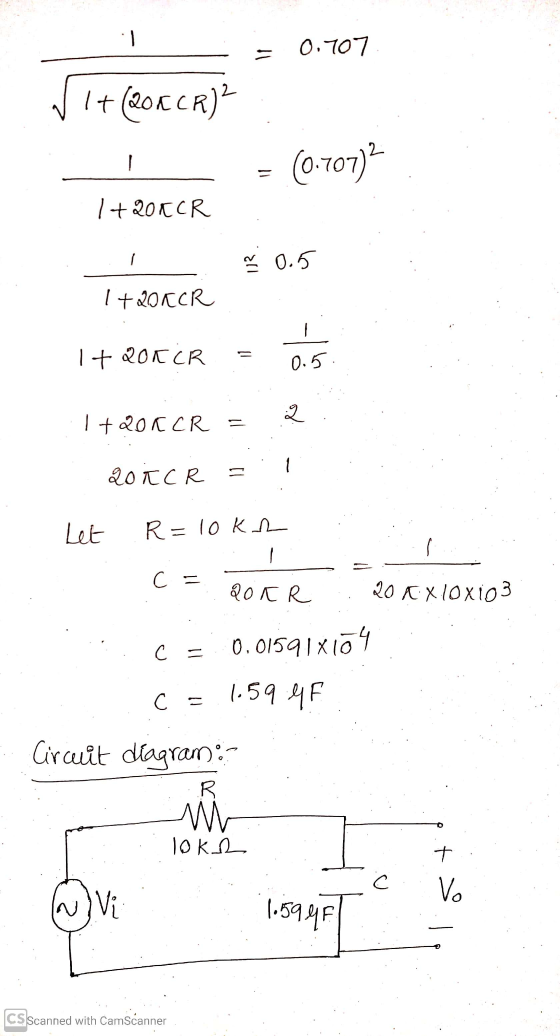
![b ) H (3W) It JW CR | H (jw)| - w=2af. i + (WCR)? 1 + (2xf CR)? from frequency response, f-0 = H = 1 f=10HZ7TH] =0.707 |-|(42](http://img.homeworklib.com/questions/442ec8e0-a968-11eb-b376-0912c4006835.png?x-oss-process=image/resize,w_560)
Thank You...!!!
Add Answer to:
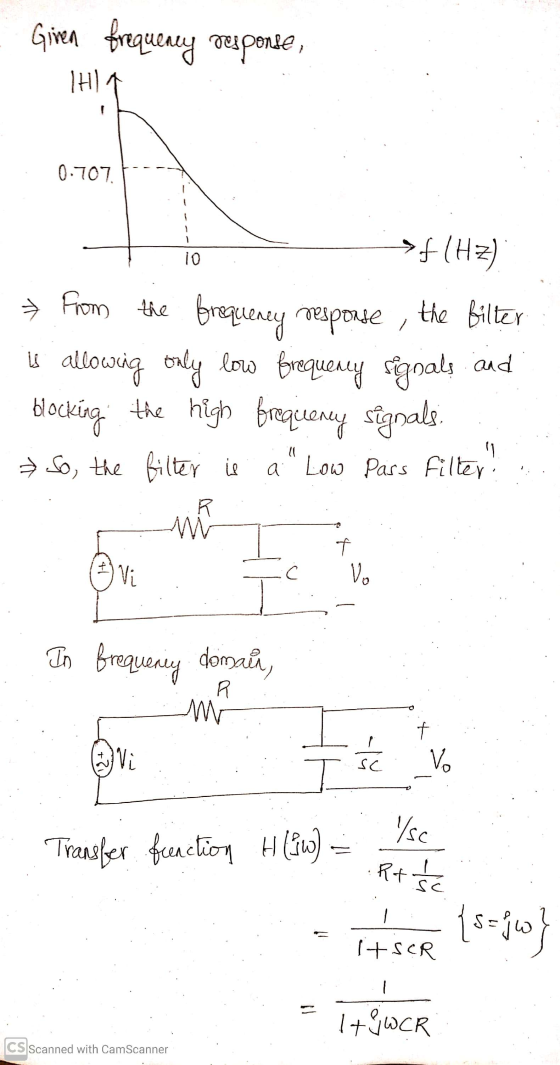
Question 3 : (2.5 x 2 = 5 points) Consider the frequency response of a filter...
Question 2 (20 points) Consider the circuit below with Vị as the input and v, as...
 Question 2 (20 points) Consider the circuit below with Vị as the input and v, as the output. Let the component values be R = 33.2, C = 470uF and L = 250mH. R + + yo(t) L - Answer the following questions using the formulas from the lecture slides: 1. What is the type of this filter? (2 points) 2. Write down the expression for the transfer function H(w) of the circuit. (4 points) 3. Write down the expression...
Question 1 (15 points) Consider the circuit below with vi as the input and v, as...
 Question 1 (15 points) Consider the circuit below with vi as the input and v, as the output. Let the component values be R = 1001 and C = 1000F. C + v;(t) vo(t) Answer the following questions using the formulas from the lecture slides: 1. What is the type of this filter? (1 points) 2. Write down the expression for the transfer function H(w) of the circuit. (4 points) 3. Write down the expression for frequency response |H(w) of...
Question 3 (30 marks) Consider the digital filter structure shown in the below figure: x[n yIn] 3 (a) Transform the giv...
 Question 3 (30 marks) Consider the digital filter structure shown in the below figure: x[n yIn] 3 (a) Transform the given block diagram to the transposed direct form II one. 2 (b) Determine the difference-equation representation of the system 4 (c) Find the transfer function for this causal filter and state the pole-zero pattern (d) Determine the impulse response of the system 2 (e) For what values of k is the system stable? (f) Determine yln if k 1 and...
- Frequency Response (Amplitude Response only). Hz). with frequency, 22. for a discrete time system shown...
 - Frequency Response (Amplitude Response only). Hz). with frequency, 22. for a discrete time system shown below. *(-1) - x[-2] - ... -0 and yf-1) - Y[-2] ... - x[r] - int) Find “Math Model" for the system. nt) Find "Transfer Function" for the system. Draw the pole-zero plot for the system (use unit circle on Re-Im axis) Sketch the amplitude response of the system → indicate values at important points (92 = 0, 1/4, 21/4, 37/4, T) include detailed...
For the low-pass filter circuit shown in Fig 2 3k Ω 200mil in out Fig 2 3.a. Use a 2.2nF capacitor to design a high-pas...
 For the low-pass filter circuit shown in Fig 2 3k Ω 200mil in out Fig 2 3.a. Use a 2.2nF capacitor to design a high-pass filter to have a cutoff frequency of Skn Draw a schematic of your design. Show all component values and voltages c. Sketch the frequency response of the voltage gain and phase shift Magnitude dB Frequency Hz Phase Frequency Hz
For the low-pass filter circuit shown in Fig 2 3k Ω 200mil in out Fig 2...
For the low-pass filter circuit shown in Fig 2 3k Ω 200mil in out Fig 2 3.a. Use a 2.2nF capacitor to design a high-pass filter to have a cutoff frequency of Skn Draw a schematic of your design. Show all component values and voltages c. Sketch the frequency response of the voltage gain and phase shift Magnitude dB Frequency Hz Phase Frequency Hz
For the low-pass filter circuit shown in Fig 2 3k Ω 200mil in out Fig 2...
For the low-pass filter circuit shown in Fig 2 200mH 3k Ω out in Fig 2...
 For the low-pass filter circuit shown in Fig 2 200mH 3k Ω out in Fig 2 (i) (ii) (iii) Write an expression for the transfer function of the circuit State the value of the dc gain of the filter circuit in dB Calculate the cutoff frequency of the filter b. Sketch the frequency response of the voltage gain and phase shift for the filter shown in Fig 2. Show all the values and required information in both graphs Magnitude Frequency...
12. Design a fourth order, 2 dB Chebyshev highpass filter with a cutoff frequency of 2.4...
 12. Design a fourth order, 2 dB Chebyshev highpass filter with a cutoff frequency of 2.4 kHz a. Draw the circuit, labeling Vin, Yout, and all component values. (14 points) and a passband gain of 0 dB. Use capacitor values of 3300 pF an approximation of the Bode plot of the magnitude transfer function IH(ia) in dB, İndicating the ripple, the cutoff frequency, and the approximate filter roll-off in dB/decade. Note, this does not reguire solving for the function. (6...
QI (a) () Design an active filter using non-inverting amplifier that will produce a frequency response...
 QI (a) () Design an active filter using non-inverting amplifier that will produce a frequency response as shown in Figure Ql(a). The bandwidth of the filter is 30 kHz. Use a capacitor value of 10 nF. (9 marks) Draw the circuit and clearly label it. (5 marks) (b) Derive the transfer function of the filter in Q1(b). (6 marks) Av (dB) 28 dB 25 dB - 20 dB/decade + 20 dB/decade - 1 1 35 kHz 40 kHz Figure Qi(a)...
Using filterDesigner in MATLAB, design a second order low pass IIR Butterworth filter whose sampling frequency...
Using filterDesigner in MATLAB, design a second order low pass IIR Butterworth filter whose sampling frequency (Fs) is 1 kHz and cutoff frequency (Fc) is 10 Hz. Find the numerator and denominator coefficients. Write its transfer function H(z) = Y(z) / X(z). Write its difference function y(k). Draw (copy from Filter Designer) the magnitude response plot. Draw (copy from Filter Designer) the phase response plot. Draw (copy from Filter Designer) the impulse response plot.
Problem 1. Find and sketch (see below) the impulse response of the ideal bandpass filter whose fr...
 Problem 1. Find and sketch (see below) the impulse response of the ideal bandpass filter whose frequency response is shown below Hints: Consider Hf)- H(f) 6f -fc) +(f+fo). . Convolution in one domain is ·To sketch, use fc = 2 Hz and W = 0.5 Hz. in the other domain. H(f) Ic -w fc c +w Figure 1: Ideal bandpass filter frequency response for Problem
Problem 1. Find and sketch (see below) the impulse response of the ideal bandpass filter...
Problem 1. Find and sketch (see below) the impulse response of the ideal bandpass filter whose frequency response is shown below Hints: Consider Hf)- H(f) 6f -fc) +(f+fo). . Convolution in one domain is ·To sketch, use fc = 2 Hz and W = 0.5 Hz. in the other domain. H(f) Ic -w fc c +w Figure 1: Ideal bandpass filter frequency response for Problem
Problem 1. Find and sketch (see below) the impulse response of the ideal bandpass filter...
 Question 2 (20 points) Consider the circuit below with Vị as the input and v, as the output. Let the component values be R = 33.2, C = 470uF and L = 250mH. R + + yo(t) L - Answer the following questions using the formulas from the lecture slides: 1. What is the type of this filter? (2 points) 2. Write down the expression for the transfer function H(w) of the circuit. (4 points) 3. Write down the expression...
 Question 1 (15 points) Consider the circuit below with vi as the input and v, as the output. Let the component values be R = 1001 and C = 1000F. C + v;(t) vo(t) Answer the following questions using the formulas from the lecture slides: 1. What is the type of this filter? (1 points) 2. Write down the expression for the transfer function H(w) of the circuit. (4 points) 3. Write down the expression for frequency response |H(w) of...
 Question 3 (30 marks) Consider the digital filter structure shown in the below figure: x[n yIn] 3 (a) Transform the given block diagram to the transposed direct form II one. 2 (b) Determine the difference-equation representation of the system 4 (c) Find the transfer function for this causal filter and state the pole-zero pattern (d) Determine the impulse response of the system 2 (e) For what values of k is the system stable? (f) Determine yln if k 1 and...
 - Frequency Response (Amplitude Response only). Hz). with frequency, 22. for a discrete time system shown below. *(-1) - x[-2] - ... -0 and yf-1) - Y[-2] ... - x[r] - int) Find “Math Model" for the system. nt) Find "Transfer Function" for the system. Draw the pole-zero plot for the system (use unit circle on Re-Im axis) Sketch the amplitude response of the system → indicate values at important points (92 = 0, 1/4, 21/4, 37/4, T) include detailed...
 For the low-pass filter circuit shown in Fig 2 3k Ω 200mil in out Fig 2 3.a. Use a 2.2nF capacitor to design a high-pass filter to have a cutoff frequency of Skn Draw a schematic of your design. Show all component values and voltages c. Sketch the frequency response of the voltage gain and phase shift Magnitude dB Frequency Hz Phase Frequency Hz
For the low-pass filter circuit shown in Fig 2 3k Ω 200mil in out Fig 2...
For the low-pass filter circuit shown in Fig 2 3k Ω 200mil in out Fig 2 3.a. Use a 2.2nF capacitor to design a high-pass filter to have a cutoff frequency of Skn Draw a schematic of your design. Show all component values and voltages c. Sketch the frequency response of the voltage gain and phase shift Magnitude dB Frequency Hz Phase Frequency Hz
For the low-pass filter circuit shown in Fig 2 3k Ω 200mil in out Fig 2...
 For the low-pass filter circuit shown in Fig 2 200mH 3k Ω out in Fig 2 (i) (ii) (iii) Write an expression for the transfer function of the circuit State the value of the dc gain of the filter circuit in dB Calculate the cutoff frequency of the filter b. Sketch the frequency response of the voltage gain and phase shift for the filter shown in Fig 2. Show all the values and required information in both graphs Magnitude Frequency...
 12. Design a fourth order, 2 dB Chebyshev highpass filter with a cutoff frequency of 2.4 kHz a. Draw the circuit, labeling Vin, Yout, and all component values. (14 points) and a passband gain of 0 dB. Use capacitor values of 3300 pF an approximation of the Bode plot of the magnitude transfer function IH(ia) in dB, İndicating the ripple, the cutoff frequency, and the approximate filter roll-off in dB/decade. Note, this does not reguire solving for the function. (6...
 QI (a) () Design an active filter using non-inverting amplifier that will produce a frequency response as shown in Figure Ql(a). The bandwidth of the filter is 30 kHz. Use a capacitor value of 10 nF. (9 marks) Draw the circuit and clearly label it. (5 marks) (b) Derive the transfer function of the filter in Q1(b). (6 marks) Av (dB) 28 dB 25 dB - 20 dB/decade + 20 dB/decade - 1 1 35 kHz 40 kHz Figure Qi(a)...
 Problem 1. Find and sketch (see below) the impulse response of the ideal bandpass filter whose frequency response is shown below Hints: Consider Hf)- H(f) 6f -fc) +(f+fo). . Convolution in one domain is ·To sketch, use fc = 2 Hz and W = 0.5 Hz. in the other domain. H(f) Ic -w fc c +w Figure 1: Ideal bandpass filter frequency response for Problem
Problem 1. Find and sketch (see below) the impulse response of the ideal bandpass filter...
Problem 1. Find and sketch (see below) the impulse response of the ideal bandpass filter whose frequency response is shown below Hints: Consider Hf)- H(f) 6f -fc) +(f+fo). . Convolution in one domain is ·To sketch, use fc = 2 Hz and W = 0.5 Hz. in the other domain. H(f) Ic -w fc c +w Figure 1: Ideal bandpass filter frequency response for Problem
Problem 1. Find and sketch (see below) the impulse response of the ideal bandpass filter...
Most questions answered within 3 hours.
-
Where is the error in this code sequence?
String s1 = "Hello";
String s2 = "ello";...
asked 10 months ago -
Financial data for Joel de Paris, Inc., for last year
follow:
Joel de Paris, Inc.
Balance...
asked 10 months ago -
Consider this reaction:
Al2(SO4)3 (aq)+ BaCl3
(aq) Al2Cl6 (aq)- +
3BaSO4(s) . What is the...
asked 10 months ago -
Suppose that Savneet is considering increasing her
recent random sample from 20 car rentals to 40...
asked 10 months ago -
Trucks arrive at an unloading terminal at an average rate of 120
per hour.
Trucks arrive...
asked 10 months ago -
Why are methanol and ethanol completely soluble in water while
octanol is not very little soluble....
asked 10 months ago -
A facilities manager at a university reads in a research report
that the mean amount of...
asked 10 months ago -
When the CuSO4 is rehydrated by adding water to the anhydrous
compound, is this an endothermic...
asked 10 months ago -
A ray of sunlight is passing from diamond into crown glass; the
angle of incidence is...
asked 10 months ago -
A block of mass 0.249 kg is placed on top of a light, vertical
spring of...
asked 10 months ago -
how do the kidneys compensate in the presences of acidosis
a) trigger hyperventilate
b) reserve acid...
asked 10 months ago -
Question 501 pts
The rental rate of capital to the firm increases. Which of the
following...
asked 10 months ago