Inspired by Lee Hartwell's Nobel Prize (2001), you decide to study cell cycle regulation in yeast....
- Inspired by Lee Hartwell's Nobel Prize (2001), you decide to study cell cycle regulation in yeast. You know that the expression of a cell cycle-associated kinase, Cdk24p, changes throughout the cell cycle, being very high in G 1/S and low in G2/M. Nevertheless, mRNA levels for CDK24 are constant throughout the cell cycle. You decide to study how this regulation occurs.
You isolate a temperature sensitive mutant cell linethat fails to divide at the non-permissive temperature and notice that Cdk24p expression is not downregulated after S phase at the non permissive temperature - it remains constitutively high. Using standard techniques, you isolate the gene that is mutated in the temperature-sensitive cell line; it is a previously undescribed gene, Cdc927, encoding a protein with two "zinc fingers" that, upon comparison to the database, fall into the category of a "ring" domain--similar to those seen in E3 ubiquitin ligases. The mutant that you isolated has a cdc927 mutation altering an arginine near a conserved cysteine within the ring domain.
Interestingly, you find that in cells with this cdc927 mutation, a panel of 8 cell cycle associated proteins fail to be down-regulated after S phase at the nonpermissive temperature. mRNA levels for all of these proteins are constant throughout the cell cycle in wild-type cells. Moreover, temperature-sensitive mutants of proteasome subunits also produce the same phenotype as the cdc927 mutant, i.e. stabilization of all 8 proteins.
-
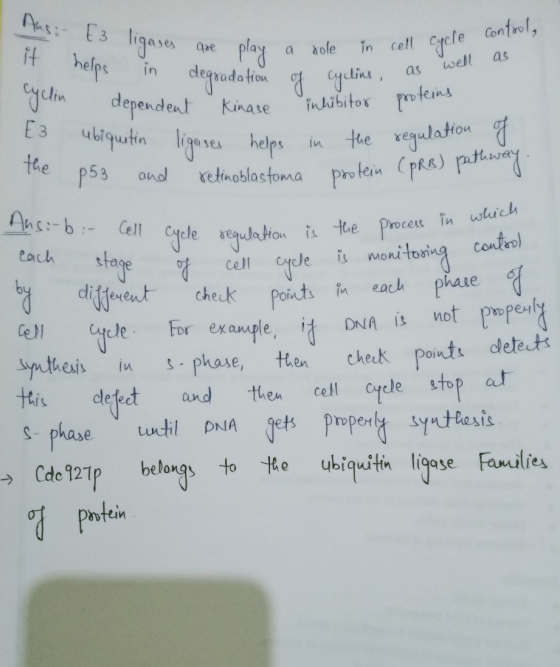
- In which stage of the cell cycle does Cdc927p likely act? Why
-
- Given these data, what you know about zinc fingers, and what you know about cell cycle regulation, propose a hypothesis for a putative function of Cdc927p. To what family of proteins does Cdc927p likely belong?
Homework Answers
 Ans- a. Cdc927p likely act on Mitosis (M)
phase of cell cycle because it is similar as E3 ubiquitin ligase
and this ligase act on M-phase of cycle for targeting the substrate
for destruction by proteosome. This ligase also contain Anaphase
promoting complex (APC) and Skp1-Cullin-F-box protein complex (SCF
complex). APC/C main function is helps in transition from metaphase
to Anaphase by specific protein degradation.
Ans- a. Cdc927p likely act on Mitosis (M)
phase of cell cycle because it is similar as E3 ubiquitin ligase
and this ligase act on M-phase of cycle for targeting the substrate
for destruction by proteosome. This ligase also contain Anaphase
promoting complex (APC) and Skp1-Cullin-F-box protein complex (SCF
complex). APC/C main function is helps in transition from metaphase
to Anaphase by specific protein degradation.
Add Answer to:
Inspired by Lee Hartwell's Nobel Prize (2001), you decide to
study cell cycle regulation in yeast....
1. You are characterizing a temperature-sensitive mutant called nlk1 in Saccharomyces cerevisiae. To examine whether the...
 1. You are characterizing a temperature-sensitive mutant called nlk1 in Saccharomyces cerevisiae. To examine whether the mutant has a defect in cell cycle progression, you perform two experiments. First, you try flow cytometry with samples of the mutant strain incubated at the permissive or non-permissive temperatures A wildtype strain incubated at each temperature is a used as control. The flow cytometry results are shown below in Panel A. Second, you examine the Nlk1 protein levels throughout the cell cycle in...
Eukaryote gene regulation question... about the yeast... please help me... 3. (7 points total) You are...
 Eukaryote gene regulation question... about the yeast... please
help me...
3. (7 points total) You are studying a set of genes in yeast (a eukaryote) that are required for the utilization of mannose. Mannose is a sugar that can be used by yeast cells but they will preferentially use glucose if it is available; this is similar to how the galactose genes work. Since you are a geneticist you study the genes by mutating them so they won't work and...
Eukaryote gene regulation question... about the yeast... please
help me...
3. (7 points total) You are studying a set of genes in yeast (a eukaryote) that are required for the utilization of mannose. Mannose is a sugar that can be used by yeast cells but they will preferentially use glucose if it is available; this is similar to how the galactose genes work. Since you are a geneticist you study the genes by mutating them so they won't work and...
 1. You are characterizing a temperature-sensitive mutant called nlk1 in Saccharomyces cerevisiae. To examine whether the mutant has a defect in cell cycle progression, you perform two experiments. First, you try flow cytometry with samples of the mutant strain incubated at the permissive or non-permissive temperatures A wildtype strain incubated at each temperature is a used as control. The flow cytometry results are shown below in Panel A. Second, you examine the Nlk1 protein levels throughout the cell cycle in...
 Eukaryote gene regulation question... about the yeast... please
help me...
3. (7 points total) You are studying a set of genes in yeast (a eukaryote) that are required for the utilization of mannose. Mannose is a sugar that can be used by yeast cells but they will preferentially use glucose if it is available; this is similar to how the galactose genes work. Since you are a geneticist you study the genes by mutating them so they won't work and...
Eukaryote gene regulation question... about the yeast... please
help me...
3. (7 points total) You are studying a set of genes in yeast (a eukaryote) that are required for the utilization of mannose. Mannose is a sugar that can be used by yeast cells but they will preferentially use glucose if it is available; this is similar to how the galactose genes work. Since you are a geneticist you study the genes by mutating them so they won't work and...
Most questions answered within 3 hours.
-
Where is the error in this code sequence?
String s1 = "Hello";
String s2 = "ello";...
asked 11 months ago -
Financial data for Joel de Paris, Inc., for last year
follow:
Joel de Paris, Inc.
Balance...
asked 11 months ago -
Consider this reaction:
Al2(SO4)3 (aq)+ BaCl3
(aq) Al2Cl6 (aq)- +
3BaSO4(s) . What is the...
asked 11 months ago -
Suppose that Savneet is considering increasing her
recent random sample from 20 car rentals to 40...
asked 11 months ago -
Trucks arrive at an unloading terminal at an average rate of 120
per hour.
Trucks arrive...
asked 11 months ago -
Why are methanol and ethanol completely soluble in water while
octanol is not very little soluble....
asked 11 months ago -
A facilities manager at a university reads in a research report
that the mean amount of...
asked 11 months ago -
When the CuSO4 is rehydrated by adding water to the anhydrous
compound, is this an endothermic...
asked 11 months ago -
A ray of sunlight is passing from diamond into crown glass; the
angle of incidence is...
asked 11 months ago -
A block of mass 0.249 kg is placed on top of a light, vertical
spring of...
asked 11 months ago -
how do the kidneys compensate in the presences of acidosis
a) trigger hyperventilate
b) reserve acid...
asked 11 months ago -
Question 501 pts
The rental rate of capital to the firm increases. Which of the
following...
asked 11 months ago