
Homework Answers
If you have any doubts, feel free to ask.
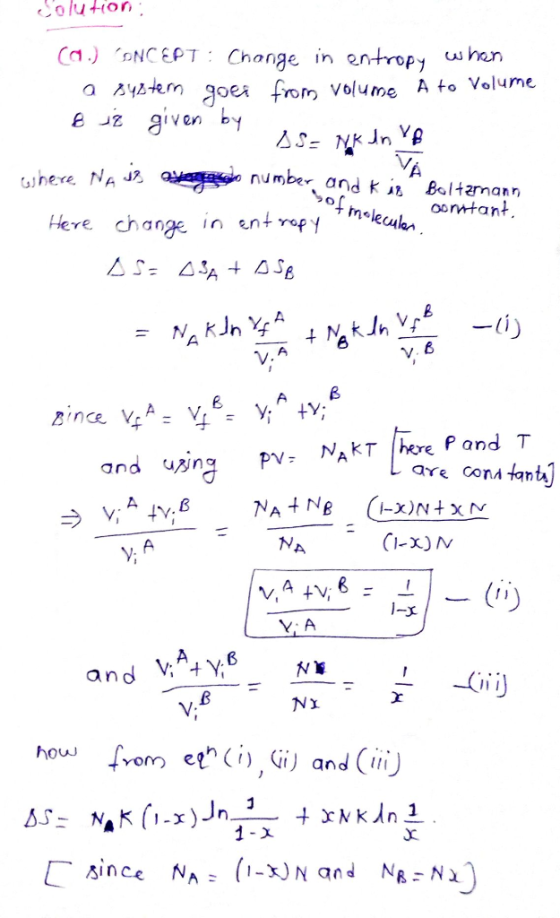
 if you found this helpful,
please give a thumbs up. It means a
lot.
if you found this helpful,
please give a thumbs up. It means a
lot.
thank you :)
Add Answer to:
B. Two distinguishable monatomic ideal gases A and B are held in a volume V by...
(a) Show that the entropy of mixing for two volumes of monatomic ideal gases A and...
 (a) Show that the entropy of mixing for two volumes of monatomic
ideal gases A and B starting from equal temperatures and pressures
is given by:
where N is the total number of atoms and fA and fB are the
fraction of atoms that are type A and B, respectively, so that fA +
fB = 1.
ASmiring = -kNISA In(fa)+fe In(fB) = -kN[fa In(fa)+fi-f, In(fi-f)
(a) Show that the entropy of mixing for two volumes of monatomic
ideal gases A and B starting from equal temperatures and pressures
is given by:
where N is the total number of atoms and fA and fB are the
fraction of atoms that are type A and B, respectively, so that fA +
fB = 1.
ASmiring = -kNISA In(fa)+fe In(fB) = -kN[fa In(fa)+fi-f, In(fi-f)
A mixture of two monatomic ideal gases consists of Na molecules of gas A and Na...
 A mixture of two monatomic ideal gases consists of Na molecules of gas A and Na molecules of gas B in a container of volume V at temperature T. (a) Obtain an expression for natural log of the number of the accessible microstates for each species (ie, ln S, and In Ω), (b) Show that the entropy of the mixture system is 4. EA and Ea are the total energies for the two molecular species, m, and m , the...
consider the situation shown in the diagram below. In state A, the system consists of two...
 consider the situation shown in the diagram below. In state A, the system consists of two separate chambers of equal volume, with 1 mole of A molecules on the left and 1 mole of B molecules on the right. The A and B molecules do not interact with each other. In State B, the partition between the two halves of the box is removed. STATE A STATE B 1 mole of A molecules 1 mole of B molecules A and...
An ideal gas with energy U and N atoms is held in one-half of a chamber...
 An ideal gas with energy U and N atoms is held in one-half of a chamber of volume V by a partition (refer Figure 1(A)). As the partition is removed and the gas in the container is allowed to occupy the entire volume V, an additional N atoms of the same gas with the same energy U is introduced into the container as shown in Figure 1(B). . Nu, V/2A) Figure 1 1. What is the initial entropy (S) of...
1 The Gibbs Paradox Consider N particles, each of mass m, in a 3-dimensional volume V at temperature T. Each particle i...
 1 The Gibbs Paradox Consider N particles, each of mass m, in a 3-dimensional volume V at temperature T. Each particle i has momentum pi. Assume that the particles are non-interacting (ideal gas) and distinguishable. a) (2P) Calculate the canonical partition function N P for the N-particle system. Make sure to work out the integral. b) (2P) Calculate the free energy F--kBTlnZ from the partition function Z. Is F an extensive quantity? c) (2P) Calculate the entropy S F/oT from...
A monatomic ideal gas initially fills a container of volume V = 0.15 m3 at an...
A monatomic ideal gas initially fills a container of volume V = 0.15 m3 at an initial pressure of P = 360 kPa and temperature T = 275 K. The gas undergoes an isobaric expansion to V2 = 0.55 m3 and then an isovolumetric heating to P2 = 680 kPa. a) Calculate the number of moles, n, contained in this ideal gas. b) Calculate the temperature of the gas, in kelvins, after it undergoes the isobaric expansion. c) Calculate the...
I thought when A has 2 mol and B has 1mol mole fraction would be 2/3 for A and 1/3 for B then the...
 I thought when A has 2 mol and B has 1mol
mole fraction would be 2/3 for A and 1/3 for B
then the result is
delta S = -R (3N)*((2/3)ln(2/3) + (1/3)ln(1/3))
(and this was actually the answer of (4)!)
but the result is 3Rln(2).
Where am i wrong?
what is the difference between microstates in
2mol A 1mol B
and
2mol A 1mol A ?
1A rigid container is divided into two compartments of equal volume by a...
I thought when A has 2 mol and B has 1mol
mole fraction would be 2/3 for A and 1/3 for B
then the result is
delta S = -R (3N)*((2/3)ln(2/3) + (1/3)ln(1/3))
(and this was actually the answer of (4)!)
but the result is 3Rln(2).
Where am i wrong?
what is the difference between microstates in
2mol A 1mol B
and
2mol A 1mol A ?
1A rigid container is divided into two compartments of equal volume by a...
Two vessels A and B each contain N molecules of the same ideal monatomic gas at the same pressure P. Initially, the two...
 Two vessels A and B each contain N molecules of the same ideal monatomic gas at the same pressure P. Initially, the two vessels are thermally isolated from each other, and have initial temperatures TA and Ta respectively. The two vessels are brought into thermal contact, and reach equilibrium at the same pressure P and the new final temperature 7, 4-2 (a) Calculate an expression for the final temperature in terms of the initial temperatures. [2 marks] (b) Find the...
A monatomic ideal gas is initially at volume, pressure, temperature (Vi, Pi, Ti). Consider two different...
 A monatomic ideal gas is initially at volume, pressure, temperature (Vi, Pi, Ti). Consider two different paths for expansion. Path 1: The gas expands quasistatically and isothermally to (Va, Pz. T2) Path 2: First the gas expands quasistatically and adiabatically (V2, P.,T-),where you will calculate P T. Then the gas is heated quasistically at constant volume to (Va. P2 T1). a. Sketch both paths on a P-V diagram. b. Calculate the entropy change of the system along all three segments...
B.2 The multiplicity of a monatomic ideal gas is given by 2 = f(N)VN U3N/2, where...
 B.2 The multiplicity of a monatomic ideal gas is given by 2 = f(N)VN U3N/2, where V is the volume occupied by the gas, U its internal energy, N the number of particles in the gas and f(N) a complicated function of N. [2] (i) Show that the entropy S of this system is given by 3 S = Nkg In V + ŽNkg In U + g(N), where g(N) is some function of N. (ii) Define the temperature T...
 (a) Show that the entropy of mixing for two volumes of monatomic
ideal gases A and B starting from equal temperatures and pressures
is given by:
where N is the total number of atoms and fA and fB are the
fraction of atoms that are type A and B, respectively, so that fA +
fB = 1.
ASmiring = -kNISA In(fa)+fe In(fB) = -kN[fa In(fa)+fi-f, In(fi-f)
(a) Show that the entropy of mixing for two volumes of monatomic
ideal gases A and B starting from equal temperatures and pressures
is given by:
where N is the total number of atoms and fA and fB are the
fraction of atoms that are type A and B, respectively, so that fA +
fB = 1.
ASmiring = -kNISA In(fa)+fe In(fB) = -kN[fa In(fa)+fi-f, In(fi-f)
 A mixture of two monatomic ideal gases consists of Na molecules of gas A and Na molecules of gas B in a container of volume V at temperature T. (a) Obtain an expression for natural log of the number of the accessible microstates for each species (ie, ln S, and In Ω), (b) Show that the entropy of the mixture system is 4. EA and Ea are the total energies for the two molecular species, m, and m , the...
 consider the situation shown in the diagram below. In state A, the system consists of two separate chambers of equal volume, with 1 mole of A molecules on the left and 1 mole of B molecules on the right. The A and B molecules do not interact with each other. In State B, the partition between the two halves of the box is removed. STATE A STATE B 1 mole of A molecules 1 mole of B molecules A and...
 An ideal gas with energy U and N atoms is held in one-half of a chamber of volume V by a partition (refer Figure 1(A)). As the partition is removed and the gas in the container is allowed to occupy the entire volume V, an additional N atoms of the same gas with the same energy U is introduced into the container as shown in Figure 1(B). . Nu, V/2A) Figure 1 1. What is the initial entropy (S) of...
 1 The Gibbs Paradox Consider N particles, each of mass m, in a 3-dimensional volume V at temperature T. Each particle i has momentum pi. Assume that the particles are non-interacting (ideal gas) and distinguishable. a) (2P) Calculate the canonical partition function N P for the N-particle system. Make sure to work out the integral. b) (2P) Calculate the free energy F--kBTlnZ from the partition function Z. Is F an extensive quantity? c) (2P) Calculate the entropy S F/oT from...
 I thought when A has 2 mol and B has 1mol
mole fraction would be 2/3 for A and 1/3 for B
then the result is
delta S = -R (3N)*((2/3)ln(2/3) + (1/3)ln(1/3))
(and this was actually the answer of (4)!)
but the result is 3Rln(2).
Where am i wrong?
what is the difference between microstates in
2mol A 1mol B
and
2mol A 1mol A ?
1A rigid container is divided into two compartments of equal volume by a...
I thought when A has 2 mol and B has 1mol
mole fraction would be 2/3 for A and 1/3 for B
then the result is
delta S = -R (3N)*((2/3)ln(2/3) + (1/3)ln(1/3))
(and this was actually the answer of (4)!)
but the result is 3Rln(2).
Where am i wrong?
what is the difference between microstates in
2mol A 1mol B
and
2mol A 1mol A ?
1A rigid container is divided into two compartments of equal volume by a...
 Two vessels A and B each contain N molecules of the same ideal monatomic gas at the same pressure P. Initially, the two vessels are thermally isolated from each other, and have initial temperatures TA and Ta respectively. The two vessels are brought into thermal contact, and reach equilibrium at the same pressure P and the new final temperature 7, 4-2 (a) Calculate an expression for the final temperature in terms of the initial temperatures. [2 marks] (b) Find the...
 A monatomic ideal gas is initially at volume, pressure, temperature (Vi, Pi, Ti). Consider two different paths for expansion. Path 1: The gas expands quasistatically and isothermally to (Va, Pz. T2) Path 2: First the gas expands quasistatically and adiabatically (V2, P.,T-),where you will calculate P T. Then the gas is heated quasistically at constant volume to (Va. P2 T1). a. Sketch both paths on a P-V diagram. b. Calculate the entropy change of the system along all three segments...
 B.2 The multiplicity of a monatomic ideal gas is given by 2 = f(N)VN U3N/2, where V is the volume occupied by the gas, U its internal energy, N the number of particles in the gas and f(N) a complicated function of N. [2] (i) Show that the entropy S of this system is given by 3 S = Nkg In V + ŽNkg In U + g(N), where g(N) is some function of N. (ii) Define the temperature T...
Most questions answered within 3 hours.
-
Where is the error in this code sequence?
String s1 = "Hello";
String s2 = "ello";...
asked 10 months ago -
Financial data for Joel de Paris, Inc., for last year
follow:
Joel de Paris, Inc.
Balance...
asked 10 months ago -
Consider this reaction:
Al2(SO4)3 (aq)+ BaCl3
(aq) Al2Cl6 (aq)- +
3BaSO4(s) . What is the...
asked 10 months ago -
Suppose that Savneet is considering increasing her
recent random sample from 20 car rentals to 40...
asked 10 months ago -
Trucks arrive at an unloading terminal at an average rate of 120
per hour.
Trucks arrive...
asked 10 months ago -
Why are methanol and ethanol completely soluble in water while
octanol is not very little soluble....
asked 10 months ago -
A facilities manager at a university reads in a research report
that the mean amount of...
asked 10 months ago -
When the CuSO4 is rehydrated by adding water to the anhydrous
compound, is this an endothermic...
asked 10 months ago -
A ray of sunlight is passing from diamond into crown glass; the
angle of incidence is...
asked 10 months ago -
A block of mass 0.249 kg is placed on top of a light, vertical
spring of...
asked 10 months ago -
how do the kidneys compensate in the presences of acidosis
a) trigger hyperventilate
b) reserve acid...
asked 10 months ago -
Question 501 pts
The rental rate of capital to the firm increases. Which of the
following...
asked 10 months ago