
Homework Answers
Add Answer to:
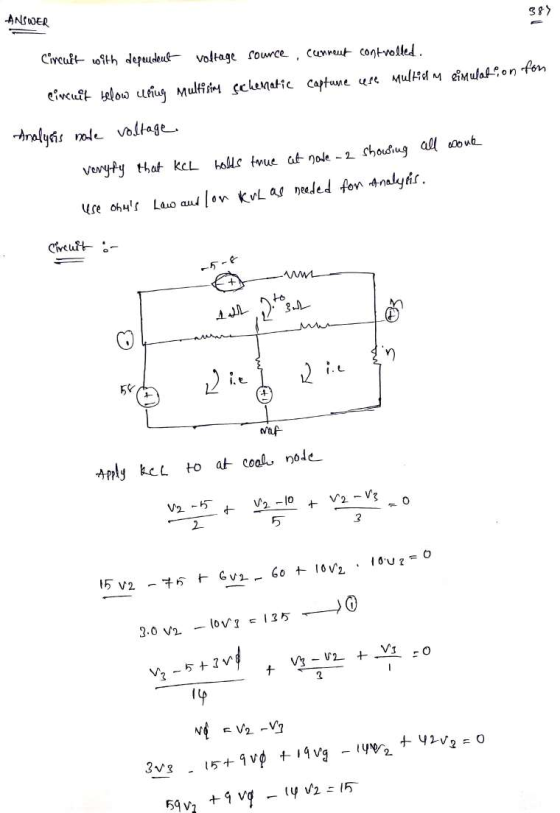
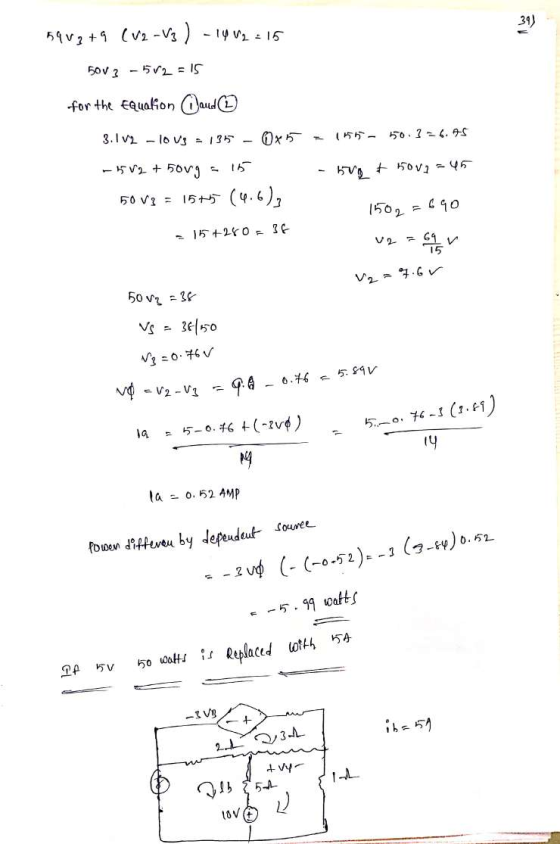
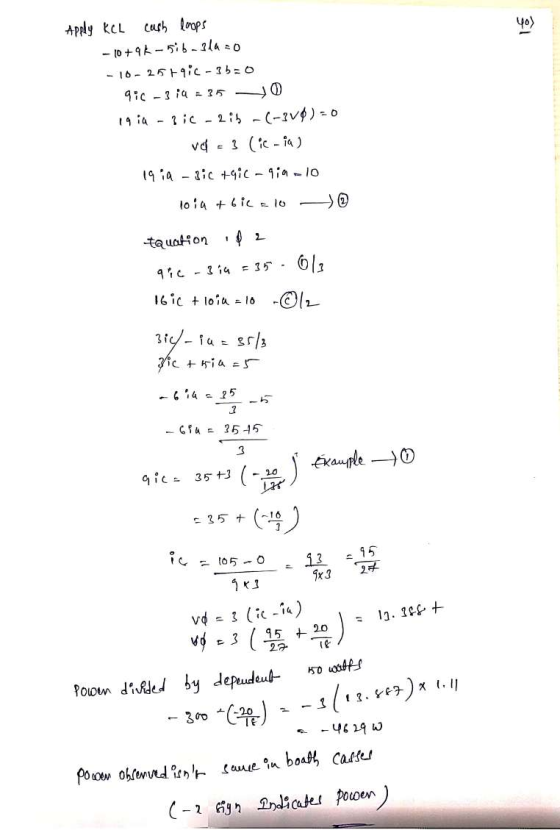
Lab 4-Circuits with Dependent Power Sources-A.pdf Lab Procedure: Part 1: Circuit with Dependent Voltage Source, Current...
Lab Procedure: Part 1: Source Free RC Circuit V(t) ilts C3 (R3 21ko 1uF IC=10V a)...
 Lab Procedure: Part 1: Source Free RC Circuit V(t) ilts C3 (R3 21ko 1uF IC=10V a) For the circuit shown above, provide the equation and calculate the following: 1. The source free equation for V(t) for V(O)= 10 volts 2. The equation for it) 3. V(t) and i(t) for t = t (one time constant) b) Now, enter the circuit using Multisim Schematic Capture. c) Simulate using Transient mode with a graphical output and verify graphical results with your calculations....
Learning Goal: To use the node-voltage method to solve circuits that contain resistors and independent sources....
 Learning Goal: To use the node-voltage method to solve circuits that contain resistors and independent sources. The node-voltage method is a general technique for solving circuits. Fundamentally, it involves writing KCL equations at essential nodes. You should review KCL and the definition of an essential node before beginning. In this tutorial, you will use the node-voltage method to find the current through the voltage source, io , and the voltage drop across the 5 kN resistor, vo, for the circuit...
Learning Goal: To use the node-voltage method to solve circuits with branches containing only a voltage...
 Learning Goal: To use the node-voltage method to solve circuits with branches containing only a voltage source. The node-voltage method is a general technique for solving circuits. Fundamentally, it involves writing KCL equations at essential nodes. When the circuit contains a dependent source, you must write a constraint equation for each dependent source, in addition to the KCL equations. When the circuit contains one or more voltage sources that are the only components in branches connecting two essential nodes, the...
II. Series-Parallel Circuits Use the Reduce and Return circuit analysis approach to solve for all voltages...
 II. Series-Parallel Circuits Use the Reduce and Return circuit analysis approach to solve for all voltages and currents in the circuit shown in Figure 1. Complete Table 1 in its entirety including analytical and Multisim results. All Multisim diagrams should be captured and included in the Lab Reprot. R1 R3 1ko 4.7k R2 2.2k RA 100 E = 15 V Figure 1: Series Parallel Circuit Focus TO Table 1: Series-Parallel Analysis (Reduce and Return Approach) Calculated Multisim RT 12 14...
please include work. II. Series-Parallel Circuits Use the Reduce and Return circuit analysis approach to solve...
 please include work.
II. Series-Parallel Circuits Use the Reduce and Return circuit analysis approach to solve for all voltages and currents in the circuit shown in Figure 1. Complete Table 1 in its entirety including analytical and Multisim results. All Multisim diagrams should be captured and included in the Lab Reprot. R1 R3 w 4.7ko 1ko R2 2.2k RA 10k0 E = 15 V Figure 1: Series Parallel Circuit TO Table 1: Series-Parallel Analysis (Reduce and Return Approach) Calculated Multisim...
please include work.
II. Series-Parallel Circuits Use the Reduce and Return circuit analysis approach to solve for all voltages and currents in the circuit shown in Figure 1. Complete Table 1 in its entirety including analytical and Multisim results. All Multisim diagrams should be captured and included in the Lab Reprot. R1 R3 w 4.7ko 1ko R2 2.2k RA 10k0 E = 15 V Figure 1: Series Parallel Circuit TO Table 1: Series-Parallel Analysis (Reduce and Return Approach) Calculated Multisim...
1) In the circuit below the currents are named A, and lc The current direction is determined by the source (out of positive terminal) in the middle and right branches and is clockwise in the left bra...
 1) In the circuit below the currents are named A, and lc The current direction is determined by the source (out of positive terminal) in the middle and right branches and is clockwise in the left branch · IA flows through R2 and R1 Is flows through R4 and Vb cflows through R3, Vc AB R2 R3 R4 R1 Vb a) Draw the circuit and show the 3 currents described above, including arrows showing the current direction. Show the voltage...
Name: ENGT 3050 Fundamentals of Electricity LAB EXERCISE #3 Series and Parallel Circuits Objectives: The objective...
 Name: ENGT 3050 Fundamentals of Electricity LAB EXERCISE #3 Series and Parallel Circuits Objectives: The objective of this exercise is to examine Kirchhoff's Voltage and Current Laws. Kirchhoff's Voltage Law (KVL) states, for a closed loop series path the algebraic sum of all the voltages around any closed loop in a circuit is equal to zero. Kirchhoff's Current Law (KCL) states, for a parallel path the total current entering a circuits junction is exactly equal to the total current leaving...
2- Set the two independent power sources to Vsi 6V and Veo" 10 V and measure...
 2- Set the two independent power sources to Vsi 6V and Veo" 10 V and measure their actual values using the DMM. Actual Values of power sources: 4.47 VS15.99 Vs- 3- Using the breadboard construct the circuit shown in Figure 4,1 (repeated below for convenience). Use the resistors measured in Step 1 (above) and the power sources Vsi- 6 V, and Vs2 -10 V. IR3 IRI RS. R5 R1 R3 Va V4 V2 V1 ww ww It 12 R4 R23...
Lab - 4.pdf (page 1 of 2) @ Search R2 Prelab Resistor Selection R1 w a....
 Lab - 4.pdf (page 1 of 2) @ Search R2 Prelab Resistor Selection R1 w a. A circuit based on the configuration in Figure 1 1 ΚΩ needs to produce: V2 R3 V1 1) A leftward current of 3.9 mA in R5. V3 2) A top-positive voltage of 1.5 V across R4. 3) A power of 2.4 mW in RL. 4.0V R4 RL = 5602 b. Sketch Figure 1 on a blank sheet of paper, add notations as needed, and...
Lab Preparation . Using DC analysis, and assuming that the transistors (QuEr and Q) are in...
 Lab Preparation . Using DC analysis, and assuming that the transistors (QuEr and Q) are in the active mode, determine the value of RREF required for generating a copy current of 0.755 mA. Take the value of Vcc to be 8 V, and the value of VE in the active mode to be equal to 0.7V. Vee H Qur о RaI Figure 3 Single-stage amplifier biased by a simple current miror device 2. The circuit shown in Figure 3, is...
 Lab Procedure: Part 1: Source Free RC Circuit V(t) ilts C3 (R3 21ko 1uF IC=10V a) For the circuit shown above, provide the equation and calculate the following: 1. The source free equation for V(t) for V(O)= 10 volts 2. The equation for it) 3. V(t) and i(t) for t = t (one time constant) b) Now, enter the circuit using Multisim Schematic Capture. c) Simulate using Transient mode with a graphical output and verify graphical results with your calculations....
 Learning Goal: To use the node-voltage method to solve circuits that contain resistors and independent sources. The node-voltage method is a general technique for solving circuits. Fundamentally, it involves writing KCL equations at essential nodes. You should review KCL and the definition of an essential node before beginning. In this tutorial, you will use the node-voltage method to find the current through the voltage source, io , and the voltage drop across the 5 kN resistor, vo, for the circuit...
 Learning Goal: To use the node-voltage method to solve circuits with branches containing only a voltage source. The node-voltage method is a general technique for solving circuits. Fundamentally, it involves writing KCL equations at essential nodes. When the circuit contains a dependent source, you must write a constraint equation for each dependent source, in addition to the KCL equations. When the circuit contains one or more voltage sources that are the only components in branches connecting two essential nodes, the...
 II. Series-Parallel Circuits Use the Reduce and Return circuit analysis approach to solve for all voltages and currents in the circuit shown in Figure 1. Complete Table 1 in its entirety including analytical and Multisim results. All Multisim diagrams should be captured and included in the Lab Reprot. R1 R3 1ko 4.7k R2 2.2k RA 100 E = 15 V Figure 1: Series Parallel Circuit Focus TO Table 1: Series-Parallel Analysis (Reduce and Return Approach) Calculated Multisim RT 12 14...
 please include work.
II. Series-Parallel Circuits Use the Reduce and Return circuit analysis approach to solve for all voltages and currents in the circuit shown in Figure 1. Complete Table 1 in its entirety including analytical and Multisim results. All Multisim diagrams should be captured and included in the Lab Reprot. R1 R3 w 4.7ko 1ko R2 2.2k RA 10k0 E = 15 V Figure 1: Series Parallel Circuit TO Table 1: Series-Parallel Analysis (Reduce and Return Approach) Calculated Multisim...
please include work.
II. Series-Parallel Circuits Use the Reduce and Return circuit analysis approach to solve for all voltages and currents in the circuit shown in Figure 1. Complete Table 1 in its entirety including analytical and Multisim results. All Multisim diagrams should be captured and included in the Lab Reprot. R1 R3 w 4.7ko 1ko R2 2.2k RA 10k0 E = 15 V Figure 1: Series Parallel Circuit TO Table 1: Series-Parallel Analysis (Reduce and Return Approach) Calculated Multisim...
 1) In the circuit below the currents are named A, and lc The current direction is determined by the source (out of positive terminal) in the middle and right branches and is clockwise in the left branch · IA flows through R2 and R1 Is flows through R4 and Vb cflows through R3, Vc AB R2 R3 R4 R1 Vb a) Draw the circuit and show the 3 currents described above, including arrows showing the current direction. Show the voltage...
 Name: ENGT 3050 Fundamentals of Electricity LAB EXERCISE #3 Series and Parallel Circuits Objectives: The objective of this exercise is to examine Kirchhoff's Voltage and Current Laws. Kirchhoff's Voltage Law (KVL) states, for a closed loop series path the algebraic sum of all the voltages around any closed loop in a circuit is equal to zero. Kirchhoff's Current Law (KCL) states, for a parallel path the total current entering a circuits junction is exactly equal to the total current leaving...
 2- Set the two independent power sources to Vsi 6V and Veo" 10 V and measure their actual values using the DMM. Actual Values of power sources: 4.47 VS15.99 Vs- 3- Using the breadboard construct the circuit shown in Figure 4,1 (repeated below for convenience). Use the resistors measured in Step 1 (above) and the power sources Vsi- 6 V, and Vs2 -10 V. IR3 IRI RS. R5 R1 R3 Va V4 V2 V1 ww ww It 12 R4 R23...
 Lab - 4.pdf (page 1 of 2) @ Search R2 Prelab Resistor Selection R1 w a. A circuit based on the configuration in Figure 1 1 ΚΩ needs to produce: V2 R3 V1 1) A leftward current of 3.9 mA in R5. V3 2) A top-positive voltage of 1.5 V across R4. 3) A power of 2.4 mW in RL. 4.0V R4 RL = 5602 b. Sketch Figure 1 on a blank sheet of paper, add notations as needed, and...
 Lab Preparation . Using DC analysis, and assuming that the transistors (QuEr and Q) are in the active mode, determine the value of RREF required for generating a copy current of 0.755 mA. Take the value of Vcc to be 8 V, and the value of VE in the active mode to be equal to 0.7V. Vee H Qur о RaI Figure 3 Single-stage amplifier biased by a simple current miror device 2. The circuit shown in Figure 3, is...
Most questions answered within 3 hours.
-
Where is the error in this code sequence?
String s1 = "Hello";
String s2 = "ello";...
asked 10 months ago -
Financial data for Joel de Paris, Inc., for last year
follow:
Joel de Paris, Inc.
Balance...
asked 10 months ago -
Consider this reaction:
Al2(SO4)3 (aq)+ BaCl3
(aq) Al2Cl6 (aq)- +
3BaSO4(s) . What is the...
asked 10 months ago -
Suppose that Savneet is considering increasing her
recent random sample from 20 car rentals to 40...
asked 10 months ago -
Trucks arrive at an unloading terminal at an average rate of 120
per hour.
Trucks arrive...
asked 10 months ago -
Why are methanol and ethanol completely soluble in water while
octanol is not very little soluble....
asked 10 months ago -
A facilities manager at a university reads in a research report
that the mean amount of...
asked 10 months ago -
When the CuSO4 is rehydrated by adding water to the anhydrous
compound, is this an endothermic...
asked 10 months ago -
A ray of sunlight is passing from diamond into crown glass; the
angle of incidence is...
asked 10 months ago -
A block of mass 0.249 kg is placed on top of a light, vertical
spring of...
asked 10 months ago -
how do the kidneys compensate in the presences of acidosis
a) trigger hyperventilate
b) reserve acid...
asked 10 months ago -
Question 501 pts
The rental rate of capital to the firm increases. Which of the
following...
asked 10 months ago