
Homework Answers
Add Answer to:
32. A Brownian particle is placed in a very long narrow channel. The particle is trapped...
A particle of mass m moves in one dimension. Let x(t) denote the position of the...
 A particle of mass m moves in one dimension. Let x(t) denote the position of the particle at time t. The particle is subjected to a force which depends only on the position of the particle; when the particle is at position x, the force is -A sin(Bx), where A and B are some positive constants. Fill in the blank so that we end up with the differential equation that describes the motion: x" = Note that x = 0...
<Chapter 27 Problem 27.74 9 of 9 > A Review | Constants Part C A particle...
 <Chapter 27 Problem 27.74 9 of 9 > A Review | Constants Part C A particle with charge q and mass m is dropped at time t = 0 from rest at its origin in a region of constant magnetic field B that points horizontally. What happens? To answer, construct a Cartesian coordinate system with the y-axis pointing downward and the z-axis pointing in the direction of the magnetic field. At time t o the particle has velocity v =...
Model for Evaluation The model used for evaluation is the single degree of freedom lumped mass mo...
 Model for Evaluation The model used for evaluation is the single degree of freedom lumped mass model defined by second order differential equation with constant coefficients. This model is shown in Figure 1. x(t)m m f(t) Figure 1 - Single Degree of Freedom Model The equation of motion describing this system can easily be shown to be md-x + cdx + kx = f(t) dt dt where m is the mass, c is the damping and k is the stiffness...
1. A particle of mass m moves in three dimensions, and has position r(t)-(x(t), y(t), z(t)) at ti...
 Mechanics. Need help with c) and d)
1. A particle of mass m moves in three dimensions, and has position r(t)-(x(t), y(t), z(t)) at time t. The particle has potential energy V(x, y, 2) so that its Lagrangian is given by where i d/dt, dy/dt, dz/dt (a) Writing q(q2.93)-(r, y, z) and denoting by p (p,P2, ps) their associated canonical momenta, show that the Hamiltonian is given by (show it from first principles rather than using the energy) H(q,p)H(g1, 92,9q3,...
Mechanics. Need help with c) and d)
1. A particle of mass m moves in three dimensions, and has position r(t)-(x(t), y(t), z(t)) at time t. The particle has potential energy V(x, y, 2) so that its Lagrangian is given by where i d/dt, dy/dt, dz/dt (a) Writing q(q2.93)-(r, y, z) and denoting by p (p,P2, ps) their associated canonical momenta, show that the Hamiltonian is given by (show it from first principles rather than using the energy) H(q,p)H(g1, 92,9q3,...
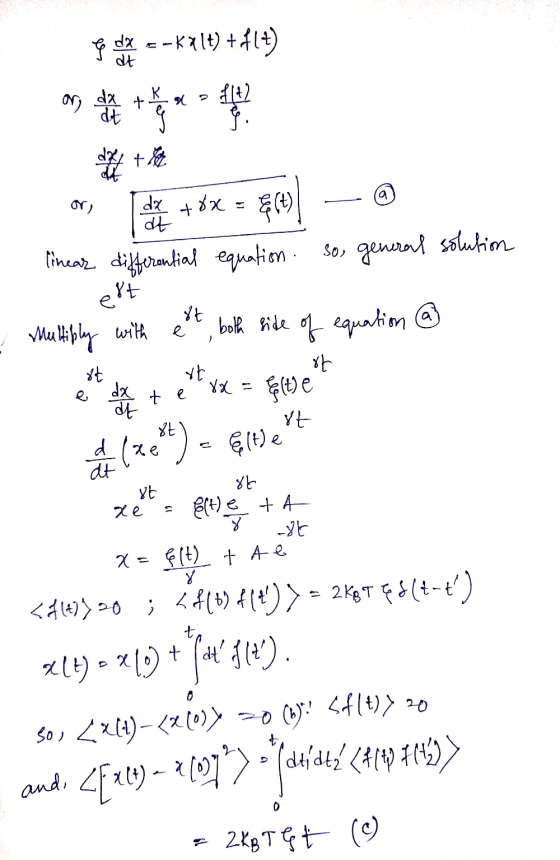
part b and c In class we derived a Fokker-Planck equation for the velocity distribution P(et)...
 part b and c
In class we derived a Fokker-Planck equation for the velocity distribution P(et) starting from the assumption of small random changes in velocity at each time step f.(t) where f(t) is chosen from a distribution WU: ). Einstein's original approach to Brownian motion had a different starting point, focusing on position differences at each time step x(t + Δt)-x(t) + E(t) where £(t) is a random displacement chosen from some distribution W(E). Underlying this ap- proach is...
part b and c
In class we derived a Fokker-Planck equation for the velocity distribution P(et) starting from the assumption of small random changes in velocity at each time step f.(t) where f(t) is chosen from a distribution WU: ). Einstein's original approach to Brownian motion had a different starting point, focusing on position differences at each time step x(t + Δt)-x(t) + E(t) where £(t) is a random displacement chosen from some distribution W(E). Underlying this ap- proach is...
An object of mass m is connected to a light spring with a force constant of...
An object of mass m is connected to a light spring with a force constant of kH N/meter which oscillates on a frictionless horizontal surface with Simple Harmonic Motion. At t = 0 the spring was at rest but is compressed x = A meter maximum during oscillation. Write the equation of motion from Newton's 2nd law FH = m·a and Hook's Law FH = -kH·x. Because of the starting position assume a solution is x = A sin(ωt) a...
the list of equations to list are attached! thanks! 6. A playground merry-go-round, i.e., a horizontal...
 the list of equations to list are attached! thanks!
6. A playground merry-go-round, i.e., a horizontal disc of radius 3 m that can rotate about a vertical axis through its center, is rotating at an angular speed 1/s (measured, as usual, in terms of radians). The moment of inertia of the merry-go-round with respect to that axis is 3000 kg m? A student of mass 80 kg is standing at the center of the merry-go-round. The student now walks outward...
the list of equations to list are attached! thanks!
6. A playground merry-go-round, i.e., a horizontal disc of radius 3 m that can rotate about a vertical axis through its center, is rotating at an angular speed 1/s (measured, as usual, in terms of radians). The moment of inertia of the merry-go-round with respect to that axis is 3000 kg m? A student of mass 80 kg is standing at the center of the merry-go-round. The student now walks outward...
8.4 The Two-Dimensional Central-Force Problem The 2D harmonic oscillator is a 2D central force pr...
 8.4 The Two-Dimensional Central-Force Problem The 2D harmonic oscillator is a 2D central force problem (as discussed in TZD Many physical systems involve a particle that moves under the influence of a central force; that is, a force that always points exactly toward, or away from, a force center O. In classical mechanics a famous example of a central force is the force of the sun on a planet. In atomic physics the most obvious example is the hydrogen atom,...
A NON stationary state A particle of mass m is in an infinite square well potential of width L, a...
 A NON stationary state A particle of mass m is in an infinite square well potential of width L, as in McIntyre's section 5.4. Suppose we have an initial state vector lv(t -0) results from Mclntrye without re-deriving them, and you may use a computer for your math as long as you include your code in your solution A(3E1) 4iE2)). You may use E. (4 pts) Use a computer to plot this probability density at 4 times: t 0, t2...
Question 7 is related to the force vs mass graph that is provided and the first...
 Question 7 is related to the force vs mass graph that is
provided and the first section of the excel sheet. Question 3 has
to do with the force bs acceleration graph and second section of
the excel sheet. The first two files are showing the equations that
are supposed to be used to find these answers. Any help would be
greatly appreciated.
I
mainly need assistance on number 1 and 2 now. The question with the
free body diagram...
Question 7 is related to the force vs mass graph that is
provided and the first section of the excel sheet. Question 3 has
to do with the force bs acceleration graph and second section of
the excel sheet. The first two files are showing the equations that
are supposed to be used to find these answers. Any help would be
greatly appreciated.
I
mainly need assistance on number 1 and 2 now. The question with the
free body diagram...
 A particle of mass m moves in one dimension. Let x(t) denote the position of the particle at time t. The particle is subjected to a force which depends only on the position of the particle; when the particle is at position x, the force is -A sin(Bx), where A and B are some positive constants. Fill in the blank so that we end up with the differential equation that describes the motion: x" = Note that x = 0...
 <Chapter 27 Problem 27.74 9 of 9 > A Review | Constants Part C A particle with charge q and mass m is dropped at time t = 0 from rest at its origin in a region of constant magnetic field B that points horizontally. What happens? To answer, construct a Cartesian coordinate system with the y-axis pointing downward and the z-axis pointing in the direction of the magnetic field. At time t o the particle has velocity v =...
 Model for Evaluation The model used for evaluation is the single degree of freedom lumped mass model defined by second order differential equation with constant coefficients. This model is shown in Figure 1. x(t)m m f(t) Figure 1 - Single Degree of Freedom Model The equation of motion describing this system can easily be shown to be md-x + cdx + kx = f(t) dt dt where m is the mass, c is the damping and k is the stiffness...
 Mechanics. Need help with c) and d)
1. A particle of mass m moves in three dimensions, and has position r(t)-(x(t), y(t), z(t)) at time t. The particle has potential energy V(x, y, 2) so that its Lagrangian is given by where i d/dt, dy/dt, dz/dt (a) Writing q(q2.93)-(r, y, z) and denoting by p (p,P2, ps) their associated canonical momenta, show that the Hamiltonian is given by (show it from first principles rather than using the energy) H(q,p)H(g1, 92,9q3,...
Mechanics. Need help with c) and d)
1. A particle of mass m moves in three dimensions, and has position r(t)-(x(t), y(t), z(t)) at time t. The particle has potential energy V(x, y, 2) so that its Lagrangian is given by where i d/dt, dy/dt, dz/dt (a) Writing q(q2.93)-(r, y, z) and denoting by p (p,P2, ps) their associated canonical momenta, show that the Hamiltonian is given by (show it from first principles rather than using the energy) H(q,p)H(g1, 92,9q3,...
 part b and c
In class we derived a Fokker-Planck equation for the velocity distribution P(et) starting from the assumption of small random changes in velocity at each time step f.(t) where f(t) is chosen from a distribution WU: ). Einstein's original approach to Brownian motion had a different starting point, focusing on position differences at each time step x(t + Δt)-x(t) + E(t) where £(t) is a random displacement chosen from some distribution W(E). Underlying this ap- proach is...
part b and c
In class we derived a Fokker-Planck equation for the velocity distribution P(et) starting from the assumption of small random changes in velocity at each time step f.(t) where f(t) is chosen from a distribution WU: ). Einstein's original approach to Brownian motion had a different starting point, focusing on position differences at each time step x(t + Δt)-x(t) + E(t) where £(t) is a random displacement chosen from some distribution W(E). Underlying this ap- proach is...
 the list of equations to list are attached! thanks!
6. A playground merry-go-round, i.e., a horizontal disc of radius 3 m that can rotate about a vertical axis through its center, is rotating at an angular speed 1/s (measured, as usual, in terms of radians). The moment of inertia of the merry-go-round with respect to that axis is 3000 kg m? A student of mass 80 kg is standing at the center of the merry-go-round. The student now walks outward...
the list of equations to list are attached! thanks!
6. A playground merry-go-round, i.e., a horizontal disc of radius 3 m that can rotate about a vertical axis through its center, is rotating at an angular speed 1/s (measured, as usual, in terms of radians). The moment of inertia of the merry-go-round with respect to that axis is 3000 kg m? A student of mass 80 kg is standing at the center of the merry-go-round. The student now walks outward...
 8.4 The Two-Dimensional Central-Force Problem The 2D harmonic oscillator is a 2D central force problem (as discussed in TZD Many physical systems involve a particle that moves under the influence of a central force; that is, a force that always points exactly toward, or away from, a force center O. In classical mechanics a famous example of a central force is the force of the sun on a planet. In atomic physics the most obvious example is the hydrogen atom,...
 A NON stationary state A particle of mass m is in an infinite square well potential of width L, as in McIntyre's section 5.4. Suppose we have an initial state vector lv(t -0) results from Mclntrye without re-deriving them, and you may use a computer for your math as long as you include your code in your solution A(3E1) 4iE2)). You may use E. (4 pts) Use a computer to plot this probability density at 4 times: t 0, t2...
 Question 7 is related to the force vs mass graph that is
provided and the first section of the excel sheet. Question 3 has
to do with the force bs acceleration graph and second section of
the excel sheet. The first two files are showing the equations that
are supposed to be used to find these answers. Any help would be
greatly appreciated.
I
mainly need assistance on number 1 and 2 now. The question with the
free body diagram...
Question 7 is related to the force vs mass graph that is
provided and the first section of the excel sheet. Question 3 has
to do with the force bs acceleration graph and second section of
the excel sheet. The first two files are showing the equations that
are supposed to be used to find these answers. Any help would be
greatly appreciated.
I
mainly need assistance on number 1 and 2 now. The question with the
free body diagram...
Most questions answered within 3 hours.
-
Where is the error in this code sequence?
String s1 = "Hello";
String s2 = "ello";...
asked 11 months ago -
Financial data for Joel de Paris, Inc., for last year
follow:
Joel de Paris, Inc.
Balance...
asked 11 months ago -
Consider this reaction:
Al2(SO4)3 (aq)+ BaCl3
(aq) Al2Cl6 (aq)- +
3BaSO4(s) . What is the...
asked 11 months ago -
Suppose that Savneet is considering increasing her
recent random sample from 20 car rentals to 40...
asked 11 months ago -
Trucks arrive at an unloading terminal at an average rate of 120
per hour.
Trucks arrive...
asked 11 months ago -
Why are methanol and ethanol completely soluble in water while
octanol is not very little soluble....
asked 11 months ago -
A facilities manager at a university reads in a research report
that the mean amount of...
asked 11 months ago -
When the CuSO4 is rehydrated by adding water to the anhydrous
compound, is this an endothermic...
asked 11 months ago -
A ray of sunlight is passing from diamond into crown glass; the
angle of incidence is...
asked 11 months ago -
A block of mass 0.249 kg is placed on top of a light, vertical
spring of...
asked 11 months ago -
how do the kidneys compensate in the presences of acidosis
a) trigger hyperventilate
b) reserve acid...
asked 11 months ago -
Question 501 pts
The rental rate of capital to the firm increases. Which of the
following...
asked 11 months ago