
Homework Answers
in case of doubt please comment.
Add Answer to:
Ja Hop view) A dumbblle TS at rest on friction less horizontal table. The dumbblel consit...
A putty ball of inertia m moving at speed v slides on a slick surface along...
A putty ball of inertia m moving at speed v slides on a slick surface along a path that is perpendicular to the long axis of a rod of length ?and inertia 2m that is at rest on the surface. The ball collides with one end of the rod and sticks to it. Ignore any effects due to friction and use the notation l for the length of the rod ?. Part A: Just as the ball sticks, what is...
3. Three masses are connected by thin rigid rods as shown below, and are initially at rest on the top of a horizontal table. A circular blob of clay (velocity shown immediately before the collisi...
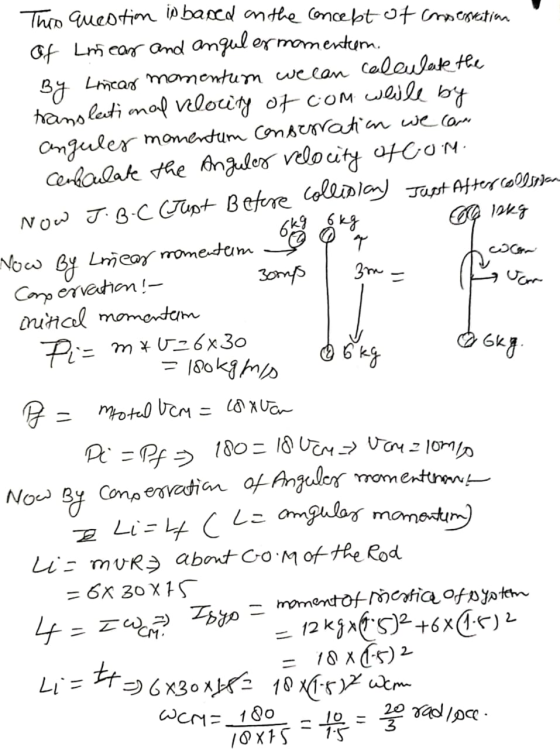
 3. Three masses are connected by thin rigid rods as shown below, and are initially at rest on the top of a horizontal table. A circular blob of clay (velocity shown immediately before the collision) hits and sticks to one of the masses as shown. The mass of the rod can be neglected and the object is NOT pinned down to the table 3 m 20 m/s i 40 2 kg Calculate the linear velocity of the center of mass,...
One 2.5 gram piece of mass moving at 100 meters per second (m/s) collides and sticks...
One 2.5 gram piece of mass moving at 100 meters per second (m/s) collides and sticks to another 2.5 gram mass at rest. The resulting 5 gram mass continues in the same direction with some speed. No external forces act on these masses, and during the collision no particles are absorbed, but 3 × 1025 photons are emitted due to the collision. These photons all have a wavelength of 1.0 μm, but their direction is split three ways. One third...
Shown below is a small particle of mass 33 g that is moving at a speed...
Shown below is a small particle of mass 33 g that is moving at a speed of 10 m/s when it collides with and sticks to the edge of a uniform solid cylinder. The cylinder is free to rotate about the axis through its center and perpendicular to the page. The cylinder has a mass of 0.4 kg and a radius of 18 cm and is initially at rest. (a) What is the angular velocity (in rad/s) of the system...
Shown below is a small particle of mass 19 g that is moving at a speed...
 Shown below is a small particle of mass 19 g that is moving at a speed of 10 m/s when it collides with and sticks to the edge of a uniform solid cylinder. The cylinder is free to rotate about the axis through its center and perpendicular to the page. The cylinder has a mass of 0.4 kg and a radius of 20 cm and is initially at rest. 10 m/s Before After (a) What is the angular velocity (in...
The top edge of a thin rectangular metal plate with a mass of 2.80 kg is...
 The top edge of a thin rectangular metal plate with a mass of 2.80 kg is attached to a horizontal rod parallel to the edge of the plate. The plate hangs from this rod and is free to rotate about it without friction. The vertical height of the plate is 45.0 cm. The plate is pulled to the right until it makes an angle of 28.0° from vertical and then released from rest. At the same time, a piece of...
9-10 As shown in the figure, a wooden ball with mass m2 is initially at rest...
 9-10
As shown in the figure, a wooden ball with mass m2 is initially at rest on a horizontal, frictionless table. A second wooden ball with mass my moving with a speed 2.00 m/s, collides with my. Assume my moves initially along the +x-axis. After the collision, my moves with speed 1.00 m/s at an angle of e = 53.0° to the positive x-axis. Assumem, -0.2009 and m, -0.300 kg) After the colon Before the collision (a) Determine the speed...
9-10
As shown in the figure, a wooden ball with mass m2 is initially at rest on a horizontal, frictionless table. A second wooden ball with mass my moving with a speed 2.00 m/s, collides with my. Assume my moves initially along the +x-axis. After the collision, my moves with speed 1.00 m/s at an angle of e = 53.0° to the positive x-axis. Assumem, -0.2009 and m, -0.300 kg) After the colon Before the collision (a) Determine the speed...
on a frictionless table collides with a stationary 7. A 10 kg ball moving at a...
 on a frictionless table collides with a stationary 7. A 10 kg ball moving at a velocity of 2 m/s 5 kg ball. Find the final velocity of each ball if the collision is inelastic? If the collision is elastic and the 10 kg ball comes to a complete stop, what is the final velocity of the second ball? 8. A woman stands at the center of a platform. She is holding a dumb-bell in each hand, and outstretched. The...
HELLO! Please answer all the questions! don't leave any of them out! Thanks! Answer all the...
 HELLO! Please answer all the questions! don't leave
any of them out! Thanks!
Answer all the questions asked please!
om 8. A ball of silly putty hits and sticks to a bowling ball that was initially at rest. After the collision, the total kinetic energy of the bowling ball and silly! putty is O (A) less than the kinetic energy of the silly putty before the collision O (B) more than the kinetic energy of the silly putty before the...
HELLO! Please answer all the questions! don't leave
any of them out! Thanks!
Answer all the questions asked please!
om 8. A ball of silly putty hits and sticks to a bowling ball that was initially at rest. After the collision, the total kinetic energy of the bowling ball and silly! putty is O (A) less than the kinetic energy of the silly putty before the collision O (B) more than the kinetic energy of the silly putty before the...
 3. Three masses are connected by thin rigid rods as shown below, and are initially at rest on the top of a horizontal table. A circular blob of clay (velocity shown immediately before the collision) hits and sticks to one of the masses as shown. The mass of the rod can be neglected and the object is NOT pinned down to the table 3 m 20 m/s i 40 2 kg Calculate the linear velocity of the center of mass,...
 Shown below is a small particle of mass 19 g that is moving at a speed of 10 m/s when it collides with and sticks to the edge of a uniform solid cylinder. The cylinder is free to rotate about the axis through its center and perpendicular to the page. The cylinder has a mass of 0.4 kg and a radius of 20 cm and is initially at rest. 10 m/s Before After (a) What is the angular velocity (in...
 The top edge of a thin rectangular metal plate with a mass of 2.80 kg is attached to a horizontal rod parallel to the edge of the plate. The plate hangs from this rod and is free to rotate about it without friction. The vertical height of the plate is 45.0 cm. The plate is pulled to the right until it makes an angle of 28.0° from vertical and then released from rest. At the same time, a piece of...
 9-10
As shown in the figure, a wooden ball with mass m2 is initially at rest on a horizontal, frictionless table. A second wooden ball with mass my moving with a speed 2.00 m/s, collides with my. Assume my moves initially along the +x-axis. After the collision, my moves with speed 1.00 m/s at an angle of e = 53.0° to the positive x-axis. Assumem, -0.2009 and m, -0.300 kg) After the colon Before the collision (a) Determine the speed...
9-10
As shown in the figure, a wooden ball with mass m2 is initially at rest on a horizontal, frictionless table. A second wooden ball with mass my moving with a speed 2.00 m/s, collides with my. Assume my moves initially along the +x-axis. After the collision, my moves with speed 1.00 m/s at an angle of e = 53.0° to the positive x-axis. Assumem, -0.2009 and m, -0.300 kg) After the colon Before the collision (a) Determine the speed...
 on a frictionless table collides with a stationary 7. A 10 kg ball moving at a velocity of 2 m/s 5 kg ball. Find the final velocity of each ball if the collision is inelastic? If the collision is elastic and the 10 kg ball comes to a complete stop, what is the final velocity of the second ball? 8. A woman stands at the center of a platform. She is holding a dumb-bell in each hand, and outstretched. The...
 HELLO! Please answer all the questions! don't leave
any of them out! Thanks!
Answer all the questions asked please!
om 8. A ball of silly putty hits and sticks to a bowling ball that was initially at rest. After the collision, the total kinetic energy of the bowling ball and silly! putty is O (A) less than the kinetic energy of the silly putty before the collision O (B) more than the kinetic energy of the silly putty before the...
HELLO! Please answer all the questions! don't leave
any of them out! Thanks!
Answer all the questions asked please!
om 8. A ball of silly putty hits and sticks to a bowling ball that was initially at rest. After the collision, the total kinetic energy of the bowling ball and silly! putty is O (A) less than the kinetic energy of the silly putty before the collision O (B) more than the kinetic energy of the silly putty before the...
Most questions answered within 3 hours.
-
Where is the error in this code sequence?
String s1 = "Hello";
String s2 = "ello";...
asked 11 months ago -
Financial data for Joel de Paris, Inc., for last year
follow:
Joel de Paris, Inc.
Balance...
asked 11 months ago -
Consider this reaction:
Al2(SO4)3 (aq)+ BaCl3
(aq) Al2Cl6 (aq)- +
3BaSO4(s) . What is the...
asked 11 months ago -
Suppose that Savneet is considering increasing her
recent random sample from 20 car rentals to 40...
asked 11 months ago -
Trucks arrive at an unloading terminal at an average rate of 120
per hour.
Trucks arrive...
asked 11 months ago -
Why are methanol and ethanol completely soluble in water while
octanol is not very little soluble....
asked 11 months ago -
A facilities manager at a university reads in a research report
that the mean amount of...
asked 11 months ago -
When the CuSO4 is rehydrated by adding water to the anhydrous
compound, is this an endothermic...
asked 11 months ago -
A ray of sunlight is passing from diamond into crown glass; the
angle of incidence is...
asked 11 months ago -
A block of mass 0.249 kg is placed on top of a light, vertical
spring of...
asked 11 months ago -
how do the kidneys compensate in the presences of acidosis
a) trigger hyperventilate
b) reserve acid...
asked 11 months ago -
Question 501 pts
The rental rate of capital to the firm increases. Which of the
following...
asked 11 months ago