

Homework Answers
Answer #1
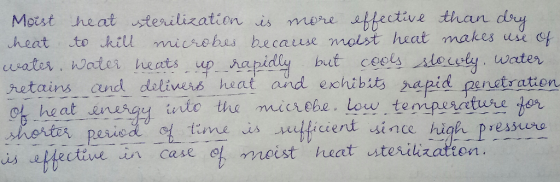
Moest heat steileスation is nee e ef ectal than heat to kill micrebas hecause molst hat makes u c euator. water heats pnq retains and delivero hsat and echibit apid pntraten ot heat eney tc tie micrehe. low tempenature tor erter pesicd time is utficient since high pressurs hapidl is uttectine in case o reist heat stesiizatien.
Know the answer?
Add Answer to:
Antimicrobial methods target different parts of a microbial cell or structure Enveloped viruses have a membrane...
Not the answer you're looking for?
Ask your own homework help question.
Our experts will answer your question WITHIN MINUTES for Free.
Similar Homework Help Questions
Chapter 12 Study Guide 1. What are the bacterial cell targets of the different antibiotics? 2....
 Chapter 12 Study Guide 1. What are the bacterial cell targets of the different antibiotics? 2. Define the following terms: a. Antibiotic resistance b. Antibiotic sensitivity c. Broad-spectrum antibiotic d. Narrow-spectrum antibiotic e. Semisynthetic antibiotic 3. Describe the mechanism of action (target) for the following antibiotics: a. Penicillins (including semisynthetics) b. Cephalosporins c. Quinolones and Fluoroquinolones d. Bacitracin e. Vancomycin f. Carbapenems g. Tetracyclines h. Sulfonamides i. Polymyxin B j. Aminoglycosides k. Macrolides I. Chloramphenicol m. Oxazolidones n. Isoniazid o....
 Chapter 12 Study Guide 1. What are the bacterial cell targets of the different antibiotics? 2. Define the following terms: a. Antibiotic resistance b. Antibiotic sensitivity c. Broad-spectrum antibiotic d. Narrow-spectrum antibiotic e. Semisynthetic antibiotic 3. Describe the mechanism of action (target) for the following antibiotics: a. Penicillins (including semisynthetics) b. Cephalosporins c. Quinolones and Fluoroquinolones d. Bacitracin e. Vancomycin f. Carbapenems g. Tetracyclines h. Sulfonamides i. Polymyxin B j. Aminoglycosides k. Macrolides I. Chloramphenicol m. Oxazolidones n. Isoniazid o....
ADVERTISEMENT
Need Online Homework Help?
Ask
a QuestionGet Answers For Free
Most questions answered within 3 hours.
Most questions answered within 3 hours.
ADVERTISEMENT
Active Questions
-
Where is the error in this code sequence?
String s1 = "Hello";
String s2 = "ello";...
asked 10 months ago -
Financial data for Joel de Paris, Inc., for last year
follow:
Joel de Paris, Inc.
Balance...
asked 10 months ago -
Consider this reaction:
Al2(SO4)3 (aq)+ BaCl3
(aq) Al2Cl6 (aq)- +
3BaSO4(s) . What is the...
asked 10 months ago -
Suppose that Savneet is considering increasing her
recent random sample from 20 car rentals to 40...
asked 10 months ago -
Trucks arrive at an unloading terminal at an average rate of 120
per hour.
Trucks arrive...
asked 10 months ago -
Why are methanol and ethanol completely soluble in water while
octanol is not very little soluble....
asked 10 months ago -
A facilities manager at a university reads in a research report
that the mean amount of...
asked 10 months ago -
When the CuSO4 is rehydrated by adding water to the anhydrous
compound, is this an endothermic...
asked 10 months ago -
A ray of sunlight is passing from diamond into crown glass; the
angle of incidence is...
asked 10 months ago -
A block of mass 0.249 kg is placed on top of a light, vertical
spring of...
asked 10 months ago -
how do the kidneys compensate in the presences of acidosis
a) trigger hyperventilate
b) reserve acid...
asked 10 months ago -
Question 501 pts
The rental rate of capital to the firm increases. Which of the
following...
asked 10 months ago
ADVERTISEMENT