Consider the circuit shown in the following figure (Figure 1) , but with the bar moving...
Consider the circuit shown in the following figure (Figure 1) , but with the bar moving to the right with speed v. The bar has length 0.372m , R = 47.8? , and B = 0.620T .
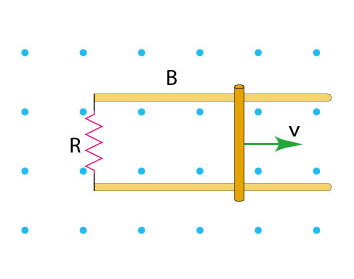
Part A:
Is the induced current in the circuit clockwise or
counterclockwise?
Part B:
At an instant when the resistor is dissipating electrical energy at a rate of 0.928J/s , what is the speed of the bar?
Express your answer with the appropriate units.

Homework Answers
A.
By Lenz law, the current must counter the change in B flux out of the page, which forces the current to be CLOCKWISE. [ANSWER]
B.
Here,
emf = B v l
As
P = (emf^2)/R
Then
P = B^2 v^2 l^2 / R
Solving for v,
v = sqrt [P R / [B^2 l^2]]
Thus,
v = 28.9 m/s [ANSWER]
Add Answer to:
Consider the circuit shown in the following figure (Figure 1) ,
but with the bar moving...
Item 21 Consider the circuit shown in the following figure (Figure 1), but with the bar...
 Item 21 Consider the circuit shown in the following figure (Figure 1), but with the bar moving to the right with speed u. Part A Is the induced current in the circuit clockwise or counterclockwise? Figure 1 of 1 O O counterclockwise clockwise Submit Request Answer < Return to Assignment Provide Feedback RE Pearson
A 0.344 m long metal bar is pulled to the left by an applied force F
 A 0.344 m long metal bar is pulled to the left by an applied force F. The bar rides on parallel metal rails connected through a 44.1 2 resistor, as shown in the following figure(Figure 1), so the apparatus makes a complete circuit. You can ignore the resistance of the bar and rails. The circuit is in a uniform 0.602 T magnetic field that is directed out of the plane of the figure. Part A At the instant when the bar is...
In the circuit shown in the following figure(Figure 1) the capacitor has capacitance 25 uF and...
 In the circuit shown in the following figure(Figure 1) the capacitor has capacitance 25 uF and is initially uncharged. The resistor Ro has resistance 12 12. An emf of 80.0 V is added in series with the capacitor and the resistor. The emf is placed between the capacitor and the switch, with the positive terminal of the emf adjacent to the capacitor. The small circuit is not connected in any way to the large one. The wire of the small...
A circuit diagram of the automobile ignition circuit is shown in the figure. Consider the circuit...
 A circuit diagram of the automobile ignition circuit is shown in
the figure. Consider the circuit characteristics that provide the
energy to ignite the fuel-air mixture in the cylinder. First, the
maximum voltage available at the spark plug,
vsp, must be high enough to ignite the
fuel. Second, the voltage across the capacitor must be limited to
prevent arcing across the switch or distributor points. Third, the
current in the primary winding of the autotransformer must cause
sufficient energy to...
A circuit diagram of the automobile ignition circuit is shown in
the figure. Consider the circuit characteristics that provide the
energy to ignite the fuel-air mixture in the cylinder. First, the
maximum voltage available at the spark plug,
vsp, must be high enough to ignite the
fuel. Second, the voltage across the capacitor must be limited to
prevent arcing across the switch or distributor points. Third, the
current in the primary winding of the autotransformer must cause
sufficient energy to...
In the circuit shown in the following figure(Figure 1) thecapacitor has capacitance 24 μF and...
 In the circuit shown in the following figure(Figure 1) the
capacitor has capacitance 24 μF and is initially uncharged. The
resistor R0 has resistance 11 Ω . An emf of 86.0 V is added in
series with the capacitor and the resistor. The emf is placed
between the capacitor and the switch, with the positive terminal of
the emf adjacent to the capacitor. The small circuit is not
connected in any way to the large one. The wire of the...
In the circuit shown in the following figure(Figure 1) the
capacitor has capacitance 24 μF and is initially uncharged. The
resistor R0 has resistance 11 Ω . An emf of 86.0 V is added in
series with the capacitor and the resistor. The emf is placed
between the capacitor and the switch, with the positive terminal of
the emf adjacent to the capacitor. The small circuit is not
connected in any way to the large one. The wire of the...
A conducting bar of length f moves to the right on two frictionless rails as shown...
 A conducting bar of length f moves to the right on two frictionless rails as shown in the figure below. A uniform magnetic field directed into the page has a magnitude of 0.290 T. Assume R-9.10 Ω and 1 0.320 m. (a) At what constant speed should the bar move to produce an 8.60-mA current in the resistor? 83m/s (b) What is the direction of the induced current? clockwise counterclockwise O into the page O out of the page (c)...
A 1.10-m-long metal bar is pulled to the right at a steady 4.0 m/s perpendicular to...
A 1.10-m-long metal bar is pulled to the right at a steady 4.0 m/s perpendicular to a uniform, 0.790-T magnetic field. The bar rides on parallel metal rails connected through R = 25.5-Ω, as shown in the figure (Figure 1), so the apparatus makes a complete circuit. You can ignore the resistance of the bar and the rails. A) Calculate the magnitude of the emf induced in the circuit. Express your answer using two significant figures. B)Find the direction of...
A conducting bar of length ! moves to the right on two frictionless rails as shown...
 A conducting bar of length ! moves to the right on two frictionless rails as shown in the figure below. A uniform magnetic field directed into the page has a magnitude of 0.290 T. Assume R = 9.10 and l = 0.330 m. X X X X X X X X * * *A* X * * * * * * * X X * * x * * * * * * * X X * * x *...
Consider the circuit shown in the figure, similar to the slide-wire generator we've discussed in class....
 Consider the circuit shown in the figure, similar to the slide-wire generator we've discussed in class. The uniform magnetic field points out of the page with a constant magnitude of 0.50 T. The resistor has a resistance of 59.0 ?, and the resistance of the rest of the conductor is negligible by comparison. The bar has a length of 0.26 m and is moving to the left with a speed v. What is this unknown speed if the resistor dissipates...
 Item 21 Consider the circuit shown in the following figure (Figure 1), but with the bar moving to the right with speed u. Part A Is the induced current in the circuit clockwise or counterclockwise? Figure 1 of 1 O O counterclockwise clockwise Submit Request Answer < Return to Assignment Provide Feedback RE Pearson
 In the circuit shown in the following figure(Figure 1) the capacitor has capacitance 25 uF and is initially uncharged. The resistor Ro has resistance 12 12. An emf of 80.0 V is added in series with the capacitor and the resistor. The emf is placed between the capacitor and the switch, with the positive terminal of the emf adjacent to the capacitor. The small circuit is not connected in any way to the large one. The wire of the small...
 A circuit diagram of the automobile ignition circuit is shown in
the figure. Consider the circuit characteristics that provide the
energy to ignite the fuel-air mixture in the cylinder. First, the
maximum voltage available at the spark plug,
vsp, must be high enough to ignite the
fuel. Second, the voltage across the capacitor must be limited to
prevent arcing across the switch or distributor points. Third, the
current in the primary winding of the autotransformer must cause
sufficient energy to...
A circuit diagram of the automobile ignition circuit is shown in
the figure. Consider the circuit characteristics that provide the
energy to ignite the fuel-air mixture in the cylinder. First, the
maximum voltage available at the spark plug,
vsp, must be high enough to ignite the
fuel. Second, the voltage across the capacitor must be limited to
prevent arcing across the switch or distributor points. Third, the
current in the primary winding of the autotransformer must cause
sufficient energy to...
 In the circuit shown in the following figure(Figure 1) the
capacitor has capacitance 24 μF and is initially uncharged. The
resistor R0 has resistance 11 Ω . An emf of 86.0 V is added in
series with the capacitor and the resistor. The emf is placed
between the capacitor and the switch, with the positive terminal of
the emf adjacent to the capacitor. The small circuit is not
connected in any way to the large one. The wire of the...
In the circuit shown in the following figure(Figure 1) the
capacitor has capacitance 24 μF and is initially uncharged. The
resistor R0 has resistance 11 Ω . An emf of 86.0 V is added in
series with the capacitor and the resistor. The emf is placed
between the capacitor and the switch, with the positive terminal of
the emf adjacent to the capacitor. The small circuit is not
connected in any way to the large one. The wire of the...
 A conducting bar of length f moves to the right on two frictionless rails as shown in the figure below. A uniform magnetic field directed into the page has a magnitude of 0.290 T. Assume R-9.10 Ω and 1 0.320 m. (a) At what constant speed should the bar move to produce an 8.60-mA current in the resistor? 83m/s (b) What is the direction of the induced current? clockwise counterclockwise O into the page O out of the page (c)...
 A conducting bar of length ! moves to the right on two frictionless rails as shown in the figure below. A uniform magnetic field directed into the page has a magnitude of 0.290 T. Assume R = 9.10 and l = 0.330 m. X X X X X X X X * * *A* X * * * * * * * X X * * x * * * * * * * X X * * x *...
 Consider the circuit shown in the figure, similar to the slide-wire generator we've discussed in class. The uniform magnetic field points out of the page with a constant magnitude of 0.50 T. The resistor has a resistance of 59.0 ?, and the resistance of the rest of the conductor is negligible by comparison. The bar has a length of 0.26 m and is moving to the left with a speed v. What is this unknown speed if the resistor dissipates...
Most questions answered within 3 hours.
-
Where is the error in this code sequence?
String s1 = "Hello";
String s2 = "ello";...
asked 10 months ago -
Financial data for Joel de Paris, Inc., for last year
follow:
Joel de Paris, Inc.
Balance...
asked 10 months ago -
Consider this reaction:
Al2(SO4)3 (aq)+ BaCl3
(aq) Al2Cl6 (aq)- +
3BaSO4(s) . What is the...
asked 10 months ago -
Suppose that Savneet is considering increasing her
recent random sample from 20 car rentals to 40...
asked 10 months ago -
Trucks arrive at an unloading terminal at an average rate of 120
per hour.
Trucks arrive...
asked 10 months ago -
Why are methanol and ethanol completely soluble in water while
octanol is not very little soluble....
asked 10 months ago -
A facilities manager at a university reads in a research report
that the mean amount of...
asked 10 months ago -
When the CuSO4 is rehydrated by adding water to the anhydrous
compound, is this an endothermic...
asked 10 months ago -
A ray of sunlight is passing from diamond into crown glass; the
angle of incidence is...
asked 10 months ago -
A block of mass 0.249 kg is placed on top of a light, vertical
spring of...
asked 10 months ago -
how do the kidneys compensate in the presences of acidosis
a) trigger hyperventilate
b) reserve acid...
asked 10 months ago -
Question 501 pts
The rental rate of capital to the firm increases. Which of the
following...
asked 10 months ago