For each of the following reactions, predict the sign of ΔS°. 2Na(s) + Cl2(g) → 2NaCl(s)...
For each of the following reactions, predict the sign of ΔS°.
2Na(s) + Cl2(g) → 2NaCl(s)
KBr(s) → K+(aq) + Br−(aq)
2H2(g) + O2(g) → 2H2O(l)
C2H2(g) + 4F2(g) → 2CF4(g) + H2(g)
Homework Answers
entropy of gas > entropy of aqueous > entropy of liquid > entropy of solid
1)
In reactant there is gas
So, reactant has more entropy than product.
So,
ΔS° is negative
2)
In product we have aqueous component and reactant is solid.
So, product has more entropy than reactant.
So,
ΔS° is positive
3)
In reactant there is gas
So, reactant has more entropy than product.
So,
ΔS° is negative
4)
In reactant there is more gas as compared to product
So, reactant has more entropy than product.
So,
ΔS° is negative
Add Answer to:
For each of the following reactions, predict the sign of
ΔS°.
2Na(s) + Cl2(g) → 2NaCl(s)...
B. Calculate the standard entropy change for the reaction 2Na(s)+Cl2(g)?2NaCl(s) using the data from the following t...
 B. Calculate the standard entropy change for the reaction
2Na(s)+Cl2(g)?2NaCl(s)
using the data from the following table:
Substance
?H?f (kJ/mol)
?G?f (kJ/mol)
S? [J/(K?mol)]
Na(s)
0.00
0.00
51.30
Cl2(g)
0.00
0.00
223.1
NaCl(s)
-411.0
-384.0
72.10
Express your answer to four significant figures and include the
appropriate units.
Part A Predict the sign of the entropy change, AS°,for each of the reaction displayed. Drag the appropriate items to their respective bins. Ag+(aq) + Cl-(aq) → AgCl(s) | | Ca(OH)2(s) →...
B. Calculate the standard entropy change for the reaction
2Na(s)+Cl2(g)?2NaCl(s)
using the data from the following table:
Substance
?H?f (kJ/mol)
?G?f (kJ/mol)
S? [J/(K?mol)]
Na(s)
0.00
0.00
51.30
Cl2(g)
0.00
0.00
223.1
NaCl(s)
-411.0
-384.0
72.10
Express your answer to four significant figures and include the
appropriate units.
Part A Predict the sign of the entropy change, AS°,for each of the reaction displayed. Drag the appropriate items to their respective bins. Ag+(aq) + Cl-(aq) → AgCl(s) | | Ca(OH)2(s) →...
QUESTION 5 All of the following reactions concerning alkali metals are correct except 2Na (s) +...
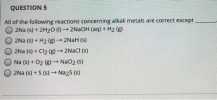 QUESTION 5 All of the following reactions concerning alkali metals are correct except 2Na (s) + 2H2O (I) 2NaOH (aq) + H2 (g) 2NaH (s) 2Na (s)+ H2 (g) 2Na (s) + Cl2 (g) 2NaCl (s) Na (s) + O2 (g)NaO2 (s) 2Na (s)+ S (s)Na2S (s)
Predict the sign of the entropy change, ΔS∘, for each of the reaction displayed. Ba2+ (aq) + SO42- (aq) --> BaSO4...
Predict the sign of the entropy change, ΔS∘, for each of the reaction displayed. Ba2+ (aq) + SO42- (aq) --> BaSO4 (s) 2NO2 (g) --> N2 (g) + 2O2 (g) C5H12 (g) + 8O2 (g) --> 5CO2 (g) + 6H2O (g) 2NaClO3 (s) --> 2NaCl (s) + 3O2 (g) 2Na (s) + Cl2 (g) --> 2NaCl (s) CH3OH (l) --> CH3OH (g)
Predict the sign of the entropy change, ?S?, for each of the reaction displayed. Drag the appropriate items to their re...
Predict the sign of the entropy change, ?S?, for each of the reaction displayed. Drag the appropriate items to their respective bins. Ba2+(aq)+SO42?(aq)?BaSO4(s) 2NaClO3(s)?2NaCl(s)+3O2(g) 2N2O(g)?2N2(g)+O2(g) 2H2(g)+O2(g)?2H2O(l) C7H16(g)+11O2(g)?7CO2(g)+8H2O(g) H2O(l)?H2O(g) Positive Negative
Without doing any calculations, predict the sign of ΔSsys for each of the following processes: positive/negative...
Without doing any calculations, predict the sign of ΔSsys for each of the following processes: positive/negative The fusion of C5H5N positive/negative The decomposition of Al2(SO4)3 into its constituent elements positive/negative 2Na(s) + 2H2O(l) → 2Na+(aq) + 2OH−(aq) + H2(g) positive/negative 2CH4(g) + O2(g) → 2CO(g) + 4H2(g)
Predict the sign of ΔS for each of the following; explain your reasoning O2(g) → O2(l)...
Predict the sign of ΔS for each of the following; explain your reasoning O2(g) → O2(l) 2 KClO4(s) → 2 KClO3(s) + O2(g) CH4(g) + 2 O2(g) → CO2(g) + 2 H2O(l)
The change in entropy, ΔS°rxn, is related to the the change in the number of moles...
The change in entropy, ΔS°rxn, is related to the the change in the number of moles of gas molecules, Δngas. Determine the change in the moles of gas for each of the following reactions and decide if the entropy increases, decreases, or has little or no change. a) 2H2(g) +O2(g)->2H2O b)C2H4(g) +H2(g)-> C2H6(g) c) CH4(g) + 2O2(g) -> CO2(g)+2H2O(l) d) PCL5(s)--> PCL3(l) + CL2(g)
What is the enthalpy change, ΔH∘rxn , for each of the following reactions? 1.2.3.Ag+(aq)+Li(s)Fe(s)+2Na+(aq)2K(s)+2H2O(l)→→→Ag(s)+Li+(aq)Fe2+(aq)+2Na(s)2KOH(aq)+H2(g) Express your...
What is the enthalpy change, ΔH∘rxn , for each of the following reactions? 1.2.3.Ag+(aq)+Li(s)Fe(s)+2Na+(aq)2K(s)+2H2O(l)→→→Ag(s)+Li+(aq)Fe2+(aq)+2Na(s)2KOH(aq)+H2(g) Express your answers in kilojoules to four significant figures separated by commas.
A chemist measures the enthalpy change 2Na (s) Cl2 (g) 2NaCl (s) /kJmol . reaction 12Na...
A chemist measures the enthalpy change 2Na (s) Cl2 (g) 2NaCl (s) /kJmol . reaction 12Na (s) 14Cl2 (g) 12NaCl (s) 2NaCl (s) 2Na (s) Cl2 (g) 4NaCl (s) 4Na (s) 2Cl2 (g) <div id="ansed_tree_ansedimage_27" class="ansed_tree" overflow:visible;"="" unselectable="on" aria-hidden="true" style="position: absolute; left: 0px; top: 0px; z-index: 3; width: 32px; height: 24px;"> kJ
Sodium reacts with chlorine gas according to the following reaction: 2Na(s)+Cl2(g)→2NaCl(s) What volume of Cl2 gas,...
Sodium reacts with chlorine gas according to the following reaction: 2Na(s)+Cl2(g)→2NaCl(s) What volume of Cl2 gas, measured at 683 torr and 39 ∘C, is required to form 28 g of NaCl?
 B. Calculate the standard entropy change for the reaction
2Na(s)+Cl2(g)?2NaCl(s)
using the data from the following table:
Substance
?H?f (kJ/mol)
?G?f (kJ/mol)
S? [J/(K?mol)]
Na(s)
0.00
0.00
51.30
Cl2(g)
0.00
0.00
223.1
NaCl(s)
-411.0
-384.0
72.10
Express your answer to four significant figures and include the
appropriate units.
Part A Predict the sign of the entropy change, AS°,for each of the reaction displayed. Drag the appropriate items to their respective bins. Ag+(aq) + Cl-(aq) → AgCl(s) | | Ca(OH)2(s) →...
B. Calculate the standard entropy change for the reaction
2Na(s)+Cl2(g)?2NaCl(s)
using the data from the following table:
Substance
?H?f (kJ/mol)
?G?f (kJ/mol)
S? [J/(K?mol)]
Na(s)
0.00
0.00
51.30
Cl2(g)
0.00
0.00
223.1
NaCl(s)
-411.0
-384.0
72.10
Express your answer to four significant figures and include the
appropriate units.
Part A Predict the sign of the entropy change, AS°,for each of the reaction displayed. Drag the appropriate items to their respective bins. Ag+(aq) + Cl-(aq) → AgCl(s) | | Ca(OH)2(s) →...
 QUESTION 5 All of the following reactions concerning alkali metals are correct except 2Na (s) + 2H2O (I) 2NaOH (aq) + H2 (g) 2NaH (s) 2Na (s)+ H2 (g) 2Na (s) + Cl2 (g) 2NaCl (s) Na (s) + O2 (g)NaO2 (s) 2Na (s)+ S (s)Na2S (s)
Most questions answered within 3 hours.
-
Where is the error in this code sequence?
String s1 = "Hello";
String s2 = "ello";...
asked 11 months ago -
Financial data for Joel de Paris, Inc., for last year
follow:
Joel de Paris, Inc.
Balance...
asked 11 months ago -
Consider this reaction:
Al2(SO4)3 (aq)+ BaCl3
(aq) Al2Cl6 (aq)- +
3BaSO4(s) . What is the...
asked 11 months ago -
Suppose that Savneet is considering increasing her
recent random sample from 20 car rentals to 40...
asked 11 months ago -
Trucks arrive at an unloading terminal at an average rate of 120
per hour.
Trucks arrive...
asked 11 months ago -
Why are methanol and ethanol completely soluble in water while
octanol is not very little soluble....
asked 11 months ago -
A facilities manager at a university reads in a research report
that the mean amount of...
asked 11 months ago -
When the CuSO4 is rehydrated by adding water to the anhydrous
compound, is this an endothermic...
asked 11 months ago -
A ray of sunlight is passing from diamond into crown glass; the
angle of incidence is...
asked 11 months ago -
A block of mass 0.249 kg is placed on top of a light, vertical
spring of...
asked 11 months ago -
how do the kidneys compensate in the presences of acidosis
a) trigger hyperventilate
b) reserve acid...
asked 11 months ago -
Question 501 pts
The rental rate of capital to the firm increases. Which of the
following...
asked 11 months ago