
Homework Answers
Add Answer to:
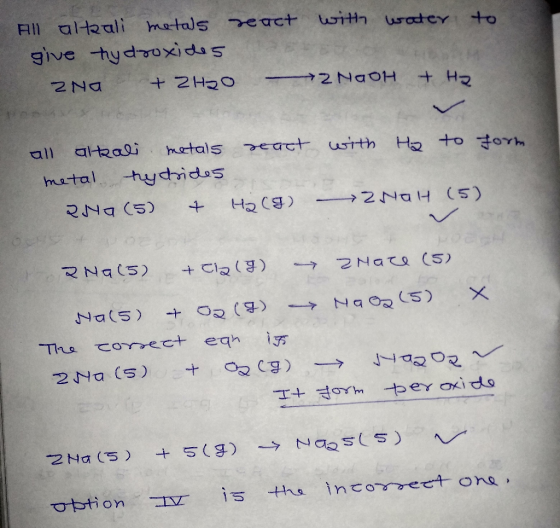
QUESTION 5 All of the following reactions concerning alkali metals are correct except 2Na (s) +...
All of the following reactions can be described as displacement reactions except Select one: a. 2Na(s)...
 All of the following reactions can be described as displacement reactions except Select one: a. 2Na(s) + 2H2O(1) ► 2NaOH(aq) + H2(g). ob. CoH(1) + Cl2(g) → CH3C1(1) + HCl(g). oc. CuSO4(aq) + Fe(s) → Cu(s) + FeSO4(aq). O d. Zn(s) + FeCl2(aq) → ZnCl2(aq) + Fe(s). e. Cu(s) + 2AgNO3(aq) + Cu(NO3)2(aq) + 2Ag(s).
For each of the following reactions, predict the sign of ΔS°. 2Na(s) + Cl2(g) → 2NaCl(s)...
For each of the following reactions, predict the sign of ΔS°. 2Na(s) + Cl2(g) → 2NaCl(s) KBr(s) → K+(aq) + Br−(aq) 2H2(g) + O2(g) → 2H2O(l) C2H2(g) + 4F2(g) → 2CF4(g) + H2(g)
All of the following reactions can be described as displacement reactions except: a.) Zn(s) + FeCl2(aq)...
All of the following reactions can be described as displacement reactions except: a.) Zn(s) + FeCl2(aq) → ZnCl2(aq) + Fe(s). b.) C6H6(l) + Cl2(g) → C6H5Cl(l) + HCl(g). c.) 2Na(s) + 2H2O(l) → 2NaOH(aq) + H2(g). d.) Cu(s) + 2AgNO3(aq) → Cu(NO3)2(aq) + 2Ag(s). e.) CuSO4(aq) + Fe(s) → Cu(s) + FeSO4(aq).
Indicate whether the following reactions will occur or not. yes or no Al(s)+Fe2+(aq) → yes or no Ag(s)+Cr3+(aq)...
Indicate whether the following reactions will occur or not. yes or no Al(s)+Fe2+(aq) → yes or no Ag(s)+Cr3+(aq) → yes or no Co(s)+Cd2+(aq) → yes or no Mn(s)+Pb2+(aq) → yes or no Cu(s)+Zn2+(aq) → The most reactive of the metals, which include the alkali metals, react with water to produce hydrogen gas. For example: 2Na(s) + 2H2O → 2Na+ + 2OH− + H2(g) Which of the following statements about this ReDox reaction are correct? correct or incorrect The oxidation number of H decreases. correct or incorrect Na...
Sodium reacts with water according to the reaction: 2Na(s)+2H2O(l)→2NaOH(aq)+H2(g) Identify the oxidizing agent. a) H2O(l) b)...
Sodium reacts with water according to the reaction: 2Na(s)+2H2O(l)→2NaOH(aq)+H2(g) Identify the oxidizing agent. a) H2O(l) b) NaOH(aq) c) Na(s) d) H2 (g)
For which of the following reactions is ΔrH∘ΔrH∘ equal to ΔfH∘ΔfH∘ of the product(s)? You do...
For which of the following reactions is ΔrH∘ΔrH∘ equal to ΔfH∘ΔfH∘ of the product(s)? You do not need to look up any values to answer this question. Check all that apply. View Available Hint(s) Check all that apply. H2O2(g)→12O2(g)+H2O(g)H2O2(g)→12O2(g)+H2O(g) 2H2(g)+O2(g)→2H2O(g)2H2(g)+O2(g)→2H2O(g) 2Na(s)+F2(g)→2NaF(s)2Na(s)+F2(g)→2NaF(s) Na(s)+12F2(g)→NaF(s)Na(s)+12F2(g)→NaF(s) H2(g)+12O2(g)→H2O(g)H2(g)+12O2(g)→H2O(g) Na(s)+12F2(l)→NaF(s)
B. Calculate the standard entropy change for the reaction 2Na(s)+Cl2(g)?2NaCl(s) using the data from the following t...
 B. Calculate the standard entropy change for the reaction
2Na(s)+Cl2(g)?2NaCl(s)
using the data from the following table:
Substance
?H?f (kJ/mol)
?G?f (kJ/mol)
S? [J/(K?mol)]
Na(s)
0.00
0.00
51.30
Cl2(g)
0.00
0.00
223.1
NaCl(s)
-411.0
-384.0
72.10
Express your answer to four significant figures and include the
appropriate units.
Part A Predict the sign of the entropy change, AS°,for each of the reaction displayed. Drag the appropriate items to their respective bins. Ag+(aq) + Cl-(aq) → AgCl(s) | | Ca(OH)2(s) →...
B. Calculate the standard entropy change for the reaction
2Na(s)+Cl2(g)?2NaCl(s)
using the data from the following table:
Substance
?H?f (kJ/mol)
?G?f (kJ/mol)
S? [J/(K?mol)]
Na(s)
0.00
0.00
51.30
Cl2(g)
0.00
0.00
223.1
NaCl(s)
-411.0
-384.0
72.10
Express your answer to four significant figures and include the
appropriate units.
Part A Predict the sign of the entropy change, AS°,for each of the reaction displayed. Drag the appropriate items to their respective bins. Ag+(aq) + Cl-(aq) → AgCl(s) | | Ca(OH)2(s) →...
Sodium metal reacts with water to produce hydrogen gas according to the following equation: 2Na(s) +...
Sodium metal reacts with water to produce hydrogen gas according to the following equation: 2Na(s) + 2H2O(l)2NaOH(aq) + H2(g) The product gas, H2, is collected over water at a temperature of 20 °C and a pressure of 753 mm Hg. If the wet H2 gas formed occupies a volume of 5.60 L, the number of moles of Na reacted was ____ mol. The vapor pressure of water is 17.5 mm Hg at 20 °C.
For which of the following reactions is ΔH∘rxn equal to ΔH∘f of the product(s)? You do...
For which of the following reactions is ΔH∘rxn equal to ΔH∘f of the product(s)? You do not need to look up any values to answer this question. Check all that apply. View Available Hint(s) Check all that apply. SO3(g)→12O2(g)+SO2(g) S(s)+O2(g)→SO2(g) Na(s)+12Cl2(l)→NaCl(s) 2Na(s)+Cl2(g)→2NaCl(s) SO(g)+12O2(g)→SO2(g) Na(s)+12Cl2(g)→NaCl(s)
For the reaction 2Na(s) + 2H2O(1) -2NaOH(aq) + H2(g) AH° -368.6 kJ and AS --15.3 J/K...
 For the reaction 2Na(s) + 2H2O(1) -2NaOH(aq) + H2(g) AH° -368.6 kJ and AS --15.3 J/K The maximum amount of work that could be done when 2.20 moles of Na(s) react at 261 K, 1 atm is kJ. Assume that AH and AS are independent of temperature.
 All of the following reactions can be described as displacement reactions except Select one: a. 2Na(s) + 2H2O(1) ► 2NaOH(aq) + H2(g). ob. CoH(1) + Cl2(g) → CH3C1(1) + HCl(g). oc. CuSO4(aq) + Fe(s) → Cu(s) + FeSO4(aq). O d. Zn(s) + FeCl2(aq) → ZnCl2(aq) + Fe(s). e. Cu(s) + 2AgNO3(aq) + Cu(NO3)2(aq) + 2Ag(s).
 B. Calculate the standard entropy change for the reaction
2Na(s)+Cl2(g)?2NaCl(s)
using the data from the following table:
Substance
?H?f (kJ/mol)
?G?f (kJ/mol)
S? [J/(K?mol)]
Na(s)
0.00
0.00
51.30
Cl2(g)
0.00
0.00
223.1
NaCl(s)
-411.0
-384.0
72.10
Express your answer to four significant figures and include the
appropriate units.
Part A Predict the sign of the entropy change, AS°,for each of the reaction displayed. Drag the appropriate items to their respective bins. Ag+(aq) + Cl-(aq) → AgCl(s) | | Ca(OH)2(s) →...
B. Calculate the standard entropy change for the reaction
2Na(s)+Cl2(g)?2NaCl(s)
using the data from the following table:
Substance
?H?f (kJ/mol)
?G?f (kJ/mol)
S? [J/(K?mol)]
Na(s)
0.00
0.00
51.30
Cl2(g)
0.00
0.00
223.1
NaCl(s)
-411.0
-384.0
72.10
Express your answer to four significant figures and include the
appropriate units.
Part A Predict the sign of the entropy change, AS°,for each of the reaction displayed. Drag the appropriate items to their respective bins. Ag+(aq) + Cl-(aq) → AgCl(s) | | Ca(OH)2(s) →...
 For the reaction 2Na(s) + 2H2O(1) -2NaOH(aq) + H2(g) AH° -368.6 kJ and AS --15.3 J/K The maximum amount of work that could be done when 2.20 moles of Na(s) react at 261 K, 1 atm is kJ. Assume that AH and AS are independent of temperature.
Most questions answered within 3 hours.
-
Where is the error in this code sequence?
String s1 = "Hello";
String s2 = "ello";...
asked 11 months ago -
Financial data for Joel de Paris, Inc., for last year
follow:
Joel de Paris, Inc.
Balance...
asked 11 months ago -
Consider this reaction:
Al2(SO4)3 (aq)+ BaCl3
(aq) Al2Cl6 (aq)- +
3BaSO4(s) . What is the...
asked 11 months ago -
Suppose that Savneet is considering increasing her
recent random sample from 20 car rentals to 40...
asked 11 months ago -
Trucks arrive at an unloading terminal at an average rate of 120
per hour.
Trucks arrive...
asked 11 months ago -
Why are methanol and ethanol completely soluble in water while
octanol is not very little soluble....
asked 11 months ago -
A facilities manager at a university reads in a research report
that the mean amount of...
asked 11 months ago -
When the CuSO4 is rehydrated by adding water to the anhydrous
compound, is this an endothermic...
asked 11 months ago -
A ray of sunlight is passing from diamond into crown glass; the
angle of incidence is...
asked 11 months ago -
A block of mass 0.249 kg is placed on top of a light, vertical
spring of...
asked 11 months ago -
how do the kidneys compensate in the presences of acidosis
a) trigger hyperventilate
b) reserve acid...
asked 11 months ago -
Question 501 pts
The rental rate of capital to the firm increases. Which of the
following...
asked 11 months ago