Indicate whether the following reactions will occur or not. yes or no Al(s)+Fe2+(aq) → yes or no Ag(s)+Cr3+(aq)...
Indicate whether the following reactions will occur or
not.
yes or no Al(s)+Fe2+(aq) →
yes or no Ag(s)+Cr3+(aq) →
yes or no Co(s)+Cd2+(aq) →
yes or no Mn(s)+Pb2+(aq) →
yes or no Cu(s)+Zn2+(aq) →
The most reactive of the metals, which include the alkali
metals, react with water to produce hydrogen gas. For
example:
2Na(s) + 2H2O → 2Na+ + 2OH− +
H2(g)
Which of the following statements about this ReDox reaction are
correct?
correct or incorrect The oxidation number of H
decreases.
correct or incorrect Na is losing electrons.
correct or incorrect H is being oxidized.
correct or incorrect Na is a reducing agent.
correct or incorrect The oxidation number of O
increases.
Homework Answers
Request Answer!
We need at least 10 more requests to produce the answer.
0 / 10 have requested this problem solution
The more requests, the faster the answer.
Add Answer to:
Indicate whether the following reactions will occur or
not.
yes or no Al(s)+Fe2+(aq) →
yes or no Ag(s)+Cr3+(aq)...
[References] Sc(s) + 3Ag+ (aq) + 3 Ag(s) + Sc3+ (aq) Redox? Oxidizing Agent Reducing Agent...
 [References] Sc(s) + 3Ag+ (aq) + 3 Ag(s) + Sc3+ (aq) Redox? Oxidizing Agent Reducing Agent Substance Oxidized Substance Reduced CE SC HBr(9) + NH3(g) + NH4Br(s) Redox? Oxidizing Agent in Reducing Agent Substance Oxidized Substance Reduced GeCl4 (1) + 2H2O(l) + 4HCl(aq) + GeO2 (s) Redox? Oxidizing Agent Reducing Agent Substance Oxidized Substance Reduced d. Si C14 (1) + 2Ba(s) + 2BaCl2(8) + Si(s) Redox? Oxidizing Agent Reducing Agent Substance Oxidized Substance Reduced Yes 2 SiBr, Ba SiBa Al(OH).-...
A) Use tabulated electrode potentials to calculate ΔG∘ for the reaction. 2K(s)+2H2O(l)→H2(g)+2OH−(aq)+2K+(aq) B) (Refer to the...
A) Use tabulated electrode potentials to calculate ΔG∘ for the reaction. 2K(s)+2H2O(l)→H2(g)+2OH−(aq)+2K+(aq) B) (Refer to the following standard reduction half-cell potentials at 25∘C: VO2+(aq)+Ni2+(aq)2H+(aq)++2e−e−→ →Ni(s)VO2+(aq) +H2O(l)E∘=−0.23V E∘=0.99V) An electrochemical cell is based on these two half-reactions: Oxidation:Reduction:Ni(s)VO2+(aq,0.024M)+2H+(aq,1.4M)+e−→→Ni2+(aq,1.8M)+2e−VO2+(aq,1.8M)+H2O(l) Calculate the cell potential under these nonstandard concentrations. C) Standard reduction half-cell potentials at 25∘C Half-reaction E∘ (V ) Half-reaction E∘ (V ) Au3+(aq)+3e−→Au(s) 1.50 Fe2+(aq)+2e−→Fe(s) − 0.45 Ag+(aq)+e−→Ag(s) 0.80 Cr3+(aq)+e−→Cr2+(aq) − 0.50 Fe3+(aq)+3e−→Fe2+(aq) 0.77 Cr3+(aq)+3e−→Cr(s) − 0.73 Cu+(aq)+e−→Cu(s) 0.52 Zn2+(aq)+2e−→Zn(s) − 0.76...
When answering Parts a-h, consider only the molecules and ions, Fe^2+(aq), Cd(OH)2(s), SO4^2-(aq), Al(s), I^-(aq), and Cr2O7^2-(aq), under standard state conditions. (1 pt each) Use standard reduction...
 When answering Parts a-h, consider only the molecules and ions,
Fe^2+(aq), Cd(OH)2(s), SO4^2-(aq), Al(s), I^-(aq),
and Cr2O7^2-(aq), under standard state conditions. (1 pt each)
Use standard reduction table.
a) Which of these molecules and ions are oxidizing agents?
b) Which of these molecules and ions are reducing agents?
c) List the oxidizing agents from part a in DECREASING order of
oxidizing agent strength. (strongest OA to weakest OA)
d) List the reducing agents from part b in DECREASING order of...
When answering Parts a-h, consider only the molecules and ions,
Fe^2+(aq), Cd(OH)2(s), SO4^2-(aq), Al(s), I^-(aq),
and Cr2O7^2-(aq), under standard state conditions. (1 pt each)
Use standard reduction table.
a) Which of these molecules and ions are oxidizing agents?
b) Which of these molecules and ions are reducing agents?
c) List the oxidizing agents from part a in DECREASING order of
oxidizing agent strength. (strongest OA to weakest OA)
d) List the reducing agents from part b in DECREASING order of...
QUESTION 5 All of the following reactions concerning alkali metals are correct except 2Na (s) +...
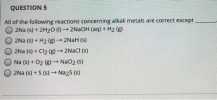 QUESTION 5 All of the following reactions concerning alkali metals are correct except 2Na (s) + 2H2O (I) 2NaOH (aq) + H2 (g) 2NaH (s) 2Na (s)+ H2 (g) 2Na (s) + Cl2 (g) 2NaCl (s) Na (s) + O2 (g)NaO2 (s) 2Na (s)+ S (s)Na2S (s)
Which of the following is the strongest reducing agent? A) Fe2+(aq) B) Fe3+(aq) C) Cd(s) D)...
 Which of the following is the strongest reducing agent? A) Fe2+(aq) B) Fe3+(aq) C) Cd(s) D) F-(aq) E) Na(s) . Which of the following is the weakest oxidizing agent? A) Cu+(s) B) Fe2+(aq) C) Sn4+(aq) D) K+(s) E) Cr3+ (aq) Which of the following is the weakest reducing agent? A) Al(s) B) K(s) C) Ba2+(aq) D) A13+ (aq) E) F-(aq) Determine which of the following pairs of reactants will result in a spontaneous reaction at 25°C. A) Pb2+ (aq) +...
Use the tabulated electrode potentials to calculate K for the oxidation of nickel by H+: Ni(s)+2H+(aq)→Ni2+(aq)+H2(g)...
Use the tabulated electrode potentials to calculate K for the oxidation of nickel by H+: Ni(s)+2H+(aq)→Ni2+(aq)+H2(g) Express your answer using two significant figures. Standard reduction half-cell potentials at 25∘C Half-reaction E∘ (V) Half-reaction E∘ (V) Au3+(aq)+3e−→Au(s) 1.50 Fe2+(aq)+2e−→Fe(s) −0.45 Ag+(aq)+e−→Ag(s) 0.80 Cr3+(aq)+e−→Cr2+(aq) −0.50 Fe3+(aq)+3e−→Fe2+(aq) 0.77 Cr3+(aq)+3e−→Cr(s) −0.73 Cu+(aq)+e−→Cu(s) 0.52 Zn2+(aq)+2e−→Zn(s) −0.76 Cu2+(aq)+2e−→Cu(s) 0.34 Mn2+(aq)+2e−→Mn(s) −1.18 2H+(aq)+2e−→H2(g) 0.00 Al3+(aq)+3e−→Al(s) −1.66 Fe3+(aq)+3e−→Fe(s) −0.036 Mg2+(aq)+2e−→Mg(s) −2.37 Pb2+(aq)+2e−→Pb(s) −0.13 Na+(aq)+e−→Na(s) −2.71 Sn2+(aq)+2e−→Sn(s) −0.14 Ca2+(aq)+2e−→Ca(s) −2.76 Ni2+(aq)+2e−→Ni(s) −0.23 Ba2+(aq)+2e−→Ba(s) −2.90 Co2+(aq)+2e−→Co(s) −0.28 K+(aq)+e−→K(s) −2.92 Cd2+(aq)+2e−→Cd(s)...
Redox Equations Which of the following reactions are redox reactions? Identify the substance oxidized, the substance...
 Redox Equations Which of the following reactions are redox reactions? Identify the substance oxidized, the substance reduced, the oxidizing agent, the reducing agent. 1.2 Mg(s) + O2(g) → 2 MgO (s) 2. H SO. (aq) + Al(OH) (aq) → Al(SO.) (aq) + H,O (1) 3. 2 Na (s) + H2O (1) ► 2 NaOH(aq) + H2(g) 4. Cao (s) + CO2(g) → Caco, (s) 5. AgNO, (aq) + NaCl (aq) ► AgCl(s) + NaNO, (aq) Identify the substance oxidized, the...
What is the enthalpy change, ΔH∘rxn , for each of the following reactions? 1.2.3.Ag+(aq)+Li(s)Fe(s)+2Na+(aq)2K(s)+2H2O(l)→→→Ag(s)+Li+(aq)Fe2+(aq)+2Na(s)2KOH(aq)+H2(g) Express your...
What is the enthalpy change, ΔH∘rxn , for each of the following reactions? 1.2.3.Ag+(aq)+Li(s)Fe(s)+2Na+(aq)2K(s)+2H2O(l)→→→Ag(s)+Li+(aq)Fe2+(aq)+2Na(s)2KOH(aq)+H2(g) Express your answers in kilojoules to four significant figures separated by commas.
Separate galvanic cells are made from the following half-cells: cell 1: H+(aq)/H2(g) and Pb2+(aq)/Pb(s) cell 2:...
 Separate galvanic cells are made from the following half-cells: cell 1: H+(aq)/H2(g) and Pb2+(aq)/Pb(s) cell 2: Fe2+(aq)/Fe(s) and Zn2+(aq)/Zn(s) Which of the following is correct for the working cells? Standard reduction potentials, 298 K, Aqueous Solution (pH = 0): Cl2(g) + 2e --> 2C1-(aq); E° = +1.36 V Fe3+(aq) + e --> Fe2+(aq); E° = +0.77 V Cu2+(aq) + 2e --> Cu(s); E° = +0.34 V 2H+(aq) + 2e --> H2(g); E° = 0.00 V Pb2+(aq) + 2e --> Pb(s);...
Standard Electrode Potentials at 25?C Reduction Half-Reaction E?(V) F2(g)+2e? ?2F?(aq) 2.87 Au3+(aq)+3e? ?Au(s) 1.50 Cl2(g)+2e? ?2Cl?(aq)...
Standard Electrode Potentials at 25?C Reduction Half-Reaction E?(V) F2(g)+2e? ?2F?(aq) 2.87 Au3+(aq)+3e? ?Au(s) 1.50 Cl2(g)+2e? ?2Cl?(aq) 1.36 O2(g)+4H+(aq)+4e? ?2H2O(l) 1.23 Br2(l)+2e? ?2Br?(aq) 1.09 NO3?(aq)+4H+(aq)+3e? ?NO(g)+2H2O(l) 0.96 Ag+(aq)+e? ?Ag(s) 0.80 I2(s)+2e? ?2I?(aq) 0.54 Cu2+(aq)+2e? ?Cu(s) 0.16 2H+(aq)+2e? ?H2(g) 0 Cr3+(aq)+3e? ?Cr(s) -0.73 2H2O(l)+2e? ?H2(g)+2OH?(aq) -0.83 Mn2+(aq)+2e? ?Mn(s) -1.18 How can the table be used to predict whether or not a metal will dissolve in HCl? In HNO3? Drag the terms on the left to the appropriate blanks on the right to...
 [References] Sc(s) + 3Ag+ (aq) + 3 Ag(s) + Sc3+ (aq) Redox? Oxidizing Agent Reducing Agent Substance Oxidized Substance Reduced CE SC HBr(9) + NH3(g) + NH4Br(s) Redox? Oxidizing Agent in Reducing Agent Substance Oxidized Substance Reduced GeCl4 (1) + 2H2O(l) + 4HCl(aq) + GeO2 (s) Redox? Oxidizing Agent Reducing Agent Substance Oxidized Substance Reduced d. Si C14 (1) + 2Ba(s) + 2BaCl2(8) + Si(s) Redox? Oxidizing Agent Reducing Agent Substance Oxidized Substance Reduced Yes 2 SiBr, Ba SiBa Al(OH).-...
 When answering Parts a-h, consider only the molecules and ions,
Fe^2+(aq), Cd(OH)2(s), SO4^2-(aq), Al(s), I^-(aq),
and Cr2O7^2-(aq), under standard state conditions. (1 pt each)
Use standard reduction table.
a) Which of these molecules and ions are oxidizing agents?
b) Which of these molecules and ions are reducing agents?
c) List the oxidizing agents from part a in DECREASING order of
oxidizing agent strength. (strongest OA to weakest OA)
d) List the reducing agents from part b in DECREASING order of...
When answering Parts a-h, consider only the molecules and ions,
Fe^2+(aq), Cd(OH)2(s), SO4^2-(aq), Al(s), I^-(aq),
and Cr2O7^2-(aq), under standard state conditions. (1 pt each)
Use standard reduction table.
a) Which of these molecules and ions are oxidizing agents?
b) Which of these molecules and ions are reducing agents?
c) List the oxidizing agents from part a in DECREASING order of
oxidizing agent strength. (strongest OA to weakest OA)
d) List the reducing agents from part b in DECREASING order of...
 QUESTION 5 All of the following reactions concerning alkali metals are correct except 2Na (s) + 2H2O (I) 2NaOH (aq) + H2 (g) 2NaH (s) 2Na (s)+ H2 (g) 2Na (s) + Cl2 (g) 2NaCl (s) Na (s) + O2 (g)NaO2 (s) 2Na (s)+ S (s)Na2S (s)
 Which of the following is the strongest reducing agent? A) Fe2+(aq) B) Fe3+(aq) C) Cd(s) D) F-(aq) E) Na(s) . Which of the following is the weakest oxidizing agent? A) Cu+(s) B) Fe2+(aq) C) Sn4+(aq) D) K+(s) E) Cr3+ (aq) Which of the following is the weakest reducing agent? A) Al(s) B) K(s) C) Ba2+(aq) D) A13+ (aq) E) F-(aq) Determine which of the following pairs of reactants will result in a spontaneous reaction at 25°C. A) Pb2+ (aq) +...
 Redox Equations Which of the following reactions are redox reactions? Identify the substance oxidized, the substance reduced, the oxidizing agent, the reducing agent. 1.2 Mg(s) + O2(g) → 2 MgO (s) 2. H SO. (aq) + Al(OH) (aq) → Al(SO.) (aq) + H,O (1) 3. 2 Na (s) + H2O (1) ► 2 NaOH(aq) + H2(g) 4. Cao (s) + CO2(g) → Caco, (s) 5. AgNO, (aq) + NaCl (aq) ► AgCl(s) + NaNO, (aq) Identify the substance oxidized, the...
 Separate galvanic cells are made from the following half-cells: cell 1: H+(aq)/H2(g) and Pb2+(aq)/Pb(s) cell 2: Fe2+(aq)/Fe(s) and Zn2+(aq)/Zn(s) Which of the following is correct for the working cells? Standard reduction potentials, 298 K, Aqueous Solution (pH = 0): Cl2(g) + 2e --> 2C1-(aq); E° = +1.36 V Fe3+(aq) + e --> Fe2+(aq); E° = +0.77 V Cu2+(aq) + 2e --> Cu(s); E° = +0.34 V 2H+(aq) + 2e --> H2(g); E° = 0.00 V Pb2+(aq) + 2e --> Pb(s);...
Most questions answered within 3 hours.
-
Where is the error in this code sequence?
String s1 = "Hello";
String s2 = "ello";...
asked 10 months ago -
Financial data for Joel de Paris, Inc., for last year
follow:
Joel de Paris, Inc.
Balance...
asked 10 months ago -
Consider this reaction:
Al2(SO4)3 (aq)+ BaCl3
(aq) Al2Cl6 (aq)- +
3BaSO4(s) . What is the...
asked 10 months ago -
Suppose that Savneet is considering increasing her
recent random sample from 20 car rentals to 40...
asked 10 months ago -
Trucks arrive at an unloading terminal at an average rate of 120
per hour.
Trucks arrive...
asked 10 months ago -
Why are methanol and ethanol completely soluble in water while
octanol is not very little soluble....
asked 10 months ago -
A facilities manager at a university reads in a research report
that the mean amount of...
asked 10 months ago -
When the CuSO4 is rehydrated by adding water to the anhydrous
compound, is this an endothermic...
asked 10 months ago -
A ray of sunlight is passing from diamond into crown glass; the
angle of incidence is...
asked 10 months ago -
A block of mass 0.249 kg is placed on top of a light, vertical
spring of...
asked 10 months ago -
how do the kidneys compensate in the presences of acidosis
a) trigger hyperventilate
b) reserve acid...
asked 10 months ago -
Question 501 pts
The rental rate of capital to the firm increases. Which of the
following...
asked 10 months ago