
Homework Answers

Add Answer to:
A charged particle is injected at 195 m/s into a 0.0773-T uniform magnetic magnetic field perpendicularly...
A charged particle is injected at 225 m/s into a 0.0715‑T uniform magnetic magnetic field perpendicularly...
A charged particle is injected at 225 m/s into a 0.0715‑T uniform magnetic magnetic field perpendicularly to the field. The diameter of its orbit is measured and found to be 0.0353 m. What is the charge–to–mass ratio of this particle?
q1 A charged particle is injected at 213 m/s into a 0.0649-T uniform magnetic magnetic field...
q1 A charged particle is injected at 213 m/s into a 0.0649-T uniform magnetic magnetic field perpendicularly to the field. The diameter of its orbit is measured and found to be 0.0405 m. What is the charge-to-mass ratio of this particle?
A particle injected into the area filled with uniform 0.1-T magnetic field with initial speed of...
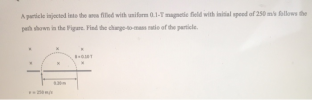 A particle injected into the area filled with uniform 0.1-T magnetic field with initial speed of 250 m/s follows the path shown in the Figure. Find the charge-to-mass ratio of the particle. B0.10T 0.20 m y = 250 m/s
A charged particle moves in a uniform magnetic field of 0.817 T with a period of...
A charged particle moves in a uniform magnetic field of 0.817 T with a period of 2.31x10^-6 s. Find its charge to mass ratio.
A charged particle moves in a uniform magnetic field of 0.753 T with a period of...
A charged particle moves in a uniform magnetic field of 0.753 T with a period of 8.63×10⁻⁶ s. Find its charge-to-mass ratio.
A charged particle moves in a uniform magnetic field of 0.829 T with a period of 3.09×10⁻⁶ s. Find its charge-to-mass ratio |?|/?.
A charged particle moves in a uniform magnetic field of 0.829 T with a period of 3.09×10⁻⁶ s. Find its charge-to-mass ratio |?|/?.
Active Figure Motion of a Charged Particle in a Uniform Magnetic Field The animation below illustrates...
 Active Figure Motion of a Charged Particle in a Uniform Magnetic Field The animation below illustrates a charged particle moving in circular motion due to the magnetic force caused by a constant and uniform magnetic field oriented into the page. The blue crosses represent the tails of the magnetic field vectors nstructions: Use the blue sliders to adjust the mass, speed, particle charge and magnetic field magnitude. Change each parameter and observe the eftect on the particle's motion. If the...
A negatively charged particle in a uniform magnetic field follows a circular path. The particle's speed is...
 A negatively charged particle in a uniform magnetic
field follows a circular path. The particle's speed is
240 m/s, the magnitude of the magnetic field is 0.28 T, and the
radius of the path is 830 m. a) Determine the mass of the
particle, given that its charge has a magnitude of 9.6 x 10^-4 C.
b) Choose the sketch which correctly shows the direction of the
magnetic field (in red) and the direction of the particle's
circular motion (in green)....
A negatively charged particle in a uniform magnetic
field follows a circular path. The particle's speed is
240 m/s, the magnitude of the magnetic field is 0.28 T, and the
radius of the path is 830 m. a) Determine the mass of the
particle, given that its charge has a magnitude of 9.6 x 10^-4 C.
b) Choose the sketch which correctly shows the direction of the
magnetic field (in red) and the direction of the particle's
circular motion (in green)....
After being accelerated to a speed of 1.11x10 m/s, the particle enters a uniform magnetic field of strength 0.700 T
 J.J. Thomson is best known for his discoveries about the nature of cathode rays. His other important contribution was the invention, together with one of his students, of the mass spectrometer, a device that measures the ratio of mass m to positive) charge q of an ion. The spectrometer consists of two regions as shown in the figure. (Figure 1) In the first region an electric field accelerates the ion and in the second the ion follows a circular are in...
A charged particle is moving in a uniform magnetic field at a speed of 1.1×10³m/s in...
A charged particle is moving in a uniform magnetic field at a speed of 1.1×10³m/s in a direction 73° from the direction of the field. The particle’s charge is 4.7 μC and the magnetic force acting on it is 0.0012 N. What is the strength of the magnetic field?
 A particle injected into the area filled with uniform 0.1-T magnetic field with initial speed of 250 m/s follows the path shown in the Figure. Find the charge-to-mass ratio of the particle. B0.10T 0.20 m y = 250 m/s
 Active Figure Motion of a Charged Particle in a Uniform Magnetic Field The animation below illustrates a charged particle moving in circular motion due to the magnetic force caused by a constant and uniform magnetic field oriented into the page. The blue crosses represent the tails of the magnetic field vectors nstructions: Use the blue sliders to adjust the mass, speed, particle charge and magnetic field magnitude. Change each parameter and observe the eftect on the particle's motion. If the...
 A negatively charged particle in a uniform magnetic
field follows a circular path. The particle's speed is
240 m/s, the magnitude of the magnetic field is 0.28 T, and the
radius of the path is 830 m. a) Determine the mass of the
particle, given that its charge has a magnitude of 9.6 x 10^-4 C.
b) Choose the sketch which correctly shows the direction of the
magnetic field (in red) and the direction of the particle's
circular motion (in green)....
A negatively charged particle in a uniform magnetic
field follows a circular path. The particle's speed is
240 m/s, the magnitude of the magnetic field is 0.28 T, and the
radius of the path is 830 m. a) Determine the mass of the
particle, given that its charge has a magnitude of 9.6 x 10^-4 C.
b) Choose the sketch which correctly shows the direction of the
magnetic field (in red) and the direction of the particle's
circular motion (in green)....
Most questions answered within 3 hours.
-
Where is the error in this code sequence?
String s1 = "Hello";
String s2 = "ello";...
asked 10 months ago -
Financial data for Joel de Paris, Inc., for last year
follow:
Joel de Paris, Inc.
Balance...
asked 10 months ago -
Consider this reaction:
Al2(SO4)3 (aq)+ BaCl3
(aq) Al2Cl6 (aq)- +
3BaSO4(s) . What is the...
asked 10 months ago -
Suppose that Savneet is considering increasing her
recent random sample from 20 car rentals to 40...
asked 10 months ago -
Trucks arrive at an unloading terminal at an average rate of 120
per hour.
Trucks arrive...
asked 10 months ago -
Why are methanol and ethanol completely soluble in water while
octanol is not very little soluble....
asked 10 months ago -
A facilities manager at a university reads in a research report
that the mean amount of...
asked 10 months ago -
When the CuSO4 is rehydrated by adding water to the anhydrous
compound, is this an endothermic...
asked 10 months ago -
A ray of sunlight is passing from diamond into crown glass; the
angle of incidence is...
asked 10 months ago -
A block of mass 0.249 kg is placed on top of a light, vertical
spring of...
asked 10 months ago -
how do the kidneys compensate in the presences of acidosis
a) trigger hyperventilate
b) reserve acid...
asked 10 months ago -
Question 501 pts
The rental rate of capital to the firm increases. Which of the
following...
asked 10 months ago