
Homework Answers

Add Answer to:
. Determine the moment M that must be applied to the am in order to create...
If the beam is subjected to a positive bending moment of M = 100 kN-m, determine...
 If the beam is subjected to a positive bending moment of M = 100 kN-m, determine the maximum and minimum bending stress. Also determine the shear stress at point, A which is 50 mm above from the bottom. The cross-section of the beam is I-shaped and shown in the figure. 300 mm 30 mm 300 mm . 50 mm 30 mm
If the beam is subjected to a positive bending moment of M = 100 kN-m, determine...
 If the beam is subjected to a positive bending moment of M = 100 kN-m, determine the maximum and minimum bending stress. Also determine the shear stress at point, A which is 50 mm above from the bottom. The cross-section of the beam is I-shaped and shown in the figure. 300 mm 30 mm 300 mm . 50 mm 30 mm
EMS If the 600-kN force acts through the centroid of FI-10 the cross section, determine the...
 EMS If the 600-kN force acts through the centroid of FI-10 the cross section, determine the location y of the centroid and the average normal stress on the cross section. Also, sketch the normal stress distribution over the cross section. 600 kN 300 mm 80 mm 60 mm 60 mmy 80 mm Prob. F1-10
If the beam is subjected to a moment of M = 100 kn-m, determine the bending stress at points A, B, and C.
 If the beam is subjected to a moment of M = 100 kn-m, determine the bending stress at points A, B, and C. Sketch the bending stress distribution on the cross Section. If the beam is made of a material having an allowable tensile and compressive stress of σallow(T) = 125 MPa and σallow(C) = 150 MPa, respectively, determine the maximum moment M that can be applied to the beam.
The beam having a cross-section as shown is subjected to the distributed load w (1) Calculate...
 The beam having a cross-section as shown is subjected to the distributed load w (1) Calculate the moment of inertia, I (2) If the allowable maximum normal stress ơmax-20 MPa, determine the largest distributed load 5. w. (3) If w 1.5 kN/m, determine the maximum bending stress in the beam. Sketch the stress distribution acting over the cross-section. 100 mm 50mm 120 mm 3 m50 mm 3 m
Determine the moment inertia along the horizontal neutral axis for the cross section of the beam...
 Determine the moment inertia along the horizontal neutral axis
for the cross section of the beam (in 106
mm4) and the maximum normal stress due to bending on a
transverse section at C (in MPa)
3 KN 3 KN 1.8 kN/m 80 mm 11 A | В 300 mm D -1.5 m -1.5 m -1.5 m
Determine the moment inertia along the horizontal neutral axis
for the cross section of the beam (in 106
mm4) and the maximum normal stress due to bending on a
transverse section at C (in MPa)
3 KN 3 KN 1.8 kN/m 80 mm 11 A | В 300 mm D -1.5 m -1.5 m -1.5 m
A) A beam of the cross section shown below is made of an elastic-plastic material for which the y...
 a) A beam of the cross section shown below is made of an elastic-plastic material for which the yield stress is 300 MPa. Find the plastic moment Mp and the maximum elastic moment Me. Also determine the distribution of the residual stresses in the beam after the plastic moment Mp is applied and then released 100mm 30mm 80mm 20mm Fig 94. Beam cross section (graphic art: Geoff Marchiori)
a) A beam of the cross section shown below is made of...
a) A beam of the cross section shown below is made of an elastic-plastic material for which the yield stress is 300 MPa. Find the plastic moment Mp and the maximum elastic moment Me. Also determine the distribution of the residual stresses in the beam after the plastic moment Mp is applied and then released 100mm 30mm 80mm 20mm Fig 94. Beam cross section (graphic art: Geoff Marchiori)
a) A beam of the cross section shown below is made of...
Question a A beam of the cross section shown below is made of an elastic-plastic material for whi...
 Question a A beam of the cross section shown below is made of an elastic-plastic material for which the yield stress is 300 MPa. Find the plastic moment M, and the maximum elastic moment M Also determine the distribution of the residual stresses in the beam after the plastic moment M, is appliod and then reloaoed. 8 mm +1 90 mm 8 mm 130 mn 8 mm
Question a A beam of the cross section shown below is made of...
Question a A beam of the cross section shown below is made of an elastic-plastic material for which the yield stress is 300 MPa. Find the plastic moment M, and the maximum elastic moment M Also determine the distribution of the residual stresses in the beam after the plastic moment M, is appliod and then reloaoed. 8 mm +1 90 mm 8 mm 130 mn 8 mm
Question a A beam of the cross section shown below is made of...
(Q2) For the shown beam, a uniformly distributed load is applied across the beam length. The...
 (Q2) For the shown beam, a uniformly distributed load is applied across the beam length. The beam cross section is symmetrical. The beam length and cross-sectional dimensions are shown in figure. 40 mm B С 300 mm 10 N/m N A 40 mm 300 mm 40 mm 500 mm 1- Plot the Shear Force Distribution (with values) 2- Plot the Bending Moment Distribution (with values) 3. Determine the maximum Moment value and indicate the most critical section 4- Calculate the...
Two equal and opposite couples of magnitude M = 40 kN·m are applied to the channel-shaped...
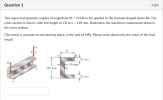 Two equal and opposite couples of magnitude M = 40 kN·m are
applied to the channel-shaped beam AB. The cross section
is shown, with the length of CD as L = 110 mm.
Determine the maximum compressive stress in the cross section.
(The result is accurate to one decimal place, in the unit of
MPa. Please write down only the value of the final result)
Question 1 1 pts Two equal and opposite couples of magnitude M = 40 kN-m...
Two equal and opposite couples of magnitude M = 40 kN·m are
applied to the channel-shaped beam AB. The cross section
is shown, with the length of CD as L = 110 mm.
Determine the maximum compressive stress in the cross section.
(The result is accurate to one decimal place, in the unit of
MPa. Please write down only the value of the final result)
Question 1 1 pts Two equal and opposite couples of magnitude M = 40 kN-m...
 If the beam is subjected to a positive bending moment of M = 100 kN-m, determine the maximum and minimum bending stress. Also determine the shear stress at point, A which is 50 mm above from the bottom. The cross-section of the beam is I-shaped and shown in the figure. 300 mm 30 mm 300 mm . 50 mm 30 mm
 If the beam is subjected to a positive bending moment of M = 100 kN-m, determine the maximum and minimum bending stress. Also determine the shear stress at point, A which is 50 mm above from the bottom. The cross-section of the beam is I-shaped and shown in the figure. 300 mm 30 mm 300 mm . 50 mm 30 mm
 EMS If the 600-kN force acts through the centroid of FI-10 the cross section, determine the location y of the centroid and the average normal stress on the cross section. Also, sketch the normal stress distribution over the cross section. 600 kN 300 mm 80 mm 60 mm 60 mmy 80 mm Prob. F1-10
 The beam having a cross-section as shown is subjected to the distributed load w (1) Calculate the moment of inertia, I (2) If the allowable maximum normal stress ơmax-20 MPa, determine the largest distributed load 5. w. (3) If w 1.5 kN/m, determine the maximum bending stress in the beam. Sketch the stress distribution acting over the cross-section. 100 mm 50mm 120 mm 3 m50 mm 3 m
 Determine the moment inertia along the horizontal neutral axis
for the cross section of the beam (in 106
mm4) and the maximum normal stress due to bending on a
transverse section at C (in MPa)
3 KN 3 KN 1.8 kN/m 80 mm 11 A | В 300 mm D -1.5 m -1.5 m -1.5 m
Determine the moment inertia along the horizontal neutral axis
for the cross section of the beam (in 106
mm4) and the maximum normal stress due to bending on a
transverse section at C (in MPa)
3 KN 3 KN 1.8 kN/m 80 mm 11 A | В 300 mm D -1.5 m -1.5 m -1.5 m
 a) A beam of the cross section shown below is made of an elastic-plastic material for which the yield stress is 300 MPa. Find the plastic moment Mp and the maximum elastic moment Me. Also determine the distribution of the residual stresses in the beam after the plastic moment Mp is applied and then released 100mm 30mm 80mm 20mm Fig 94. Beam cross section (graphic art: Geoff Marchiori)
a) A beam of the cross section shown below is made of...
a) A beam of the cross section shown below is made of an elastic-plastic material for which the yield stress is 300 MPa. Find the plastic moment Mp and the maximum elastic moment Me. Also determine the distribution of the residual stresses in the beam after the plastic moment Mp is applied and then released 100mm 30mm 80mm 20mm Fig 94. Beam cross section (graphic art: Geoff Marchiori)
a) A beam of the cross section shown below is made of...
 Question a A beam of the cross section shown below is made of an elastic-plastic material for which the yield stress is 300 MPa. Find the plastic moment M, and the maximum elastic moment M Also determine the distribution of the residual stresses in the beam after the plastic moment M, is appliod and then reloaoed. 8 mm +1 90 mm 8 mm 130 mn 8 mm
Question a A beam of the cross section shown below is made of...
Question a A beam of the cross section shown below is made of an elastic-plastic material for which the yield stress is 300 MPa. Find the plastic moment M, and the maximum elastic moment M Also determine the distribution of the residual stresses in the beam after the plastic moment M, is appliod and then reloaoed. 8 mm +1 90 mm 8 mm 130 mn 8 mm
Question a A beam of the cross section shown below is made of...
 (Q2) For the shown beam, a uniformly distributed load is applied across the beam length. The beam cross section is symmetrical. The beam length and cross-sectional dimensions are shown in figure. 40 mm B С 300 mm 10 N/m N A 40 mm 300 mm 40 mm 500 mm 1- Plot the Shear Force Distribution (with values) 2- Plot the Bending Moment Distribution (with values) 3. Determine the maximum Moment value and indicate the most critical section 4- Calculate the...
 Two equal and opposite couples of magnitude M = 40 kN·m are
applied to the channel-shaped beam AB. The cross section
is shown, with the length of CD as L = 110 mm.
Determine the maximum compressive stress in the cross section.
(The result is accurate to one decimal place, in the unit of
MPa. Please write down only the value of the final result)
Question 1 1 pts Two equal and opposite couples of magnitude M = 40 kN-m...
Two equal and opposite couples of magnitude M = 40 kN·m are
applied to the channel-shaped beam AB. The cross section
is shown, with the length of CD as L = 110 mm.
Determine the maximum compressive stress in the cross section.
(The result is accurate to one decimal place, in the unit of
MPa. Please write down only the value of the final result)
Question 1 1 pts Two equal and opposite couples of magnitude M = 40 kN-m...
Most questions answered within 3 hours.
-
Where is the error in this code sequence?
String s1 = "Hello";
String s2 = "ello";...
asked 10 months ago -
Financial data for Joel de Paris, Inc., for last year
follow:
Joel de Paris, Inc.
Balance...
asked 10 months ago -
Consider this reaction:
Al2(SO4)3 (aq)+ BaCl3
(aq) Al2Cl6 (aq)- +
3BaSO4(s) . What is the...
asked 10 months ago -
Suppose that Savneet is considering increasing her
recent random sample from 20 car rentals to 40...
asked 10 months ago -
Trucks arrive at an unloading terminal at an average rate of 120
per hour.
Trucks arrive...
asked 10 months ago -
Why are methanol and ethanol completely soluble in water while
octanol is not very little soluble....
asked 10 months ago -
A facilities manager at a university reads in a research report
that the mean amount of...
asked 10 months ago -
When the CuSO4 is rehydrated by adding water to the anhydrous
compound, is this an endothermic...
asked 10 months ago -
A ray of sunlight is passing from diamond into crown glass; the
angle of incidence is...
asked 10 months ago -
A block of mass 0.249 kg is placed on top of a light, vertical
spring of...
asked 10 months ago -
how do the kidneys compensate in the presences of acidosis
a) trigger hyperventilate
b) reserve acid...
asked 10 months ago -
Question 501 pts
The rental rate of capital to the firm increases. Which of the
following...
asked 10 months ago