1) You calculated a equivalent capacitance of 0.42 μF ± 0.08 μF. If the manufacturer has...
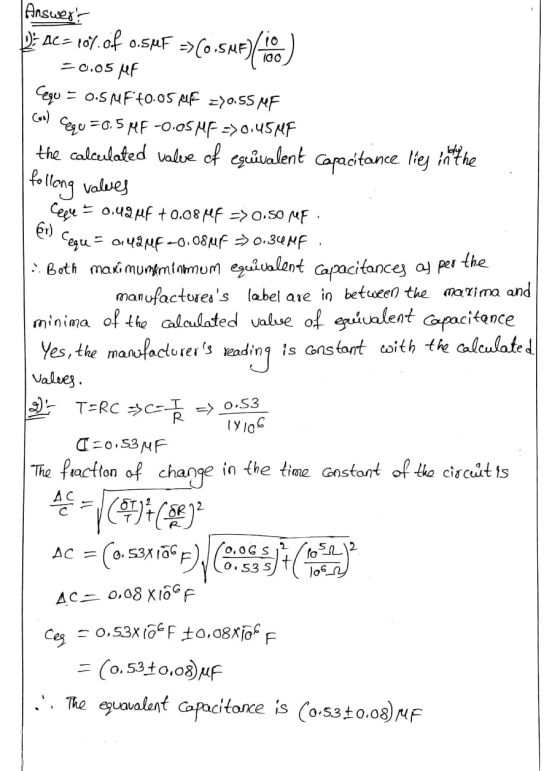
1) You calculated a equivalent capacitance of 0.42 μF ± 0.08 μF. If the manufacturer has labeled the capacitor as 0.5 μF ± 10%, is this consistent with your result? yes, no, or cannot be determined?
2) You calculated a value of 0.53 s ± 0.06 s for the time constant from your graph. If you used a 1MΩ resistor with a tolerance of 10%, what is the equivalent capacitance of your circuit (including the uncertainty)?
Homework Answers
Add Answer to:
1) You calculated a equivalent capacitance of 0.42 μF ± 0.08 μF.
If the manufacturer has...
You calculated a value of 0.53 s ± 0.06 s for the time constant from your...
You calculated a value of 0.53 s ± 0.06 s for the time constant from your graph. If you used a 1MΩ resistor with a tolerance of 10%, what is the equivalent capacitance of your circuit (including the uncertainty)? (Answer ± Answer) F
You calculated a value of 0.54 s ± 0.06 s for the time constant from your...
You calculated a value of 0.54 s ± 0.06 s for the time constant from your graph. If you used a 1MΩ resistor with a tolerance of 10%, what is the equivalent capacitance of your circuit (including the uncertainty)?
You calculated a value of 0.45 s ± 0.04 s for the time constant from your...
You calculated a value of 0.45 s ± 0.04 s for the time constant from your graph. If you used a 1MΩ resistor with a tolerance of 10%, what is the equivalent capacitance of your circuit (including the uncertainty)? [Answer +/- Answer] F (MUST BE IN FARADS)
You are charging a 11895 μF capacitor that is in an R-C circuit with a resistor...
You are charging a 11895 μF capacitor that is in an R-C circuit with a resistor that has a nominal value of 7910 Ω. What is the charging time constant? τ= 94.08945s A typical 1/4 W resistor has a tolerance of 10% (shown by a silver fourth color band). If the capacitor has an uncertainty of ±7%, what is the uncertainty of the time constant? δτ= ____ s
A) find the capacitance of the equivalent capacitor in the circuit B) if the voltage across...
 A) find the capacitance of the equivalent capacitor in the
circuit
B) if the voltage across capacitor C is V=10 mV, what is the
energy stored in C?
Can you please show your worl as well? thank you
3 μF 6μF нЕ 3μF 2μF σ 6 μF 24 μΕ
A) find the capacitance of the equivalent capacitor in the
circuit
B) if the voltage across capacitor C is V=10 mV, what is the
energy stored in C?
Can you please show your worl as well? thank you
3 μF 6μF нЕ 3μF 2μF σ 6 μF 24 μΕ
In the circuit shown in the following figure(Figure 1) thecapacitor has capacitance 24 μF and...
 In the circuit shown in the following figure(Figure 1) the
capacitor has capacitance 24 μF and is initially uncharged. The
resistor R0 has resistance 11 Ω . An emf of 86.0 V is added in
series with the capacitor and the resistor. The emf is placed
between the capacitor and the switch, with the positive terminal of
the emf adjacent to the capacitor. The small circuit is not
connected in any way to the large one. The wire of the...
In the circuit shown in the following figure(Figure 1) the
capacitor has capacitance 24 μF and is initially uncharged. The
resistor R0 has resistance 11 Ω . An emf of 86.0 V is added in
series with the capacitor and the resistor. The emf is placed
between the capacitor and the switch, with the positive terminal of
the emf adjacent to the capacitor. The small circuit is not
connected in any way to the large one. The wire of the...
We calculated the capacticance of our capacitior in farads and we have to compare it to...
 We
calculated the capacticance of our capacitior in farads and we have
to compare it to the listed capacitance of the capacitor as shown
in the picture. When we do percent difference we get 200%... where
did I mess up? That can't be right. The resistance of our resistor
is 12970 ohms. Please explain this like you were talking to a
child.
Amicon 26936KO (M) 2000 F25V 81-POLAR NPS wire leads of the resistor to the table the body of...
We
calculated the capacticance of our capacitior in farads and we have
to compare it to the listed capacitance of the capacitor as shown
in the picture. When we do percent difference we get 200%... where
did I mess up? That can't be right. The resistance of our resistor
is 12970 ohms. Please explain this like you were talking to a
child.
Amicon 26936KO (M) 2000 F25V 81-POLAR NPS wire leads of the resistor to the table the body of...
Capacitance 1 Part 1A Capacitance 2 Part 2B Capacitance 3 Part 2A Capacitance 4 Part 2B...
 Capacitance 1
Part 1A
Capacitance
2 Part 2B
Capacitance 3
Part 2A
Capacitance
4 Part 2B
Data Sheet Trial 1 2 3 4 5 Table 1: Snap Circuits Capacitance Data Capacitance 1 Capacitance 2 Capacitance 3 Time (8) Time (6) Time (s) 5.86 0.85 1.75 5.26 1.31 1.84 3.04 1.18 1,44 4.48 D.91 1.45 S.56 1.00 1.40 5.78 .82 1.45 5.97 1.24 1,33 4.97 1.07 1.76 4.98 1.37 6.05 .85 1,45 5.40s 1.025 1.52s Capacitance 4 Time (s) 6.04 S.53...
Capacitance 1
Part 1A
Capacitance
2 Part 2B
Capacitance 3
Part 2A
Capacitance
4 Part 2B
Data Sheet Trial 1 2 3 4 5 Table 1: Snap Circuits Capacitance Data Capacitance 1 Capacitance 2 Capacitance 3 Time (8) Time (6) Time (s) 5.86 0.85 1.75 5.26 1.31 1.84 3.04 1.18 1,44 4.48 D.91 1.45 S.56 1.00 1.40 5.78 .82 1.45 5.97 1.24 1,33 4.97 1.07 1.76 4.98 1.37 6.05 .85 1,45 5.40s 1.025 1.52s Capacitance 4 Time (s) 6.04 S.53...
Study the equivalent resistance readings for the series circuits.Can you come up with a rule for...
 Study the equivalent resistance readings for the series
circuits.Can you come up with a rule for the equivalent resistance
of a series circuit with two resistors? For each of the three
series circuits, compare the experimental results with the
resistance calculated using your rule. Consider tolerance of each
resistor using the minimum and maximum values. Lastly, calculate
the equivalent resistance of the circuit for each of the three
parallel circuits.
Table . Labeling Restrictors Color Codes Labeled Restrictor Value Tolerance...
Study the equivalent resistance readings for the series
circuits.Can you come up with a rule for the equivalent resistance
of a series circuit with two resistors? For each of the three
series circuits, compare the experimental results with the
resistance calculated using your rule. Consider tolerance of each
resistor using the minimum and maximum values. Lastly, calculate
the equivalent resistance of the circuit for each of the three
parallel circuits.
Table . Labeling Restrictors Color Codes Labeled Restrictor Value Tolerance...
Please Help. This is a PSPICE Simulation problem. Thanks. Equipment For the laboratory experimentation, the standard...
 Please Help. This is a PSPICE Simulation problem. Thanks.
Equipment For the laboratory experimentation, the standard laboratory equipment (function generator, oscilloscope, multimeter) will be used along with a capacitor (0.027 μF), an inductor (10 mH for the series RLC circuit and 1 mH for the parallel RLC circuit), and a resistor (to be determined in your prelab work) Lab 4 PSPICE Simulation: Using the circuit parameter values given in the prelab, model the circuits given in Fig. 1 using PSPICE....
Please Help. This is a PSPICE Simulation problem. Thanks.
Equipment For the laboratory experimentation, the standard laboratory equipment (function generator, oscilloscope, multimeter) will be used along with a capacitor (0.027 μF), an inductor (10 mH for the series RLC circuit and 1 mH for the parallel RLC circuit), and a resistor (to be determined in your prelab work) Lab 4 PSPICE Simulation: Using the circuit parameter values given in the prelab, model the circuits given in Fig. 1 using PSPICE....
 A) find the capacitance of the equivalent capacitor in the
circuit
B) if the voltage across capacitor C is V=10 mV, what is the
energy stored in C?
Can you please show your worl as well? thank you
3 μF 6μF нЕ 3μF 2μF σ 6 μF 24 μΕ
A) find the capacitance of the equivalent capacitor in the
circuit
B) if the voltage across capacitor C is V=10 mV, what is the
energy stored in C?
Can you please show your worl as well? thank you
3 μF 6μF нЕ 3μF 2μF σ 6 μF 24 μΕ
 In the circuit shown in the following figure(Figure 1) the
capacitor has capacitance 24 μF and is initially uncharged. The
resistor R0 has resistance 11 Ω . An emf of 86.0 V is added in
series with the capacitor and the resistor. The emf is placed
between the capacitor and the switch, with the positive terminal of
the emf adjacent to the capacitor. The small circuit is not
connected in any way to the large one. The wire of the...
In the circuit shown in the following figure(Figure 1) the
capacitor has capacitance 24 μF and is initially uncharged. The
resistor R0 has resistance 11 Ω . An emf of 86.0 V is added in
series with the capacitor and the resistor. The emf is placed
between the capacitor and the switch, with the positive terminal of
the emf adjacent to the capacitor. The small circuit is not
connected in any way to the large one. The wire of the...
 We
calculated the capacticance of our capacitior in farads and we have
to compare it to the listed capacitance of the capacitor as shown
in the picture. When we do percent difference we get 200%... where
did I mess up? That can't be right. The resistance of our resistor
is 12970 ohms. Please explain this like you were talking to a
child.
Amicon 26936KO (M) 2000 F25V 81-POLAR NPS wire leads of the resistor to the table the body of...
We
calculated the capacticance of our capacitior in farads and we have
to compare it to the listed capacitance of the capacitor as shown
in the picture. When we do percent difference we get 200%... where
did I mess up? That can't be right. The resistance of our resistor
is 12970 ohms. Please explain this like you were talking to a
child.
Amicon 26936KO (M) 2000 F25V 81-POLAR NPS wire leads of the resistor to the table the body of...
 Capacitance 1
Part 1A
Capacitance
2 Part 2B
Capacitance 3
Part 2A
Capacitance
4 Part 2B
Data Sheet Trial 1 2 3 4 5 Table 1: Snap Circuits Capacitance Data Capacitance 1 Capacitance 2 Capacitance 3 Time (8) Time (6) Time (s) 5.86 0.85 1.75 5.26 1.31 1.84 3.04 1.18 1,44 4.48 D.91 1.45 S.56 1.00 1.40 5.78 .82 1.45 5.97 1.24 1,33 4.97 1.07 1.76 4.98 1.37 6.05 .85 1,45 5.40s 1.025 1.52s Capacitance 4 Time (s) 6.04 S.53...
Capacitance 1
Part 1A
Capacitance
2 Part 2B
Capacitance 3
Part 2A
Capacitance
4 Part 2B
Data Sheet Trial 1 2 3 4 5 Table 1: Snap Circuits Capacitance Data Capacitance 1 Capacitance 2 Capacitance 3 Time (8) Time (6) Time (s) 5.86 0.85 1.75 5.26 1.31 1.84 3.04 1.18 1,44 4.48 D.91 1.45 S.56 1.00 1.40 5.78 .82 1.45 5.97 1.24 1,33 4.97 1.07 1.76 4.98 1.37 6.05 .85 1,45 5.40s 1.025 1.52s Capacitance 4 Time (s) 6.04 S.53...
 Study the equivalent resistance readings for the series
circuits.Can you come up with a rule for the equivalent resistance
of a series circuit with two resistors? For each of the three
series circuits, compare the experimental results with the
resistance calculated using your rule. Consider tolerance of each
resistor using the minimum and maximum values. Lastly, calculate
the equivalent resistance of the circuit for each of the three
parallel circuits.
Table . Labeling Restrictors Color Codes Labeled Restrictor Value Tolerance...
Study the equivalent resistance readings for the series
circuits.Can you come up with a rule for the equivalent resistance
of a series circuit with two resistors? For each of the three
series circuits, compare the experimental results with the
resistance calculated using your rule. Consider tolerance of each
resistor using the minimum and maximum values. Lastly, calculate
the equivalent resistance of the circuit for each of the three
parallel circuits.
Table . Labeling Restrictors Color Codes Labeled Restrictor Value Tolerance...
 Please Help. This is a PSPICE Simulation problem. Thanks.
Equipment For the laboratory experimentation, the standard laboratory equipment (function generator, oscilloscope, multimeter) will be used along with a capacitor (0.027 μF), an inductor (10 mH for the series RLC circuit and 1 mH for the parallel RLC circuit), and a resistor (to be determined in your prelab work) Lab 4 PSPICE Simulation: Using the circuit parameter values given in the prelab, model the circuits given in Fig. 1 using PSPICE....
Please Help. This is a PSPICE Simulation problem. Thanks.
Equipment For the laboratory experimentation, the standard laboratory equipment (function generator, oscilloscope, multimeter) will be used along with a capacitor (0.027 μF), an inductor (10 mH for the series RLC circuit and 1 mH for the parallel RLC circuit), and a resistor (to be determined in your prelab work) Lab 4 PSPICE Simulation: Using the circuit parameter values given in the prelab, model the circuits given in Fig. 1 using PSPICE....
Most questions answered within 3 hours.
-
Where is the error in this code sequence?
String s1 = "Hello";
String s2 = "ello";...
asked 10 months ago -
Financial data for Joel de Paris, Inc., for last year
follow:
Joel de Paris, Inc.
Balance...
asked 10 months ago -
Consider this reaction:
Al2(SO4)3 (aq)+ BaCl3
(aq) Al2Cl6 (aq)- +
3BaSO4(s) . What is the...
asked 10 months ago -
Suppose that Savneet is considering increasing her
recent random sample from 20 car rentals to 40...
asked 10 months ago -
Trucks arrive at an unloading terminal at an average rate of 120
per hour.
Trucks arrive...
asked 10 months ago -
Why are methanol and ethanol completely soluble in water while
octanol is not very little soluble....
asked 10 months ago -
A facilities manager at a university reads in a research report
that the mean amount of...
asked 10 months ago -
When the CuSO4 is rehydrated by adding water to the anhydrous
compound, is this an endothermic...
asked 10 months ago -
A ray of sunlight is passing from diamond into crown glass; the
angle of incidence is...
asked 10 months ago -
A block of mass 0.249 kg is placed on top of a light, vertical
spring of...
asked 10 months ago -
how do the kidneys compensate in the presences of acidosis
a) trigger hyperventilate
b) reserve acid...
asked 10 months ago -
Question 501 pts
The rental rate of capital to the firm increases. Which of the
following...
asked 10 months ago