
Homework Answers
Answer-
| Dye | molecular weight | total diatance | Diffusion rate |
| Blue dye | 793g/m | 5.2mm | 156mm/h |
| Red dye | 496g/m | 5.9 mm | 177mm/h |
Because speed is equal to total distance × 30
So 5.2× 30= 156
And 5.9×30= 177
Add Answer to:
Table 1: Rate of Diffusion in Corn Syrup + Time (sec) Blue Dye Dye 4.0mm 10...
Based off of my results, how do I compute the rate of diffusion of the potassium...
 Based off of my results, how do I compute the rate of diffusion of
the potassium permanganate molecules in millimeters per minute.?
And how do I compute the rate of diffusion of the methylene blue
molecules in millimeter per minute?
56 Exercise 5 Calculate the diffision te Activity 1: Dye Diffusion Results 3 F time Diffusion of methylene blue Diffusion of potassium permanganate (mm) dye Time (min) (mm) Time 15 mm Qmm 8mm I mm 1amm Time 30 amm amm...
Based off of my results, how do I compute the rate of diffusion of
the potassium permanganate molecules in millimeters per minute.?
And how do I compute the rate of diffusion of the methylene blue
molecules in millimeter per minute?
56 Exercise 5 Calculate the diffision te Activity 1: Dye Diffusion Results 3 F time Diffusion of methylene blue Diffusion of potassium permanganate (mm) dye Time (min) (mm) Time 15 mm Qmm 8mm I mm 1amm Time 30 amm amm...
Based off of my results, how do I compute the rate of diffusion of the potassium...
 Based off of my results, how do I compute the rate of
diffusion of the potassium permanganate molecules in millimeters
per minute.? And how do I compute the rate of diffusion of the
methylene blue molecules in millimeter per minute?
Calculate the diffusion Activity 1: Dye Diffusion Results Diffusion of I Diffusion of methylene blue potassium Time (min) (mm) permanganate (mm) 15 amm | amm I amm 8 mm amm 11mm 18mm 12mm Which dye diffused more rapidly? 2 What...
Based off of my results, how do I compute the rate of
diffusion of the potassium permanganate molecules in millimeters
per minute.? And how do I compute the rate of diffusion of the
methylene blue molecules in millimeter per minute?
Calculate the diffusion Activity 1: Dye Diffusion Results Diffusion of I Diffusion of methylene blue potassium Time (min) (mm) permanganate (mm) 15 amm | amm I amm 8 mm amm 11mm 18mm 12mm Which dye diffused more rapidly? 2 What...
Need help with how i should draw the graph e diffusion rate in Table 4, divide...
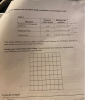 Need help with how i should draw the graph
e diffusion rate in Table 4, divide (net distance traveled (mm) by total wate da www. Table 4 Molecular weight (g/mol) Diffusion rate (mm/min) Substance Potassium permanganate (KMNO4) 119 7.65/40 .01625mm/min 1.01125mmlimin .45/40 . Methylene blue 374 1.35140 Carmine red 492 1.00875 mm/min Why did the different substances diffuse at different rates? Because rate of diffusion depends, in part, on the size (molecular weight) of a substance. Graph your results from...
Need help with how i should draw the graph
e diffusion rate in Table 4, divide (net distance traveled (mm) by total wate da www. Table 4 Molecular weight (g/mol) Diffusion rate (mm/min) Substance Potassium permanganate (KMNO4) 119 7.65/40 .01625mm/min 1.01125mmlimin .45/40 . Methylene blue 374 1.35140 Carmine red 492 1.00875 mm/min Why did the different substances diffuse at different rates? Because rate of diffusion depends, in part, on the size (molecular weight) of a substance. Graph your results from...
Effect of Molecular weight on Diffusion Time (Minutes) 0 10 20 30 40 50 60 Percent...
 Effect of Molecular weight on Diffusion Time (Minutes) 0 10 20 30 40 50 60 Percent increase Methylene Blue 14.022.0125.0 20.0 20.-22 -100 9.0|14.0/16.0 18.0 /19.0/19.000122.221 Potassium Permanganate According to your data, what molecule (methylene blue or potassium permanganate) diffused the fastest? Check Your Understanding 1.1 Based on the data, what generalization can be made about the relationship between diffusion rate and molecular weight? 1.2 By observing the rate of diffusion from the data collected, does diffusion rate change over...
Experiment 1: Diffusion through Gelatin Data Tables Purpose (What question is this experiment designed to answer?):...
 Experiment 1: Diffusion through Gelatin
Data Tables
Purpose (What question is this experiment
designed to answer?):
Hypothesis (Based on what you’ve learned in the
pre-lab materials, write and If/Then statement regarding the
outcome of this experiment.):
Table 1: Diffusion Data
Test Tube
Distance After 4 Hours (mm)
Distance After 24 Hours (mm)
A
B
C
Claim (What are the results of your
experiment?):
Evidence (What data did you collect that
supports your claim? Explain the meaning behind the data and...
Experiment 1: Diffusion through Gelatin
Data Tables
Purpose (What question is this experiment
designed to answer?):
Hypothesis (Based on what you’ve learned in the
pre-lab materials, write and If/Then statement regarding the
outcome of this experiment.):
Table 1: Diffusion Data
Test Tube
Distance After 4 Hours (mm)
Distance After 24 Hours (mm)
A
B
C
Claim (What are the results of your
experiment?):
Evidence (What data did you collect that
supports your claim? Explain the meaning behind the data and...
1) Liquid leaked from a damaged tank at a rate of r(t) liters per hour. The rate decreased as time passed and values of the rate at two-hour time intervals are shown in the table. t (hr) r(t) (L/h)...
1) Liquid leaked from a damaged tank at a rate of r(t) liters per hour. The rate decreased as time passed and values of the rate at two-hour time intervals are shown in the table. t (hr) r(t) (L/h) 0 10.4 2 10.1 4 9.8 6 9.6 8 9.3 10 9 Find lower and upper estimates for the total amount of liquid that leaked out. lower estimate = liters upper estimate = 2) When estimating distances from a table of...
 Based off of my results, how do I compute the rate of diffusion of
the potassium permanganate molecules in millimeters per minute.?
And how do I compute the rate of diffusion of the methylene blue
molecules in millimeter per minute?
56 Exercise 5 Calculate the diffision te Activity 1: Dye Diffusion Results 3 F time Diffusion of methylene blue Diffusion of potassium permanganate (mm) dye Time (min) (mm) Time 15 mm Qmm 8mm I mm 1amm Time 30 amm amm...
Based off of my results, how do I compute the rate of diffusion of
the potassium permanganate molecules in millimeters per minute.?
And how do I compute the rate of diffusion of the methylene blue
molecules in millimeter per minute?
56 Exercise 5 Calculate the diffision te Activity 1: Dye Diffusion Results 3 F time Diffusion of methylene blue Diffusion of potassium permanganate (mm) dye Time (min) (mm) Time 15 mm Qmm 8mm I mm 1amm Time 30 amm amm...
 Based off of my results, how do I compute the rate of
diffusion of the potassium permanganate molecules in millimeters
per minute.? And how do I compute the rate of diffusion of the
methylene blue molecules in millimeter per minute?
Calculate the diffusion Activity 1: Dye Diffusion Results Diffusion of I Diffusion of methylene blue potassium Time (min) (mm) permanganate (mm) 15 amm | amm I amm 8 mm amm 11mm 18mm 12mm Which dye diffused more rapidly? 2 What...
Based off of my results, how do I compute the rate of
diffusion of the potassium permanganate molecules in millimeters
per minute.? And how do I compute the rate of diffusion of the
methylene blue molecules in millimeter per minute?
Calculate the diffusion Activity 1: Dye Diffusion Results Diffusion of I Diffusion of methylene blue potassium Time (min) (mm) permanganate (mm) 15 amm | amm I amm 8 mm amm 11mm 18mm 12mm Which dye diffused more rapidly? 2 What...
 Need help with how i should draw the graph
e diffusion rate in Table 4, divide (net distance traveled (mm) by total wate da www. Table 4 Molecular weight (g/mol) Diffusion rate (mm/min) Substance Potassium permanganate (KMNO4) 119 7.65/40 .01625mm/min 1.01125mmlimin .45/40 . Methylene blue 374 1.35140 Carmine red 492 1.00875 mm/min Why did the different substances diffuse at different rates? Because rate of diffusion depends, in part, on the size (molecular weight) of a substance. Graph your results from...
Need help with how i should draw the graph
e diffusion rate in Table 4, divide (net distance traveled (mm) by total wate da www. Table 4 Molecular weight (g/mol) Diffusion rate (mm/min) Substance Potassium permanganate (KMNO4) 119 7.65/40 .01625mm/min 1.01125mmlimin .45/40 . Methylene blue 374 1.35140 Carmine red 492 1.00875 mm/min Why did the different substances diffuse at different rates? Because rate of diffusion depends, in part, on the size (molecular weight) of a substance. Graph your results from...
 Effect of Molecular weight on Diffusion Time (Minutes) 0 10 20 30 40 50 60 Percent increase Methylene Blue 14.022.0125.0 20.0 20.-22 -100 9.0|14.0/16.0 18.0 /19.0/19.000122.221 Potassium Permanganate According to your data, what molecule (methylene blue or potassium permanganate) diffused the fastest? Check Your Understanding 1.1 Based on the data, what generalization can be made about the relationship between diffusion rate and molecular weight? 1.2 By observing the rate of diffusion from the data collected, does diffusion rate change over...
 Experiment 1: Diffusion through Gelatin
Data Tables
Purpose (What question is this experiment
designed to answer?):
Hypothesis (Based on what you’ve learned in the
pre-lab materials, write and If/Then statement regarding the
outcome of this experiment.):
Table 1: Diffusion Data
Test Tube
Distance After 4 Hours (mm)
Distance After 24 Hours (mm)
A
B
C
Claim (What are the results of your
experiment?):
Evidence (What data did you collect that
supports your claim? Explain the meaning behind the data and...
Experiment 1: Diffusion through Gelatin
Data Tables
Purpose (What question is this experiment
designed to answer?):
Hypothesis (Based on what you’ve learned in the
pre-lab materials, write and If/Then statement regarding the
outcome of this experiment.):
Table 1: Diffusion Data
Test Tube
Distance After 4 Hours (mm)
Distance After 24 Hours (mm)
A
B
C
Claim (What are the results of your
experiment?):
Evidence (What data did you collect that
supports your claim? Explain the meaning behind the data and...
Most questions answered within 3 hours.
-
Where is the error in this code sequence?
String s1 = "Hello";
String s2 = "ello";...
asked 10 months ago -
Financial data for Joel de Paris, Inc., for last year
follow:
Joel de Paris, Inc.
Balance...
asked 10 months ago -
Consider this reaction:
Al2(SO4)3 (aq)+ BaCl3
(aq) Al2Cl6 (aq)- +
3BaSO4(s) . What is the...
asked 10 months ago -
Suppose that Savneet is considering increasing her
recent random sample from 20 car rentals to 40...
asked 10 months ago -
Trucks arrive at an unloading terminal at an average rate of 120
per hour.
Trucks arrive...
asked 10 months ago -
Why are methanol and ethanol completely soluble in water while
octanol is not very little soluble....
asked 10 months ago -
A facilities manager at a university reads in a research report
that the mean amount of...
asked 10 months ago -
When the CuSO4 is rehydrated by adding water to the anhydrous
compound, is this an endothermic...
asked 10 months ago -
A ray of sunlight is passing from diamond into crown glass; the
angle of incidence is...
asked 10 months ago -
A block of mass 0.249 kg is placed on top of a light, vertical
spring of...
asked 10 months ago -
how do the kidneys compensate in the presences of acidosis
a) trigger hyperventilate
b) reserve acid...
asked 10 months ago -
Question 501 pts
The rental rate of capital to the firm increases. Which of the
following...
asked 10 months ago