Will the number of chromosomes in an organism affect the amount of DNA that is separated?...
Will the number of chromosomes in an organism affect the amount of DNA that is separated? (DNA Extraction Strawberry Lab)
Homework Answers
Yes, the number of chromosomes in an organism affects the amount of DNA that is separated or extracted. The best example is "the amount of DNA extracted from normal diploid vegetative cells" is higher when compared to "the amount of DNA extracted from haploid sperm cell or egg cell after reduction division (meiosis)". Haploid germ cells possess half of the chromosomes with histone proteins (separated using tenderizer) when compared to diploid parent cells or somatic cells. Therefore, the amount of DNA extracted from these two types of cells is completely different in their amount.
Add Answer to:
Will the number of chromosomes in an organism affect the amount
of DNA that is separated?...
An organism produces gametes with a haploid number of chromosomes equal to 12; how many chromosomes...
An organism produces gametes with a haploid number of chromosomes equal to 12; how many chromosomes exist in the diploid cells of this organism?
An organism has a diploid number of 32. What would be the number of chromosomes found...
An organism has a diploid number of 32. What would be the number of chromosomes found in the cells of this organism undergoing meiosis? Explain.
QUESTION 4 What is a transgenic organism? O an organism into which DNA from a different...
 QUESTION 4 What is a transgenic organism? O an organism into which DNA from a different organism is spliced O an organism that is both male and female an organism that is unable to reproduce offspring an organism that has a dominant genetic disorder O an organism that was cloned QUESTION 5 Which of the following statements correctly indicates the relationship among chromosomes, genes, and proteins? Proteins are found on chromosomes and code for genes. O A chromosome contains many...
For a diploid organism where 2n = 16, please indicate the number of chromosomes and chromatids...
For a diploid organism where 2n = 16, please indicate the number of chromosomes and chromatids at each of the following stages stage s phase mitosis meiosis 1 meiosis 2 Number of chromosomes at the beginning of the stage Number of chromatids at the beginning of the stage Number of chromosomes at the end of the stage Number of chromatids at the end of the stage thanks !!
14. For an organism with a diploid number of 30 chromosomes, determine the per cell number...
 14. For an organism with a diploid number of 30 chromosomes, determine the per cell number of the following: a. chromatids at metaphase of mitosis b. chromosomes at metaphase of mitosis C. centromeres at metaphase of mitosis d. chromatids at anaphase of mitosis e. chromosomes at anaphase of mitosis f. centromeres at anaphase of mitosis 8. tetrads at metaphase I of meiosis h. chromosomes at metaphase I of meiosis i. chromatids at metaphase I of meiosis j. chromosomes at anaphase...
Which of the following best explains how the pattern of DNA arrangement in chromosomes could be...
Which of the following best explains how the pattern of DNA arrangement in chromosomes could be used, in most cases, to determine if an organism was a prokaryote or a eukaryote? Prokaryotic DNA Eukaryotic DNA Single circular chromosome Multiple circular chromosomes A Prokaryotic DNA Eukaryotic DNA Multiple chromosomes Single chromosome B Prokaryotic DNA Eukaryotic DNA Single linear chromosome Multiple linear chromosomes C Prokaryotic DNA Eukaryotic DNA Single circular chromosome Multiple linear chromosomes D
t takes about the same amount of time for the DNA in eukaryotic chromosomes to be...
 t takes about the same amount of time for the DNA in eukaryotic chromosomes to be replicated in vivo as it does for replication of DNA in E. coli. Why is his statement true? Answers: Eukaryotes have multiple origins of replication: E. coli has one unique origin. A. Eukaryotic replication occurs at a faster rate, enabling replication of the larger chromosomes in about the same amount of time. B. The replication of DNA in eukaryotes is faster due to a...
A diploid organism receives 6 chromosomes from mom and 6 chromosomes from dad. The chromosomal number...
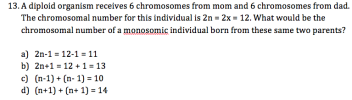 A diploid organism receives 6 chromosomes from mom and 6 chromosomes from dad. The chromosomal number for this individual is 2n = 2x = 12. What would be the chromosomal number of a monosomic individual born from these same two parents? a) 2n-l = 12-1 = 11 b) 2n+l = 12 + 1 = 13 c) (n-1) + (n-1) = 10 d) (n+1) + (n+1) = 14
if an organism is diploid or 2n number of 16 how many chromosomes do its sperm...
if an organism is diploid or 2n number of 16 how many chromosomes do its sperm cells or eggs contain?
An elephant is a diploid organism with 56 chromosomes. At the beginning of meiosis II, each...
An elephant is a diploid organism with 56 chromosomes. At the beginning of meiosis II, each daughter cell will have _____ DNA duplexes in it. A. 112 B. 28 C. 224 D.56
 QUESTION 4 What is a transgenic organism? O an organism into which DNA from a different organism is spliced O an organism that is both male and female an organism that is unable to reproduce offspring an organism that has a dominant genetic disorder O an organism that was cloned QUESTION 5 Which of the following statements correctly indicates the relationship among chromosomes, genes, and proteins? Proteins are found on chromosomes and code for genes. O A chromosome contains many...
 14. For an organism with a diploid number of 30 chromosomes, determine the per cell number of the following: a. chromatids at metaphase of mitosis b. chromosomes at metaphase of mitosis C. centromeres at metaphase of mitosis d. chromatids at anaphase of mitosis e. chromosomes at anaphase of mitosis f. centromeres at anaphase of mitosis 8. tetrads at metaphase I of meiosis h. chromosomes at metaphase I of meiosis i. chromatids at metaphase I of meiosis j. chromosomes at anaphase...
 t takes about the same amount of time for the DNA in eukaryotic chromosomes to be replicated in vivo as it does for replication of DNA in E. coli. Why is his statement true? Answers: Eukaryotes have multiple origins of replication: E. coli has one unique origin. A. Eukaryotic replication occurs at a faster rate, enabling replication of the larger chromosomes in about the same amount of time. B. The replication of DNA in eukaryotes is faster due to a...
 A diploid organism receives 6 chromosomes from mom and 6 chromosomes from dad. The chromosomal number for this individual is 2n = 2x = 12. What would be the chromosomal number of a monosomic individual born from these same two parents? a) 2n-l = 12-1 = 11 b) 2n+l = 12 + 1 = 13 c) (n-1) + (n-1) = 10 d) (n+1) + (n+1) = 14
Most questions answered within 3 hours.
-
Where is the error in this code sequence?
String s1 = "Hello";
String s2 = "ello";...
asked 11 months ago -
Financial data for Joel de Paris, Inc., for last year
follow:
Joel de Paris, Inc.
Balance...
asked 11 months ago -
Consider this reaction:
Al2(SO4)3 (aq)+ BaCl3
(aq) Al2Cl6 (aq)- +
3BaSO4(s) . What is the...
asked 11 months ago -
Suppose that Savneet is considering increasing her
recent random sample from 20 car rentals to 40...
asked 11 months ago -
Trucks arrive at an unloading terminal at an average rate of 120
per hour.
Trucks arrive...
asked 11 months ago -
Why are methanol and ethanol completely soluble in water while
octanol is not very little soluble....
asked 11 months ago -
A facilities manager at a university reads in a research report
that the mean amount of...
asked 11 months ago -
When the CuSO4 is rehydrated by adding water to the anhydrous
compound, is this an endothermic...
asked 11 months ago -
A ray of sunlight is passing from diamond into crown glass; the
angle of incidence is...
asked 11 months ago -
A block of mass 0.249 kg is placed on top of a light, vertical
spring of...
asked 11 months ago -
how do the kidneys compensate in the presences of acidosis
a) trigger hyperventilate
b) reserve acid...
asked 11 months ago -
Question 501 pts
The rental rate of capital to the firm increases. Which of the
following...
asked 11 months ago