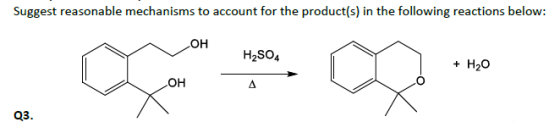
Suggest reasonable mechanisms to account for the product(s)
Homework Answers

Add Answer to:
Suggest reasonable mechanisms to account for the product(s)
Suggest reasonable mechanisms to account for the product(s)...
2. Suggest reasonable mechanisms for each of the following reactions. Use curved arrows to show electron...
 2. Suggest reasonable mechanisms for each of the following reactions. Use curved arrows to show electron flow. (6) CH, + H2O HO (mixture of stereoisomers) -CH OH
4.2. Suggest reasonable mechanisms for each of the following reactions. The starting materials are racemic, unless...
 4.2. Suggest reasonable mechanisms for each of the following reactions. The starting materials are racemic, unless otherwise stated. PhCH,CI + POCH3)3 — PhCH POCH3)2 + CH,CI сн. CH3 CH₂ OH BSCI CHA . CH₂ OH pyridine CH1 but e CH₂ CH₂ BSCI pyridine Bs BsO HC=CCH CH CH CI CF3CO H H percevonova co ,C=CCH2CH2CH2O2CF3 n nousemuannen NH2 TOH NaNO2, H20 NO2, H2 C H=0but (CH3), HCIOTY OH NaNO2, H20 NH, HClO (CH3), HOCH=0 Br CH₂ CH₃ CH₃ CH but...
3. Provide step-by-step mechanisms to account for the product of each of the following reactions. Show...
 3. Provide step-by-step mechanisms to account for the product of each of the following reactions. Show the structure of each of the intermediates and use curved arrows to indicate electron flow in each of these steps. A. cat. H30 H20 OH B. H20
3. Draw the mechanisms for the following two schemes (two separate mechanisms). Only show the mechanism...
 3. Draw the mechanisms for the following two schemes (two separate mechanisms). Only show the mechanism for the most stable product for each scheme. What is the key difference in the mechanistic steps between these two reactions? ОН conc H2SO4 heat OH conc H2SO4 heat
5. Provide reasonable step-by-step mechanisms for the following reactions. Use arrows to indicate the movement of e...
 5. Provide reasonable step-by-step mechanisms for the following reactions. Use arrows to indicate the movement of electrons. cat. NaOCH CH, OH (solvent) OCH cat. NaOH, H20 (solvent)
CONCEPT QUESTION: PREDICT THE PRODUCT Provide the stable organic product(s) that would result for each reaction...
 CONCEPT QUESTION: PREDICT THE PRODUCT Provide the stable organic product(s) that would result for each reaction below. Label the product formed in highest yield as "major" OH OH K2Cr207 H2SO4 acetone 0 OH NaNO3 (2 eq.) AcOH reflux HO 0 PCC (3 eq.) H20 он HO PCC (3 eq.) DCM но K2Cr207 H2SO4 H20 он
Part I – Reactions Draw the expected major product(s) or required reagent(s) for each of the...
 Part I – Reactions Draw the expected major product(s) or
required reagent(s) for each of the following reactions.
Part 1 - Reactions (20 marks) Draw the expected major product(s) or required reagent(s) for each of the following reactions. Question Answer 1. MgBr 1. CH3CN 2. H30* 2. OH HT ОН 3. Br PPh3 1. BULI 2. CH20 CI (1 mole) ОН 5. 1. LDA ? (directed aldol condensation) 2. CH3CHO 6. HO H (cat) OH ? (cyclic anhydride) . (-H20)...
Part I – Reactions Draw the expected major product(s) or
required reagent(s) for each of the following reactions.
Part 1 - Reactions (20 marks) Draw the expected major product(s) or required reagent(s) for each of the following reactions. Question Answer 1. MgBr 1. CH3CN 2. H30* 2. OH HT ОН 3. Br PPh3 1. BULI 2. CH20 CI (1 mole) ОН 5. 1. LDA ? (directed aldol condensation) 2. CH3CHO 6. HO H (cat) OH ? (cyclic anhydride) . (-H20)...
4.1.3 X 10', n = 5:4.3. 4.2. Suggest reasonable mechanisms for each of the following reactions....
 4.1.3 X 10', n = 5:4.3. 4.2. Suggest reasonable mechanisms for each of the following reactions. The materials are racemic, unless otherwise stated. ctions. The starting PHCHCI + PLOCH)3 = PhCH P(OC Hs)2 + CHCI CH CH. CH O H BSCI CH, CH₂ CH₂ CH CH but Bsci "OH pyridine CH Bso pyridine Bso HCBCCH CHỊCHCI - HẠC CCHỊCH,CHẠOCF O NaNO,H,O HCIO CH=o bự (CH4)ẠCAM-OH NaNO2, H2O NH, HCIO (CH) CH CHE (Ac), CHON H, heat but but OH (Ac),...
Ci cuil. 1. Predict the major product(s) for the following reactions. (18 points) NO2 HNO3 H2SO4...
 Ci cuil. 1. Predict the major product(s) for the following reactions. (18 points) NO2 HNO3 H2SO4 Na NH3 CH3CH2OH 1. KMnO4 H20 Heat 2. H2O* OH H2SO4 Pd(OAC), PPh3 NEt3 Cl2 AlCl3 2. Suggest a synthesis for the formation of 3-pro (7 points)
1.Predict all the products for the following reaction. Which is the major product? Why? + conc....
 1.Predict all the products for the following reaction. Which is the major product? Why? + conc. H2SO4 heat OH 2. Give an alcohol that you could use to synthesis each of the following alkenes? din 3.Draw the mechanisms for the following two schemes (two separate mechanisms). Only show the mechanism for the most stable product for each scheme. What is the key difference in the mechanistic steps between these two reactions? ОН ОН conc H2SO4 conc H2SO4 heat heat
 2. Suggest reasonable mechanisms for each of the following reactions. Use curved arrows to show electron flow. (6) CH, + H2O HO (mixture of stereoisomers) -CH OH
 4.2. Suggest reasonable mechanisms for each of the following reactions. The starting materials are racemic, unless otherwise stated. PhCH,CI + POCH3)3 — PhCH POCH3)2 + CH,CI сн. CH3 CH₂ OH BSCI CHA . CH₂ OH pyridine CH1 but e CH₂ CH₂ BSCI pyridine Bs BsO HC=CCH CH CH CI CF3CO H H percevonova co ,C=CCH2CH2CH2O2CF3 n nousemuannen NH2 TOH NaNO2, H20 NO2, H2 C H=0but (CH3), HCIOTY OH NaNO2, H20 NH, HClO (CH3), HOCH=0 Br CH₂ CH₃ CH₃ CH but...
 3. Provide step-by-step mechanisms to account for the product of each of the following reactions. Show the structure of each of the intermediates and use curved arrows to indicate electron flow in each of these steps. A. cat. H30 H20 OH B. H20
 3. Draw the mechanisms for the following two schemes (two separate mechanisms). Only show the mechanism for the most stable product for each scheme. What is the key difference in the mechanistic steps between these two reactions? ОН conc H2SO4 heat OH conc H2SO4 heat
 5. Provide reasonable step-by-step mechanisms for the following reactions. Use arrows to indicate the movement of electrons. cat. NaOCH CH, OH (solvent) OCH cat. NaOH, H20 (solvent)
 CONCEPT QUESTION: PREDICT THE PRODUCT Provide the stable organic product(s) that would result for each reaction below. Label the product formed in highest yield as "major" OH OH K2Cr207 H2SO4 acetone 0 OH NaNO3 (2 eq.) AcOH reflux HO 0 PCC (3 eq.) H20 он HO PCC (3 eq.) DCM но K2Cr207 H2SO4 H20 он
 Part I – Reactions Draw the expected major product(s) or
required reagent(s) for each of the following reactions.
Part 1 - Reactions (20 marks) Draw the expected major product(s) or required reagent(s) for each of the following reactions. Question Answer 1. MgBr 1. CH3CN 2. H30* 2. OH HT ОН 3. Br PPh3 1. BULI 2. CH20 CI (1 mole) ОН 5. 1. LDA ? (directed aldol condensation) 2. CH3CHO 6. HO H (cat) OH ? (cyclic anhydride) . (-H20)...
Part I – Reactions Draw the expected major product(s) or
required reagent(s) for each of the following reactions.
Part 1 - Reactions (20 marks) Draw the expected major product(s) or required reagent(s) for each of the following reactions. Question Answer 1. MgBr 1. CH3CN 2. H30* 2. OH HT ОН 3. Br PPh3 1. BULI 2. CH20 CI (1 mole) ОН 5. 1. LDA ? (directed aldol condensation) 2. CH3CHO 6. HO H (cat) OH ? (cyclic anhydride) . (-H20)...
 4.1.3 X 10', n = 5:4.3. 4.2. Suggest reasonable mechanisms for each of the following reactions. The materials are racemic, unless otherwise stated. ctions. The starting PHCHCI + PLOCH)3 = PhCH P(OC Hs)2 + CHCI CH CH. CH O H BSCI CH, CH₂ CH₂ CH CH but Bsci "OH pyridine CH Bso pyridine Bso HCBCCH CHỊCHCI - HẠC CCHỊCH,CHẠOCF O NaNO,H,O HCIO CH=o bự (CH4)ẠCAM-OH NaNO2, H2O NH, HCIO (CH) CH CHE (Ac), CHON H, heat but but OH (Ac),...
 Ci cuil. 1. Predict the major product(s) for the following reactions. (18 points) NO2 HNO3 H2SO4 Na NH3 CH3CH2OH 1. KMnO4 H20 Heat 2. H2O* OH H2SO4 Pd(OAC), PPh3 NEt3 Cl2 AlCl3 2. Suggest a synthesis for the formation of 3-pro (7 points)
 1.Predict all the products for the following reaction. Which is the major product? Why? + conc. H2SO4 heat OH 2. Give an alcohol that you could use to synthesis each of the following alkenes? din 3.Draw the mechanisms for the following two schemes (two separate mechanisms). Only show the mechanism for the most stable product for each scheme. What is the key difference in the mechanistic steps between these two reactions? ОН ОН conc H2SO4 conc H2SO4 heat heat
Most questions answered within 3 hours.
-
Where is the error in this code sequence?
String s1 = "Hello";
String s2 = "ello";...
asked 10 months ago -
Financial data for Joel de Paris, Inc., for last year
follow:
Joel de Paris, Inc.
Balance...
asked 10 months ago -
Consider this reaction:
Al2(SO4)3 (aq)+ BaCl3
(aq) Al2Cl6 (aq)- +
3BaSO4(s) . What is the...
asked 10 months ago -
Suppose that Savneet is considering increasing her
recent random sample from 20 car rentals to 40...
asked 10 months ago -
Trucks arrive at an unloading terminal at an average rate of 120
per hour.
Trucks arrive...
asked 10 months ago -
Why are methanol and ethanol completely soluble in water while
octanol is not very little soluble....
asked 10 months ago -
A facilities manager at a university reads in a research report
that the mean amount of...
asked 10 months ago -
When the CuSO4 is rehydrated by adding water to the anhydrous
compound, is this an endothermic...
asked 10 months ago -
A ray of sunlight is passing from diamond into crown glass; the
angle of incidence is...
asked 10 months ago -
A block of mass 0.249 kg is placed on top of a light, vertical
spring of...
asked 10 months ago -
how do the kidneys compensate in the presences of acidosis
a) trigger hyperventilate
b) reserve acid...
asked 10 months ago -
Question 501 pts
The rental rate of capital to the firm increases. Which of the
following...
asked 10 months ago