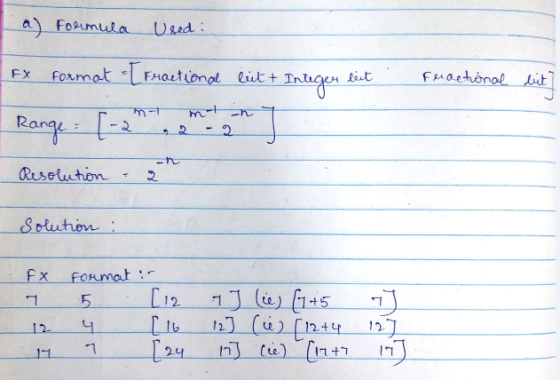
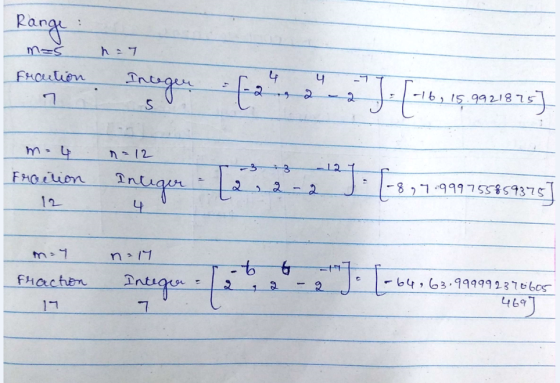
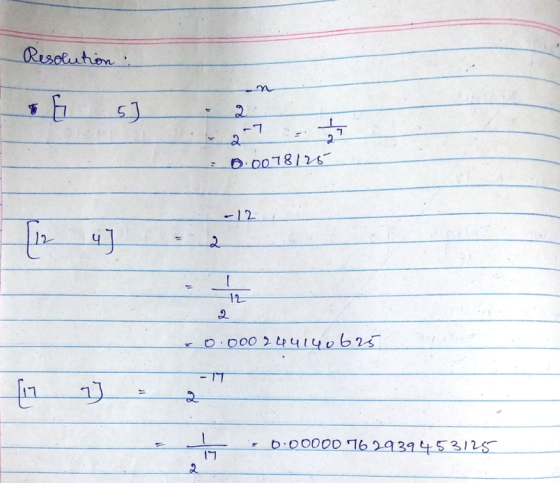
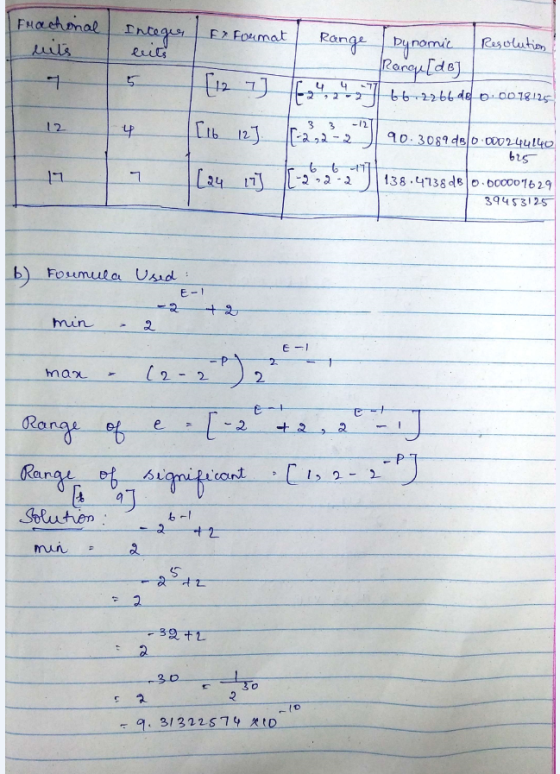
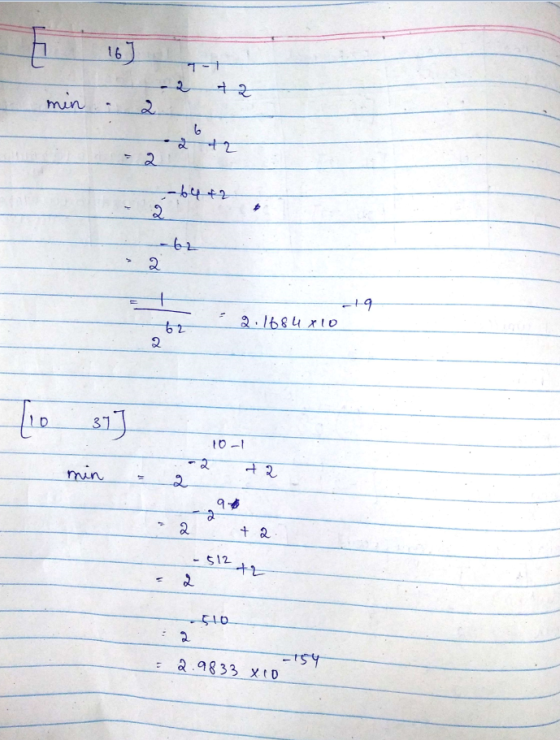
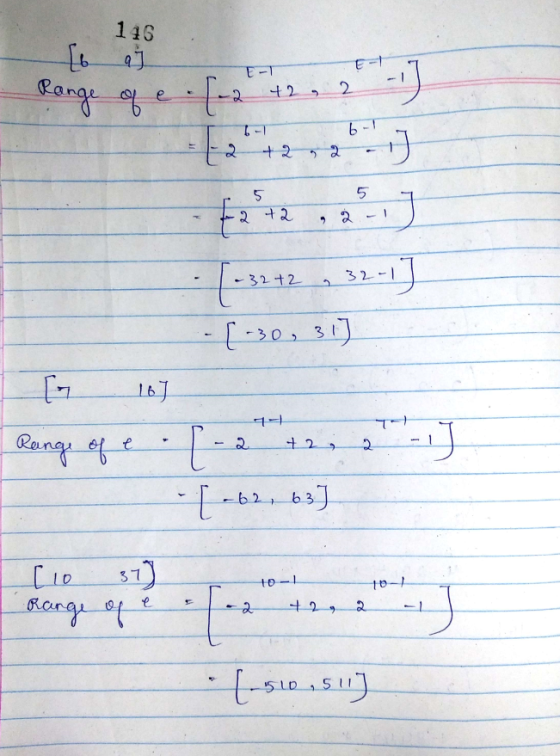
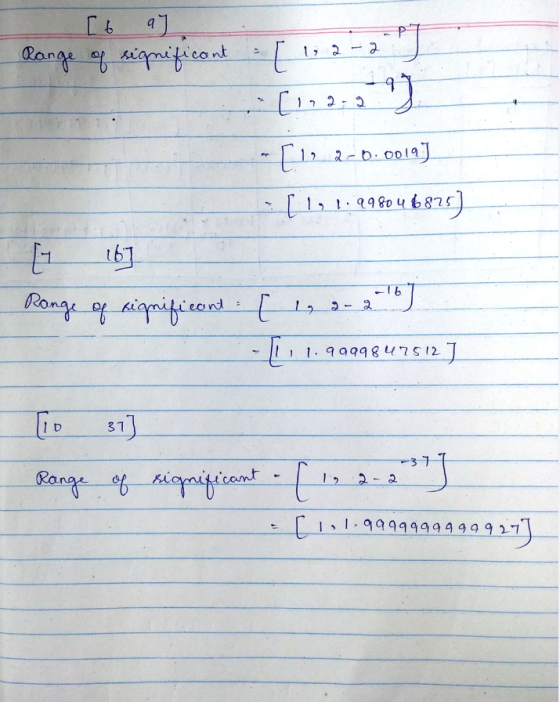
 how to find the dynamic range
and the FX format??!!
how to find the dynamic range
and the FX format??!!
Homework Answers


Add Answer to:
how to find the dynamic range
and the FX format??!!
Complete the table for the following...
How do I figure out the range of possible numbers that can be represented by the...
How do I figure out the range of possible numbers that can be represented by the IEEE 754 format? I know that you can have 32 bits, 16 bits and 8 bits and I don't know how you find the range of numbers each one could represent.
IEEE 754-2008 contains a half precision that is only 16 bits wide. The leftmost bit is...
IEEE 754-2008 contains a half precision that is only 16 bits wide. The leftmost bit is still the sign bit, the exponent is 5 bits wide and has a bias of 15, and the mantissa is 10 bits long. A hidden 1 is assumed. Write down the bit pattern to represent -1.6875 X 100 assuming a version of this format, which uses an excess-16 format to store the exponent. Comment on how the range and accuracy of this 16-bit floating...
Convert the following numbers to 32b IEEE 754 Floating Point format. Show bits in diagrams below....
 Convert the following numbers to 32b IEEE 754 Floating Point format. Show bits in diagrams below. a) -769.0234375 Mantissa Exponent b) 8.111 Mantissa Exponent
4. (5 points) IEEE 754-2008 contains a half precision that is only 16 bits wide. The leftmost bit...
 4. (5 points) IEEE 754-2008 contains a half precision that is only 16 bits wide. The leftmost bit is still the sign bit, the exponent is 5 bits wide and has a bias of 15, and the mantissa is 10 bits long. A hidden 1 is assumed. Write down the bit pattern to represent-1.09375 x 10⁻¹ assuming a version of this format, which uses an excess-16 format to store the exponent. Comment on how the range and accuracy of this...
I would like a step by step explanation as to how the 7-bit floating point representations from Format A were converted...
I would like a step by step explanation as to how the 7-bit floating point representations from Format A were converted to Format B. Thanks. Consider the following two 7-bit floating point representations based on the IEEE floating point format. Neither has a sign bit - they can only represent non-negative numbers. i). Format A. There are k=3 exponent bits. The exponent bias is 3. There are n=4 fraction bits. ii). Format B. There are k=4 exponent bits. The exponent...
Question: Calculate the sum of 2.6125x101 and 4.150390625 x 10⁻¹ by hand, assuming A and B...
Question: Calculate the sum of 2.6125x101 and 4.150390625 x 10⁻¹ by hand, assuming A and B are stored in the 16-bit half precision described in Exercise 1. Assume 1 guard, 1 round bit, and 1 sticky bit, and round to the nearest even. Note: show all the steps for your calculation. Exercise 1: IEEE 754-2008 contains a half precision that it is only 16 bits wide. The leftmost bit is still the sign bit, the exponent is 5 bits wide...
Consider a 9-bit floating-point representation based on the IEEE floating-point format, with one sign bit, four...
 Consider a 9-bit floating-point representation based on the IEEE floating-point format, with one sign bit, four exponent bits (k = 4), and four fraction bits (n = 4). The exponent bias is 24-1-1-7. The table that follows enumerates some of the values for this 9-bit floating-point representation. Fill in the blank table entries using the following directions: e : The value represented by considering the exponent field to be an unsigned integer (as a decimal value) E: The value of...
Problem 5 (20 points) Consider a floating point number representation that is 16 bit wide. The...
 Problem 5 (20 points) Consider a floating point number representation that is 16 bit wide. The leftmost bit is the sign bit, and the next 5 bits from the left make up an exponent (which has a bias of 15). The remainder 10 bits give the magnitude of the number. This representation assumes a hidden 1. Consider the number -1.3215 x 10⁻¹ How doe its rine and acrac cmpare wit a he same number, this time b) How does its...
I would like a step by step explanation as to how the 7-bit floating point representations...
I would like a step by step explanation as to how the 7-bit floating point representations from Format A were converted to Format B. Thanks. Consider the following two 7-bit floating point representations based on the IEEE floating point format. Neither has a sign bit - they can only represent non-negative numbers. i). Format A. There are k=3 exponent bits. The exponent bias is 3. There are n=4 fraction bits. ii). Format B. There are k=4 exponent bits. The exponent...
Please give me First and second answer. If you don't mind please check my 3rd question...
Please give me First and second answer. If you don't mind please check my 3rd question is this my question is right or wrong. Thanks Show how each of the following floating point values would be stored using IEEE-754 single precision (be sure to indicate the sign bit, the exponent, and the significand fields): (show your work) 12.5 −1.5 0.75 26.625 ______________________________________________________________________________ Show how each of the following floating point values would be stored using IEEE-754 double precision (be sure...
 Convert the following numbers to 32b IEEE 754 Floating Point format. Show bits in diagrams below. a) -769.0234375 Mantissa Exponent b) 8.111 Mantissa Exponent
 4. (5 points) IEEE 754-2008 contains a half precision that is only 16 bits wide. The leftmost bit is still the sign bit, the exponent is 5 bits wide and has a bias of 15, and the mantissa is 10 bits long. A hidden 1 is assumed. Write down the bit pattern to represent-1.09375 x 10⁻¹ assuming a version of this format, which uses an excess-16 format to store the exponent. Comment on how the range and accuracy of this...
 Consider a 9-bit floating-point representation based on the IEEE floating-point format, with one sign bit, four exponent bits (k = 4), and four fraction bits (n = 4). The exponent bias is 24-1-1-7. The table that follows enumerates some of the values for this 9-bit floating-point representation. Fill in the blank table entries using the following directions: e : The value represented by considering the exponent field to be an unsigned integer (as a decimal value) E: The value of...
 Problem 5 (20 points) Consider a floating point number representation that is 16 bit wide. The leftmost bit is the sign bit, and the next 5 bits from the left make up an exponent (which has a bias of 15). The remainder 10 bits give the magnitude of the number. This representation assumes a hidden 1. Consider the number -1.3215 x 10⁻¹ How doe its rine and acrac cmpare wit a he same number, this time b) How does its...
Most questions answered within 3 hours.
-
Where is the error in this code sequence?
String s1 = "Hello";
String s2 = "ello";...
asked 10 months ago -
Financial data for Joel de Paris, Inc., for last year
follow:
Joel de Paris, Inc.
Balance...
asked 10 months ago -
Consider this reaction:
Al2(SO4)3 (aq)+ BaCl3
(aq) Al2Cl6 (aq)- +
3BaSO4(s) . What is the...
asked 10 months ago -
Suppose that Savneet is considering increasing her
recent random sample from 20 car rentals to 40...
asked 10 months ago -
Trucks arrive at an unloading terminal at an average rate of 120
per hour.
Trucks arrive...
asked 10 months ago -
Why are methanol and ethanol completely soluble in water while
octanol is not very little soluble....
asked 10 months ago -
A facilities manager at a university reads in a research report
that the mean amount of...
asked 10 months ago -
When the CuSO4 is rehydrated by adding water to the anhydrous
compound, is this an endothermic...
asked 10 months ago -
A ray of sunlight is passing from diamond into crown glass; the
angle of incidence is...
asked 10 months ago -
A block of mass 0.249 kg is placed on top of a light, vertical
spring of...
asked 10 months ago -
how do the kidneys compensate in the presences of acidosis
a) trigger hyperventilate
b) reserve acid...
asked 10 months ago -
Question 501 pts
The rental rate of capital to the firm increases. Which of the
following...
asked 10 months ago