How do I figure out the range of possible numbers that can be represented by the...
How do I figure out the range of possible numbers that can be represented by the IEEE 754 format? I know that you can have 32 bits, 16 bits and 8 bits and I don't know how you find the range of numbers each one could represent.
Homework Answers


Add Answer to:
How do I figure out the range of possible numbers that can be
represented by the...
how to find the dynamic range and the FX format??!! Complete the table for the following...
 how to find the dynamic range
and the FX format??!!
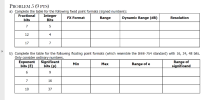
Complete the table for the following fixed point formats (signed numbers): Complete the table for the following floating point formats (which resemble the IEEE-754 standard) with 16, 24, 48 bits. On consider ordinary numbers.
how to find the dynamic range
and the FX format??!!
Complete the table for the following fixed point formats (signed numbers): Complete the table for the following floating point formats (which resemble the IEEE-754 standard) with 16, 24, 48 bits. On consider ordinary numbers.
5) What is the possible range of numbers that can be represented with the following a....
 5) What is the possible range of numbers that can be represented with the following a. 12 bits in binary b. 6 digits in hex c. 6 digits in decimal
Calculate the range (minimum and maximum numbers which can be represented) and the precision (the smallest...
Calculate the range (minimum and maximum numbers which can be represented) and the precision (the smallest non-zero representable number) of an 8-bit fixed point unsigned integer with the binary point located as shown: bbbbbb.bb, i.e. 6 bits to represent the integer part and 2 bits to represent the fractional part (each b represents a binary bit so it can be 0 or 1). Example of a number in such format could be 100101012 = 1×2+5 + 0×2+4 + 0×2+3 +...
Watching a YouTube tutorial on how to convert decimal to floating point numbers (IEEE 754) and...
 Watching a YouTube tutorial on how to convert decimal to
floating point numbers (IEEE 754) and normalisation may prove to be
beneficial.
Watching a YouTube tutorial on how to convert decimal to floating point numbers (IEEE 754) may prove to be beneficial Convert the decimal number to 32 bits I Decimal number 18 to its binary equivalent I. 18 normalized in binary: 1.-2刈2n) II Biased exponent: 10 IV. Conversion to EE 754 16 I: 10, For ii please normalize the...
Watching a YouTube tutorial on how to convert decimal to
floating point numbers (IEEE 754) and normalisation may prove to be
beneficial.
Watching a YouTube tutorial on how to convert decimal to floating point numbers (IEEE 754) may prove to be beneficial Convert the decimal number to 32 bits I Decimal number 18 to its binary equivalent I. 18 normalized in binary: 1.-2刈2n) II Biased exponent: 10 IV. Conversion to EE 754 16 I: 10, For ii please normalize the...
The answer below is correct, but can you guys show me how to get it? I...
 The answer below is correct, but can you guys show me
how to get it? I need conplete solution. thanks
Consider a 16-bit floating-point representation based on the IEEE floating-point format, with one sign bit, seven exponent bits (k=7), and eight fraction bits (n:8). The exponent bias is 27-1-1-63. Fill in the table that follows for each of the numbers given, with the following instructions for each column: Hex: the four hexadecimal digits describing the encoded form. M the value...
The answer below is correct, but can you guys show me
how to get it? I need conplete solution. thanks
Consider a 16-bit floating-point representation based on the IEEE floating-point format, with one sign bit, seven exponent bits (k=7), and eight fraction bits (n:8). The exponent bias is 27-1-1-63. Fill in the table that follows for each of the numbers given, with the following instructions for each column: Hex: the four hexadecimal digits describing the encoded form. M the value...
2.) What is the largest positive number in decimal, that can be represented using 8 bits?...
2.) What is the largest positive number in decimal, that can be represented using 8 bits? Each groups of binary numbers can be represented more compactly in base-16 numbering, which is called hexadecimal. The hexadecimal digits are 0,1,2,3,4,5,6,7,8,9,A,B,C,D,E,F. 3.) What range of positive decimal numbers can one hexadecimal digit represent? Colors on a computer monitor are represented by 6 hexadecimal numbers, the first pair to the left specifies the amount of red to display, the middle pair of numbers specify...
I would like a step by step explanation as to how the 7-bit floating point representations...
I would like a step by step explanation as to how the 7-bit floating point representations from Format A were converted to Format B. Thanks. Consider the following two 7-bit floating point representations based on the IEEE floating point format. Neither has a sign bit - they can only represent non-negative numbers. i). Format A. There are k=3 exponent bits. The exponent bias is 3. There are n=4 fraction bits. ii). Format B. There are k=4 exponent bits. The exponent...
I would like a step by step explanation as to how the 7-bit floating point representations from Format A were converted...
I would like a step by step explanation as to how the 7-bit floating point representations from Format A were converted to Format B. Thanks. Consider the following two 7-bit floating point representations based on the IEEE floating point format. Neither has a sign bit - they can only represent non-negative numbers. i). Format A. There are k=3 exponent bits. The exponent bias is 3. There are n=4 fraction bits. ii). Format B. There are k=4 exponent bits. The exponent...
How do I figure this out?
 This is my homework assignment, I do not want the answer, just want to know how to do this, as I cannot find any information within the textbook on how to figure this out. What am I supposed to be doing to get this answer?
To write a C program (not C++) that converts numbers between Decimal and IEEE-754 format and...
To write a C program (not C++) that converts numbers between Decimal and IEEE-754 format and vice versa. Inputs: Number in Decimal format (including special case of 0) Number in IEEE-754 format (including special cases) Output: Equivalent number in IEEE-754 format Equivalent number in Decimal Specification: The program converts a number based on choosing from a menu of choices, where each choice calls the appropriate procedure, where the choices are: Decimal to IEEE-754 conversion IEEE-754 to Decimal conversion Quit program...
 how to find the dynamic range
and the FX format??!!
Complete the table for the following fixed point formats (signed numbers): Complete the table for the following floating point formats (which resemble the IEEE-754 standard) with 16, 24, 48 bits. On consider ordinary numbers.
how to find the dynamic range
and the FX format??!!
Complete the table for the following fixed point formats (signed numbers): Complete the table for the following floating point formats (which resemble the IEEE-754 standard) with 16, 24, 48 bits. On consider ordinary numbers.
 5) What is the possible range of numbers that can be represented with the following a. 12 bits in binary b. 6 digits in hex c. 6 digits in decimal
 Watching a YouTube tutorial on how to convert decimal to
floating point numbers (IEEE 754) and normalisation may prove to be
beneficial.
Watching a YouTube tutorial on how to convert decimal to floating point numbers (IEEE 754) may prove to be beneficial Convert the decimal number to 32 bits I Decimal number 18 to its binary equivalent I. 18 normalized in binary: 1.-2刈2n) II Biased exponent: 10 IV. Conversion to EE 754 16 I: 10, For ii please normalize the...
Watching a YouTube tutorial on how to convert decimal to
floating point numbers (IEEE 754) and normalisation may prove to be
beneficial.
Watching a YouTube tutorial on how to convert decimal to floating point numbers (IEEE 754) may prove to be beneficial Convert the decimal number to 32 bits I Decimal number 18 to its binary equivalent I. 18 normalized in binary: 1.-2刈2n) II Biased exponent: 10 IV. Conversion to EE 754 16 I: 10, For ii please normalize the...
 The answer below is correct, but can you guys show me
how to get it? I need conplete solution. thanks
Consider a 16-bit floating-point representation based on the IEEE floating-point format, with one sign bit, seven exponent bits (k=7), and eight fraction bits (n:8). The exponent bias is 27-1-1-63. Fill in the table that follows for each of the numbers given, with the following instructions for each column: Hex: the four hexadecimal digits describing the encoded form. M the value...
The answer below is correct, but can you guys show me
how to get it? I need conplete solution. thanks
Consider a 16-bit floating-point representation based on the IEEE floating-point format, with one sign bit, seven exponent bits (k=7), and eight fraction bits (n:8). The exponent bias is 27-1-1-63. Fill in the table that follows for each of the numbers given, with the following instructions for each column: Hex: the four hexadecimal digits describing the encoded form. M the value...
Most questions answered within 3 hours.
-
Where is the error in this code sequence?
String s1 = "Hello";
String s2 = "ello";...
asked 10 months ago -
Financial data for Joel de Paris, Inc., for last year
follow:
Joel de Paris, Inc.
Balance...
asked 10 months ago -
Consider this reaction:
Al2(SO4)3 (aq)+ BaCl3
(aq) Al2Cl6 (aq)- +
3BaSO4(s) . What is the...
asked 10 months ago -
Suppose that Savneet is considering increasing her
recent random sample from 20 car rentals to 40...
asked 10 months ago -
Trucks arrive at an unloading terminal at an average rate of 120
per hour.
Trucks arrive...
asked 10 months ago -
Why are methanol and ethanol completely soluble in water while
octanol is not very little soluble....
asked 10 months ago -
A facilities manager at a university reads in a research report
that the mean amount of...
asked 10 months ago -
When the CuSO4 is rehydrated by adding water to the anhydrous
compound, is this an endothermic...
asked 10 months ago -
A ray of sunlight is passing from diamond into crown glass; the
angle of incidence is...
asked 10 months ago -
A block of mass 0.249 kg is placed on top of a light, vertical
spring of...
asked 10 months ago -
how do the kidneys compensate in the presences of acidosis
a) trigger hyperventilate
b) reserve acid...
asked 10 months ago -
Question 501 pts
The rental rate of capital to the firm increases. Which of the
following...
asked 10 months ago