1. Why must both switches of the circuit be closed when adjusting the terminal voltage on...
1. Why must both switches of the circuit be closed when adjusting the terminal voltage on the power supply?
2. Whenever you are calculating the currents in a circuit using kirchhoff's rules, if you should calculate a negative value for a current, what does that mean?
Homework Answers
1. Why must both switches of the circuit be closed when adjusting the terminal voltage on the power supply?
Both the switches must be switchwed off because the fluctuation in voltage might destroy the components attached to it, can lead to sudden increase in the current which might damage the wires, resistors, and can even lead to fire.
2. Whenever you are calculating the currents in a circuit using kirchhoff's rules, if you should calculate a negative value for a current, what does that mean?
If you have to calculate or calculated a negative value of current, this means the current flows in the opposite direction form the direction you have assumed or given previously in the question. Ex- If in a circuit you assume the current flows clockwise and after calculations the value of current comes to be negative. This you had assumed the wrong direction of current in that circuit, the current will be in just opposite direction.
Add Answer to:
1. Why must both switches of the circuit be closed when
adjusting the terminal voltage on...
1. What are the two Kirchhoff's rules regarding circuit analysis 2. While using Kirchhoff's rules to...
 1. What are the two Kirchhoff's rules regarding circuit analysis 2. While using Kirchhoff's rules to calculate the current, if a value comes out negative, what does it signify? 3. For the circuit shown, calculate the three currents. Use the directions of the currents as shown. 50 12 15 V 13 6Ω 11 8Ω 12 V 702
126 S. Consider the large circuit shown in Figure 3, where the components have the following values: We will use...
 126 S. Consider the large circuit shown in Figure 3, where the components have the following values: We will use Kirchhoff's rules to calculate the current passing through each of the nineteen circuit components. ineteen components in this circuit, there are only twelve through two components that are in series. After considering this fact, draw twelve arrows on Figure 3, indicating twelve distinct currents. Label these currents as 112 These twelve currents are unknown, and we wish to find their...
Question 1 (15 Marks): The electrical circuit shown consists of resistors and voltage sources. We can determine the current in each resistor, using the mesh current method based on Kirchhoffs voltage...
 Question 1 (15 Marks): The electrical circuit shown consists of resistors and voltage sources. We can determine the current in each resistor, using the mesh current method based on Kirchhoffs voltage law. (Kirchhoff's voltage law states that the sum of the voltage around a closed circuit is zero) 2 Σ vsource-IR = 0 i3 IH - Note: if two currents passes through one resistor we should use difference or summation between them based on direction of the currents i.e ii-j^,....
ANALYSIS Use your experimental results to analyze the circuit in terms of Kirchhoff net current fow...
 ANALYSIS Use your experimental results to analyze the circuit in terms of Kirchhoff net current fow into and out of each of the four nodes, and determine whetheC s Rules. Consider supported by your data. Determine the net voltage drop around at leaston Sign determine whether or not your data supports the loop rule. (Pay close attosed loops convention.) In adition, verify ir Ohm's law is satisfied for at least three resistors and for the total reji >Q12: Why do...
Do both questions please. Thanks. Which of the following statements about Kirchhoff's Current Law (KCL) below...
 Do both questions please. Thanks.
Which of the following statements about Kirchhoff's Current Law (KCL) below are true? ■ The sum of currents going into the node equals the sum of the currents leaving the node Currents going into the node are always assumed to have a positive sign ■ KCL is derived from conservation of electric charge (ie charge cannot build up at a node) KCL cannot be applied to a node connected to a voltage controlled current source...
Do both questions please. Thanks.
Which of the following statements about Kirchhoff's Current Law (KCL) below are true? ■ The sum of currents going into the node equals the sum of the currents leaving the node Currents going into the node are always assumed to have a positive sign ■ KCL is derived from conservation of electric charge (ie charge cannot build up at a node) KCL cannot be applied to a node connected to a voltage controlled current source...
Figure shown above has six reisitors connected to a power supply of 20 V.When the switches...
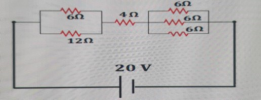 Figure shown above has six reisitors connected to a
power supply of 20 V.When the switches
are closed ,using value of effective resistance, how wiil you
evaluate the total current passing
through the entire circuit ? How would you use circuit to predict
the total power dissipated in it?
Explain the reason why connecting wires are made of copper?
20 v HE
Figure shown above has six reisitors connected to a
power supply of 20 V.When the switches
are closed ,using value of effective resistance, how wiil you
evaluate the total current passing
through the entire circuit ? How would you use circuit to predict
the total power dissipated in it?
Explain the reason why connecting wires are made of copper?
20 v HE
1)If one measures the current in series resistors, is the current measured before the resistors different...
1)If one measures the current in series resistors, is the current measured before the resistors different than what measured between the two resistors? a) no difference, current is the same b) the difference depends on the direction of the current c)the current after the first resistor will decrease d) yes, they are different If one measures the current in parallel resistors, are the currents in parallel resistors always the same? a) no, only currents in series resistors are the same...
You are analyzing a complex circuit with Kirchhoff's Laws. When writing the voltage equation for one...
 You are analyzing a complex circuit with Kirchhoff's Laws. When writing the voltage equation for one of the loops, what sign do you give the voltage change across a resistor, depending on the current through it? positive no matter what the direction positive in the same direction as the current, negative in the opposite direction negative in the same direction as the current, positive in the opposite direction negative no matter what the direction
HOMEWORK FOR LAB 7 KIRCHHOFF'S CIRCUIT RULES Find the equivalent resistance of the followine etwock. Alles...
 HOMEWORK FOR LAB 7 KIRCHHOFF'S CIRCUIT RULES Find the equivalent resistance of the followine etwock. Alles in ohms.) Show your work below. 1. network (All resistances are potential 2. Show on the circuit diagram in Question 1 how you would connect a mu meter to measure the current through the 8-n resistor a. Explain why the multimeter is connected in this way. has a low vesitity so it would difference. b. What characteristic of a good multimeter allows you to...
please answer both 4 and 5 if possible thank you Multi-loop complex circuits: In All the...
 please answer both 4 and 5 if possible thank you
Multi-loop complex circuits: In All the circuit problems below, use Kirchhoffs Law. The use of Kirchhoff's law greatly simplifies the circuit problem especially with multi loop cireuits. 4. (a) Calculate the currents I, Iz and the emf of the battery e in the circuit below (0.71 A. 2.3 A and 19 Vrespectively) ) Calculate the voltage and power dissipated across the 4.5 resistor (10 V and 24 W) 3.00 4.5Q...
please answer both 4 and 5 if possible thank you
Multi-loop complex circuits: In All the circuit problems below, use Kirchhoffs Law. The use of Kirchhoff's law greatly simplifies the circuit problem especially with multi loop cireuits. 4. (a) Calculate the currents I, Iz and the emf of the battery e in the circuit below (0.71 A. 2.3 A and 19 Vrespectively) ) Calculate the voltage and power dissipated across the 4.5 resistor (10 V and 24 W) 3.00 4.5Q...
 1. What are the two Kirchhoff's rules regarding circuit analysis 2. While using Kirchhoff's rules to calculate the current, if a value comes out negative, what does it signify? 3. For the circuit shown, calculate the three currents. Use the directions of the currents as shown. 50 12 15 V 13 6Ω 11 8Ω 12 V 702
 126 S. Consider the large circuit shown in Figure 3, where the components have the following values: We will use Kirchhoff's rules to calculate the current passing through each of the nineteen circuit components. ineteen components in this circuit, there are only twelve through two components that are in series. After considering this fact, draw twelve arrows on Figure 3, indicating twelve distinct currents. Label these currents as 112 These twelve currents are unknown, and we wish to find their...
 Question 1 (15 Marks): The electrical circuit shown consists of resistors and voltage sources. We can determine the current in each resistor, using the mesh current method based on Kirchhoffs voltage law. (Kirchhoff's voltage law states that the sum of the voltage around a closed circuit is zero) 2 Σ vsource-IR = 0 i3 IH - Note: if two currents passes through one resistor we should use difference or summation between them based on direction of the currents i.e ii-j^,....
 ANALYSIS Use your experimental results to analyze the circuit in terms of Kirchhoff net current fow into and out of each of the four nodes, and determine whetheC s Rules. Consider supported by your data. Determine the net voltage drop around at leaston Sign determine whether or not your data supports the loop rule. (Pay close attosed loops convention.) In adition, verify ir Ohm's law is satisfied for at least three resistors and for the total reji >Q12: Why do...
 Do both questions please. Thanks.
Which of the following statements about Kirchhoff's Current Law (KCL) below are true? ■ The sum of currents going into the node equals the sum of the currents leaving the node Currents going into the node are always assumed to have a positive sign ■ KCL is derived from conservation of electric charge (ie charge cannot build up at a node) KCL cannot be applied to a node connected to a voltage controlled current source...
Do both questions please. Thanks.
Which of the following statements about Kirchhoff's Current Law (KCL) below are true? ■ The sum of currents going into the node equals the sum of the currents leaving the node Currents going into the node are always assumed to have a positive sign ■ KCL is derived from conservation of electric charge (ie charge cannot build up at a node) KCL cannot be applied to a node connected to a voltage controlled current source...
 Figure shown above has six reisitors connected to a
power supply of 20 V.When the switches
are closed ,using value of effective resistance, how wiil you
evaluate the total current passing
through the entire circuit ? How would you use circuit to predict
the total power dissipated in it?
Explain the reason why connecting wires are made of copper?
20 v HE
Figure shown above has six reisitors connected to a
power supply of 20 V.When the switches
are closed ,using value of effective resistance, how wiil you
evaluate the total current passing
through the entire circuit ? How would you use circuit to predict
the total power dissipated in it?
Explain the reason why connecting wires are made of copper?
20 v HE
 You are analyzing a complex circuit with Kirchhoff's Laws. When writing the voltage equation for one of the loops, what sign do you give the voltage change across a resistor, depending on the current through it? positive no matter what the direction positive in the same direction as the current, negative in the opposite direction negative in the same direction as the current, positive in the opposite direction negative no matter what the direction
 HOMEWORK FOR LAB 7 KIRCHHOFF'S CIRCUIT RULES Find the equivalent resistance of the followine etwock. Alles in ohms.) Show your work below. 1. network (All resistances are potential 2. Show on the circuit diagram in Question 1 how you would connect a mu meter to measure the current through the 8-n resistor a. Explain why the multimeter is connected in this way. has a low vesitity so it would difference. b. What characteristic of a good multimeter allows you to...
 please answer both 4 and 5 if possible thank you
Multi-loop complex circuits: In All the circuit problems below, use Kirchhoffs Law. The use of Kirchhoff's law greatly simplifies the circuit problem especially with multi loop cireuits. 4. (a) Calculate the currents I, Iz and the emf of the battery e in the circuit below (0.71 A. 2.3 A and 19 Vrespectively) ) Calculate the voltage and power dissipated across the 4.5 resistor (10 V and 24 W) 3.00 4.5Q...
please answer both 4 and 5 if possible thank you
Multi-loop complex circuits: In All the circuit problems below, use Kirchhoffs Law. The use of Kirchhoff's law greatly simplifies the circuit problem especially with multi loop cireuits. 4. (a) Calculate the currents I, Iz and the emf of the battery e in the circuit below (0.71 A. 2.3 A and 19 Vrespectively) ) Calculate the voltage and power dissipated across the 4.5 resistor (10 V and 24 W) 3.00 4.5Q...
Most questions answered within 3 hours.
-
Where is the error in this code sequence?
String s1 = "Hello";
String s2 = "ello";...
asked 11 months ago -
Financial data for Joel de Paris, Inc., for last year
follow:
Joel de Paris, Inc.
Balance...
asked 11 months ago -
Consider this reaction:
Al2(SO4)3 (aq)+ BaCl3
(aq) Al2Cl6 (aq)- +
3BaSO4(s) . What is the...
asked 11 months ago -
Suppose that Savneet is considering increasing her
recent random sample from 20 car rentals to 40...
asked 11 months ago -
Trucks arrive at an unloading terminal at an average rate of 120
per hour.
Trucks arrive...
asked 11 months ago -
Why are methanol and ethanol completely soluble in water while
octanol is not very little soluble....
asked 11 months ago -
A facilities manager at a university reads in a research report
that the mean amount of...
asked 11 months ago -
When the CuSO4 is rehydrated by adding water to the anhydrous
compound, is this an endothermic...
asked 11 months ago -
A ray of sunlight is passing from diamond into crown glass; the
angle of incidence is...
asked 11 months ago -
A block of mass 0.249 kg is placed on top of a light, vertical
spring of...
asked 11 months ago -
how do the kidneys compensate in the presences of acidosis
a) trigger hyperventilate
b) reserve acid...
asked 11 months ago -
Question 501 pts
The rental rate of capital to the firm increases. Which of the
following...
asked 11 months ago