
Homework Answers
Add Answer to:
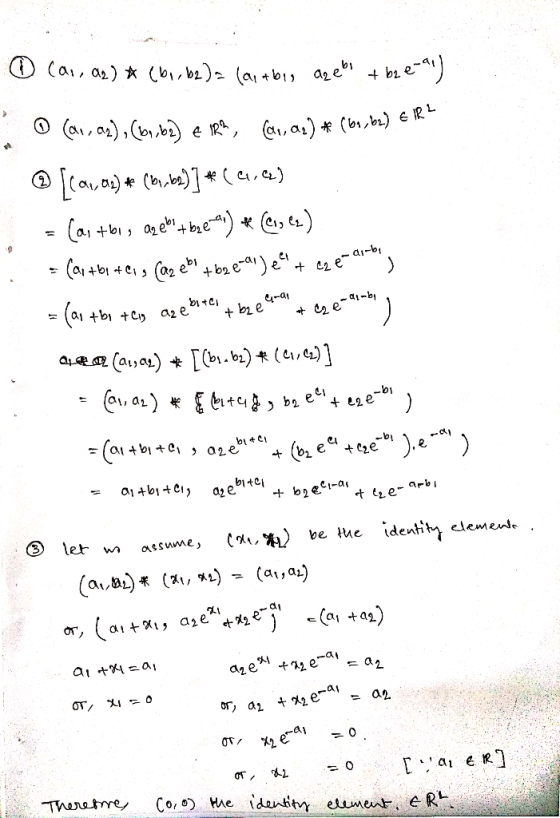
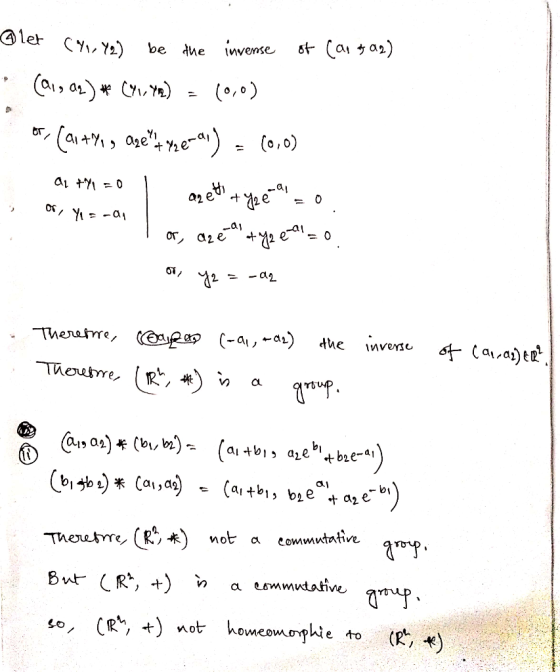
Problem 4 (10 points) On the set R2, we define the following operation (ait a ,...
(10 points) The set G = {a e Qla #0} is closed under the binary operation...
 (10 points) The set G = {a e Qla #0} is closed under the binary operation a * b ab 3 Prove that (G, *) is an abelian group.
Problem 68. Define for any 2 n є N, the set U(n)-(x| 1 x n and...
 Problem 68. Define for any 2 n є N, the set U(n)-(x| 1 x n and gcd(z, n-1} For example U(12) 1,5,7,11 Further, define n to be multiplication modulo n. For example 9 10 90 (mod 8) 2. i. Show that o is a binary operation on U/). Hint: Use the lemma from Problem 3 on your take-home exam.) ii. Pick a є N. Prove that a: 1 (mod n) has a solution (some number z є U(n)) if and...
The set G = {a ∈ Q| a≠0} is closed under the binary operation a ∗...
 The set G = {a ∈ Q| a≠0} is closed under the binary operation a
∗ b = ab/3 . Prove that (G, ∗) is an abelian group.
4. (10 points) The set G = {a e Qla #0} is closed under the binary operation a*b = ab 3 Prove that (G, *) is an abelian group.
The set G = {a ∈ Q| a≠0} is closed under the binary operation a
∗ b = ab/3 . Prove that (G, ∗) is an abelian group.
4. (10 points) The set G = {a e Qla #0} is closed under the binary operation a*b = ab 3 Prove that (G, *) is an abelian group.
4. (a) For n eZ, define multiplication mod n by ao b-a b (where indicates regular...
 4. (a) For n eZ, define multiplication mod n by ao b-a b (where indicates regular real number multiplication), prove that On is a binary operation on Zn. That is, (Hint your proof will be very similar to the proof for homework 4 problem 7ab) (b) Let n E Z. Is the binary algebraic structure 〈L,On) always a group? Explain. (c) Prove There exists be Zn such that a n I if and only if (a, n)1. (d) It is...
Problem 4. Determine if the following sets B1, B2, B3, B4 and Bs are open, closed,...
 Problem 4. Determine if the following sets B1, B2, B3, B4 and Bs are open, closed, compact or connected. (You don't need to prove your findings here) a) B1 =RQ. b) We define the set B2 iteratively: C1 = [0, 1] C2 =[0,1/4] U [3/4, 1] C3 =[0,1/16] U [3/16, 4/16] U [12/16, 13/16] U [15/16, 1] Then B2 = n Cn. NEN c) B3 = U (2-7,3+"). nn +1 NEN d) f:R+R continuous and V CR closed. B4 =...
3. Now suppose that (a,b), (a2, b2),..., (aq, be) are l distinct points on R2. Let...
 3. Now suppose that (a,b), (a2, b2),..., (aq, be) are l distinct points on R2. Let X be the set formed by these l points. Prove that there are l vector fields F1, F2,..., Fe, each defined on R2X (the set R2 without the points in X), with the following properties: (i) curl F; = 0 on RP X for all i = 1, ..., l. (ii) (“linearly independent”) If C1,C2, ..., Ce are real numbers such that the vector...
Problem 7a please. Chapter 4 Be able to define an interpolating polynomial for a set of...
 Problem 7a please.
Chapter 4 Be able to define an interpolating polynomial for a set of points, and a Cardinal Polynomial. Be able to use Cardinal polynomials to prove the existence of interpolating polynomials, and be able to prove they are unique Be able to state and prove the Recursive Property of divided differences (18. 134) nnd the Invariance Theorem (pg. 135). Problem 7a. Consider the points (1.1),(2,5), (5.41). Find the corresponding Cardinal polynomials and use them to construct the...
Problem 7a please.
Chapter 4 Be able to define an interpolating polynomial for a set of points, and a Cardinal Polynomial. Be able to use Cardinal polynomials to prove the existence of interpolating polynomials, and be able to prove they are unique Be able to state and prove the Recursive Property of divided differences (18. 134) nnd the Invariance Theorem (pg. 135). Problem 7a. Consider the points (1.1),(2,5), (5.41). Find the corresponding Cardinal polynomials and use them to construct the...
Problem 1 [10 points] Prove that if A is a nonempty set of real numbers with...
 Problem 1 [10 points] Prove that if A is a nonempty set of real numbers with a lower bound and B is a nonempty subset of A, then inf A <inf B. Problem 2 [10 points) Let A be a nonempty set of real numbers with a lower bound. Prove there exists a sequence (ar) =1 such that are A for all n and we have limntan = inf A.
12. [10 bonus points) Let us define an operation truncate, which removes the rightmost symbol from...
 12. [10 bonus points) Let us define an operation truncate, which removes the rightmost symbol from any string. For example, truncate (aaaba) is aaab. The operation can be extended to languages by truncate(L) = {truncate (w): WE L} Show how, given a DFA for any regular language L, one can construct a DFA for truncate(L). From this, prove that if L is a regular language not containing 1, then truncate(L) is also regular.
c We define the operation * on subsets of a universal set U as follows. For...
 c
We define the operation * on subsets of a universal set U as follows. For any two sets A and B: A*B:= AUB Answer the following questions using the Laws of Set Operations and any derived results given in lec- tures) to justify your answer: (a) What is (A + B) * (A*B)? (b) Express A using only A, * and parentheses (if necessary). (c) Express using only A, * and parentheses (if necessary). (d) Express A | B...
c
We define the operation * on subsets of a universal set U as follows. For any two sets A and B: A*B:= AUB Answer the following questions using the Laws of Set Operations and any derived results given in lec- tures) to justify your answer: (a) What is (A + B) * (A*B)? (b) Express A using only A, * and parentheses (if necessary). (c) Express using only A, * and parentheses (if necessary). (d) Express A | B...
 (10 points) The set G = {a e Qla #0} is closed under the binary operation a * b ab 3 Prove that (G, *) is an abelian group.
 Problem 68. Define for any 2 n є N, the set U(n)-(x| 1 x n and gcd(z, n-1} For example U(12) 1,5,7,11 Further, define n to be multiplication modulo n. For example 9 10 90 (mod 8) 2. i. Show that o is a binary operation on U/). Hint: Use the lemma from Problem 3 on your take-home exam.) ii. Pick a є N. Prove that a: 1 (mod n) has a solution (some number z є U(n)) if and...
 The set G = {a ∈ Q| a≠0} is closed under the binary operation a
∗ b = ab/3 . Prove that (G, ∗) is an abelian group.
4. (10 points) The set G = {a e Qla #0} is closed under the binary operation a*b = ab 3 Prove that (G, *) is an abelian group.
The set G = {a ∈ Q| a≠0} is closed under the binary operation a
∗ b = ab/3 . Prove that (G, ∗) is an abelian group.
4. (10 points) The set G = {a e Qla #0} is closed under the binary operation a*b = ab 3 Prove that (G, *) is an abelian group.
 4. (a) For n eZ, define multiplication mod n by ao b-a b (where indicates regular real number multiplication), prove that On is a binary operation on Zn. That is, (Hint your proof will be very similar to the proof for homework 4 problem 7ab) (b) Let n E Z. Is the binary algebraic structure 〈L,On) always a group? Explain. (c) Prove There exists be Zn such that a n I if and only if (a, n)1. (d) It is...
 Problem 4. Determine if the following sets B1, B2, B3, B4 and Bs are open, closed, compact or connected. (You don't need to prove your findings here) a) B1 =RQ. b) We define the set B2 iteratively: C1 = [0, 1] C2 =[0,1/4] U [3/4, 1] C3 =[0,1/16] U [3/16, 4/16] U [12/16, 13/16] U [15/16, 1] Then B2 = n Cn. NEN c) B3 = U (2-7,3+"). nn +1 NEN d) f:R+R continuous and V CR closed. B4 =...
 3. Now suppose that (a,b), (a2, b2),..., (aq, be) are l distinct points on R2. Let X be the set formed by these l points. Prove that there are l vector fields F1, F2,..., Fe, each defined on R2X (the set R2 without the points in X), with the following properties: (i) curl F; = 0 on RP X for all i = 1, ..., l. (ii) (“linearly independent”) If C1,C2, ..., Ce are real numbers such that the vector...
 Problem 7a please.
Chapter 4 Be able to define an interpolating polynomial for a set of points, and a Cardinal Polynomial. Be able to use Cardinal polynomials to prove the existence of interpolating polynomials, and be able to prove they are unique Be able to state and prove the Recursive Property of divided differences (18. 134) nnd the Invariance Theorem (pg. 135). Problem 7a. Consider the points (1.1),(2,5), (5.41). Find the corresponding Cardinal polynomials and use them to construct the...
Problem 7a please.
Chapter 4 Be able to define an interpolating polynomial for a set of points, and a Cardinal Polynomial. Be able to use Cardinal polynomials to prove the existence of interpolating polynomials, and be able to prove they are unique Be able to state and prove the Recursive Property of divided differences (18. 134) nnd the Invariance Theorem (pg. 135). Problem 7a. Consider the points (1.1),(2,5), (5.41). Find the corresponding Cardinal polynomials and use them to construct the...
 Problem 1 [10 points] Prove that if A is a nonempty set of real numbers with a lower bound and B is a nonempty subset of A, then inf A <inf B. Problem 2 [10 points) Let A be a nonempty set of real numbers with a lower bound. Prove there exists a sequence (ar) =1 such that are A for all n and we have limntan = inf A.
 12. [10 bonus points) Let us define an operation truncate, which removes the rightmost symbol from any string. For example, truncate (aaaba) is aaab. The operation can be extended to languages by truncate(L) = {truncate (w): WE L} Show how, given a DFA for any regular language L, one can construct a DFA for truncate(L). From this, prove that if L is a regular language not containing 1, then truncate(L) is also regular.
 c
We define the operation * on subsets of a universal set U as follows. For any two sets A and B: A*B:= AUB Answer the following questions using the Laws of Set Operations and any derived results given in lec- tures) to justify your answer: (a) What is (A + B) * (A*B)? (b) Express A using only A, * and parentheses (if necessary). (c) Express using only A, * and parentheses (if necessary). (d) Express A | B...
c
We define the operation * on subsets of a universal set U as follows. For any two sets A and B: A*B:= AUB Answer the following questions using the Laws of Set Operations and any derived results given in lec- tures) to justify your answer: (a) What is (A + B) * (A*B)? (b) Express A using only A, * and parentheses (if necessary). (c) Express using only A, * and parentheses (if necessary). (d) Express A | B...
Most questions answered within 3 hours.
-
Where is the error in this code sequence?
String s1 = "Hello";
String s2 = "ello";...
asked 10 months ago -
Financial data for Joel de Paris, Inc., for last year
follow:
Joel de Paris, Inc.
Balance...
asked 10 months ago -
Consider this reaction:
Al2(SO4)3 (aq)+ BaCl3
(aq) Al2Cl6 (aq)- +
3BaSO4(s) . What is the...
asked 10 months ago -
Suppose that Savneet is considering increasing her
recent random sample from 20 car rentals to 40...
asked 10 months ago -
Trucks arrive at an unloading terminal at an average rate of 120
per hour.
Trucks arrive...
asked 10 months ago -
Why are methanol and ethanol completely soluble in water while
octanol is not very little soluble....
asked 10 months ago -
A facilities manager at a university reads in a research report
that the mean amount of...
asked 10 months ago -
When the CuSO4 is rehydrated by adding water to the anhydrous
compound, is this an endothermic...
asked 10 months ago -
A ray of sunlight is passing from diamond into crown glass; the
angle of incidence is...
asked 10 months ago -
A block of mass 0.249 kg is placed on top of a light, vertical
spring of...
asked 10 months ago -
how do the kidneys compensate in the presences of acidosis
a) trigger hyperventilate
b) reserve acid...
asked 10 months ago -
Question 501 pts
The rental rate of capital to the firm increases. Which of the
following...
asked 10 months ago