Homework Answers
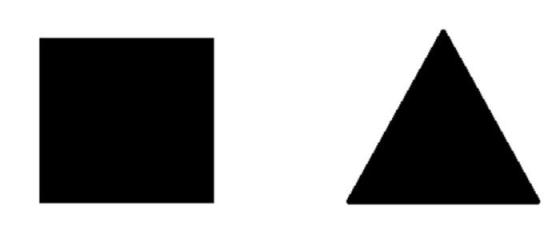
Here is the code that will detect the shapes and will also detect the squares and triangles differently
Make sure you install required packages like opencv etc
/**
 * Simple shape detector program.
 * It loads an image and tries to find simple shapes (rectangle, triangle, circle, squares etc) in it.

 */
#include <opencv2/highgui/highgui.hpp>
#include <opencv2/imgproc/imgproc.hpp>
#include <cmath>
#include <iostream>

/**
 * Helper function to find a cosine of angle between vectors
 * from pt0->pt1 and pt0->pt2
 */
static double angle(cv::Point pt1, cv::Point pt2, cv::Point pt0)
{
        double dx1 = pt1.x - pt0.x;
        double dy1 = pt1.y - pt0.y;
        double dx2 = pt2.x - pt0.x;
        double dy2 = pt2.y - pt0.y;
        return (dx1*dx2 + dy1*dy2)/sqrt((dx1*dx1 + dy1*dy1)*(dx2*dx2 + dy2*dy2) + 1e-10);
}

/**
 * Helper function to display text in the center of a contour
 */
void setLabel(cv::Mat& im, const std::string label, std::vector<cv::Point>& contour)
{
        int fontface = cv::FONT_HERSHEY_SIMPLEX;
        double scale = 0.4;
        int thickness = 1;
        int baseline = 0;

        cv::Size text = cv::getTextSize(label, fontface, scale, thickness, &baseline);
        cv::Rect r = cv::boundingRect(contour);

        cv::Point pt(r.x + ((r.width - text.width) / 2), r.y + ((r.height + text.height) / 2));
        cv::rectangle(im, pt + cv::Point(0, baseline), pt + cv::Point(text.width, -text.height), CV_RGB(255,255,255), CV_FILLED);
        cv::putText(im, label, pt, fontface, scale, CV_RGB(0,0,0), thickness, 8);
}

int main()
{
        //cv::Mat src = cv::imread("polygon.png");
        cv::Mat src = cv::imread("assets/basic-shapes-2.png");
        if (src.empty())
                return -1;

        // Convert to grayscale
        cv::Mat gray;
        cv::cvtColor(src, gray, CV_BGR2GRAY);

        // Use Canny instead of threshold to catch squares with gradient shading
        cv::Mat bw;
        cv::Canny(gray, bw, 0, 50, 5);

        // Find contours
        std::vector<std::vector<cv::Point> > contours;
        cv::findContours(bw.clone(), contours, CV_RETR_EXTERNAL, CV_CHAIN_APPROX_SIMPLE);

        std::vector<cv::Point> approx;
        cv::Mat dst = src.clone();

        for (int i = 0; i < contours.size(); i++)
        {
                // Approximate contour with accuracy proportional
                // to the contour perimeter
                cv::approxPolyDP(cv::Mat(contours[i]), approx, cv::arcLength(cv::Mat(contours[i]), true)*0.02, true);

                // Skip small or non-convex objects
                if (std::fabs(cv::contourArea(contours[i])) < 100 || !cv::isContourConvex(approx))
                        continue;

                if (approx.size() == 3)
                {
                        setLabel(dst, "TRI", contours[i]);    // Triangles
                }
                else if (approx.size() >= 4 && approx.size() <= 6)
                {
                        // Number of vertices of polygonal curve
                        int vtc = approx.size();

                        // Get the cosines of all corners
                        std::vector<double> cos;
                        for (int j = 2; j < vtc+1; j++)
                                cos.push_back(angle(approx[j%vtc], approx[j-2], approx[j-1]));

                        // Sort ascending the cosine values
                        std::sort(cos.begin(), cos.end());

                        // Get the lowest and the highest cosine
                        double mincos = cos.front();
                        double maxcos = cos.back();

                        // Use the degrees obtained above and the number of vertices
                        // to determine the shape of the contour
                        if (vtc == 4 && mincos >= -0.1 && maxcos <= 0.3)
                                setLabel(dst, "RECT", contours[i]);
                        else if (vtc == 5 && mincos >= -0.34 && maxcos <= -0.27)
                                setLabel(dst, "PENTA", contours[i]);
                        else if (vtc == 6 && mincos >= -0.55 && maxcos <= -0.45)
                                setLabel(dst, "HEXA", contours[i]);
                }
                else
                {
                        // Detect and label circles
                        double area = cv::contourArea(contours[i]);
                        cv::Rect r = cv::boundingRect(contours[i]);
                        int radius = r.width / 2;

                        if (std::abs(1 - ((double)r.width / r.height)) <= 0.2 &&
                            std::abs(1 - (area / (CV_PI * std::pow(radius, 2)))) <= 0.2)
                                setLabel(dst, "CIR", contours[i]);
                }
        }

        cv::imshow("src", src);
        cv::imshow("dst", dst);
        cv::waitKey(0);
        return 0;
}
Please comment if you have issues while running the code
Also if it shows the following error
fatal error: opencv2/highgui/highgui.hpp: No such file or directory
6 | #include <opencv2/highgui/highgui.hpp>
kindly do the following
if using linux install the package like this
~$ sudo apt-get install libopencv-highgui-dev
Here is the code that will detect the shapes and will also detect the squares and triangles differently
Make sure you install required packages like opencv etc
/**
 * Simple shape detector program.
 * It loads an image and tries to find simple shapes (rectangle, triangle, circle, squares etc) in it.

 */
#include <opencv2/highgui/highgui.hpp>
#include <opencv2/imgproc/imgproc.hpp>
#include <cmath>
#include <iostream>

/**
 * Helper function to find a cosine of angle between vectors
 * from pt0->pt1 and pt0->pt2
 */
static double angle(cv::Point pt1, cv::Point pt2, cv::Point pt0)
{
        double dx1 = pt1.x - pt0.x;
        double dy1 = pt1.y - pt0.y;
        double dx2 = pt2.x - pt0.x;
        double dy2 = pt2.y - pt0.y;
        return (dx1*dx2 + dy1*dy2)/sqrt((dx1*dx1 + dy1*dy1)*(dx2*dx2 + dy2*dy2) + 1e-10);
}

/**
 * Helper function to display text in the center of a contour
 */
void setLabel(cv::Mat& im, const std::string label, std::vector<cv::Point>& contour)
{
        int fontface = cv::FONT_HERSHEY_SIMPLEX;
        double scale = 0.4;
        int thickness = 1;
        int baseline = 0;

        cv::Size text = cv::getTextSize(label, fontface, scale, thickness, &baseline);
        cv::Rect r = cv::boundingRect(contour);

        cv::Point pt(r.x + ((r.width - text.width) / 2), r.y + ((r.height + text.height) / 2));
        cv::rectangle(im, pt + cv::Point(0, baseline), pt + cv::Point(text.width, -text.height), CV_RGB(255,255,255), CV_FILLED);
        cv::putText(im, label, pt, fontface, scale, CV_RGB(0,0,0), thickness, 8);
}

int main()
{
        //cv::Mat src = cv::imread("polygon.png");
        cv::Mat src = cv::imread("assets/basic-shapes-2.png");
        if (src.empty())
                return -1;

        // Convert to grayscale
        cv::Mat gray;
        cv::cvtColor(src, gray, CV_BGR2GRAY);

        // Use Canny instead of threshold to catch squares with gradient shading
        cv::Mat bw;
        cv::Canny(gray, bw, 0, 50, 5);

        // Find contours
        std::vector<std::vector<cv::Point> > contours;
        cv::findContours(bw.clone(), contours, CV_RETR_EXTERNAL, CV_CHAIN_APPROX_SIMPLE);

        std::vector<cv::Point> approx;
        cv::Mat dst = src.clone();

        for (int i = 0; i < contours.size(); i++)
        {
                // Approximate contour with accuracy proportional
                // to the contour perimeter
                cv::approxPolyDP(cv::Mat(contours[i]), approx, cv::arcLength(cv::Mat(contours[i]), true)*0.02, true);

                // Skip small or non-convex objects
                if (std::fabs(cv::contourArea(contours[i])) < 100 || !cv::isContourConvex(approx))
                        continue;

                if (approx.size() == 3)
                {
                        setLabel(dst, "TRI", contours[i]);    // Triangles
                }
                else if (approx.size() >= 4 && approx.size() <= 6)
                {
                        // Number of vertices of polygonal curve
                        int vtc = approx.size();

                        // Get the cosines of all corners
                        std::vector<double> cos;
                        for (int j = 2; j < vtc+1; j++)
                                cos.push_back(angle(approx[j%vtc], approx[j-2], approx[j-1]));

                        // Sort ascending the cosine values
                        std::sort(cos.begin(), cos.end());

                        // Get the lowest and the highest cosine
                        double mincos = cos.front();
                        double maxcos = cos.back();

                        // Use the degrees obtained above and the number of vertices
                        // to determine the shape of the contour
                        if (vtc == 4 && mincos >= -0.1 && maxcos <= 0.3)
                                setLabel(dst, "RECT", contours[i]);
                        else if (vtc == 5 && mincos >= -0.34 && maxcos <= -0.27)
                                setLabel(dst, "PENTA", contours[i]);
                        else if (vtc == 6 && mincos >= -0.55 && maxcos <= -0.45)
                                setLabel(dst, "HEXA", contours[i]);
                }
                else
                {
                        // Detect and label circles
                        double area = cv::contourArea(contours[i]);
                        cv::Rect r = cv::boundingRect(contours[i]);
                        int radius = r.width / 2;

                        if (std::abs(1 - ((double)r.width / r.height)) <= 0.2 &&
                            std::abs(1 - (area / (CV_PI * std::pow(radius, 2)))) <= 0.2)
                                setLabel(dst, "CIR", contours[i]);
                }
        }

        cv::imshow("src", src);
        cv::imshow("dst", dst);
        cv::waitKey(0);
        return 0;
}
Please comment if you have issues while running the code
Also if it shows the following error
fatal error: opencv2/highgui/highgui.hpp: No such file or directory
6 | #include <opencv2/highgui/highgui.hpp>
Add Answer to:
How
do you implement a program using opencv to distinguish whether the
object is triangle or...
PLEASE DO IN C# AND MAKE SURE I CAN COPY CODE IN VISUAL STUDIO Program 2:...
PLEASE DO IN C# AND MAKE SURE I CAN COPY CODE IN VISUAL STUDIO Program 2: Design (pseudocode) and implement (source code) a class called Counter. It should have one private instance variable representing the value of the counter. It should have two instance methods: increment() which adds on to the counter value and getValue() which returns the current value. After creating the Counter class, create a program that simulates tossing a coin 100 times using two Counter objects (Head...
The program output should indicate whether or not the triangle is an equilateral triangle. Use The...
The program output should indicate whether or not the triangle is an equilateral triangle. Use The triangle is equilateral. and The triangle is not equilateral. as your final outputs.\ I am using python
Resampling: Do not use any in-built functions from opencv and numpy. In general, you can use...
Resampling: Do not use any in-built functions from opencv and numpy. In general, you can use function from math library. Functions allowed for this part are: np.array(), np.matrix(), np.zeros(), np.ones(), cv2.imread(), cv2.namedWindow(), cv2.waitKey(). Write code for zooming and shrinking an image using the nearest neighbor and bilinear interpolation. The input to your program is: (i) image, (ii) transformation parameters, and (iii) interpolation method. (Can I get more of an explanation and puesdocode of how you use nearest neighbor and bilinear...
hii, can you please help me to implement a program in c# that creates a form...
hii, can you please help me to implement a program in c# that creates a form and make automatic schedule for any store. in visual studio 2019, create a schedule maker . how to read a file in window form application
OCF (Orthodox Canonical Form) Using Visual Studio, design, implement, and test an object class for a...
 OCF (Orthodox Canonical Form)
Using Visual Studio, design, implement, and test an object class for a Cartesian 3-dimensional vector. Your class MUST be declared in a header (h) file, and methods implemented in a C++ (.cpp) file The origin of your vector by default is the point, (0, 0, 0) You must implement the OCF. You may implement as many preferred ctors as makes sense. You must be able to calculate and return the scalar magnitude of your vector in...
OCF (Orthodox Canonical Form)
Using Visual Studio, design, implement, and test an object class for a Cartesian 3-dimensional vector. Your class MUST be declared in a header (h) file, and methods implemented in a C++ (.cpp) file The origin of your vector by default is the point, (0, 0, 0) You must implement the OCF. You may implement as many preferred ctors as makes sense. You must be able to calculate and return the scalar magnitude of your vector in...
Please use C++ and Please do all file separate separately. And also I need output too....
Please use C++ and Please do all file separate separately. And also I need output too. thanks. Please do it complete work. ShapeNodePoly.cpp Avaliable from: Wednesday, July 27, 2016, 10:20 AM Requested files: Point.h, Point.cpp, Shape.h, Shape.cpp, Polygon.h, Polygon.cpp, Ellipse.h, Ellipse.cpp, ShapeNodePoly.cpp, ShapeNodePoly_test.cpp (Download) Type of work: Individual work In this assignment, you will create a class that can behave as any of the shapes listed below. You will use object inheritance to enable all shapes to be managed using...
1) Using the O-O Paradigm create a class in C++ for the object Dog 2) Implement...
1) Using the O-O Paradigm create a class in C++ for the object Dog 2) Implement ALL the behaviors (member functions/methods- including any needed constructors, and helper methods ) of the class. 3) Write the necessary Client/Application/User program The Client program should do the following: a) create at least 4 objects. b) show all the behaviors
I need help building a program on microsoft visual studio using c++ language. implement a program...
I need help building a program on microsoft visual studio using c++ language. implement a program called "charword_freq.cpp" to determine the number of words and the number of occurrences of each letter in a block of text stored in a data file called “mytext.dat”. Define a word to be any string of letters that is delimited at each end by either whitespace, a period, a comma, or the beginning or end of a line. You can assume that the input...
Using Visual Studio 2017 Create This Program Using C# implement source code Program 5: The concept...
Using Visual Studio 2017 Create This Program Using C# implement source code Program 5: The concept of a 5-digit palindrome number is a 5-digit number that reads the same from left to right and from right to left. For example, 12121, 45454, and 14741 are valid 5-digit palindrome numbers. Design (pseudocode) and implement (source code) a program (name it FiveDigitPalindrom) that reads a 5-digit number from the user (as integer value, not string) and then mathematically (using division and remainder...
GUI bouncing shapes program use this interface the out put of the program should be a jFr...
 GUI bouncing shapes program
use this interface
the out put of the program should be a jFrame with three
buttons: “add triangle”, “add square” and “add circle” and a blank
screen. when the user clicks any of these buttons the corresponding
shape appears and starts bouncing around the screen. the shape of
these shaoes and randomized and anytime the user clicks the button
you should be able to keeping adding shapes on the screen while the
previosus shape is bouncing...
GUI bouncing shapes program
use this interface
the out put of the program should be a jFrame with three
buttons: “add triangle”, “add square” and “add circle” and a blank
screen. when the user clicks any of these buttons the corresponding
shape appears and starts bouncing around the screen. the shape of
these shaoes and randomized and anytime the user clicks the button
you should be able to keeping adding shapes on the screen while the
previosus shape is bouncing...
 OCF (Orthodox Canonical Form)
Using Visual Studio, design, implement, and test an object class for a Cartesian 3-dimensional vector. Your class MUST be declared in a header (h) file, and methods implemented in a C++ (.cpp) file The origin of your vector by default is the point, (0, 0, 0) You must implement the OCF. You may implement as many preferred ctors as makes sense. You must be able to calculate and return the scalar magnitude of your vector in...
OCF (Orthodox Canonical Form)
Using Visual Studio, design, implement, and test an object class for a Cartesian 3-dimensional vector. Your class MUST be declared in a header (h) file, and methods implemented in a C++ (.cpp) file The origin of your vector by default is the point, (0, 0, 0) You must implement the OCF. You may implement as many preferred ctors as makes sense. You must be able to calculate and return the scalar magnitude of your vector in...
 GUI bouncing shapes program
use this interface
the out put of the program should be a jFrame with three
buttons: “add triangle”, “add square” and “add circle” and a blank
screen. when the user clicks any of these buttons the corresponding
shape appears and starts bouncing around the screen. the shape of
these shaoes and randomized and anytime the user clicks the button
you should be able to keeping adding shapes on the screen while the
previosus shape is bouncing...
GUI bouncing shapes program
use this interface
the out put of the program should be a jFrame with three
buttons: “add triangle”, “add square” and “add circle” and a blank
screen. when the user clicks any of these buttons the corresponding
shape appears and starts bouncing around the screen. the shape of
these shaoes and randomized and anytime the user clicks the button
you should be able to keeping adding shapes on the screen while the
previosus shape is bouncing...
Most questions answered within 3 hours.
-
Where is the error in this code sequence?
String s1 = "Hello";
String s2 = "ello";...
asked 10 months ago -
Financial data for Joel de Paris, Inc., for last year
follow:
Joel de Paris, Inc.
Balance...
asked 10 months ago -
Consider this reaction:
Al2(SO4)3 (aq)+ BaCl3
(aq) Al2Cl6 (aq)- +
3BaSO4(s) . What is the...
asked 10 months ago -
Suppose that Savneet is considering increasing her
recent random sample from 20 car rentals to 40...
asked 10 months ago -
Trucks arrive at an unloading terminal at an average rate of 120
per hour.
Trucks arrive...
asked 10 months ago -
Why are methanol and ethanol completely soluble in water while
octanol is not very little soluble....
asked 10 months ago -
A facilities manager at a university reads in a research report
that the mean amount of...
asked 10 months ago -
When the CuSO4 is rehydrated by adding water to the anhydrous
compound, is this an endothermic...
asked 10 months ago -
A ray of sunlight is passing from diamond into crown glass; the
angle of incidence is...
asked 10 months ago -
A block of mass 0.249 kg is placed on top of a light, vertical
spring of...
asked 10 months ago -
how do the kidneys compensate in the presences of acidosis
a) trigger hyperventilate
b) reserve acid...
asked 10 months ago -
Question 501 pts
The rental rate of capital to the firm increases. Which of the
following...
asked 10 months ago