
Homework Answers


Add Answer to:
Problem II A 15 tonne wagon travelling at 3.6 m/s is brought to rest by a...
A 5000-kg freight car rolls along rails with negligible friction. The car is brought to rest...
A 5000-kg freight car rolls along rails with negligible friction. The car is brought to rest by a combination of two coiled springs as illustrated in the figure below. Both springs are described by Hooke's law and have spring constants with k1 = 1500 N/m and k2 = 3500 N/m. After the first spring compresses a distance of 28.5 cm, the second spring acts with the first to increase the force as additional compression occurs as shown in the graph....
An object of mass m = 1.70 kg is travelling on a horizontal surface. The coefficient...
 An object of mass m = 1.70 kg is travelling on a horizontal surface. The coefficient of kinetic friction between the object and the surface is muk = 0.200. The object has speed v = 1 .35 m/s when it reaches x = 0 and encounters a spring. The object compresses the spring a distance d/2, stops instantaneously, and then travels back to x = 0 where it stops completely. Eventually you will be asked to find the spring constant,...
Spring Problem
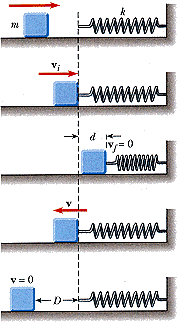 A 1.50 kg object slides to the righton a surface having a coefficient of kinetic friction 0.250 (Fig.P7.54). The object has a speed of vi=3.40 m/s when it makes contact with alight spring that has a force constant of 50.0 N/m. The objectcomes to rest after the spring has been compressed adistanced. The object is then forced toward the left by the springand continues to move in that direction beyond the spring'sunstretched position. The objectfinally comes to rest a distanceD...
A spring of stiffness k = 200 N/m is mounted against the 10 kg block. The...
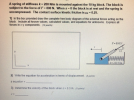 A spring of stiffness k = 200 N/m is mounted against the 10 kg block. The block is subject to the force of F-800 N. When s - O the block is at rest and the spring is uncompressed. The contact surface kinetic friction is uk = 0.25. 1) In the box provided draw the complete free body diagram of the external forces acting on the block. Include all known values, calculated values, and equations for unknowns. Express all forces...
help with part 5 1. A 125-kg load is lifted 12.0 m vertically with an acceleration...
 help with part 5
1. A 125-kg load is lifted 12.0 m vertically with an acceleration a -0.32g by a single cable. Determine: (a) the tension in the cable, (b) the net work done on the load, (c) the work done by the cable on the load, (d) the work done by gravity on the load, and (e) the final speed of the load assuming it started from rest. 2. A 1.60-m tall person lifts a 2.10-kg book from the...
help with part 5
1. A 125-kg load is lifted 12.0 m vertically with an acceleration a -0.32g by a single cable. Determine: (a) the tension in the cable, (b) the net work done on the load, (c) the work done by the cable on the load, (d) the work done by gravity on the load, and (e) the final speed of the load assuming it started from rest. 2. A 1.60-m tall person lifts a 2.10-kg book from the...
As indicated in the figure, a steel ball (m 200 g) is attached to a massless elastic cord which is initially not stretched. When the ball is released from rest at A, t slides without friction through...
 As indicated in the figure, a steel ball (m 200 g) is attached to a massless elastic cord which is initially not stretched. When the ball is released from rest at A, t slides without friction through a thin curved tube with constant radius of curvature r = 70.0 cm. The cord stretches as the ball slides down the tube and follows the curvature of the surface, as indicated by the thick dashed line in the figure. Furthermore, the cord...
Rolling Without Slipping & Conservation of Mechanical Energy 1. A caveman applies a horizontal force of...
 Rolling Without Slipping & Conservation of Mechanical Energy 1. A caveman applies a horizontal force of 800 N at height of 0.1 m above the center of a large spherical boulder of mass 400 kg and radius of 0.5 m (treat as a sphere: lon-2/5 mr2). Assume the sphere starts from rest and rolls horizontally without slipping. a) Draw a free-body diagram and label all the forces at their point of contact. b) Write equations applying Newton's 2 nd law...
Problem 9 m,r A solid ball of mass m and radius r sits at rest at the top of a hill of height H l...
 Problem 9 m,r A solid ball of mass m and radius r sits at rest at the top of a hill of height H leading to a circular loop-the loop. The center of mass of the ball will move in a circle of radius R if it goes around the loop. The moment of inertia of a solid ball is Ibull--mr. (a) Find an expression for the minimum height H for which the ball barely goes around the loop, staying...
2. Suppose a car travels 108 km at a speed of 20.0 m/s, and uses 2.20...
 2. Suppose a car travels 108 km at a speed of 20.0 m/s, and uses
2.20 gallons of gasoline. Only 30% of the gasoline goes into useful
work by the force that keeps the car moving at constant speed
despite friction. (The energy content of gasoline is 1.3 ✕
108 J per gallon.)
(a) What is the force exerted to keep the car moving at constant
speed?
N
(b) If the required force is directly proportional to speed, how
many...
2. Suppose a car travels 108 km at a speed of 20.0 m/s, and uses
2.20 gallons of gasoline. Only 30% of the gasoline goes into useful
work by the force that keeps the car moving at constant speed
despite friction. (The energy content of gasoline is 1.3 ✕
108 J per gallon.)
(a) What is the force exerted to keep the car moving at constant
speed?
N
(b) If the required force is directly proportional to speed, how
many...
 An object of mass m = 1.70 kg is travelling on a horizontal surface. The coefficient of kinetic friction between the object and the surface is muk = 0.200. The object has speed v = 1 .35 m/s when it reaches x = 0 and encounters a spring. The object compresses the spring a distance d/2, stops instantaneously, and then travels back to x = 0 where it stops completely. Eventually you will be asked to find the spring constant,...
 A spring of stiffness k = 200 N/m is mounted against the 10 kg block. The block is subject to the force of F-800 N. When s - O the block is at rest and the spring is uncompressed. The contact surface kinetic friction is uk = 0.25. 1) In the box provided draw the complete free body diagram of the external forces acting on the block. Include all known values, calculated values, and equations for unknowns. Express all forces...
 help with part 5
1. A 125-kg load is lifted 12.0 m vertically with an acceleration a -0.32g by a single cable. Determine: (a) the tension in the cable, (b) the net work done on the load, (c) the work done by the cable on the load, (d) the work done by gravity on the load, and (e) the final speed of the load assuming it started from rest. 2. A 1.60-m tall person lifts a 2.10-kg book from the...
help with part 5
1. A 125-kg load is lifted 12.0 m vertically with an acceleration a -0.32g by a single cable. Determine: (a) the tension in the cable, (b) the net work done on the load, (c) the work done by the cable on the load, (d) the work done by gravity on the load, and (e) the final speed of the load assuming it started from rest. 2. A 1.60-m tall person lifts a 2.10-kg book from the...
 As indicated in the figure, a steel ball (m 200 g) is attached to a massless elastic cord which is initially not stretched. When the ball is released from rest at A, t slides without friction through a thin curved tube with constant radius of curvature r = 70.0 cm. The cord stretches as the ball slides down the tube and follows the curvature of the surface, as indicated by the thick dashed line in the figure. Furthermore, the cord...
 Rolling Without Slipping & Conservation of Mechanical Energy 1. A caveman applies a horizontal force of 800 N at height of 0.1 m above the center of a large spherical boulder of mass 400 kg and radius of 0.5 m (treat as a sphere: lon-2/5 mr2). Assume the sphere starts from rest and rolls horizontally without slipping. a) Draw a free-body diagram and label all the forces at their point of contact. b) Write equations applying Newton's 2 nd law...
 Problem 9 m,r A solid ball of mass m and radius r sits at rest at the top of a hill of height H leading to a circular loop-the loop. The center of mass of the ball will move in a circle of radius R if it goes around the loop. The moment of inertia of a solid ball is Ibull--mr. (a) Find an expression for the minimum height H for which the ball barely goes around the loop, staying...
 2. Suppose a car travels 108 km at a speed of 20.0 m/s, and uses
2.20 gallons of gasoline. Only 30% of the gasoline goes into useful
work by the force that keeps the car moving at constant speed
despite friction. (The energy content of gasoline is 1.3 ✕
108 J per gallon.)
(a) What is the force exerted to keep the car moving at constant
speed?
N
(b) If the required force is directly proportional to speed, how
many...
2. Suppose a car travels 108 km at a speed of 20.0 m/s, and uses
2.20 gallons of gasoline. Only 30% of the gasoline goes into useful
work by the force that keeps the car moving at constant speed
despite friction. (The energy content of gasoline is 1.3 ✕
108 J per gallon.)
(a) What is the force exerted to keep the car moving at constant
speed?
N
(b) If the required force is directly proportional to speed, how
many...
Most questions answered within 3 hours.
-
Where is the error in this code sequence?
String s1 = "Hello";
String s2 = "ello";...
asked 10 months ago -
Financial data for Joel de Paris, Inc., for last year
follow:
Joel de Paris, Inc.
Balance...
asked 10 months ago -
Consider this reaction:
Al2(SO4)3 (aq)+ BaCl3
(aq) Al2Cl6 (aq)- +
3BaSO4(s) . What is the...
asked 10 months ago -
Suppose that Savneet is considering increasing her
recent random sample from 20 car rentals to 40...
asked 10 months ago -
Trucks arrive at an unloading terminal at an average rate of 120
per hour.
Trucks arrive...
asked 10 months ago -
Why are methanol and ethanol completely soluble in water while
octanol is not very little soluble....
asked 10 months ago -
A facilities manager at a university reads in a research report
that the mean amount of...
asked 10 months ago -
When the CuSO4 is rehydrated by adding water to the anhydrous
compound, is this an endothermic...
asked 10 months ago -
A ray of sunlight is passing from diamond into crown glass; the
angle of incidence is...
asked 10 months ago -
A block of mass 0.249 kg is placed on top of a light, vertical
spring of...
asked 10 months ago -
how do the kidneys compensate in the presences of acidosis
a) trigger hyperventilate
b) reserve acid...
asked 10 months ago -
Question 501 pts
The rental rate of capital to the firm increases. Which of the
following...
asked 10 months ago