When you perform a pcr reaction, what length of product is predicted? a. 5’ end one...
When you perform a pcr reaction, what length of product is predicted?
a. 5’ end one primer to 5’ end of other
b. 5’ end one primer to 3’ end of other
c. 3’ end one primer to 3’ end of other
d. not possible to predict the length
Homework Answers
The answer of your question When you perform a pcr reaction, what length of product is predicted?
a. 5’ end one primer to 5’ end of other
b. 5’ end one primer to 3’ end of other
c. 3’ end one primer to 3’ end of other
d. not possible to predict the length
Is i think from 5end to 3end..
D is not possible because we can predict the length by usimg different methods..
So according to my knowledge the answer could be b...
Please dont unlike it..if ir would be wrong do comment me in comment box i will do some more research on it then but please donr unlike..
Thank you so much
Add Answer to:
When you perform a pcr reaction, what length of product is
predicted?
a. 5’ end one...
You do a PCR reaction with primers to the D1S80 locus. You use your TAs DNA...
You do a PCR reaction with primers to the D1S80 locus. You use your TAs DNA as the template. Assume there are no primer-dimer formations or non-specific priming events. What banding patterns could you possibly see on the gel after you complete the PCR reaction? a) 1 band only b) 2 bands c) 3 bands d) a and b are possible e) all of the above are possible f) impossible to predict
You do a PCR reaction with primers to the D1S80 locus. You use your TAs DNA...
You do a PCR reaction with primers to the D1S80 locus. You use your TAs DNA as the template. Assume there are no primer-dimer formations or non-specific priming events. What banding patterns could you possibly see on the gel after you complete the PCR reaction? a) 1 band only (INCORRECT) b) 2 bands c) 3 bands d) a and b are possible e) all of the above are possible f) impossible to predict
If primer-dimers were to form as a product of the TAS2R38 PCR, what size would you...
 If primer-dimers were to form as a product of the TAS2R38 PCR, what size would you predict them to be? d. O PCR Master Mix GoTaq DNA Polymerase 2.5 μM forward primer: 5'-AACTGGCAGAATAAAGATCTC 2.5 ㎂Λ reverse primer: 5-AACACAAACCATCACSCCTATTTT-3 200 μΜ dATP, dGTP, dCTP, dTTP 1.5 mM MgCl2. Nuclease free H,O
Add SYBR green to the remaining half of each PCR reaction product and perform a melting...
 Add SYBR green to the remaining half of each PCR reaction
product and perform a melting curve analysis. slowly increase the
temperature of the samples from 60oC to 95oC, recording the
fluorescence emitted from each sample with every 5oC increase in
temperature. Draw the fluorescence (y axis) versus temperature (x
axis) plot that you would expect to see for each product (1 mark
each). Specify relevant temperatures for each sample on the x axes
of your plots (1 mark each)...
Add SYBR green to the remaining half of each PCR reaction
product and perform a melting curve analysis. slowly increase the
temperature of the samples from 60oC to 95oC, recording the
fluorescence emitted from each sample with every 5oC increase in
temperature. Draw the fluorescence (y axis) versus temperature (x
axis) plot that you would expect to see for each product (1 mark
each). Specify relevant temperatures for each sample on the x axes
of your plots (1 mark each)...
Problem.1: What does a PCR optimization means? Problem.2: You are working on a gradient PCR to...
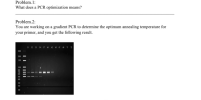 Problem.1: What does a PCR optimization means? Problem.2: You are working on a gradient PCR to determine the optimum annealing temperature for your primer, and you get the following result. Problem.5: Your target is to amplify a promoter region of TRF2 gene. You design the following primer pair: Forward: 5'- CAGCGCTGCCTGAAACTC-3: Tm: 58.6°C, length: 18 bp, GC%: 61.11% Reverse: 5'- GTCCTGCCCCTTCACCTT-3' Tm: 59°C, length: 18 bp, GC%: 61.11% Product size: 200 bp -You get the following result: Marker CC CCC...
What is the purpose in a PCR reaction for each of the following reagents? Taq Taq...
What is the purpose in a PCR reaction for each of the following reagents? Taq Taq buffer dNTPs Forward primer Reverse primer Genomic DNA What do you think would happen if you forgot to add your Reverse primer when you did a PCR?
D. After you run your PCR reaction, what next steps would you perform to determine that...
 D. After you run your PCR reaction, what next steps would you perform to determine that the PCR amplified the region of interest? E. After your procedures in step D above, you decide to measure the concentration of DNA in your PCR product. Briefly explain how you would do this given the tools we have available. What values would you expect to confirm that you have a good DNA concentration and purity? F. Write and briefly describe a program you...
CALCULATIONS [2 points each] You are asked to perform a PCR experiment in the lab. However, in th...
 CALCULATIONS [2 points each] You are asked to perform a PCR experiment in the lab. However, in this experiment you must add each ingredient separately (unlike the "master-mix" we used in our own experiment). In this experiment, each PCR reaction tube contained the following ingredients added with a micropipetor... 10 HL of 5x Buffer 6 μ1 of 25 mM MgCl2 solution μL of 10 mM dNTP mix 1.5 μL oligonucleotide primer mix 0.5 HL Taq DNA Polymerase stock solution 28...
Assume you will run a PCR on a 1Kb DNA fragment. Assume your DNA template's upper...
Assume you will run a PCR on a 1Kb DNA fragment. Assume your DNA template's upper strand is the 5' to 3' strand. The primers you will use are P1 and P2. The 5’ end of P1 recognizes sequence # 190. The 5’ end of P2 recognizes sequence # 350. The PCR conditions are 95oC for 1 minute, 55oC 30 seconds and 72oC for 30 seconds for 30 cycles. (a) indicate the size of your PCR product; (b) which primer,...
1.) How many kinds of reverse transcriptases are there ? 2.) What would normally be a...
1.) How many kinds of reverse transcriptases are there ? 2.) What would normally be a proper order to assemble yout RT reaction mix ? Your PCR mix ? Why is the order important ? 3.) Why do you need many PCR cycles to see reaction products ? 4.) Why are multiple product bands sometimes seen during PCR reactions ? How can this problem be minimized ? 5.) Betaine is often included in transcription reactions. What is betaine ? What...
 If primer-dimers were to form as a product of the TAS2R38 PCR, what size would you predict them to be? d. O PCR Master Mix GoTaq DNA Polymerase 2.5 μM forward primer: 5'-AACTGGCAGAATAAAGATCTC 2.5 ㎂Λ reverse primer: 5-AACACAAACCATCACSCCTATTTT-3 200 μΜ dATP, dGTP, dCTP, dTTP 1.5 mM MgCl2. Nuclease free H,O
 Add SYBR green to the remaining half of each PCR reaction
product and perform a melting curve analysis. slowly increase the
temperature of the samples from 60oC to 95oC, recording the
fluorescence emitted from each sample with every 5oC increase in
temperature. Draw the fluorescence (y axis) versus temperature (x
axis) plot that you would expect to see for each product (1 mark
each). Specify relevant temperatures for each sample on the x axes
of your plots (1 mark each)...
Add SYBR green to the remaining half of each PCR reaction
product and perform a melting curve analysis. slowly increase the
temperature of the samples from 60oC to 95oC, recording the
fluorescence emitted from each sample with every 5oC increase in
temperature. Draw the fluorescence (y axis) versus temperature (x
axis) plot that you would expect to see for each product (1 mark
each). Specify relevant temperatures for each sample on the x axes
of your plots (1 mark each)...
 Problem.1: What does a PCR optimization means? Problem.2: You are working on a gradient PCR to determine the optimum annealing temperature for your primer, and you get the following result. Problem.5: Your target is to amplify a promoter region of TRF2 gene. You design the following primer pair: Forward: 5'- CAGCGCTGCCTGAAACTC-3: Tm: 58.6°C, length: 18 bp, GC%: 61.11% Reverse: 5'- GTCCTGCCCCTTCACCTT-3' Tm: 59°C, length: 18 bp, GC%: 61.11% Product size: 200 bp -You get the following result: Marker CC CCC...
 D. After you run your PCR reaction, what next steps would you perform to determine that the PCR amplified the region of interest? E. After your procedures in step D above, you decide to measure the concentration of DNA in your PCR product. Briefly explain how you would do this given the tools we have available. What values would you expect to confirm that you have a good DNA concentration and purity? F. Write and briefly describe a program you...
 CALCULATIONS [2 points each] You are asked to perform a PCR experiment in the lab. However, in this experiment you must add each ingredient separately (unlike the "master-mix" we used in our own experiment). In this experiment, each PCR reaction tube contained the following ingredients added with a micropipetor... 10 HL of 5x Buffer 6 μ1 of 25 mM MgCl2 solution μL of 10 mM dNTP mix 1.5 μL oligonucleotide primer mix 0.5 HL Taq DNA Polymerase stock solution 28...
Most questions answered within 3 hours.
-
Where is the error in this code sequence?
String s1 = "Hello";
String s2 = "ello";...
asked 10 months ago -
Financial data for Joel de Paris, Inc., for last year
follow:
Joel de Paris, Inc.
Balance...
asked 10 months ago -
Consider this reaction:
Al2(SO4)3 (aq)+ BaCl3
(aq) Al2Cl6 (aq)- +
3BaSO4(s) . What is the...
asked 10 months ago -
Suppose that Savneet is considering increasing her
recent random sample from 20 car rentals to 40...
asked 10 months ago -
Trucks arrive at an unloading terminal at an average rate of 120
per hour.
Trucks arrive...
asked 10 months ago -
Why are methanol and ethanol completely soluble in water while
octanol is not very little soluble....
asked 10 months ago -
A facilities manager at a university reads in a research report
that the mean amount of...
asked 10 months ago -
When the CuSO4 is rehydrated by adding water to the anhydrous
compound, is this an endothermic...
asked 10 months ago -
A ray of sunlight is passing from diamond into crown glass; the
angle of incidence is...
asked 10 months ago -
A block of mass 0.249 kg is placed on top of a light, vertical
spring of...
asked 10 months ago -
how do the kidneys compensate in the presences of acidosis
a) trigger hyperventilate
b) reserve acid...
asked 10 months ago -
Question 501 pts
The rental rate of capital to the firm increases. Which of the
following...
asked 10 months ago