
Homework Answers
 w
w
Add Answer to:
1-9 please
We Isentropic 04/13/2020 By writing my name above. I understand that no programmable calculators...
A gasoline engine operates on the air standard Otto cycle. The air intake to the engine...
 A gasoline engine operates on the air standard Otto cycle. The air intake to the engine is at 300K and 95kPa (State 1). The air is compressed in the engine to an unknown pressure. Heat is then added during combustion at an amount of 1100 kJ/kg. At the end of the heat addition process, the temperature reaches 2200K. Compute the following: (a) the temperature at the end of the compression process, (b) the volumetric compression ratio of this engine, (c)...
Question 1 (based on the example to the example we worked in class) (30 points) Consider...
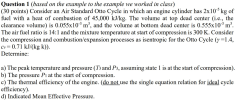 Question 1 (based on the example to the example we worked in class) (30 points) Consider an Air Standard Otto Cycle in which an engine cylinder has 2x10 kg of fuel with a heat of combustion of 45,000 kJ/kg. The volume at top dead center (i.e., the clearance volume) is 0.055x10³ m3, and the volume at bottom dead center is 0.555x 10³ m2. The air fuel ratio is 14:1 and the mixture temperature at start of compression is 300 K....
operates with a 11:1 compression be Mercedes-AMG GTR is powered by a Vs-biturbo spark Tating whopping...
 operates with a 11:1 compression be Mercedes-AMG GTR is powered by a Vs-biturbo spark Tating whopping 577 hp. This a biturbo spark ignition engineen se t s with a 111 cm and its large front intake ducts and radiator allow the air to be me at 15°C. After turbocharging and the combustion process o m standard gas temperature in the engine raises to 1500 K Assume cold-air stands assumptions, and perform an ideal cycle analysis of the engine's operation properties...
Surprise Quiz (1) The temperature at the beginning of the compression process of an air standard...
 Surprise Quiz (1) The temperature at the beginning of the compression process of an air standard Otto cycle with a compression ratio of 8 is 27 °C=540 R, the pressure is 105 Pa, and the cylinder volume is 5.66 x 10⁴ m². The maximum temperature during the cycle is 1727 °C=3600R. For the compression and PI 3 expansion processes, use T3 = 3600°R isentropic equations from equation sheet. Tv*-* = T, v*-? PV = P, V. n=11 - T3 =...
Problem 1 A diesel engine has a compression ratio r = 20 and uses air as...
 Problem 1 A diesel engine has a compression ratio r = 20 and uses air as the working fluid. The state of air at the beginning of the compression process is P1 = 95 kPa and T = 20°C. However, the isentropic expansion normally occuring between state 3 and state 4 is replaced by a polytropic process along which: Pul.35 = constant. The maximum temperature in the cycle is not to exceed 2200 K. In this analysis, the variation of...
An aircraft engine operates on a simple ideal Brayton cycle with a pressure ratio rp of...
 An aircraft engine operates on a simple ideal Brayton cycle with
a pressure ratio rp of 9. Heat is added to the cycle at a rate of
490 kW; air passes through the engine at a rate of 1.1 kg/s; and
the air at the beginning of the compression is at P1 = 71 kPa and
T1 = 0 oC. Use constant specific heats at room temperature. The
properties of air at room temperature are cp =1.005 kJ/kg.K and k...
An aircraft engine operates on a simple ideal Brayton cycle with
a pressure ratio rp of 9. Heat is added to the cycle at a rate of
490 kW; air passes through the engine at a rate of 1.1 kg/s; and
the air at the beginning of the compression is at P1 = 71 kPa and
T1 = 0 oC. Use constant specific heats at room temperature. The
properties of air at room temperature are cp =1.005 kJ/kg.K and k...
Problem 3 In modern high-speed compression ignition engines, fuel is injected into the combustion chamber much...
 Problem 3 In modern high-speed compression ignition engines, fuel is injected into the combustion chamber much sooner than in early diesel engines. That means, heat is added partly at constant volume and partly at constant pressure. The advantage of this modification is that more time is available for the fuel to completely combust. The ideal dual cycle consists of the following operations: • Process -: Isentropic compression • Process -3: Addition of heat at constant volume. • Process - Addition...
Need help for this Brayton Cycle problem. Please help me 4. (30 marks) A gas-turbine power plant operates on the simple...
 Need help for this Brayton Cycle problem.
Please help me
4. (30 marks) A gas-turbine power plant operates on the simple Brayton cycle between the pressure limits of 100 kPa and 800 kPa. The T-s diagram of this cycle is shown in Fig. 2. Air enters the compressor at 30°C and leaves at 330°C at a mass flow rate of 200 kg/s. The maximum cycle temperature is 1400 K. During operation of the cycle, the net power output is measured...
Need help for this Brayton Cycle problem.
Please help me
4. (30 marks) A gas-turbine power plant operates on the simple Brayton cycle between the pressure limits of 100 kPa and 800 kPa. The T-s diagram of this cycle is shown in Fig. 2. Air enters the compressor at 30°C and leaves at 330°C at a mass flow rate of 200 kg/s. The maximum cycle temperature is 1400 K. During operation of the cycle, the net power output is measured...
C only please Question 1 (50 points) One kg of air is in a piston-cylinder assembly....
 C
only please
Question 1 (50 points) One kg of air is in a piston-cylinder assembly. Air is modeled as an ideal gas with a constant specific heat ratio, k = 1.4. The air undergoes a power cycle consisting of four processes in series: Process 1-2: Constant-temperature expansion at 600 K from P, = 0.5 MPa to P2 = 0.4 MPa Process 2–3: Polytropic expansion with n=k to Pz = 0.3 MPa Process 3-4: Constant-pressure compression to V4 = V....
C
only please
Question 1 (50 points) One kg of air is in a piston-cylinder assembly. Air is modeled as an ideal gas with a constant specific heat ratio, k = 1.4. The air undergoes a power cycle consisting of four processes in series: Process 1-2: Constant-temperature expansion at 600 K from P, = 0.5 MPa to P2 = 0.4 MPa Process 2–3: Polytropic expansion with n=k to Pz = 0.3 MPa Process 3-4: Constant-pressure compression to V4 = V....
I just need a reduction in the first law for these three problems, to check my...
 I just need a reduction in the first law for these
three problems, to check my work. Also state your CV for each
problem and why. Do not solve the problems. Thank you.
4-23 An ideal gas undergoes two processes in a piston- cylinder device as follows: 1-2 Polytropic compression from T, and P, with a polytropic exponent n and a compression ratio of r = V1/V2. 2-3 Constant pressure expansion at Pa = P, until V=V. (a) Sketch the...
I just need a reduction in the first law for these
three problems, to check my work. Also state your CV for each
problem and why. Do not solve the problems. Thank you.
4-23 An ideal gas undergoes two processes in a piston- cylinder device as follows: 1-2 Polytropic compression from T, and P, with a polytropic exponent n and a compression ratio of r = V1/V2. 2-3 Constant pressure expansion at Pa = P, until V=V. (a) Sketch the...
 A gasoline engine operates on the air standard Otto cycle. The air intake to the engine is at 300K and 95kPa (State 1). The air is compressed in the engine to an unknown pressure. Heat is then added during combustion at an amount of 1100 kJ/kg. At the end of the heat addition process, the temperature reaches 2200K. Compute the following: (a) the temperature at the end of the compression process, (b) the volumetric compression ratio of this engine, (c)...
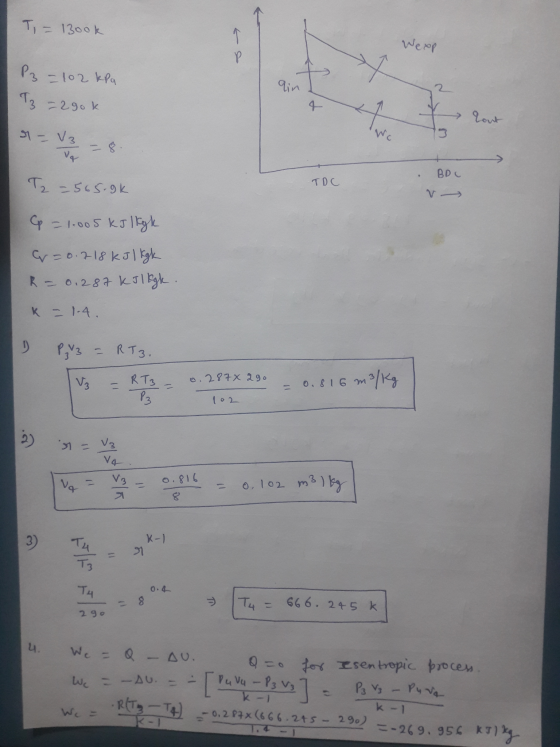
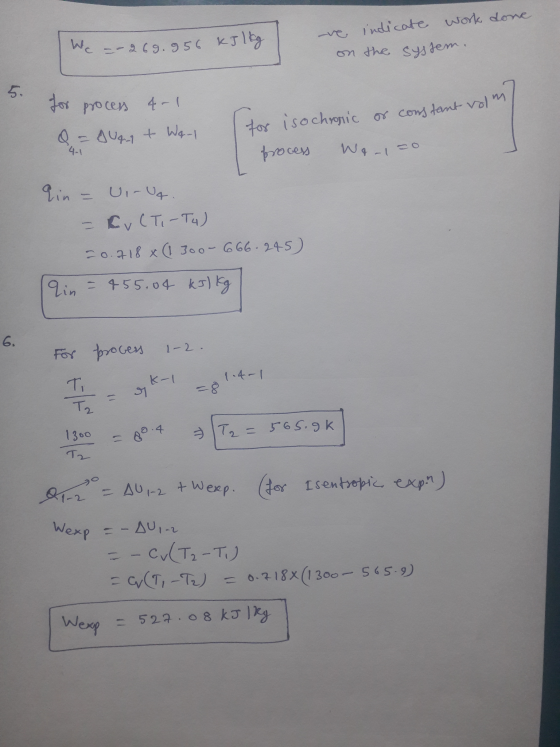
 Question 1 (based on the example to the example we worked in class) (30 points) Consider an Air Standard Otto Cycle in which an engine cylinder has 2x10 kg of fuel with a heat of combustion of 45,000 kJ/kg. The volume at top dead center (i.e., the clearance volume) is 0.055x10³ m3, and the volume at bottom dead center is 0.555x 10³ m2. The air fuel ratio is 14:1 and the mixture temperature at start of compression is 300 K....
 operates with a 11:1 compression be Mercedes-AMG GTR is powered by a Vs-biturbo spark Tating whopping 577 hp. This a biturbo spark ignition engineen se t s with a 111 cm and its large front intake ducts and radiator allow the air to be me at 15°C. After turbocharging and the combustion process o m standard gas temperature in the engine raises to 1500 K Assume cold-air stands assumptions, and perform an ideal cycle analysis of the engine's operation properties...
 Surprise Quiz (1) The temperature at the beginning of the compression process of an air standard Otto cycle with a compression ratio of 8 is 27 °C=540 R, the pressure is 105 Pa, and the cylinder volume is 5.66 x 10⁴ m². The maximum temperature during the cycle is 1727 °C=3600R. For the compression and PI 3 expansion processes, use T3 = 3600°R isentropic equations from equation sheet. Tv*-* = T, v*-? PV = P, V. n=11 - T3 =...
 Problem 1 A diesel engine has a compression ratio r = 20 and uses air as the working fluid. The state of air at the beginning of the compression process is P1 = 95 kPa and T = 20°C. However, the isentropic expansion normally occuring between state 3 and state 4 is replaced by a polytropic process along which: Pul.35 = constant. The maximum temperature in the cycle is not to exceed 2200 K. In this analysis, the variation of...
 An aircraft engine operates on a simple ideal Brayton cycle with
a pressure ratio rp of 9. Heat is added to the cycle at a rate of
490 kW; air passes through the engine at a rate of 1.1 kg/s; and
the air at the beginning of the compression is at P1 = 71 kPa and
T1 = 0 oC. Use constant specific heats at room temperature. The
properties of air at room temperature are cp =1.005 kJ/kg.K and k...
An aircraft engine operates on a simple ideal Brayton cycle with
a pressure ratio rp of 9. Heat is added to the cycle at a rate of
490 kW; air passes through the engine at a rate of 1.1 kg/s; and
the air at the beginning of the compression is at P1 = 71 kPa and
T1 = 0 oC. Use constant specific heats at room temperature. The
properties of air at room temperature are cp =1.005 kJ/kg.K and k...
 Problem 3 In modern high-speed compression ignition engines, fuel is injected into the combustion chamber much sooner than in early diesel engines. That means, heat is added partly at constant volume and partly at constant pressure. The advantage of this modification is that more time is available for the fuel to completely combust. The ideal dual cycle consists of the following operations: • Process -: Isentropic compression • Process -3: Addition of heat at constant volume. • Process - Addition...
 Need help for this Brayton Cycle problem.
Please help me
4. (30 marks) A gas-turbine power plant operates on the simple Brayton cycle between the pressure limits of 100 kPa and 800 kPa. The T-s diagram of this cycle is shown in Fig. 2. Air enters the compressor at 30°C and leaves at 330°C at a mass flow rate of 200 kg/s. The maximum cycle temperature is 1400 K. During operation of the cycle, the net power output is measured...
Need help for this Brayton Cycle problem.
Please help me
4. (30 marks) A gas-turbine power plant operates on the simple Brayton cycle between the pressure limits of 100 kPa and 800 kPa. The T-s diagram of this cycle is shown in Fig. 2. Air enters the compressor at 30°C and leaves at 330°C at a mass flow rate of 200 kg/s. The maximum cycle temperature is 1400 K. During operation of the cycle, the net power output is measured...
 C
only please
Question 1 (50 points) One kg of air is in a piston-cylinder assembly. Air is modeled as an ideal gas with a constant specific heat ratio, k = 1.4. The air undergoes a power cycle consisting of four processes in series: Process 1-2: Constant-temperature expansion at 600 K from P, = 0.5 MPa to P2 = 0.4 MPa Process 2–3: Polytropic expansion with n=k to Pz = 0.3 MPa Process 3-4: Constant-pressure compression to V4 = V....
C
only please
Question 1 (50 points) One kg of air is in a piston-cylinder assembly. Air is modeled as an ideal gas with a constant specific heat ratio, k = 1.4. The air undergoes a power cycle consisting of four processes in series: Process 1-2: Constant-temperature expansion at 600 K from P, = 0.5 MPa to P2 = 0.4 MPa Process 2–3: Polytropic expansion with n=k to Pz = 0.3 MPa Process 3-4: Constant-pressure compression to V4 = V....
 I just need a reduction in the first law for these
three problems, to check my work. Also state your CV for each
problem and why. Do not solve the problems. Thank you.
4-23 An ideal gas undergoes two processes in a piston- cylinder device as follows: 1-2 Polytropic compression from T, and P, with a polytropic exponent n and a compression ratio of r = V1/V2. 2-3 Constant pressure expansion at Pa = P, until V=V. (a) Sketch the...
I just need a reduction in the first law for these
three problems, to check my work. Also state your CV for each
problem and why. Do not solve the problems. Thank you.
4-23 An ideal gas undergoes two processes in a piston- cylinder device as follows: 1-2 Polytropic compression from T, and P, with a polytropic exponent n and a compression ratio of r = V1/V2. 2-3 Constant pressure expansion at Pa = P, until V=V. (a) Sketch the...
Most questions answered within 3 hours.
-
Where is the error in this code sequence?
String s1 = "Hello";
String s2 = "ello";...
asked 11 months ago -
Financial data for Joel de Paris, Inc., for last year
follow:
Joel de Paris, Inc.
Balance...
asked 11 months ago -
Consider this reaction:
Al2(SO4)3 (aq)+ BaCl3
(aq) Al2Cl6 (aq)- +
3BaSO4(s) . What is the...
asked 11 months ago -
Suppose that Savneet is considering increasing her
recent random sample from 20 car rentals to 40...
asked 11 months ago -
Trucks arrive at an unloading terminal at an average rate of 120
per hour.
Trucks arrive...
asked 11 months ago -
Why are methanol and ethanol completely soluble in water while
octanol is not very little soluble....
asked 11 months ago -
A facilities manager at a university reads in a research report
that the mean amount of...
asked 11 months ago -
When the CuSO4 is rehydrated by adding water to the anhydrous
compound, is this an endothermic...
asked 11 months ago -
A ray of sunlight is passing from diamond into crown glass; the
angle of incidence is...
asked 11 months ago -
A block of mass 0.249 kg is placed on top of a light, vertical
spring of...
asked 11 months ago -
how do the kidneys compensate in the presences of acidosis
a) trigger hyperventilate
b) reserve acid...
asked 11 months ago -
Question 501 pts
The rental rate of capital to the firm increases. Which of the
following...
asked 11 months ago