

Homework Answers


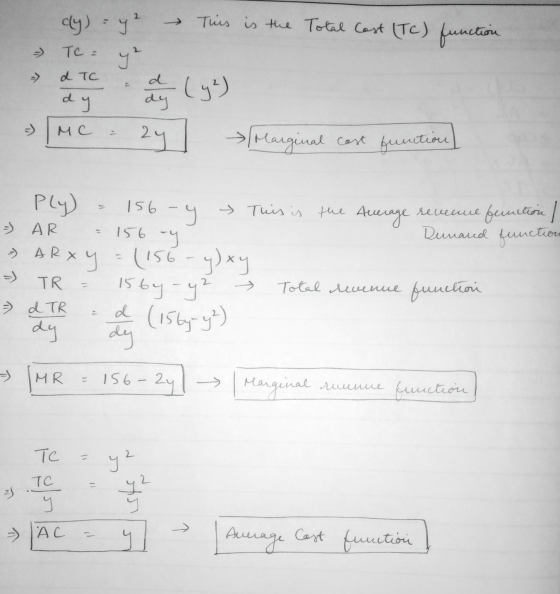

(Please consider giving an upvote if you find it useful)
Add Answer to:
A monopolist has a cost function given by c(y) = y and faces an inverse demand...
02 Question (5 points) 1st attempt Part 1 (2 points) Feedback O See Hint A monopolist...
 02 Question (5 points) 1st attempt Part 1 (2 points) Feedback O See Hint A monopolist has a cost function given by c(y) = y2 and faces an inverse demand curve given by P(y) = 120.00 – y, where P is the per-unit price and yis the quantity of output sold. Assume this monopolist cannot discriminate and charges a single price. What is the profit-maximizing level of output? * 120 What is its profit-maximizing price? * $ 120 Part 2...
Practice Question 4. The inverse demand curve a monopoly faces is p = 30 – Q....
 Practice Question 4. The inverse demand curve a monopoly faces is p = 30 – Q. The firm's total cost function is C(Q) = 0.5Q² and thus marginal cost function is MC(Q) = Q. (a) Determine the monopoly quantity, price and profit, and calculate the CS, PS and social welfare under the monopoly. (b) Determine the socially optimal outcome and calculate the CS, PS and social welfare under the social optimum. (c) Calculate the deadweight loss due to the monopolist...
A natural monopolist faces the following demand curve: P = 202 - 5Q, its total cost is given by: ...
A natural monopolist faces the following demand curve: P = 202 - 5Q, its total cost is given by: TC = 720 + 2Q (marginal cost is the slope of total cost). (a) If the government regulates the monopolist to charge a socially optimal price, what price will it charge and how many units will it sell? How much are the profit, consumer surplus and producer surplus? (b) If it is not a regulated monopolist, what is its profit maximizing...
2. A monopolist has a cost function given by TC -250+q+.004q2. The inverse market demand for...
 2. A monopolist has a cost function given by TC -250+q+.004q2. The inverse market demand for boxes is given by p = governmental zoning rule. (a) What is its output and what price does it charge for boxes? (b) Calculate the firm's profit at this output level. (c) Calculate the firm's producer's surplus at this output level. (d) Calculate the consumer's surplus in this situation. 8-.001Q. The monopolist is currently able to exclude rivals from the market because of a...
2. A monopolist has a cost function given by TC 250+q+.004q2. The inverse market demand for...
 2. A monopolist has a cost function given by TC 250+q+.004q2. The inverse market demand for boxes is given by p 8-.0010. The monopolist is currently able to exclude rivals from the market because of a special governmental zoning rule. (a) What is its output and what price does it charge for boxes? (b) Calculate the firm's profit at this output level. (c) Calculate the firm's producer's surplus at this output level. (d) Calculate the consumer's surplus in this situation....
A monopolist faces the following demand curve: P = 520 - 0.7Q, its total cost is...
A monopolist faces the following demand curve: P = 520 - 0.7Q, its total cost is given by: TC = 4600 + 0.3Q2 and its marginal cost is given by: MC = 0.6Q. (a) If it is a single price monopolist, what is its profit maximizing price and quantity? Show your work. How much is the profit? How much are consumer surplus and producer surplus? (b) Suppose it is a first degree price discriminator instead of a single price monopolist....
A monopolist faces inverse market demand of P = 140- TC(Q) = 20° + 10Q +...
 A monopolist faces inverse market demand of P = 140- TC(Q) = 20° + 10Q + 200. and has Total Cost given by (20 points) Find this monopolist's profit maximizing output level. Find this monopolist's profit maximizing price How much profit is this monopolist earning?
A monopolist who sells toys faces the following demand: P(y)=100-2y. The total cost function of the...
A monopolist who sells toys faces the following demand: P(y)=100-2y. The total cost function of the monopolist is given by: c(y)=20y+10y2 . a) Find the price and quantity that maximizes the monopolist’s profit. Also calculate the profit. [3+3] b) If the monopolist can do a perfect price discrimination, then find the consumer and producer surplus.
Suppose the inverse demand for a product produced by a single firm is given by: P...
Suppose the inverse demand for a product produced by a single firm is given by: P = 72 – 3(Q) and this firm has a marginal cost of production of: MC = 2(Q) 1. If the firm cannot price-discriminate what is the profit-maximizing price ____________ and level of output? ____________ 2. If the firm cannot price-discriminatew what is : -the consumer surplus ____________ -the producer surplus ____________ -the dead-weight loss ____________ 3. If the firm can practice perfect price discrmination,...
A natural monopolist faces the following demand curve: P = 409 - 2Q, its total cost...
A natural monopolist faces the following demand curve: P = 409 - 2Q, its total cost is given by: TC = 12800 + 9Q (marginal cost is the slope of total cost). (a) If the government regulates the monopolist to charge a socially optimal price, what price will it charge and how many units will it sell? How much are the profit, consumer surplus and producer surplus? (b) If it is not a regulated monopolist, what is its profit maximizing...
 02 Question (5 points) 1st attempt Part 1 (2 points) Feedback O See Hint A monopolist has a cost function given by c(y) = y2 and faces an inverse demand curve given by P(y) = 120.00 – y, where P is the per-unit price and yis the quantity of output sold. Assume this monopolist cannot discriminate and charges a single price. What is the profit-maximizing level of output? * 120 What is its profit-maximizing price? * $ 120 Part 2...
 Practice Question 4. The inverse demand curve a monopoly faces is p = 30 – Q. The firm's total cost function is C(Q) = 0.5Q² and thus marginal cost function is MC(Q) = Q. (a) Determine the monopoly quantity, price and profit, and calculate the CS, PS and social welfare under the monopoly. (b) Determine the socially optimal outcome and calculate the CS, PS and social welfare under the social optimum. (c) Calculate the deadweight loss due to the monopolist...
 2. A monopolist has a cost function given by TC -250+q+.004q2. The inverse market demand for boxes is given by p = governmental zoning rule. (a) What is its output and what price does it charge for boxes? (b) Calculate the firm's profit at this output level. (c) Calculate the firm's producer's surplus at this output level. (d) Calculate the consumer's surplus in this situation. 8-.001Q. The monopolist is currently able to exclude rivals from the market because of a...
 2. A monopolist has a cost function given by TC 250+q+.004q2. The inverse market demand for boxes is given by p 8-.0010. The monopolist is currently able to exclude rivals from the market because of a special governmental zoning rule. (a) What is its output and what price does it charge for boxes? (b) Calculate the firm's profit at this output level. (c) Calculate the firm's producer's surplus at this output level. (d) Calculate the consumer's surplus in this situation....
 A monopolist faces inverse market demand of P = 140- TC(Q) = 20° + 10Q + 200. and has Total Cost given by (20 points) Find this monopolist's profit maximizing output level. Find this monopolist's profit maximizing price How much profit is this monopolist earning?
Most questions answered within 3 hours.
-
Where is the error in this code sequence?
String s1 = "Hello";
String s2 = "ello";...
asked 10 months ago -
Financial data for Joel de Paris, Inc., for last year
follow:
Joel de Paris, Inc.
Balance...
asked 10 months ago -
Consider this reaction:
Al2(SO4)3 (aq)+ BaCl3
(aq) Al2Cl6 (aq)- +
3BaSO4(s) . What is the...
asked 10 months ago -
Suppose that Savneet is considering increasing her
recent random sample from 20 car rentals to 40...
asked 10 months ago -
Trucks arrive at an unloading terminal at an average rate of 120
per hour.
Trucks arrive...
asked 10 months ago -
Why are methanol and ethanol completely soluble in water while
octanol is not very little soluble....
asked 10 months ago -
A facilities manager at a university reads in a research report
that the mean amount of...
asked 10 months ago -
When the CuSO4 is rehydrated by adding water to the anhydrous
compound, is this an endothermic...
asked 10 months ago -
A ray of sunlight is passing from diamond into crown glass; the
angle of incidence is...
asked 10 months ago -
A block of mass 0.249 kg is placed on top of a light, vertical
spring of...
asked 10 months ago -
how do the kidneys compensate in the presences of acidosis
a) trigger hyperventilate
b) reserve acid...
asked 10 months ago -
Question 501 pts
The rental rate of capital to the firm increases. Which of the
following...
asked 10 months ago