


Homework Answers
Add Answer to:
(8 pts) Carbon dioxide in the atmosphere dissolves in water to establish an equilibrium that can...
(8 pts) Carbon dioxide in the atmosphere dissolves in water to establish an equilibrium that can...
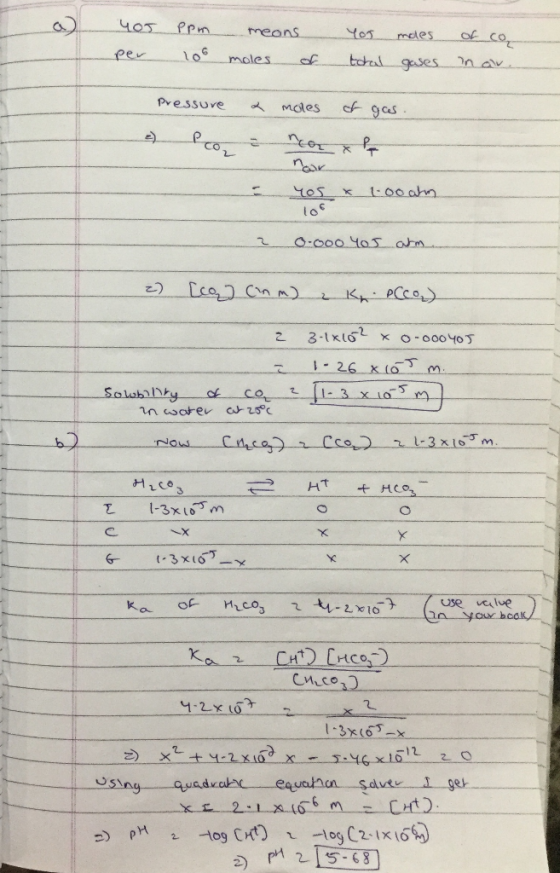
(8 pts) Carbon dioxide in the atmosphere dissolves in water to establish an equilibrium that can increase the acidity of aqueous solutions in the environment. This equilibrium is CO2 (g) ⇌ CO2 (aq), Kh = 3.1 * 10^2 at 25°C. Kh is called the Henry’s law constant, which relates the solubility of the gas CO2 in the aqueous solution, [CO2], to the partial pressure of CO2 over the solution, p(CO2): [CO2] (M) = Kh * p(CO2) (atm) During the preceding...
Carbonic acid present in the blood comes mainly from dissolved carbon dioxide (CO2). Dissolved carbon dioxide,...
Carbonic acid present in the blood comes mainly from dissolved carbon dioxide (CO2). Dissolved carbon dioxide, CO2(aq), reacts with water to produce H2CO3. a) Write the equilibrium expression for this process. b) The equilibrium constant for this reaction is the hydration constant for CO2, Kh = [H2CO3]/[CO2(aq)] = 3.0 x 10⁻³ . Combine this equation with the expression you derived in 1.a) for the equilibrium expressions for the first ionization (controlled by Ka1) and rearrange to obtain the apparent equilibrium...
Carbon dioxide dissolves in water to form carbonic acid, which is primarily dissolved CO2 . Dissolved...
Carbon dioxide dissolves in water to form carbonic acid, which is primarily dissolved CO2 . Dissolved CO2 satisfies the equilibrium equation CO2(g)↽−−⇀CO2(aq)?=0.032 CO 2 ( g ) ↽ − − ⇀ CO 2 ( aq ) K = 0.032 The acid dissociation constants listed in most standard reference texts for carbonic acid actually apply to dissolved CO2 CO 2 . For a CO2 CO 2 partial pressure of 2.6×10⁻⁴ bar 2.6 × 10 − 4 bar in the atmosphere, what...
Carbon dioxide dissolves in water to form carbonic acid, which is primarily dissolved CO2. Dissolved CO2...
 Carbon dioxide dissolves in water to form carbonic acid, which
is primarily dissolved CO2. Dissolved CO2 satisfies the equilibrium
equation The acid dissociation constants listed in most standard
reference texts for carbonic acid actually apply to dissolved CO2.
For a CO2 partial pressure of 1.8×10⁻⁴ bar in the atmosphere, what
is the pH of water in equilibrium with the atmosphere? (For
carbonic acid Ka1 = 4.46× 10⁻⁷ and Ka2 = 4.69× 10⁻¹¹).
Carbon dioxide dissolves in water to form carbonic...
Carbon dioxide dissolves in water to form carbonic acid, which
is primarily dissolved CO2. Dissolved CO2 satisfies the equilibrium
equation The acid dissociation constants listed in most standard
reference texts for carbonic acid actually apply to dissolved CO2.
For a CO2 partial pressure of 1.8×10⁻⁴ bar in the atmosphere, what
is the pH of water in equilibrium with the atmosphere? (For
carbonic acid Ka1 = 4.46× 10⁻⁷ and Ka2 = 4.69× 10⁻¹¹).
Carbon dioxide dissolves in water to form carbonic...
Carbon dioxide dissolves in water to form carbonic acid, which is primarily dissolved CO2. Dissol...
Carbon dioxide dissolves in water to form carbonic acid, which is primarily dissolved CO2. Dissolved CO2 satisfies the equilibrium equation. CO2 (g) <--> CO2 (aq) K= 0.032 M atm-1 The acid dissociation constants listed in most standard reference texts for carbonic acid actually apply to dissolved CO2. For a CO2 partial pressure of 8.8×10⁻⁴ atm in the atmosphere, what is the pH of water in equilibrium with the atmosphere?
Carbon dioxide dissolves in water to form carbonic acid, which is primarily dissolved CO2. Dissolved CO2...
Carbon dioxide dissolves in water to form carbonic acid, which is primarily dissolved CO2. Dissolved CO2 satisfies the equilibrium equation CO2(gas)<------>CO2(aq) K=0.032 M*atm-1 The acid dissociation constants listed in most standard reference texts for carbonic acid actually apply to dissolved CO2. For a CO2 partial pressure of 3.1×10⁻⁴ atm in the atmosphere, what is the pH of water in equilibrium with the atmosphere?
Calculate the pH of a 0.10 M solution of aluminum chloride, which dissolves completely in water...
Calculate the pH of a 0.10 M solution of aluminum chloride, which dissolves completely in water to give the hydrated aluminum ion [Al(H2O)6]3+ in solution. Al3+(aq) + H2O(l) → [Al(H2O)6]3+(aq) [Al(H2O)6]3+(aq) + H2O(l) → [Al(H2O)5OH]2+(aq) + H3O+(aq) Ka = 1.4 x 10⁻⁵ Soda water (carbonated water) is a solution of carbon dioxide in water. The solution is acidic because CO2 reacts with water to form carbonic acid, H2CO3. What are [H3O+], [HCO3-], [CO3-2] in a saturated solution of CO2 with...
8. (4 pts) The biological catalyst carbonic anhydrase converts carbon dioxide to carbonic acid, an essential...
 8. (4 pts) The biological catalyst carbonic anhydrase converts carbon dioxide to carbonic acid, an essential component of the bicarbonate buffer system regulating our blood pH. What mass (in me) of sodium carbonate (NaHCO, MM: 84.006 g/mol) must be added to 500.0 ml of 0.029 M carbonic acid (K. 1 4.3 x 10⁻⁷, K., 4.8 x 10⁻¹¹) to produce a solution with pH = 7.40? Assume no volume change after the addition of sodium carbonate. H2CO3 + H2O=HCO3 + H20...
i need help you mix equal concentrations of the following reactants and products, will the reaction...
 i need help
you mix equal concentrations of the following reactants and products, will the reaction proceed to the left or to the right? Explain your answer briefly. (6 pts) (a) HF (aq) + NO3(a) HNO, (aq) + F (b) NH. (aq) + CO2(aq) HCO3' (aq) + NH3(aq) 17. The concentration of OH in human blood is 2.24 x 10⁻⁷M. Calculate the concentration of H30 ions and classify the solution as acidic, neutral or basic (5 pts) 18. (a) What...
i need help
you mix equal concentrations of the following reactants and products, will the reaction proceed to the left or to the right? Explain your answer briefly. (6 pts) (a) HF (aq) + NO3(a) HNO, (aq) + F (b) NH. (aq) + CO2(aq) HCO3' (aq) + NH3(aq) 17. The concentration of OH in human blood is 2.24 x 10⁻⁷M. Calculate the concentration of H30 ions and classify the solution as acidic, neutral or basic (5 pts) 18. (a) What...
Model I: The Dissolution of Magnesium Hydroxide in Water When solid Mg(OH)2 dissolves in water, the...
Model I: The Dissolution of Magnesium Hydroxide in Water When solid Mg(OH)2 dissolves in water, the chemical reaction is: Mg(OH)2(s) Mg2+(aq) + 2OH-(aq) (1) Table I. These are the results after equilibrium has been established for the addition of solid Mg(OH)2(s) to water yielding a final volume of 10.0 L of solution. Total amount of Mg(OH)2 added Mg2+ concentration in the resulting solution at eq OH- concentration in the resulting solution at eq Mass of Mg(OH)2 that does not dissolve...
 Carbon dioxide dissolves in water to form carbonic acid, which
is primarily dissolved CO2. Dissolved CO2 satisfies the equilibrium
equation The acid dissociation constants listed in most standard
reference texts for carbonic acid actually apply to dissolved CO2.
For a CO2 partial pressure of 1.8×10⁻⁴ bar in the atmosphere, what
is the pH of water in equilibrium with the atmosphere? (For
carbonic acid Ka1 = 4.46× 10⁻⁷ and Ka2 = 4.69× 10⁻¹¹).
Carbon dioxide dissolves in water to form carbonic...
Carbon dioxide dissolves in water to form carbonic acid, which
is primarily dissolved CO2. Dissolved CO2 satisfies the equilibrium
equation The acid dissociation constants listed in most standard
reference texts for carbonic acid actually apply to dissolved CO2.
For a CO2 partial pressure of 1.8×10⁻⁴ bar in the atmosphere, what
is the pH of water in equilibrium with the atmosphere? (For
carbonic acid Ka1 = 4.46× 10⁻⁷ and Ka2 = 4.69× 10⁻¹¹).
Carbon dioxide dissolves in water to form carbonic...
 8. (4 pts) The biological catalyst carbonic anhydrase converts carbon dioxide to carbonic acid, an essential component of the bicarbonate buffer system regulating our blood pH. What mass (in me) of sodium carbonate (NaHCO, MM: 84.006 g/mol) must be added to 500.0 ml of 0.029 M carbonic acid (K. 1 4.3 x 10⁻⁷, K., 4.8 x 10⁻¹¹) to produce a solution with pH = 7.40? Assume no volume change after the addition of sodium carbonate. H2CO3 + H2O=HCO3 + H20...
 i need help
you mix equal concentrations of the following reactants and products, will the reaction proceed to the left or to the right? Explain your answer briefly. (6 pts) (a) HF (aq) + NO3(a) HNO, (aq) + F (b) NH. (aq) + CO2(aq) HCO3' (aq) + NH3(aq) 17. The concentration of OH in human blood is 2.24 x 10⁻⁷M. Calculate the concentration of H30 ions and classify the solution as acidic, neutral or basic (5 pts) 18. (a) What...
i need help
you mix equal concentrations of the following reactants and products, will the reaction proceed to the left or to the right? Explain your answer briefly. (6 pts) (a) HF (aq) + NO3(a) HNO, (aq) + F (b) NH. (aq) + CO2(aq) HCO3' (aq) + NH3(aq) 17. The concentration of OH in human blood is 2.24 x 10⁻⁷M. Calculate the concentration of H30 ions and classify the solution as acidic, neutral or basic (5 pts) 18. (a) What...
Most questions answered within 3 hours.
-
Where is the error in this code sequence?
String s1 = "Hello";
String s2 = "ello";...
asked 10 months ago -
Financial data for Joel de Paris, Inc., for last year
follow:
Joel de Paris, Inc.
Balance...
asked 10 months ago -
Consider this reaction:
Al2(SO4)3 (aq)+ BaCl3
(aq) Al2Cl6 (aq)- +
3BaSO4(s) . What is the...
asked 10 months ago -
Suppose that Savneet is considering increasing her
recent random sample from 20 car rentals to 40...
asked 10 months ago -
Trucks arrive at an unloading terminal at an average rate of 120
per hour.
Trucks arrive...
asked 10 months ago -
Why are methanol and ethanol completely soluble in water while
octanol is not very little soluble....
asked 10 months ago -
A facilities manager at a university reads in a research report
that the mean amount of...
asked 10 months ago -
When the CuSO4 is rehydrated by adding water to the anhydrous
compound, is this an endothermic...
asked 10 months ago -
A ray of sunlight is passing from diamond into crown glass; the
angle of incidence is...
asked 10 months ago -
A block of mass 0.249 kg is placed on top of a light, vertical
spring of...
asked 10 months ago -
how do the kidneys compensate in the presences of acidosis
a) trigger hyperventilate
b) reserve acid...
asked 10 months ago -
Question 501 pts
The rental rate of capital to the firm increases. Which of the
following...
asked 10 months ago