Calculate the first-order correction to the ground and first excited states of a one dimensional harmonic...
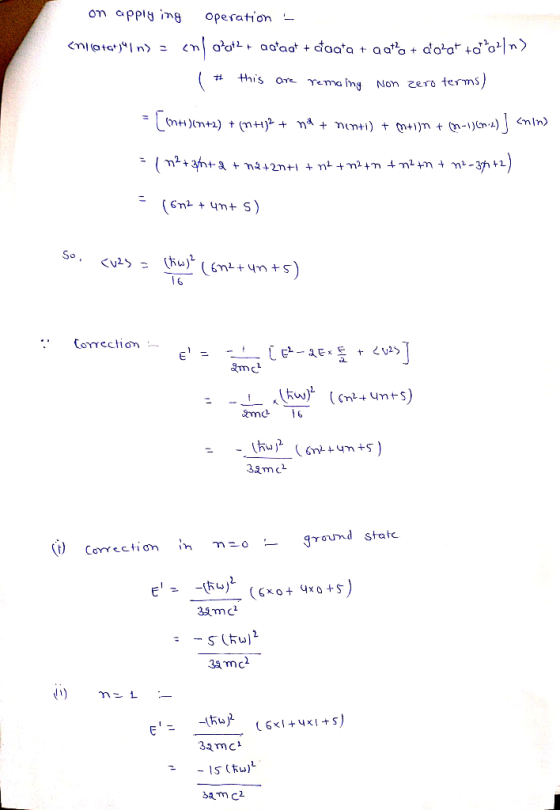
Calculate the first-order correction to the ground and first excited states of a one dimensional harmonic oscillator due to the relativistic correction to its kinetic energy. The mass of the oscillator is m, and its natural frequency is ω. What would be an analog of “fine structure constant” in this system?
Homework Answers



Add Answer to:
Calculate the first-order correction to the ground and first
excited states of a one dimensional harmonic...
Calculate the first order correction to the energy of a harmonic oscillator subject to a small...
Calculate the first order correction to the energy of a harmonic oscillator subject to a small quadratic perturbation H'=bx^4. Calculate the correction for the ground state υ=0 and the 1st excited state υ=1. Comment on the response spacing between the energy levels and hence the spectral position of the υ=0, υ=1.
A particle of charge q and mass m is bound in the ground state of a one-dimensional harmonic osci...
 A particle of charge q and mass m is bound in the ground state of a one-dimensional harmonic oscillator potential with frequency oo. At time t-0 a weak spatially uniform electric field (E) is turned on, so that the perturbation to the Hamiltonian can be described as R'(t) =-q Exe-t/t for t> 0. Using first order, time-dependent perturbation theory, calculate the following probabilities: (a) the particle is detected in the first excited state after a very long time (t »...
[4] Consider a harmonic oscillator of mass m and angular frequency ω. At time t-0, the state of this oscillator is given by y(о) со фо) + с ф.) where the states I 0) .) represent the ground state...
 [4] Consider a harmonic oscillator of mass m and angular frequency ω. At time t-0, the state of this oscillator is given by y(о) со фо) + с ф.) where the states I 0) .) represent the ground state and first excited state respectively. (a) Write the normalization condition for lv(o) and determine the mean value (H) of the energy in terms of co and ci. (b) With the additional requirement (H)-ho. calculate eoand o,p.
[4] Consider a harmonic oscillator...
[4] Consider a harmonic oscillator of mass m and angular frequency ω. At time t-0, the state of this oscillator is given by y(о) со фо) + с ф.) where the states I 0) .) represent the ground state and first excited state respectively. (a) Write the normalization condition for lv(o) and determine the mean value (H) of the energy in terms of co and ci. (b) With the additional requirement (H)-ho. calculate eoand o,p.
[4] Consider a harmonic oscillator...
3. The quantum harmonic oscillator is the quantum-mechanical analog of the classical harmonic oscillator. Because an...
 3. The quantum harmonic oscillator is the quantum-mechanical analog of the classical harmonic oscillator. Because an arbitrary potential can usually be approximated as a harmonic potential at the vicinity of a stable equilibrium point, it is one of the most important model systems in quantum mechanics. Consider an electron trapped by a one-dimensional harmonic potential V(x)=-5 mo?x” (where m is the electron mass, o is a constant angular frequency). In this case, the Schrödinger equation takes the following form, **...
(a) Use the variational method to estimate the ground state energy of a particle of |mass...
 (a) Use the variational method to estimate the ground state energy of a particle of |mass m in a potential Vx)kx, k > 0. (b) Calculate the energy shift in the ground state and in the degenerate 1t excited state of a 2-dimensional harmonic oscillator H(P2P,2/2m m(x +y)due to the perturbation V 2Axy. (20 pts)
(a) Use the variational method to estimate the ground state energy of a particle of |mass m in a potential Vx)kx, k > 0. (b)...
(a) Use the variational method to estimate the ground state energy of a particle of |mass m in a potential Vx)kx, k > 0. (b) Calculate the energy shift in the ground state and in the degenerate 1t excited state of a 2-dimensional harmonic oscillator H(P2P,2/2m m(x +y)due to the perturbation V 2Axy. (20 pts)
(a) Use the variational method to estimate the ground state energy of a particle of |mass m in a potential Vx)kx, k > 0. (b)...
3. Anharmonicity (6 marks] Consider the three-dimensional isotropic harmonic oscillator 2 1 242 р...
 3. Anharmonicity (6 marks] Consider the three-dimensional isotropic harmonic oscillator 2 1 242 рґ which has energy eigenvalues En-hu(n+3/2), where n- 0,1,2.. (a) Calculate the first-order shift in the ground-state energy of the harmonic oscillator due to the addition of an anharmonic term C24 to the potential, where C> 0. (b) Calculate instead the first-order shifts in the energies of the n - 1 ercited states due to the addition of the anharmonic term C (c) For the lowest energy...
Example Question Suppose a molecule exists as a one dimensional harmonic oscillator in a superposition state...
 Example Question Suppose a molecule exists as a one dimensional harmonic oscillator in a superposition state that is given by the following wavefunction: 1 15 Y = -4 +291 Where Y. and Y, are the ground state and the first excited state wavefunctions of the harmonic oscillator. Evaluate the expectation value of the vibrational energy this molecule in such a superposition state (in cm ) given that the vibration constant for the molecule is about 1800 cm
Please do this problem about quantum mechanic harmonic oscillator and show all your steps thank you. Q1. Consider a particle of mass m moving in a one-dimensional harmonic oscillator potential. 1....
 Please do this problem about quantum mechanic harmonic
oscillator and show all your steps thank you.
Q1. Consider a particle of mass m moving in a one-dimensional harmonic oscillator potential. 1. Calculate the product of uncertainties in position and momentum for the particle in 2. Compare the result of (a) with the uncertainty product when the particle is in its the fifth excited state, ie. (OxơP)5. lowest energy state.
Q1. Consider a particle of mass m moving in a one-dimensional...
Please do this problem about quantum mechanic harmonic
oscillator and show all your steps thank you.
Q1. Consider a particle of mass m moving in a one-dimensional harmonic oscillator potential. 1. Calculate the product of uncertainties in position and momentum for the particle in 2. Compare the result of (a) with the uncertainty product when the particle is in its the fifth excited state, ie. (OxơP)5. lowest energy state.
Q1. Consider a particle of mass m moving in a one-dimensional...
Quantum, 1D harmonic oscillator. Please answer in full. Thanks. Q3. The energy levels of the 1D harmonic oscillator are given by: En = (n +2)ha, n=0. 1, 2, 3, The CO molecule has a (reduced) mass of...
 Quantum, 1D harmonic oscillator. Please answer in full.
Thanks.
Q3. The energy levels of the 1D harmonic oscillator are given by: En = (n +2)ha, n=0. 1, 2, 3, The CO molecule has a (reduced) mass of mco = 1.139 × 10⁻²⁶ kg. Assuming a force constant of kco 1860 N/m, what is: a) The angular frequency, w, of the ground state CO bond vibration? b) The energy separation between the ground and first excited vibrational states? 7 marks] The...
Quantum, 1D harmonic oscillator. Please answer in full.
Thanks.
Q3. The energy levels of the 1D harmonic oscillator are given by: En = (n +2)ha, n=0. 1, 2, 3, The CO molecule has a (reduced) mass of mco = 1.139 × 10⁻²⁶ kg. Assuming a force constant of kco 1860 N/m, what is: a) The angular frequency, w, of the ground state CO bond vibration? b) The energy separation between the ground and first excited vibrational states? 7 marks] The...
Question no 6.1, statistical physics by Reif Volume 5 Problems 6.1 Phase space of a classical harmonic oscillator The en...
 Question no 6.1,
statistical physics by Reif Volume 5
Problems 6.1 Phase space of a classical harmonic oscillator The energy of a one-dimensional harmonic oscillator, whose position coordinate is x and whose momentum is p, is given by where the first term on the right is its kinetic and the second term its potential energy. Here m denotes the mass of the osellating particle and a the spring constant of the restoring force acting on the particle. Consider an ensemble...
Question no 6.1,
statistical physics by Reif Volume 5
Problems 6.1 Phase space of a classical harmonic oscillator The energy of a one-dimensional harmonic oscillator, whose position coordinate is x and whose momentum is p, is given by where the first term on the right is its kinetic and the second term its potential energy. Here m denotes the mass of the osellating particle and a the spring constant of the restoring force acting on the particle. Consider an ensemble...
 A particle of charge q and mass m is bound in the ground state of a one-dimensional harmonic oscillator potential with frequency oo. At time t-0 a weak spatially uniform electric field (E) is turned on, so that the perturbation to the Hamiltonian can be described as R'(t) =-q Exe-t/t for t> 0. Using first order, time-dependent perturbation theory, calculate the following probabilities: (a) the particle is detected in the first excited state after a very long time (t »...
 [4] Consider a harmonic oscillator of mass m and angular frequency ω. At time t-0, the state of this oscillator is given by y(о) со фо) + с ф.) where the states I 0) .) represent the ground state and first excited state respectively. (a) Write the normalization condition for lv(o) and determine the mean value (H) of the energy in terms of co and ci. (b) With the additional requirement (H)-ho. calculate eoand o,p.
[4] Consider a harmonic oscillator...
[4] Consider a harmonic oscillator of mass m and angular frequency ω. At time t-0, the state of this oscillator is given by y(о) со фо) + с ф.) where the states I 0) .) represent the ground state and first excited state respectively. (a) Write the normalization condition for lv(o) and determine the mean value (H) of the energy in terms of co and ci. (b) With the additional requirement (H)-ho. calculate eoand o,p.
[4] Consider a harmonic oscillator...
 3. The quantum harmonic oscillator is the quantum-mechanical analog of the classical harmonic oscillator. Because an arbitrary potential can usually be approximated as a harmonic potential at the vicinity of a stable equilibrium point, it is one of the most important model systems in quantum mechanics. Consider an electron trapped by a one-dimensional harmonic potential V(x)=-5 mo?x” (where m is the electron mass, o is a constant angular frequency). In this case, the Schrödinger equation takes the following form, **...
 (a) Use the variational method to estimate the ground state energy of a particle of |mass m in a potential Vx)kx, k > 0. (b) Calculate the energy shift in the ground state and in the degenerate 1t excited state of a 2-dimensional harmonic oscillator H(P2P,2/2m m(x +y)due to the perturbation V 2Axy. (20 pts)
(a) Use the variational method to estimate the ground state energy of a particle of |mass m in a potential Vx)kx, k > 0. (b)...
(a) Use the variational method to estimate the ground state energy of a particle of |mass m in a potential Vx)kx, k > 0. (b) Calculate the energy shift in the ground state and in the degenerate 1t excited state of a 2-dimensional harmonic oscillator H(P2P,2/2m m(x +y)due to the perturbation V 2Axy. (20 pts)
(a) Use the variational method to estimate the ground state energy of a particle of |mass m in a potential Vx)kx, k > 0. (b)...
 3. Anharmonicity (6 marks] Consider the three-dimensional isotropic harmonic oscillator 2 1 242 рґ which has energy eigenvalues En-hu(n+3/2), where n- 0,1,2.. (a) Calculate the first-order shift in the ground-state energy of the harmonic oscillator due to the addition of an anharmonic term C24 to the potential, where C> 0. (b) Calculate instead the first-order shifts in the energies of the n - 1 ercited states due to the addition of the anharmonic term C (c) For the lowest energy...
 Example Question Suppose a molecule exists as a one dimensional harmonic oscillator in a superposition state that is given by the following wavefunction: 1 15 Y = -4 +291 Where Y. and Y, are the ground state and the first excited state wavefunctions of the harmonic oscillator. Evaluate the expectation value of the vibrational energy this molecule in such a superposition state (in cm ) given that the vibration constant for the molecule is about 1800 cm
 Please do this problem about quantum mechanic harmonic
oscillator and show all your steps thank you.
Q1. Consider a particle of mass m moving in a one-dimensional harmonic oscillator potential. 1. Calculate the product of uncertainties in position and momentum for the particle in 2. Compare the result of (a) with the uncertainty product when the particle is in its the fifth excited state, ie. (OxơP)5. lowest energy state.
Q1. Consider a particle of mass m moving in a one-dimensional...
Please do this problem about quantum mechanic harmonic
oscillator and show all your steps thank you.
Q1. Consider a particle of mass m moving in a one-dimensional harmonic oscillator potential. 1. Calculate the product of uncertainties in position and momentum for the particle in 2. Compare the result of (a) with the uncertainty product when the particle is in its the fifth excited state, ie. (OxơP)5. lowest energy state.
Q1. Consider a particle of mass m moving in a one-dimensional...
 Quantum, 1D harmonic oscillator. Please answer in full.
Thanks.
Q3. The energy levels of the 1D harmonic oscillator are given by: En = (n +2)ha, n=0. 1, 2, 3, The CO molecule has a (reduced) mass of mco = 1.139 × 10⁻²⁶ kg. Assuming a force constant of kco 1860 N/m, what is: a) The angular frequency, w, of the ground state CO bond vibration? b) The energy separation between the ground and first excited vibrational states? 7 marks] The...
Quantum, 1D harmonic oscillator. Please answer in full.
Thanks.
Q3. The energy levels of the 1D harmonic oscillator are given by: En = (n +2)ha, n=0. 1, 2, 3, The CO molecule has a (reduced) mass of mco = 1.139 × 10⁻²⁶ kg. Assuming a force constant of kco 1860 N/m, what is: a) The angular frequency, w, of the ground state CO bond vibration? b) The energy separation between the ground and first excited vibrational states? 7 marks] The...
 Question no 6.1,
statistical physics by Reif Volume 5
Problems 6.1 Phase space of a classical harmonic oscillator The energy of a one-dimensional harmonic oscillator, whose position coordinate is x and whose momentum is p, is given by where the first term on the right is its kinetic and the second term its potential energy. Here m denotes the mass of the osellating particle and a the spring constant of the restoring force acting on the particle. Consider an ensemble...
Question no 6.1,
statistical physics by Reif Volume 5
Problems 6.1 Phase space of a classical harmonic oscillator The energy of a one-dimensional harmonic oscillator, whose position coordinate is x and whose momentum is p, is given by where the first term on the right is its kinetic and the second term its potential energy. Here m denotes the mass of the osellating particle and a the spring constant of the restoring force acting on the particle. Consider an ensemble...
Most questions answered within 3 hours.
-
Where is the error in this code sequence?
String s1 = "Hello";
String s2 = "ello";...
asked 11 months ago -
Financial data for Joel de Paris, Inc., for last year
follow:
Joel de Paris, Inc.
Balance...
asked 11 months ago -
Consider this reaction:
Al2(SO4)3 (aq)+ BaCl3
(aq) Al2Cl6 (aq)- +
3BaSO4(s) . What is the...
asked 11 months ago -
Suppose that Savneet is considering increasing her
recent random sample from 20 car rentals to 40...
asked 11 months ago -
Trucks arrive at an unloading terminal at an average rate of 120
per hour.
Trucks arrive...
asked 11 months ago -
Why are methanol and ethanol completely soluble in water while
octanol is not very little soluble....
asked 11 months ago -
A facilities manager at a university reads in a research report
that the mean amount of...
asked 11 months ago -
When the CuSO4 is rehydrated by adding water to the anhydrous
compound, is this an endothermic...
asked 11 months ago -
A ray of sunlight is passing from diamond into crown glass; the
angle of incidence is...
asked 11 months ago -
A block of mass 0.249 kg is placed on top of a light, vertical
spring of...
asked 11 months ago -
how do the kidneys compensate in the presences of acidosis
a) trigger hyperventilate
b) reserve acid...
asked 11 months ago -
Question 501 pts
The rental rate of capital to the firm increases. Which of the
following...
asked 11 months ago