
Homework Answers
Add Answer to:
A particle of charge q and mass m is bound in the ground state of a one-dimensional harmonic osci...
please solve with explanations 3. (20 pts) A particle of mass m and charge q is in a one dimensional harmonic oscillato...
 please solve with explanations
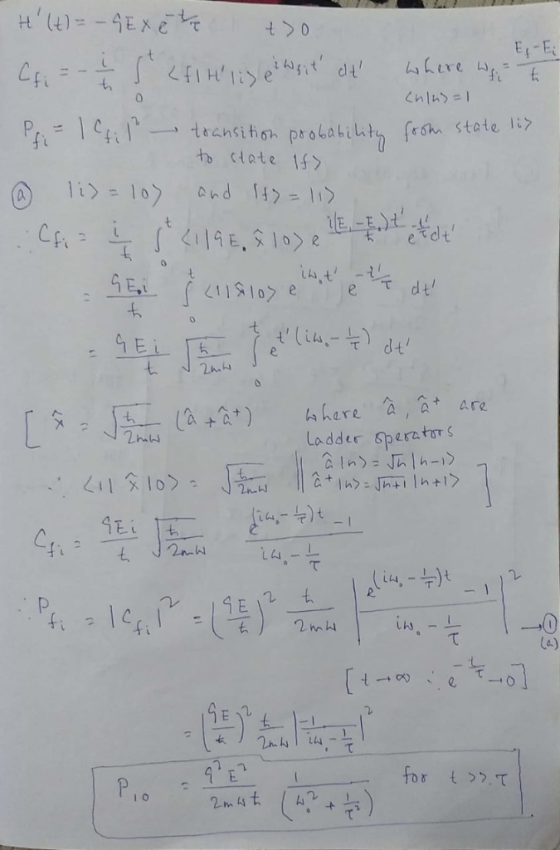
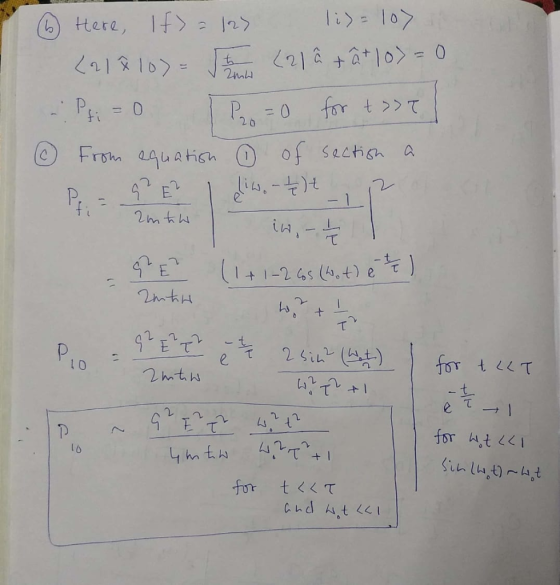
3. (20 pts) A particle of mass m and charge q is in a one dimensional harmonic oscillator potential ()1ma'. A time dependent uniform electric field E, ()E, os eris 2 applied in the x direction. The particle is in the harmonic oscillator ground state at time a) What is the time dependent perturbation Hamiltonian H'(t) - the potential enegy of the charge in this electric field? b) Find the amplitude ci(t) of finding the particle...
please solve with explanations
3. (20 pts) A particle of mass m and charge q is in a one dimensional harmonic oscillator potential ()1ma'. A time dependent uniform electric field E, ()E, os eris 2 applied in the x direction. The particle is in the harmonic oscillator ground state at time a) What is the time dependent perturbation Hamiltonian H'(t) - the potential enegy of the charge in this electric field? b) Find the amplitude ci(t) of finding the particle...
Suppose a particle is in a one-dimensional harmonic oscillator potential. Suppose that a perturbation is added...
 Suppose a particle is in a one-dimensional harmonic oscillator
potential. Suppose that
a perturbation is added at time t = 0 of the form . Assume that at time t = 0 the
particle
is in the ground state. Use first order perturbation theory to find
the probability that at some
time t1 > 0 the particle is in the first excited state of the
harmonic oscillator.
H' = ext.
Suppose a particle is in a one-dimensional harmonic oscillator
potential. Suppose that
a perturbation is added at time t = 0 of the form . Assume that at time t = 0 the
particle
is in the ground state. Use first order perturbation theory to find
the probability that at some
time t1 > 0 the particle is in the first excited state of the
harmonic oscillator.
H' = ext.
1. Consider a spin-0 particle of mass m and charge q moving in a symmetric three-dimensional harm...
 1. Consider a spin-0 particle of mass m and charge q moving in a symmetric three-dimensional harmonic oscillator potential with natural frequency W.Att-0 an external magnetic field is turned on which is uniform in space but oscillates with temporal frequency W as follows. E(t)-Bo sin(at) At time t>0, the perturbation is turned off. Assuming that the system starts off at t-0 in the ground state, apply time-dependent perturbation theory to estimate the probability that the system ends up in an...
1. A particle, initially (t -> 0) in the ground state of an infinite, 1D potential...
 1. A particle, initially (t -> 0) in the ground state of an infinite, 1D potential box with walls at r 0 and = a, is subjected at time t = 0 to a time-dependent perturbation V (r, t) et/7, with eo a small real number a) Calculate to first order the probability of finding the particle in an excited state for t 0. Consider all final states. Are all possible transitions allowed? b) Examine the time dependence of the...
9.5 A particle of mass m is in the ground state in the harmonic oscillator potential...
 9.5 A particle of mass m is in the ground state in the harmonic oscillator potential A small perturbation Bx6 is added to this potential (a) What are the units of ?? (b) How small must B be in order for perturbation theory to be valid? (c) Calculate the first-order change in the energy of the particle.
(a) Use the variational method to estimate the ground state energy of a particle of |mass...
 (a) Use the variational method to estimate the ground state energy of a particle of |mass m in a potential Vx)kx, k > 0. (b) Calculate the energy shift in the ground state and in the degenerate 1t excited state of a 2-dimensional harmonic oscillator H(P2P,2/2m m(x +y)due to the perturbation V 2Axy. (20 pts)
(a) Use the variational method to estimate the ground state energy of a particle of |mass m in a potential Vx)kx, k > 0. (b)...
(a) Use the variational method to estimate the ground state energy of a particle of |mass m in a potential Vx)kx, k > 0. (b) Calculate the energy shift in the ground state and in the degenerate 1t excited state of a 2-dimensional harmonic oscillator H(P2P,2/2m m(x +y)due to the perturbation V 2Axy. (20 pts)
(a) Use the variational method to estimate the ground state energy of a particle of |mass m in a potential Vx)kx, k > 0. (b)...
3. (a) Consider a 1-dim harmonic oscillator in its ground state (0) of the unperturbed Hamiltonian at t--0o. Let a pert...
 3. (a) Consider a 1-dim harmonic oscillator in its ground state (0) of the unperturbed Hamiltonian at t--0o. Let a perturbation Hi(t)--eEXe t2 (e, E and rare constants) be applied between - and too. What is the probability that the oscillator will be in the state n) (of the unperturbed oscillator) as t-> oo?(15%) (b) The bottom of an infinite well is changed to have the shape V(x)-ε sin® for 0Sxa. Calculate the energy shifts for all the excited states...
As a result of a sudden perturbation of the harmonic oscillator originally in the ground state, t...
 As a result of a sudden perturbation of the harmonic oscillator originally in the ground state, the restoring force coefficient k in its potential energy U(a) (1/2)k2 changes to k' ak, a>0. Find the proba- bility to find the new oscillator in an excited state.
As a result of a sudden perturbation of the harmonic oscillator originally in the ground state, the restoring force coefficient k in its potential energy U(a) (1/2)k2 changes to k' ak, a>0. Find the proba-...
As a result of a sudden perturbation of the harmonic oscillator originally in the ground state, the restoring force coefficient k in its potential energy U(a) (1/2)k2 changes to k' ak, a>0. Find the proba- bility to find the new oscillator in an excited state.
As a result of a sudden perturbation of the harmonic oscillator originally in the ground state, the restoring force coefficient k in its potential energy U(a) (1/2)k2 changes to k' ak, a>0. Find the proba-...
10. A harmonic oscillator with the Hamiltonian H t 2m dr? mooʻr is now subject to...
 10. A harmonic oscillator with the Hamiltonian H t 2m dr? mooʻr is now subject to a 2 weak perturbation: H-ix. You are asked to solve the ground state of the new Hamiltonian - À + in two ways. (a) Solve by using the time-independent perturbation theory. Find the lowest non- vanishing order correction to the energy of the ground state. And find the lowest non vanishing order correction to the wavefunction of the ground state. (b) Find the wavefunction...
Consider a particle with mass m described by the Hamilton operator for a one-dimensional harmonic oscillator...
 Consider a particle with mass m described by the Hamilton operator for a one-dimensional harmonic oscillator 2 Zm 2 The normalized eigenfunctions for Hare φη (x) with energies E,,-(n + 2) ha. At time t-0 the wavefunction of the particle is given by у(x,0)- (V3іфі (x) + ф3(x)). Now let H' be an operator given by where k is a positive constant. 1) Show that H' is Hermitian. 2) Express H' by the step-operators a+ and a 3) Calculate the...
 please solve with explanations
3. (20 pts) A particle of mass m and charge q is in a one dimensional harmonic oscillator potential ()1ma'. A time dependent uniform electric field E, ()E, os eris 2 applied in the x direction. The particle is in the harmonic oscillator ground state at time a) What is the time dependent perturbation Hamiltonian H'(t) - the potential enegy of the charge in this electric field? b) Find the amplitude ci(t) of finding the particle...
please solve with explanations
3. (20 pts) A particle of mass m and charge q is in a one dimensional harmonic oscillator potential ()1ma'. A time dependent uniform electric field E, ()E, os eris 2 applied in the x direction. The particle is in the harmonic oscillator ground state at time a) What is the time dependent perturbation Hamiltonian H'(t) - the potential enegy of the charge in this electric field? b) Find the amplitude ci(t) of finding the particle...
 Suppose a particle is in a one-dimensional harmonic oscillator
potential. Suppose that
a perturbation is added at time t = 0 of the form . Assume that at time t = 0 the
particle
is in the ground state. Use first order perturbation theory to find
the probability that at some
time t1 > 0 the particle is in the first excited state of the
harmonic oscillator.
H' = ext.
Suppose a particle is in a one-dimensional harmonic oscillator
potential. Suppose that
a perturbation is added at time t = 0 of the form . Assume that at time t = 0 the
particle
is in the ground state. Use first order perturbation theory to find
the probability that at some
time t1 > 0 the particle is in the first excited state of the
harmonic oscillator.
H' = ext.
 1. Consider a spin-0 particle of mass m and charge q moving in a symmetric three-dimensional harmonic oscillator potential with natural frequency W.Att-0 an external magnetic field is turned on which is uniform in space but oscillates with temporal frequency W as follows. E(t)-Bo sin(at) At time t>0, the perturbation is turned off. Assuming that the system starts off at t-0 in the ground state, apply time-dependent perturbation theory to estimate the probability that the system ends up in an...
 1. A particle, initially (t -> 0) in the ground state of an infinite, 1D potential box with walls at r 0 and = a, is subjected at time t = 0 to a time-dependent perturbation V (r, t) et/7, with eo a small real number a) Calculate to first order the probability of finding the particle in an excited state for t 0. Consider all final states. Are all possible transitions allowed? b) Examine the time dependence of the...
 9.5 A particle of mass m is in the ground state in the harmonic oscillator potential A small perturbation Bx6 is added to this potential (a) What are the units of ?? (b) How small must B be in order for perturbation theory to be valid? (c) Calculate the first-order change in the energy of the particle.
 (a) Use the variational method to estimate the ground state energy of a particle of |mass m in a potential Vx)kx, k > 0. (b) Calculate the energy shift in the ground state and in the degenerate 1t excited state of a 2-dimensional harmonic oscillator H(P2P,2/2m m(x +y)due to the perturbation V 2Axy. (20 pts)
(a) Use the variational method to estimate the ground state energy of a particle of |mass m in a potential Vx)kx, k > 0. (b)...
(a) Use the variational method to estimate the ground state energy of a particle of |mass m in a potential Vx)kx, k > 0. (b) Calculate the energy shift in the ground state and in the degenerate 1t excited state of a 2-dimensional harmonic oscillator H(P2P,2/2m m(x +y)due to the perturbation V 2Axy. (20 pts)
(a) Use the variational method to estimate the ground state energy of a particle of |mass m in a potential Vx)kx, k > 0. (b)...
 3. (a) Consider a 1-dim harmonic oscillator in its ground state (0) of the unperturbed Hamiltonian at t--0o. Let a perturbation Hi(t)--eEXe t2 (e, E and rare constants) be applied between - and too. What is the probability that the oscillator will be in the state n) (of the unperturbed oscillator) as t-> oo?(15%) (b) The bottom of an infinite well is changed to have the shape V(x)-ε sin® for 0Sxa. Calculate the energy shifts for all the excited states...
 As a result of a sudden perturbation of the harmonic oscillator originally in the ground state, the restoring force coefficient k in its potential energy U(a) (1/2)k2 changes to k' ak, a>0. Find the proba- bility to find the new oscillator in an excited state.
As a result of a sudden perturbation of the harmonic oscillator originally in the ground state, the restoring force coefficient k in its potential energy U(a) (1/2)k2 changes to k' ak, a>0. Find the proba-...
As a result of a sudden perturbation of the harmonic oscillator originally in the ground state, the restoring force coefficient k in its potential energy U(a) (1/2)k2 changes to k' ak, a>0. Find the proba- bility to find the new oscillator in an excited state.
As a result of a sudden perturbation of the harmonic oscillator originally in the ground state, the restoring force coefficient k in its potential energy U(a) (1/2)k2 changes to k' ak, a>0. Find the proba-...
 10. A harmonic oscillator with the Hamiltonian H t 2m dr? mooʻr is now subject to a 2 weak perturbation: H-ix. You are asked to solve the ground state of the new Hamiltonian - À + in two ways. (a) Solve by using the time-independent perturbation theory. Find the lowest non- vanishing order correction to the energy of the ground state. And find the lowest non vanishing order correction to the wavefunction of the ground state. (b) Find the wavefunction...
 Consider a particle with mass m described by the Hamilton operator for a one-dimensional harmonic oscillator 2 Zm 2 The normalized eigenfunctions for Hare φη (x) with energies E,,-(n + 2) ha. At time t-0 the wavefunction of the particle is given by у(x,0)- (V3іфі (x) + ф3(x)). Now let H' be an operator given by where k is a positive constant. 1) Show that H' is Hermitian. 2) Express H' by the step-operators a+ and a 3) Calculate the...
Most questions answered within 3 hours.
-
Where is the error in this code sequence?
String s1 = "Hello";
String s2 = "ello";...
asked 11 months ago -
Financial data for Joel de Paris, Inc., for last year
follow:
Joel de Paris, Inc.
Balance...
asked 11 months ago -
Consider this reaction:
Al2(SO4)3 (aq)+ BaCl3
(aq) Al2Cl6 (aq)- +
3BaSO4(s) . What is the...
asked 11 months ago -
Suppose that Savneet is considering increasing her
recent random sample from 20 car rentals to 40...
asked 11 months ago -
Trucks arrive at an unloading terminal at an average rate of 120
per hour.
Trucks arrive...
asked 11 months ago -
Why are methanol and ethanol completely soluble in water while
octanol is not very little soluble....
asked 11 months ago -
A facilities manager at a university reads in a research report
that the mean amount of...
asked 11 months ago -
When the CuSO4 is rehydrated by adding water to the anhydrous
compound, is this an endothermic...
asked 11 months ago -
A ray of sunlight is passing from diamond into crown glass; the
angle of incidence is...
asked 11 months ago -
A block of mass 0.249 kg is placed on top of a light, vertical
spring of...
asked 11 months ago -
how do the kidneys compensate in the presences of acidosis
a) trigger hyperventilate
b) reserve acid...
asked 11 months ago -
Question 501 pts
The rental rate of capital to the firm increases. Which of the
following...
asked 11 months ago