
Homework Answers
![0 nSweV ien tha [a7 aj yield 3 Males A Consued maィ ms tantaneouS 2 CA CB b] CA CA CB](http://img.homeworklib.com/questions/f7964910-b617-11eb-a87a-d1799a50605e.png?x-oss-process=image/resize,w_560)
Add Answer to:
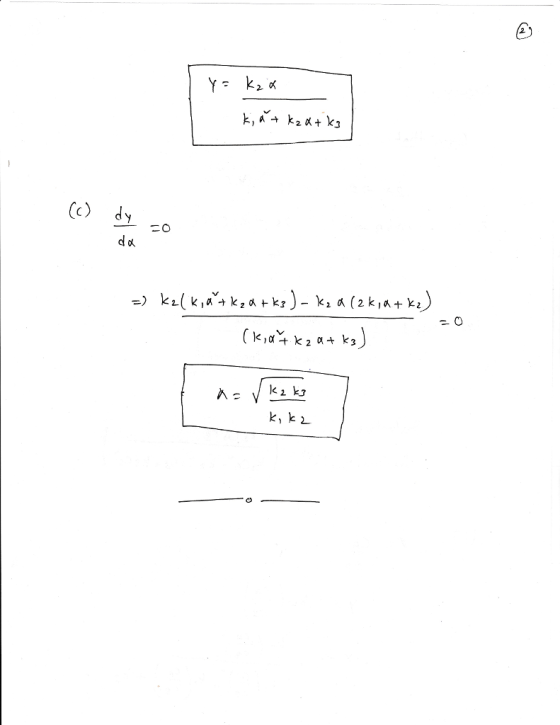
2. (30 points). A and B react as follows, where S is the desired product.: 2...
A chemical reaction, A+B → P, has the following mechanism: 2A< Ki>A, (fast to equilibrium) A+B&K, ™C (fast to...
 A chemical reaction, A+B → P, has the following mechanism: 2A< Ki>A, (fast to equilibrium) A+B&K, ™C (fast to equilibrium), A,+C-k>P+ 2A (slow) where Kį and K2 are the equilibrium constants for the first two reactions, respectively. k3 is the rate constant for the third reaction. (a) [5 points] Based on this mechanism, show that the rate of product (P) formation is: d[P] – k[A[B], where k is the rate constant of the overall reaction. Write k in terms of...
Pure reactant A flows into the tubular reactor (PFR) at a rate of 50 dm3/min as...
 Pure reactant A flows into the tubular reactor (PFR) at a rate
of 50 dm3/min as a liquid to produce the desired product, B. And
the intermediate product B is competitively converted to the
unwanted products X and Y simultaneously. Each reaction is a
primary reaction, and the reaction rate constants are k1=0.2min-1,
k2=0.3min-1, and k3=0.1min-1. Answer the following questions.
(1) Find product B as a function of residence time (τ)
(2) What is the size of the reactor for...
Pure reactant A flows into the tubular reactor (PFR) at a rate
of 50 dm3/min as a liquid to produce the desired product, B. And
the intermediate product B is competitively converted to the
unwanted products X and Y simultaneously. Each reaction is a
primary reaction, and the reaction rate constants are k1=0.2min-1,
k2=0.3min-1, and k3=0.1min-1. Answer the following questions.
(1) Find product B as a function of residence time (τ)
(2) What is the size of the reactor for...
2. (30 pts) CSTR Reactor Multiple Reactions: Consider the following set of series reactions which occurs...
 2. (30 pts) CSTR Reactor Multiple Reactions: Consider the following set of series reactions which occurs in a CSTR reactor, with the given intrinsic reaction rate equations and kinetic constants Rxn 1: 2A → B; r1=kCA; ki = 0.5 (L/mole)-min Rxn 2: 2B → C; r = k Ce?; k2 = 0.2 (/mol)-min! a. Algebraic equation for each species: Write out the applicable algebraic equations for CA C using the space time parameter t, for these reactions occurring in a...
please solve it right . Example: Van de Vusse Reaction in an CSTR Van de Vusse liquid phase reaction is carried out...
 please solve it right .
Example: Van de Vusse Reaction in an CSTR Van de Vusse liquid phase reaction is carried out in an isothermal CSTR according to the following stoichiometric equations: k3 where B is the desired product, and C and D are the undesired byproducts. The feed to the CSTR contains the reactant A only. The reaction rates are given by the following rate laws: 2 Additional information: k 0.8333 min k2 1.667 min, k3 0.1667 L min...
please solve it right .
Example: Van de Vusse Reaction in an CSTR Van de Vusse liquid phase reaction is carried out in an isothermal CSTR according to the following stoichiometric equations: k3 where B is the desired product, and C and D are the undesired byproducts. The feed to the CSTR contains the reactant A only. The reaction rates are given by the following rate laws: 2 Additional information: k 0.8333 min k2 1.667 min, k3 0.1667 L min...
we can find the type of the reactor at problem no.(c). 3. (40 pts.) Consider the following parallel reactions that...
 we
can find the type of the reactor at problem no.(c).
3. (40 pts.) Consider the following parallel reactions that we have encountered in producing the desired product B at 300 K FF rB kiCA 0.0015 CA (1) A B (2) A C rc k 0.0001 (3) A D : rD kCA 0.008 CA The reactions are in liquid-phase. The activation energies of the reaction (1), (2), and (3) are 5x 10⁴ kJ/mol, 4x10 kJ/mol, and 8x10 kJ/mol, respectively. We...
we
can find the type of the reactor at problem no.(c).
3. (40 pts.) Consider the following parallel reactions that we have encountered in producing the desired product B at 300 K FF rB kiCA 0.0015 CA (1) A B (2) A C rc k 0.0001 (3) A D : rD kCA 0.008 CA The reactions are in liquid-phase. The activation energies of the reaction (1), (2), and (3) are 5x 10⁴ kJ/mol, 4x10 kJ/mol, and 8x10 kJ/mol, respectively. We...
Problem 1: For the mechanical system shown below, m-2 kg, b-2 N/(m/s). ki 10N/m, k2-2N/m, k3...
 Problem 1: For the mechanical system shown below, m-2 kg, b-2 N/(m/s). ki 10N/m, k2-2N/m, k3 8N/m. u(t)2 1(t) is the input of the system and the displacement of the mass, z1(t) is the output. a. b. c. Find the governing equations of the system Find the state space model (matrices, A, B. C, D) Will you see any oscillation in the trajectory of the displacement a? Explain while using the eigenvalues of the system matrix. Hint. Eigen values of...
Consider the following system of gas-phase reactions: 3,1/2 .1 B is the desired product, and X...
 Consider the following system of gas-phase reactions: 3,1/2 .1 B is the desired product, and X and Y are foul pollutants that are expensive to get rid of. The specific reaction rates are at 27°C. The reaction system is to be operated at 27°C and 4 atm. Pure A enters the system at a volumetric flow rate of 10 dm3/min. 1) Write out the expression for selectivity and generate a plot of selectivity vs. concentration of A. 2) Choose a...
B) Consider the series reaction A R S that we studied in lecture, where both reactions...
 B) Consider the series reaction A R S that we studied in lecture, where both reactions are first order and irreversible. A batch reactor is loaded with Cao=4 mol/L and k1=0.25 min!. Plot CA, CR, and Cs as a function of time for a set of different ka's ranging from 0.025 to 2.5 min!. Comment on the dynamics that you observe for the different cases. Which rate constants and operating conditions are optimal if your goal is to maximize the...
Problem 51: (25 points) Figure 5 is an example of a feedback control system that is designed to r...
 Problem 51: (25 points) Figure 5 is an example of a feedback control system that is designed to regulate the angular position θ(t) of a motor shaft to a desired value θr(t). The signal e(t) represents the error between the measured shaft angle θ(t) and the desired shaft angle θ (t). The Laplace transforms ofa,(t), θ(t), and e(t) are denoted as ΘR(s), θ(s), and E(s), respectively. The control gains Ki and K2 are chosen by the control engineer to achieve...
5. Lead will react with hydrochloric acid as follows: + PbCl(s) + H2(g) 2 HCl(aq) +...
 5. Lead will react with hydrochloric acid as follows: + PbCl(s) + H2(g) 2 HCl(aq) + Pb(s) a. (10 points) Assign oxidation states to each atom, and identify the oxidizing agent and the reducing agent. b. (10 points) In the lab, a student mixes together 2.76 grams of lead with 1.12 grams hydrochloric acid. Determine the limiting reactant and the theoretical yield of solid lead (II) chloride (in grams).
 A chemical reaction, A+B → P, has the following mechanism: 2A< Ki>A, (fast to equilibrium) A+B&K, ™C (fast to equilibrium), A,+C-k>P+ 2A (slow) where Kį and K2 are the equilibrium constants for the first two reactions, respectively. k3 is the rate constant for the third reaction. (a) [5 points] Based on this mechanism, show that the rate of product (P) formation is: d[P] – k[A[B], where k is the rate constant of the overall reaction. Write k in terms of...
 Pure reactant A flows into the tubular reactor (PFR) at a rate
of 50 dm3/min as a liquid to produce the desired product, B. And
the intermediate product B is competitively converted to the
unwanted products X and Y simultaneously. Each reaction is a
primary reaction, and the reaction rate constants are k1=0.2min-1,
k2=0.3min-1, and k3=0.1min-1. Answer the following questions.
(1) Find product B as a function of residence time (τ)
(2) What is the size of the reactor for...
Pure reactant A flows into the tubular reactor (PFR) at a rate
of 50 dm3/min as a liquid to produce the desired product, B. And
the intermediate product B is competitively converted to the
unwanted products X and Y simultaneously. Each reaction is a
primary reaction, and the reaction rate constants are k1=0.2min-1,
k2=0.3min-1, and k3=0.1min-1. Answer the following questions.
(1) Find product B as a function of residence time (τ)
(2) What is the size of the reactor for...
 2. (30 pts) CSTR Reactor Multiple Reactions: Consider the following set of series reactions which occurs in a CSTR reactor, with the given intrinsic reaction rate equations and kinetic constants Rxn 1: 2A → B; r1=kCA; ki = 0.5 (L/mole)-min Rxn 2: 2B → C; r = k Ce?; k2 = 0.2 (/mol)-min! a. Algebraic equation for each species: Write out the applicable algebraic equations for CA C using the space time parameter t, for these reactions occurring in a...
 please solve it right .
Example: Van de Vusse Reaction in an CSTR Van de Vusse liquid phase reaction is carried out in an isothermal CSTR according to the following stoichiometric equations: k3 where B is the desired product, and C and D are the undesired byproducts. The feed to the CSTR contains the reactant A only. The reaction rates are given by the following rate laws: 2 Additional information: k 0.8333 min k2 1.667 min, k3 0.1667 L min...
please solve it right .
Example: Van de Vusse Reaction in an CSTR Van de Vusse liquid phase reaction is carried out in an isothermal CSTR according to the following stoichiometric equations: k3 where B is the desired product, and C and D are the undesired byproducts. The feed to the CSTR contains the reactant A only. The reaction rates are given by the following rate laws: 2 Additional information: k 0.8333 min k2 1.667 min, k3 0.1667 L min...
 we
can find the type of the reactor at problem no.(c).
3. (40 pts.) Consider the following parallel reactions that we have encountered in producing the desired product B at 300 K FF rB kiCA 0.0015 CA (1) A B (2) A C rc k 0.0001 (3) A D : rD kCA 0.008 CA The reactions are in liquid-phase. The activation energies of the reaction (1), (2), and (3) are 5x 10⁴ kJ/mol, 4x10 kJ/mol, and 8x10 kJ/mol, respectively. We...
we
can find the type of the reactor at problem no.(c).
3. (40 pts.) Consider the following parallel reactions that we have encountered in producing the desired product B at 300 K FF rB kiCA 0.0015 CA (1) A B (2) A C rc k 0.0001 (3) A D : rD kCA 0.008 CA The reactions are in liquid-phase. The activation energies of the reaction (1), (2), and (3) are 5x 10⁴ kJ/mol, 4x10 kJ/mol, and 8x10 kJ/mol, respectively. We...
 Problem 1: For the mechanical system shown below, m-2 kg, b-2 N/(m/s). ki 10N/m, k2-2N/m, k3 8N/m. u(t)2 1(t) is the input of the system and the displacement of the mass, z1(t) is the output. a. b. c. Find the governing equations of the system Find the state space model (matrices, A, B. C, D) Will you see any oscillation in the trajectory of the displacement a? Explain while using the eigenvalues of the system matrix. Hint. Eigen values of...
 Consider the following system of gas-phase reactions: 3,1/2 .1 B is the desired product, and X and Y are foul pollutants that are expensive to get rid of. The specific reaction rates are at 27°C. The reaction system is to be operated at 27°C and 4 atm. Pure A enters the system at a volumetric flow rate of 10 dm3/min. 1) Write out the expression for selectivity and generate a plot of selectivity vs. concentration of A. 2) Choose a...
 B) Consider the series reaction A R S that we studied in lecture, where both reactions are first order and irreversible. A batch reactor is loaded with Cao=4 mol/L and k1=0.25 min!. Plot CA, CR, and Cs as a function of time for a set of different ka's ranging from 0.025 to 2.5 min!. Comment on the dynamics that you observe for the different cases. Which rate constants and operating conditions are optimal if your goal is to maximize the...
 Problem 51: (25 points) Figure 5 is an example of a feedback control system that is designed to regulate the angular position θ(t) of a motor shaft to a desired value θr(t). The signal e(t) represents the error between the measured shaft angle θ(t) and the desired shaft angle θ (t). The Laplace transforms ofa,(t), θ(t), and e(t) are denoted as ΘR(s), θ(s), and E(s), respectively. The control gains Ki and K2 are chosen by the control engineer to achieve...
 5. Lead will react with hydrochloric acid as follows: + PbCl(s) + H2(g) 2 HCl(aq) + Pb(s) a. (10 points) Assign oxidation states to each atom, and identify the oxidizing agent and the reducing agent. b. (10 points) In the lab, a student mixes together 2.76 grams of lead with 1.12 grams hydrochloric acid. Determine the limiting reactant and the theoretical yield of solid lead (II) chloride (in grams).
Most questions answered within 3 hours.
-
Where is the error in this code sequence?
String s1 = "Hello";
String s2 = "ello";...
asked 10 months ago -
Financial data for Joel de Paris, Inc., for last year
follow:
Joel de Paris, Inc.
Balance...
asked 10 months ago -
Consider this reaction:
Al2(SO4)3 (aq)+ BaCl3
(aq) Al2Cl6 (aq)- +
3BaSO4(s) . What is the...
asked 10 months ago -
Suppose that Savneet is considering increasing her
recent random sample from 20 car rentals to 40...
asked 10 months ago -
Trucks arrive at an unloading terminal at an average rate of 120
per hour.
Trucks arrive...
asked 10 months ago -
Why are methanol and ethanol completely soluble in water while
octanol is not very little soluble....
asked 10 months ago -
A facilities manager at a university reads in a research report
that the mean amount of...
asked 10 months ago -
When the CuSO4 is rehydrated by adding water to the anhydrous
compound, is this an endothermic...
asked 10 months ago -
A ray of sunlight is passing from diamond into crown glass; the
angle of incidence is...
asked 10 months ago -
A block of mass 0.249 kg is placed on top of a light, vertical
spring of...
asked 10 months ago -
how do the kidneys compensate in the presences of acidosis
a) trigger hyperventilate
b) reserve acid...
asked 10 months ago -
Question 501 pts
The rental rate of capital to the firm increases. Which of the
following...
asked 10 months ago