a)
The water molecule consists of two hydrogen atoms and one oxygen
atom. Since the oxygen atom has a higher electronegativity than the
hydrogen atom, the side of the molecule with the oxygen atom has a
partial negative charge.
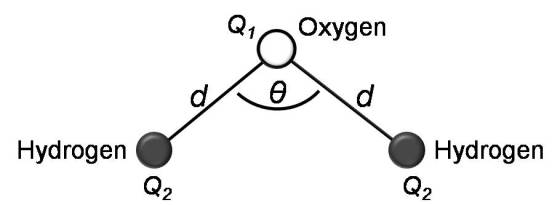
Assume that the partial positive charge on each hydrogen atom is
Q2 = 0.512 x 10⁻¹⁹ C. What is the
electric charge Q1 on the Oxygen atom?
b)
The water molecule forms an angle, with hydrogen atoms at the
tips and the oxygen atom at the vertex (see diagram in the previous
problem).
Assume that the angle at the oxygen atom is θ (theta) =
104.0o and the distance between the oxygen and the
hydrogen atoms is d = 95.3 x 10⁻⁹ m.
Calculate the magnitude of the net electrostatic force on the
oxygen atom. Use the charges from the previous problem.
Homework Answers


Add Answer to:
a)
The water molecule consists of two hydrogen atoms and one oxygen
atom. Since the oxygen...
The distance between the oxygen and each of the hydrogen atoms in a water molecule is...
The distance between the oxygen and each of the hydrogen atoms in a water molecule is 0.09584 nm; the angle between the bonds is 104.45°. Find the distance of the center-of-mass from the oxygen atom
1) Water is a polar molecule. There is an effective accumulation of negative charge near the...
 1) Water is a polar molecule. There is an effective accumulation of negative charge near the oxygen atom and an effective lack of negative charge ( positive charge) near each of the hydrogen atoms. The molecule is triangular in shape, as diagramed below, with the angle near the oxygen vertex equal to 104.5°. d is the distance from each of the hydrogen atoms to the oxygen atom +Q 5225 52.25 -20 +Q Derive a formula for the electric field produced...
Imagine that a water molecule is made of two positively charged hydrogen atoms, each with charge...
 Imagine that a water molecule is made of two positively charged
hydrogen atoms, each with charge +q, and one negatively charged
oxygen atom, with charge –2q. These atoms are arranged as shown.
The magnitude of the electron charge q = 1.6 x 10^19 C and the
distance unit used in the diagram, “pm”, is picometers, or 10^-12
m. How much energy would it take for you to completely remove the
positively charged hydrogen atom on the left from this molecule,...
Imagine that a water molecule is made of two positively charged
hydrogen atoms, each with charge +q, and one negatively charged
oxygen atom, with charge –2q. These atoms are arranged as shown.
The magnitude of the electron charge q = 1.6 x 10^19 C and the
distance unit used in the diagram, “pm”, is picometers, or 10^-12
m. How much energy would it take for you to completely remove the
positively charged hydrogen atom on the left from this molecule,...
Water molecules have one oxygen atom that is more electronegative than the two hydrogen atoms bound...
Water molecules have one oxygen atom that is more electronegative than the two hydrogen atoms bound to it. As a result, which type of bonding holds the atoms within one water molecule together? A. non-polar covalent bonding B. polar covalent bonding C. Ionic bonding D. hydrogen bonds
When a water molecule forms a hydrogen bond with another water molecule, which atoms are involved...
 When a water molecule forms a hydrogen bond with another water molecule, which atoms are involved in the interaction? A) a hydrogen from one molecule and a hydrogn from the other molecule B) a hydrogen from one molecule and an oxygen from the other molecule C) an oxygen from one molecule and an oxygen from the other molecule D) an oxygen and a hydrogen from the same molecule E) two hydrogens from one molecule and one hydrogen from the other...
The drawing shows a sulfur dioxide molecule. It consists of two oxygen atoms and a sulfur...
 The drawing shows a sulfur dioxide molecule. It consists of two
oxygen atoms and a sulfur atom. A sulfur atom is twice as massive
as an oxygen atom. Using this information and the data provided in
the drawing, find (a) the x coordinate and (b) the
y coordinate of the center of mass of the sulfur dioxide
molecule. Express your answers in nanometers (1 nm = 1.00 10-9 m).
(a) xcmx =
(b) ycmy =
The drawing shows a sulfur dioxide molecule. It consists of two
oxygen atoms and a sulfur atom. A sulfur atom is twice as massive
as an oxygen atom. Using this information and the data provided in
the drawing, find (a) the x coordinate and (b) the
y coordinate of the center of mass of the sulfur dioxide
molecule. Express your answers in nanometers (1 nm = 1.00 10-9 m).
(a) xcmx =
(b) ycmy =
2. A molecule contains 2 carbon atoms, 6 hydrogen atoms, and 1 oxygen atom. a. Write a molecular formula for the mo...
 2. A molecule contains 2 carbon atoms, 6 hydrogen atoms, and 1 oxygen atom. a. Write a molecular formula for the molecule. Liebe. .bialaliita...ba...ba..... bed.....
The drawing shows a sulfur dioxide molecule. It consists of two oxygen atoms and a suifur...
 The drawing shows a sulfur dioxide molecule. It consists of two oxygen atoms and a suifur atom. A sulfur atom is twice as massive as an oxygen atom. Using this information and the data provided in the drawing, find (a) the x coordinate and (b) the y coordinate of the center of mass of the sulfur dioxide molecule. Express your answers in nanometers 1.00 x 10 m). (1 nm Oygen Orygen 60.0 60.0 0.143 n O.143 nm Sulfur (a) xs...
Predict which intermolecular forces contribute the most to the dissolution of NaCl in water?
NaCl is an ionic solid. The Na+ and Cl− ions in NaCl are bonded through an electrostatic force of attraction commonly known as the ionic bond. Water is a polar solvent. The oxygen atom, being more electronegative, attracts the electron cloud toward itself. As the electron cloud is pulled by the oxygen atom, it carries a partial negative charge, and the hydrogen atoms carry a partial positive charge. This partial separation of charges in the water molecule makes it polar....
In a covalent bond between two atoms, the more electronegative atom will attract more electron density...
 In a covalent bond between two atoms, the more electronegative atom will attract more electron density toward itself, producing a polar bond. The more electronegative element will carry a partial negative charge, whereas the less electronegative element will carry a partial positive charge. The direction of the bond dipole is always toward the more electronegative element. This is often indicated by an arrow, as shown in the figure. The magnitude of the bond polarity can be estimated by using the...
 1) Water is a polar molecule. There is an effective accumulation of negative charge near the oxygen atom and an effective lack of negative charge ( positive charge) near each of the hydrogen atoms. The molecule is triangular in shape, as diagramed below, with the angle near the oxygen vertex equal to 104.5°. d is the distance from each of the hydrogen atoms to the oxygen atom +Q 5225 52.25 -20 +Q Derive a formula for the electric field produced...
 Imagine that a water molecule is made of two positively charged
hydrogen atoms, each with charge +q, and one negatively charged
oxygen atom, with charge –2q. These atoms are arranged as shown.
The magnitude of the electron charge q = 1.6 x 10^19 C and the
distance unit used in the diagram, “pm”, is picometers, or 10^-12
m. How much energy would it take for you to completely remove the
positively charged hydrogen atom on the left from this molecule,...
Imagine that a water molecule is made of two positively charged
hydrogen atoms, each with charge +q, and one negatively charged
oxygen atom, with charge –2q. These atoms are arranged as shown.
The magnitude of the electron charge q = 1.6 x 10^19 C and the
distance unit used in the diagram, “pm”, is picometers, or 10^-12
m. How much energy would it take for you to completely remove the
positively charged hydrogen atom on the left from this molecule,...
 When a water molecule forms a hydrogen bond with another water molecule, which atoms are involved in the interaction? A) a hydrogen from one molecule and a hydrogn from the other molecule B) a hydrogen from one molecule and an oxygen from the other molecule C) an oxygen from one molecule and an oxygen from the other molecule D) an oxygen and a hydrogen from the same molecule E) two hydrogens from one molecule and one hydrogen from the other...
 The drawing shows a sulfur dioxide molecule. It consists of two
oxygen atoms and a sulfur atom. A sulfur atom is twice as massive
as an oxygen atom. Using this information and the data provided in
the drawing, find (a) the x coordinate and (b) the
y coordinate of the center of mass of the sulfur dioxide
molecule. Express your answers in nanometers (1 nm = 1.00 10-9 m).
(a) xcmx =
(b) ycmy =
The drawing shows a sulfur dioxide molecule. It consists of two
oxygen atoms and a sulfur atom. A sulfur atom is twice as massive
as an oxygen atom. Using this information and the data provided in
the drawing, find (a) the x coordinate and (b) the
y coordinate of the center of mass of the sulfur dioxide
molecule. Express your answers in nanometers (1 nm = 1.00 10-9 m).
(a) xcmx =
(b) ycmy =
 2. A molecule contains 2 carbon atoms, 6 hydrogen atoms, and 1 oxygen atom. a. Write a molecular formula for the molecule. Liebe. .bialaliita...ba...ba..... bed.....
 The drawing shows a sulfur dioxide molecule. It consists of two oxygen atoms and a suifur atom. A sulfur atom is twice as massive as an oxygen atom. Using this information and the data provided in the drawing, find (a) the x coordinate and (b) the y coordinate of the center of mass of the sulfur dioxide molecule. Express your answers in nanometers 1.00 x 10 m). (1 nm Oygen Orygen 60.0 60.0 0.143 n O.143 nm Sulfur (a) xs...
 In a covalent bond between two atoms, the more electronegative atom will attract more electron density toward itself, producing a polar bond. The more electronegative element will carry a partial negative charge, whereas the less electronegative element will carry a partial positive charge. The direction of the bond dipole is always toward the more electronegative element. This is often indicated by an arrow, as shown in the figure. The magnitude of the bond polarity can be estimated by using the...
Most questions answered within 3 hours.
-
Where is the error in this code sequence?
String s1 = "Hello";
String s2 = "ello";...
asked 11 months ago -
Financial data for Joel de Paris, Inc., for last year
follow:
Joel de Paris, Inc.
Balance...
asked 11 months ago -
Consider this reaction:
Al2(SO4)3 (aq)+ BaCl3
(aq) Al2Cl6 (aq)- +
3BaSO4(s) . What is the...
asked 11 months ago -
Suppose that Savneet is considering increasing her
recent random sample from 20 car rentals to 40...
asked 11 months ago -
Trucks arrive at an unloading terminal at an average rate of 120
per hour.
Trucks arrive...
asked 11 months ago -
Why are methanol and ethanol completely soluble in water while
octanol is not very little soluble....
asked 11 months ago -
A facilities manager at a university reads in a research report
that the mean amount of...
asked 11 months ago -
When the CuSO4 is rehydrated by adding water to the anhydrous
compound, is this an endothermic...
asked 11 months ago -
A ray of sunlight is passing from diamond into crown glass; the
angle of incidence is...
asked 11 months ago -
A block of mass 0.249 kg is placed on top of a light, vertical
spring of...
asked 11 months ago -
how do the kidneys compensate in the presences of acidosis
a) trigger hyperventilate
b) reserve acid...
asked 11 months ago -
Question 501 pts
The rental rate of capital to the firm increases. Which of the
following...
asked 11 months ago