
Homework Answers
Doubt in any step then comment below.. I will explain you.
.
please thumbs up for this solution... Thanks.
.
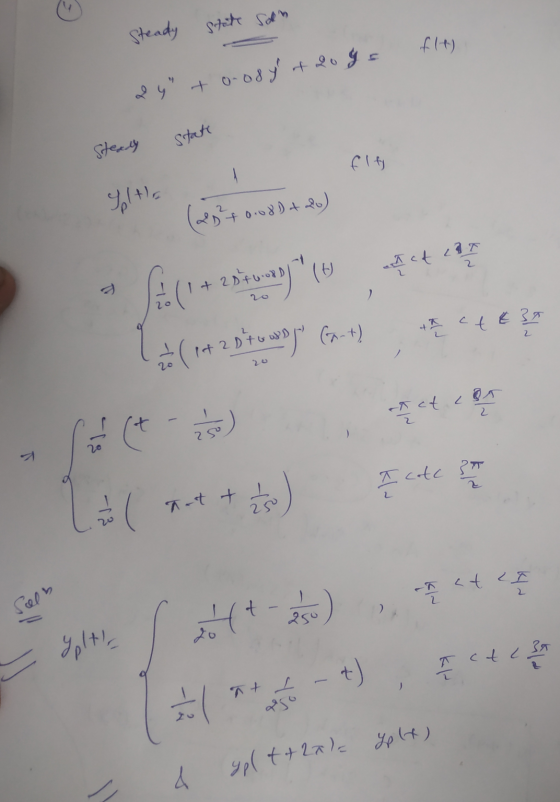
here steady solution means particular solution...
.
Add Answer to:
04: Let m = 2g, c = 0.08g/sec, and k = 20g/sec?, in a forced oscillation...
damped forced mass-spring system with m 2, and k 26, under the 2 Consider a influence...
 damped forced mass-spring system with m 2, and k 26, under the 2 Consider a influence of an external force F(t)= 82 cos (4t) 1, 7 = a) (8 points) Find the position u(t) of the mass at any time t, if u(0) 6 and u'(0) = 0. b) (4 points) Find the transient solution u(t) and the steady state solution U(t). How would you characterize these two solutions in terms of their behavior in time? We were unable to...
Consider a damped forced mass-spring system with m = 1, γ = 2, and k =...
Consider a damped forced mass-spring system with m = 1, γ = 2, and k = 26, under the influence of an external force F(t) = 82 cos(4t). a) (8 points) Find the position u(t) of the mass at any time t, if u(0) = 6 and u 0 (0) = 0. b) (4 points) Find the transient solution uc(t) and the steady state solution U(t). How would you characterize these two solutions in terms of their behavior in time?...
For the given values of m, c, k and f(t), assume the forced vibration in a spring-mass dashpot system is initially at eq...
For the given values of m, c, k and f(t), assume the forced vibration in a spring-mass dashpot system is initially at equilibrum. For t>0, find the motion x(t) and identify the steady periodic and transient parts m=2, c=2, k=1, f(t)= 5cos(t)
For the given values of m, c, k, and f(t), assume the forced vibration is initially at equilibrium. For t 0, find the m...
 For the given values of m, c, k, and f(t), assume the forced vibration is initially at equilibrium. For t 0, find the motion x(t), and identify the steady-periodic xs(t) and transient Xtrt) parts m 1, c4, k 5, f(t) 20 cos(3t) x(t) ain(3)cos (3t) xsp(t)= xtr(t)
For the given values of m, c, k, and f(t), assume the forced vibration is initially at equilibrium. For t 0, find the motion x(t), and identify the steady-periodic xs(t) and transient Xtrt)...
For the given values of m, c, k, and f(t), assume the forced vibration is initially at equilibrium. For t 0, find the motion x(t), and identify the steady-periodic xs(t) and transient Xtrt) parts m 1, c4, k 5, f(t) 20 cos(3t) x(t) ain(3)cos (3t) xsp(t)= xtr(t)
For the given values of m, c, k, and f(t), assume the forced vibration is initially at equilibrium. For t 0, find the motion x(t), and identify the steady-periodic xs(t) and transient Xtrt)...
QUESTION 4 This question will reinforce how the Bode plot provides the steady-state response for ...
 QUESTION 4 This question will reinforce how the Bode plot provides the steady-state response for a linear system in response to a sinusoidal input. Consider this forced mass-spring-damper system: Let M 6, B-48, K-72 Part a) As you did for HW 1, determine steady-state solution "x,()" when FC) 3120 cos(4b) Part b) Determine the transfer function Part c) The Bode plots for the transfer function of Part b are provided in this handout. with the parameter values of Part a....
Problem 2 (25 points): Consider an undamped single-degree-of-freedom system with k = 10 N/m, 41 =...
 Problem 2 (25 points): Consider an undamped single-degree-of-freedom system with k = 10 N/m, 41 = 10 N 92 = 8N, and m = 10 kg subjected to the harmonic force f(t) = qı sin(vt) + 92 cos(vt), v = 1 rad/ sec. Assume zero initial conditions (0) = 0 and c(0) = 0. Derive and plot the analytical solution of the displacement of the system. mm m = f(t) WWWWWWWW No friction Problem 2 Problem 3 (30 points): Using...
Consider a damped forced mass-spring system with m = 1, γ = 2, and k =...
Consider a damped forced mass-spring system with m = 1, γ = 2, and k = 26 under the influence of an external force F(t) = 82 cos(ωt). We can prove that the amplitude of this motion is given by R(ω) = p F0 m2 (ω0 2 − ω2 ) 2 + γ 2ω2 = 82 √ ω4 − 48ω2 + 76 For what value of ω will the maximum amplitude occur? When resonance will occur and how would you...
F Fosin t m k 2 Figure Qla: System is subjected to a periodic force excitation (a) Derive the equation of motion of the...
 F Fosin t m k 2 Figure Qla: System is subjected to a periodic force excitation (a) Derive the equation of motion of the system (state the concepts you use) (b) Write the characteristic equation of the system [4 marks 12 marks (c) What is the category of differential equations does the characteristic equation [2 marks fall into? (d) Prove that the steady state amplitude of vibration of the system is Xk Fo 25 + 0 marks (e) Prove that...
2. The angular displacement e(t) of a damped forced pendulum of length 1 swinging in a...
 2. The angular displacement e(t) of a damped forced pendulum of length 1 swinging in a vertical plane under the influence of gravity can be modelled with the second order non-homogeneous ODE 0"(t) + 270'(t) +w20(t) = f(t), (2) where wa = g/l. The second term in the equation represents the damping force (e.g. air resistance) for the given constant 7 > 0. The model can be used to approximate the motion of a magnetic pendulum bob being driven by...
04. (25 pts)(Fourier Analysis) A periodically driven oscillator and the forcing function is shown tbelow. F(t) The gove...
 04. (25 pts)(Fourier Analysis) A periodically driven oscillator and the forcing function is shown tbelow. F(t) The governing equation of the system shown above can be written as mx" + cx' +kx = F(t) where m, c and k are some constants. Considering a forcing function defined as a pulse below for 0 T/2 t 2 for π /2 < t <3m/2 , or 3π which is periodic with a period of 2π in the interval of OSK o Find...
 damped forced mass-spring system with m 2, and k 26, under the 2 Consider a influence of an external force F(t)= 82 cos (4t) 1, 7 = a) (8 points) Find the position u(t) of the mass at any time t, if u(0) 6 and u'(0) = 0. b) (4 points) Find the transient solution u(t) and the steady state solution U(t). How would you characterize these two solutions in terms of their behavior in time? We were unable to...
 For the given values of m, c, k, and f(t), assume the forced vibration is initially at equilibrium. For t 0, find the motion x(t), and identify the steady-periodic xs(t) and transient Xtrt) parts m 1, c4, k 5, f(t) 20 cos(3t) x(t) ain(3)cos (3t) xsp(t)= xtr(t)
For the given values of m, c, k, and f(t), assume the forced vibration is initially at equilibrium. For t 0, find the motion x(t), and identify the steady-periodic xs(t) and transient Xtrt)...
For the given values of m, c, k, and f(t), assume the forced vibration is initially at equilibrium. For t 0, find the motion x(t), and identify the steady-periodic xs(t) and transient Xtrt) parts m 1, c4, k 5, f(t) 20 cos(3t) x(t) ain(3)cos (3t) xsp(t)= xtr(t)
For the given values of m, c, k, and f(t), assume the forced vibration is initially at equilibrium. For t 0, find the motion x(t), and identify the steady-periodic xs(t) and transient Xtrt)...
 QUESTION 4 This question will reinforce how the Bode plot provides the steady-state response for a linear system in response to a sinusoidal input. Consider this forced mass-spring-damper system: Let M 6, B-48, K-72 Part a) As you did for HW 1, determine steady-state solution "x,()" when FC) 3120 cos(4b) Part b) Determine the transfer function Part c) The Bode plots for the transfer function of Part b are provided in this handout. with the parameter values of Part a....
 Problem 2 (25 points): Consider an undamped single-degree-of-freedom system with k = 10 N/m, 41 = 10 N 92 = 8N, and m = 10 kg subjected to the harmonic force f(t) = qı sin(vt) + 92 cos(vt), v = 1 rad/ sec. Assume zero initial conditions (0) = 0 and c(0) = 0. Derive and plot the analytical solution of the displacement of the system. mm m = f(t) WWWWWWWW No friction Problem 2 Problem 3 (30 points): Using...
 F Fosin t m k 2 Figure Qla: System is subjected to a periodic force excitation (a) Derive the equation of motion of the system (state the concepts you use) (b) Write the characteristic equation of the system [4 marks 12 marks (c) What is the category of differential equations does the characteristic equation [2 marks fall into? (d) Prove that the steady state amplitude of vibration of the system is Xk Fo 25 + 0 marks (e) Prove that...
 2. The angular displacement e(t) of a damped forced pendulum of length 1 swinging in a vertical plane under the influence of gravity can be modelled with the second order non-homogeneous ODE 0"(t) + 270'(t) +w20(t) = f(t), (2) where wa = g/l. The second term in the equation represents the damping force (e.g. air resistance) for the given constant 7 > 0. The model can be used to approximate the motion of a magnetic pendulum bob being driven by...
 04. (25 pts)(Fourier Analysis) A periodically driven oscillator and the forcing function is shown tbelow. F(t) The governing equation of the system shown above can be written as mx" + cx' +kx = F(t) where m, c and k are some constants. Considering a forcing function defined as a pulse below for 0 T/2 t 2 for π /2 < t <3m/2 , or 3π which is periodic with a period of 2π in the interval of OSK o Find...
Most questions answered within 3 hours.
-
Where is the error in this code sequence?
String s1 = "Hello";
String s2 = "ello";...
asked 11 months ago -
Financial data for Joel de Paris, Inc., for last year
follow:
Joel de Paris, Inc.
Balance...
asked 11 months ago -
Consider this reaction:
Al2(SO4)3 (aq)+ BaCl3
(aq) Al2Cl6 (aq)- +
3BaSO4(s) . What is the...
asked 11 months ago -
Suppose that Savneet is considering increasing her
recent random sample from 20 car rentals to 40...
asked 11 months ago -
Trucks arrive at an unloading terminal at an average rate of 120
per hour.
Trucks arrive...
asked 11 months ago -
Why are methanol and ethanol completely soluble in water while
octanol is not very little soluble....
asked 11 months ago -
A facilities manager at a university reads in a research report
that the mean amount of...
asked 11 months ago -
When the CuSO4 is rehydrated by adding water to the anhydrous
compound, is this an endothermic...
asked 11 months ago -
A ray of sunlight is passing from diamond into crown glass; the
angle of incidence is...
asked 11 months ago -
A block of mass 0.249 kg is placed on top of a light, vertical
spring of...
asked 11 months ago -
how do the kidneys compensate in the presences of acidosis
a) trigger hyperventilate
b) reserve acid...
asked 11 months ago -
Question 501 pts
The rental rate of capital to the firm increases. Which of the
following...
asked 11 months ago