
Homework Answers


So 

Thus, we have 


The general solution is 
Initial conditions imply 

Thus, 
Where transient solution is 

Add Answer to:
For the given values of m, c, k, and f(t), assume the forced vibration is initially at equilibrium. For t 0, find the m...
For the given values of m, c, k and f(t), assume the forced vibration in a spring-mass dashpot system is initially at eq...
For the given values of m, c, k and f(t), assume the forced vibration in a spring-mass dashpot system is initially at equilibrum. For t>0, find the motion x(t) and identify the steady periodic and transient parts m=2, c=2, k=1, f(t)= 5cos(t)
Consider a damped forced mass-spring system with m = 1, γ = 2, and k =...
Consider a damped forced mass-spring system with m = 1, γ = 2, and k = 26, under the influence of an external force F(t) = 82 cos(4t). a) (8 points) Find the position u(t) of the mass at any time t, if u(0) = 6 and u 0 (0) = 0. b) (4 points) Find the transient solution uc(t) and the steady state solution U(t). How would you characterize these two solutions in terms of their behavior in time?...
Question 4 The equation of motion of a forced vibration problem is given by d-x dx,...
 Question 4 The equation of motion of a forced vibration problem is given by d-x dx, m- *+kx = Pcos(wt) dt? dt Given the values, m = 6.45, r = 67.42, k = 398.01, P = 5.6 and W = 6.42. Determine the steady-state solution, xp(15.12) of the differential equation, giving your answer correct to 3 decimal places.
Consider the forced vibration in Figure 1. We mass, m Figure 1: Forced Vibration 1. Use...
 Consider the forced vibration in Figure 1. We mass, m Figure 1: Forced Vibration 1. Use a free-body diagram and apply Newton's 2nd Law to show that the upward displacement of the mass, r(t), can be modelled with the ODE da da mdt2 + cat + kz = F(t) where k is the spring coefficient and c is the damping coefficient. = 2 kg, c = For the remainder of the questions, use the following values: m 8 Ns/m, k...
damped forced mass-spring system with m 2, and k 26, under the 2 Consider a influence...
 damped forced mass-spring system with m 2, and k 26, under the 2 Consider a influence of an external force F(t)= 82 cos (4t) 1, 7 = a) (8 points) Find the position u(t) of the mass at any time t, if u(0) 6 and u'(0) = 0. b) (4 points) Find the transient solution u(t) and the steady state solution U(t). How would you characterize these two solutions in terms of their behavior in time? We were unable to...
ONLY attempt to solve if you know what you are doing. A mass of 1 kg is attached to a spring whose constant is 5 N/m. Initially, the mass is released 1 m below the equilibrium position with a downwar...
 ONLY attempt to solve if you know what you are
doing.
A mass of 1 kg is attached to a spring whose constant is 5 N/m. Initially, the mass is released 1 m below the equilibrium position with a downward velocity of 5 m/s, and the subsequent motion takes place in a medium that offers a damping force that is numerically equal to 2 times the instantaneous velocit y. a) Find the equation of motion if the mass is driven...
ONLY attempt to solve if you know what you are
doing.
A mass of 1 kg is attached to a spring whose constant is 5 N/m. Initially, the mass is released 1 m below the equilibrium position with a downward velocity of 5 m/s, and the subsequent motion takes place in a medium that offers a damping force that is numerically equal to 2 times the instantaneous velocit y. a) Find the equation of motion if the mass is driven...
04: Let m = 2g, c = 0.08g/sec, and k = 20g/sec?, in a forced oscillation...
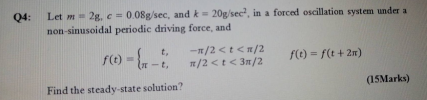 04: Let m = 2g, c = 0.08g/sec, and k = 20g/sec?, in a forced oscillation system under a non-sinusoidal periodic driving force, and f(t) = { t, -t, --1/2 <t</2 TI/2 < t <31/2 f(t) = f(t + 210) (15Marks) Find the steady-state solution?
Question 1 Suppose m-2 kg, k- 32 N/m and F() is an odd periodic force with a period of 2 s given in one period by ON if O<t<I Construct the steady periodic motion, Xsn) using the Fourier series...
 Question 1 Suppose m-2 kg, k- 32 N/m and F() is an odd periodic force with a period of 2 s given in one period by ON if O<t<I Construct the steady periodic motion, Xsn) using the Fourier series.
Question 1 Suppose m-2 kg, k- 32 N/m and F() is an odd periodic force with a period of 2 s given in one period by ON if O
Question 1 Suppose m-2 kg, k- 32 N/m and F() is an odd periodic force with a period of 2 s given in one period by ON if O<t<I Construct the steady periodic motion, Xsn) using the Fourier series.
Question 1 Suppose m-2 kg, k- 32 N/m and F() is an odd periodic force with a period of 2 s given in one period by ON if O
QUESTION 2: Consider this forced translational mass-spring-damper (MSD) system: The input is the external force "F(t)"...
 QUESTION 2: Consider this forced translational mass-spring-damper (MSD) system: The input is the external force "F(t)" and the output is position "x(t)." The transfer function for this system is g) - 6 - Mz? +BS+K It is known that M - 1 kg. B - 10 mm, and there are three possible values of K: (K = 16 K = 34 NK-89 The only possible external forces "F(t)" have the following Laplace transforms: 1) F,(s) - 0 (corresponding to external...
a C k ww fwyn F(t) (m Calculate the vibration response of the shown system when...
 a C k ww fwyn F(t) (m Calculate the vibration response of the shown system when the force F(1) = 25 S(1), where 8(t) is the Dirac delta function. Consider the data of Problem 4 and zero initial conditions.
 Question 4 The equation of motion of a forced vibration problem is given by d-x dx, m- *+kx = Pcos(wt) dt? dt Given the values, m = 6.45, r = 67.42, k = 398.01, P = 5.6 and W = 6.42. Determine the steady-state solution, xp(15.12) of the differential equation, giving your answer correct to 3 decimal places.
 Consider the forced vibration in Figure 1. We mass, m Figure 1: Forced Vibration 1. Use a free-body diagram and apply Newton's 2nd Law to show that the upward displacement of the mass, r(t), can be modelled with the ODE da da mdt2 + cat + kz = F(t) where k is the spring coefficient and c is the damping coefficient. = 2 kg, c = For the remainder of the questions, use the following values: m 8 Ns/m, k...
 damped forced mass-spring system with m 2, and k 26, under the 2 Consider a influence of an external force F(t)= 82 cos (4t) 1, 7 = a) (8 points) Find the position u(t) of the mass at any time t, if u(0) 6 and u'(0) = 0. b) (4 points) Find the transient solution u(t) and the steady state solution U(t). How would you characterize these two solutions in terms of their behavior in time? We were unable to...
 ONLY attempt to solve if you know what you are
doing.
A mass of 1 kg is attached to a spring whose constant is 5 N/m. Initially, the mass is released 1 m below the equilibrium position with a downward velocity of 5 m/s, and the subsequent motion takes place in a medium that offers a damping force that is numerically equal to 2 times the instantaneous velocit y. a) Find the equation of motion if the mass is driven...
ONLY attempt to solve if you know what you are
doing.
A mass of 1 kg is attached to a spring whose constant is 5 N/m. Initially, the mass is released 1 m below the equilibrium position with a downward velocity of 5 m/s, and the subsequent motion takes place in a medium that offers a damping force that is numerically equal to 2 times the instantaneous velocit y. a) Find the equation of motion if the mass is driven...
 04: Let m = 2g, c = 0.08g/sec, and k = 20g/sec?, in a forced oscillation system under a non-sinusoidal periodic driving force, and f(t) = { t, -t, --1/2 <t</2 TI/2 < t <31/2 f(t) = f(t + 210) (15Marks) Find the steady-state solution?
 Question 1 Suppose m-2 kg, k- 32 N/m and F() is an odd periodic force with a period of 2 s given in one period by ON if O<t<I Construct the steady periodic motion, Xsn) using the Fourier series.
Question 1 Suppose m-2 kg, k- 32 N/m and F() is an odd periodic force with a period of 2 s given in one period by ON if O
Question 1 Suppose m-2 kg, k- 32 N/m and F() is an odd periodic force with a period of 2 s given in one period by ON if O<t<I Construct the steady periodic motion, Xsn) using the Fourier series.
Question 1 Suppose m-2 kg, k- 32 N/m and F() is an odd periodic force with a period of 2 s given in one period by ON if O
 QUESTION 2: Consider this forced translational mass-spring-damper (MSD) system: The input is the external force "F(t)" and the output is position "x(t)." The transfer function for this system is g) - 6 - Mz? +BS+K It is known that M - 1 kg. B - 10 mm, and there are three possible values of K: (K = 16 K = 34 NK-89 The only possible external forces "F(t)" have the following Laplace transforms: 1) F,(s) - 0 (corresponding to external...
 a C k ww fwyn F(t) (m Calculate the vibration response of the shown system when the force F(1) = 25 S(1), where 8(t) is the Dirac delta function. Consider the data of Problem 4 and zero initial conditions.
Most questions answered within 3 hours.
-
Where is the error in this code sequence?
String s1 = "Hello";
String s2 = "ello";...
asked 11 months ago -
Financial data for Joel de Paris, Inc., for last year
follow:
Joel de Paris, Inc.
Balance...
asked 11 months ago -
Consider this reaction:
Al2(SO4)3 (aq)+ BaCl3
(aq) Al2Cl6 (aq)- +
3BaSO4(s) . What is the...
asked 11 months ago -
Suppose that Savneet is considering increasing her
recent random sample from 20 car rentals to 40...
asked 11 months ago -
Trucks arrive at an unloading terminal at an average rate of 120
per hour.
Trucks arrive...
asked 11 months ago -
Why are methanol and ethanol completely soluble in water while
octanol is not very little soluble....
asked 11 months ago -
A facilities manager at a university reads in a research report
that the mean amount of...
asked 11 months ago -
When the CuSO4 is rehydrated by adding water to the anhydrous
compound, is this an endothermic...
asked 11 months ago -
A ray of sunlight is passing from diamond into crown glass; the
angle of incidence is...
asked 11 months ago -
A block of mass 0.249 kg is placed on top of a light, vertical
spring of...
asked 11 months ago -
how do the kidneys compensate in the presences of acidosis
a) trigger hyperventilate
b) reserve acid...
asked 11 months ago -
Question 501 pts
The rental rate of capital to the firm increases. Which of the
following...
asked 11 months ago