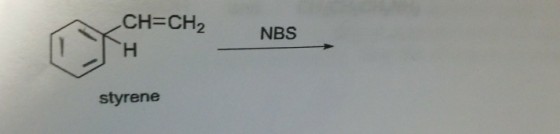
Draw two resonance forms for the free radical intermediate of styrene with NBS
Homework Answers

Add Answer to:
Draw two resonance forms for the free radical
intermediate of styrene with NBS
CH=CH2 NBS styrene
[8 marks] 1. In the boxes below, draw the resonance structures of the organic radical intermediate...
 [8 marks] 1. In the boxes below, draw the resonance structures of the organic radical intermediate of the given reaction, along with the two different products (constitutional isomers) that would be produced. No electron-flow arrows are required at any time. Stereochemistry is not required. Note: NBS N-bromosuccinimide Organic reaction intermediate NBS hv Product 2 Product 1 [6 marks 2. In the boxes below, draw structures corresponding to the following names. Please use proper line-angle
Draw some resonance forms for allyl benzene radical
Draw some resonance forms for allyl benzene radical
CНз NBS, CCI4, hv lintermediate product(s) Hас Give all resonance structures of the allylic radical intermediate tha...
 CНз NBS, CCI4, hv lintermediate product(s) Hас Give all resonance structures of the allylic radical intermediate that arise from reaction above. 2. All allylic C-H on the molecule are equivalent so only show the two resonance structures arising from one C-H bond reacting. 3. Are the resonance structures above equivalent or non-equivalent? Think about the degree of the atom where the radical (the dot) is. Give all the products expected from the reaction above. 4.
The compound below is treated with N-bromosuccinimide (NBS) in the presence of light. Draw both resonance...
 The compound below is treated with N-bromosuccinimide (NBS) in the presence of light. Draw both resonance structures for the radical produced by reaction of the compound with a bromine atom. Assume reaction occurs only at the weakest C-H bond. • You do not have to consider stereochemistry. • You do not have to explicitly draw H atoms, Review Topics] [References) The compound below is treated with N-bromosuccinimide (NBS) in the presence of light. Draw both resonance structures for the radical...
The compound below is treated with N-bromosuccinimide (NBS) in the presence of light. Draw both resonance...
 The compound below is treated with N-bromosuccinimide (NBS) in the presence of light. Draw both resonance structures for the radical produced by reaction of the compound with a bromine atom. Assume reaction occurs only at the weakest C-H bond. • You do not have to consider stereochemistry. • You do not have to explicitly draw H atoms. • Separate resonance structures using the symbol from the drop-down menu. • Include all valence radical electrons in your answer. 1.) The compound...
1. Rank the following carbocation intermediates in order of incrasing stability and draw important resonance forms...
 1. Rank the following carbocation intermediates in order of incrasing stability and draw important resonance forms when applicable. Classify each as primary, secondary, tertiary, allylic, or benzylic. 2. Rank the following free radical intermediates in order of increasing stability and draw important resonance forms when applicable. Classify each as primary, secondary, tertiary, allylic, or benzylic. CH2 bro ledo IV b III 10 112TV ] 21 3. 2,3-Dimethylbutane reacts with bromine in the presence of light to give a monobrominated product....
This is a question on free radical halogenation. How and why does the bromoethane bond form...
 This is a question on free radical halogenation.
How and why does the bromoethane bond form for the 2nd resonance
structure?
3. The allylic bromination of the alkene below with NBS gives four different products. Draw the two initially formed free radical intermediates with any applicable resonance structures, then draw the four products. Indicate which product will be the major product and which you would predict to have the lowest yield. Br, hv ® Ýsa Ś Br sminor 3 &+Br....
This is a question on free radical halogenation.
How and why does the bromoethane bond form for the 2nd resonance
structure?
3. The allylic bromination of the alkene below with NBS gives four different products. Draw the two initially formed free radical intermediates with any applicable resonance structures, then draw the four products. Indicate which product will be the major product and which you would predict to have the lowest yield. Br, hv ® Ýsa Ś Br sminor 3 &+Br....
The compound below is treated with N-bromosuccinimide (NBS) in the presence of light. Draw both resonance...
 The compound below is treated with N-bromosuccinimide (NBS) in the presence of light. Draw both resonance structures for the radical produced by reaction of the compound with a bromine atom. Assume reaction occurs only at the weakest C-H bond. • You do not have to consider stereochemistry. • You do not have to explicitly draw H atoms. • Separate resonance structures using the symbol from the drop-down menu. • Include all valence radical electrons in your answer.
The compound below is treated with N-bromosuccinimide (NBS) in the presence of light. Draw both resonance...
 The compound below is treated with N-bromosuccinimide (NBS) in the presence of light. Draw both resonance structures for the radical produced by reaction of the compound with a bromine atom. Assume reaction occurs only at the weakest C-H bond. • You do not have to consider stereochemistry. • You do not have to explicitly draw H atoms. Separate resonance structures using the symbol from the drop-down menu. • Include all valence radical electrons in your answer.
What vinylic bromide would need to be coupled with styrene (C6H5−CH=CH2) for the synthesis of each...
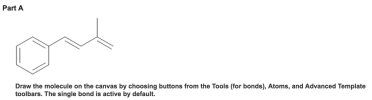 What vinylic bromide would need to be coupled with styrene
(C6H5−CH=CH2) for the synthesis of each of the following compounds
using a Heck reaction?
Part A Draw the molecule the button from on canvas by choosing the Tools (for bonds), Atoms, and Advanced Template toolbars. The single bond is active by default.
What vinylic bromide would need to be coupled with styrene
(C6H5−CH=CH2) for the synthesis of each of the following compounds
using a Heck reaction?
Part A Draw the molecule the button from on canvas by choosing the Tools (for bonds), Atoms, and Advanced Template toolbars. The single bond is active by default.
 [8 marks] 1. In the boxes below, draw the resonance structures of the organic radical intermediate of the given reaction, along with the two different products (constitutional isomers) that would be produced. No electron-flow arrows are required at any time. Stereochemistry is not required. Note: NBS N-bromosuccinimide Organic reaction intermediate NBS hv Product 2 Product 1 [6 marks 2. In the boxes below, draw structures corresponding to the following names. Please use proper line-angle
 CНз NBS, CCI4, hv lintermediate product(s) Hас Give all resonance structures of the allylic radical intermediate that arise from reaction above. 2. All allylic C-H on the molecule are equivalent so only show the two resonance structures arising from one C-H bond reacting. 3. Are the resonance structures above equivalent or non-equivalent? Think about the degree of the atom where the radical (the dot) is. Give all the products expected from the reaction above. 4.
 The compound below is treated with N-bromosuccinimide (NBS) in the presence of light. Draw both resonance structures for the radical produced by reaction of the compound with a bromine atom. Assume reaction occurs only at the weakest C-H bond. • You do not have to consider stereochemistry. • You do not have to explicitly draw H atoms, Review Topics] [References) The compound below is treated with N-bromosuccinimide (NBS) in the presence of light. Draw both resonance structures for the radical...
 The compound below is treated with N-bromosuccinimide (NBS) in the presence of light. Draw both resonance structures for the radical produced by reaction of the compound with a bromine atom. Assume reaction occurs only at the weakest C-H bond. • You do not have to consider stereochemistry. • You do not have to explicitly draw H atoms. • Separate resonance structures using the symbol from the drop-down menu. • Include all valence radical electrons in your answer. 1.) The compound...
 1. Rank the following carbocation intermediates in order of incrasing stability and draw important resonance forms when applicable. Classify each as primary, secondary, tertiary, allylic, or benzylic. 2. Rank the following free radical intermediates in order of increasing stability and draw important resonance forms when applicable. Classify each as primary, secondary, tertiary, allylic, or benzylic. CH2 bro ledo IV b III 10 112TV ] 21 3. 2,3-Dimethylbutane reacts with bromine in the presence of light to give a monobrominated product....
 This is a question on free radical halogenation.
How and why does the bromoethane bond form for the 2nd resonance
structure?
3. The allylic bromination of the alkene below with NBS gives four different products. Draw the two initially formed free radical intermediates with any applicable resonance structures, then draw the four products. Indicate which product will be the major product and which you would predict to have the lowest yield. Br, hv ® Ýsa Ś Br sminor 3 &+Br....
This is a question on free radical halogenation.
How and why does the bromoethane bond form for the 2nd resonance
structure?
3. The allylic bromination of the alkene below with NBS gives four different products. Draw the two initially formed free radical intermediates with any applicable resonance structures, then draw the four products. Indicate which product will be the major product and which you would predict to have the lowest yield. Br, hv ® Ýsa Ś Br sminor 3 &+Br....
 The compound below is treated with N-bromosuccinimide (NBS) in the presence of light. Draw both resonance structures for the radical produced by reaction of the compound with a bromine atom. Assume reaction occurs only at the weakest C-H bond. • You do not have to consider stereochemistry. • You do not have to explicitly draw H atoms. • Separate resonance structures using the symbol from the drop-down menu. • Include all valence radical electrons in your answer.
 The compound below is treated with N-bromosuccinimide (NBS) in the presence of light. Draw both resonance structures for the radical produced by reaction of the compound with a bromine atom. Assume reaction occurs only at the weakest C-H bond. • You do not have to consider stereochemistry. • You do not have to explicitly draw H atoms. Separate resonance structures using the symbol from the drop-down menu. • Include all valence radical electrons in your answer.
 What vinylic bromide would need to be coupled with styrene
(C6H5−CH=CH2) for the synthesis of each of the following compounds
using a Heck reaction?
Part A Draw the molecule the button from on canvas by choosing the Tools (for bonds), Atoms, and Advanced Template toolbars. The single bond is active by default.
What vinylic bromide would need to be coupled with styrene
(C6H5−CH=CH2) for the synthesis of each of the following compounds
using a Heck reaction?
Part A Draw the molecule the button from on canvas by choosing the Tools (for bonds), Atoms, and Advanced Template toolbars. The single bond is active by default.
Most questions answered within 3 hours.
-
Where is the error in this code sequence?
String s1 = "Hello";
String s2 = "ello";...
asked 10 months ago -
Financial data for Joel de Paris, Inc., for last year
follow:
Joel de Paris, Inc.
Balance...
asked 10 months ago -
Consider this reaction:
Al2(SO4)3 (aq)+ BaCl3
(aq) Al2Cl6 (aq)- +
3BaSO4(s) . What is the...
asked 10 months ago -
Suppose that Savneet is considering increasing her
recent random sample from 20 car rentals to 40...
asked 10 months ago -
Trucks arrive at an unloading terminal at an average rate of 120
per hour.
Trucks arrive...
asked 10 months ago -
Why are methanol and ethanol completely soluble in water while
octanol is not very little soluble....
asked 10 months ago -
A facilities manager at a university reads in a research report
that the mean amount of...
asked 10 months ago -
When the CuSO4 is rehydrated by adding water to the anhydrous
compound, is this an endothermic...
asked 10 months ago -
A ray of sunlight is passing from diamond into crown glass; the
angle of incidence is...
asked 10 months ago -
A block of mass 0.249 kg is placed on top of a light, vertical
spring of...
asked 10 months ago -
how do the kidneys compensate in the presences of acidosis
a) trigger hyperventilate
b) reserve acid...
asked 10 months ago -
Question 501 pts
The rental rate of capital to the firm increases. Which of the
following...
asked 10 months ago