
Homework Answers

Add Answer to:
Which amino acids in chymotrypsin are found in the active site and are participants in substrate...
56. In the lock and key model of substrate binding to enzymes Pprat wnich they work...
 56. In the lock and key model of substrate binding to enzymes Pprat wnich they work best a the substrate changes its conformation to fit the active site b. the active site changes its conformation to fit the substrate c. the active site is rigid and the substrate must fit exactly d. the substrate binds only to part of the active site In the induced-fit model of substrate binding a. 57. the substrate changes its conformation to fit the active...
Reset Help noncompetitive enzyme irreversible acetylcholinesterase competitive active site 1. A inhibitor binds to a site...
 Reset Help noncompetitive enzyme irreversible acetylcholinesterase competitive active site 1. A inhibitor binds to a site on the enzyme that is not the active site. 2. Insecticides and nerve gases act as irreversible inhibitors of nerve conduction. an enzyme needed for 3. A inhibitor has a structure that is so similar to the substrate that it can bond to the enzyme just like the substrate. 4. Usually, an nhibitor forms a covalent bond with an amino acid side group within...
The structure of the active site of chymotrypsin is shown below. The catalytic triad shown (Ser...
 The structure of the active site of chymotrypsin is shown below. The catalytic triad shown (Ser 195, His 57, and aspl02) are shown. A peptide with a phenylalanine is shown bound in the active site. 1. Chymotrypsin is a serine protease. The Km for chymotrypsin with N-acetylvaline ethyl ester is 8.8 X 10² M. The Km for the reaction with N-acetyltyrosine ethyl ester is 6.6 X 10 (a) Which substrate has the higher affinity for this enzyme? (b) Give a...
2. hypothesize the best conditions (pH and temperature) under which the enzyme chymotrypsin functions with an...
 2. hypothesize the best conditions (pH and temperature) under
which the enzyme chymotrypsin functions with an appropriate
reference. also, hypothesize what will occur in the presence of an
inhibitor and the type of inhibition.
EXPERIMENT 5: ENZYME ACTIVITY WITH a-CHYMOTRYPSIN Prelab Assignment 1. Prepare a flow chart, covering one half of the experimental work (either part A and C if your lab bench is on the window side of the lab or part B and D if your locker is...
2. hypothesize the best conditions (pH and temperature) under
which the enzyme chymotrypsin functions with an appropriate
reference. also, hypothesize what will occur in the presence of an
inhibitor and the type of inhibition.
EXPERIMENT 5: ENZYME ACTIVITY WITH a-CHYMOTRYPSIN Prelab Assignment 1. Prepare a flow chart, covering one half of the experimental work (either part A and C if your lab bench is on the window side of the lab or part B and D if your locker is...
The active site of an enzyme ____. A. is remote form the site of substrate attachment...
 The active site of an enzyme ____. A. is remote form the site of substrate attachment B. is converted to a product C. is the region where the reaction takes place D. increases the energy of reaction E. includes the entire enzyme In the lock-and-key model of enzyme actin, the enzyme active site is thought of as ___. A. a rigid, nonflexible shape that fits the substrate exactly B. an area of the enzyme that can adjust to fit the...
A. Choose anly one correcet answer for each of the following questions (4 pts cach). AL Some and ...
 A. Choose anly one correcet answer for each of the following questions (4 pts cach). AL Some and KM values are shown below for enzyme-substrate pairs. Which of the following enzymes is most efficient in converting the substrate into the product? b) kes.-4x10s s", KM-0.026 M d)k,,-5.7 x1o's", K-2x10s M c)人at-900 s", KM-2.5 × 10.5 M A2. Which of the following enzyme reaction mechanisms has multiple substrates? a) induced-fit e) Michaclis-Menton b) random sequential d) reversible covalent modification e) None...
41. An enzyme-substrate complex forms when substrate binds to an enzyme at the enzyme's site. 42....
 41. An enzyme-substrate complex forms when substrate binds to an enzyme at the enzyme's site. 42. An inorganic ion such as zinc or manganese that is needed for an enzyme to function is acting as a 43. Competitive inhibition of enzymes occurs when: site A) catalytic B) allosterie C) operative B) cofactor C) apoenzyme D) holoenzyme A) coenzyme A) the inhibitor binds to the active site of the enzyme B) the inhibitor binds to the allosteric site of the enzyme...
When a peeled apple Is exposed to air, it turns brown. This is because apple contains...
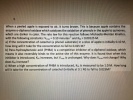 When a peeled apple Is exposed to air, it turns brown. This is because apple contains the enzyme o-diphenol oxidase which catalyzes the oxidation of phenols in the apple to quinines, which are darker in color. The rate law for this reaction follows Michaelis-Menten kinetics, with the following constants: V_max = 0.10 minutes^-1 and K_M = 0.00125 M. a) If the concentration of catechol (a phenol substrate) in a slice of apple is initially 0.10 M, how long will it...
Which statement about enzyme catalysis is false? All of the active site amino acids are next...
 Which statement about enzyme catalysis is false? All of the active site amino acids are next to each other in the primary sequence. Enzymes speed up reactions by forming specific non-covalent bonds between the enzyme amino acids and the transition state molecule. Some enzymes require other molecules, called cofactors, to carry out chemical reactions. Generally, the most important amino acids for an enzyme's function are those in the active site. Question 6 1 pt When [S] is much more than...
12. Which of the following statements is true of enzyme catalysts? A B C To be...
 12. Which of the following statements is true of enzyme catalysts? A B C To be effective, they must be present at the same concentration as their substrate. They can increase the equilibrium constant for a given reaction by a thousand-fold or more. They lower the activation energy for conversion of substrate to product. Their catalytic activity is independent of pH. They are generally equally active on D and L isomers of a given substrate. D E 13. In competitive...
 56. In the lock and key model of substrate binding to enzymes Pprat wnich they work best a the substrate changes its conformation to fit the active site b. the active site changes its conformation to fit the substrate c. the active site is rigid and the substrate must fit exactly d. the substrate binds only to part of the active site In the induced-fit model of substrate binding a. 57. the substrate changes its conformation to fit the active...
 Reset Help noncompetitive enzyme irreversible acetylcholinesterase competitive active site 1. A inhibitor binds to a site on the enzyme that is not the active site. 2. Insecticides and nerve gases act as irreversible inhibitors of nerve conduction. an enzyme needed for 3. A inhibitor has a structure that is so similar to the substrate that it can bond to the enzyme just like the substrate. 4. Usually, an nhibitor forms a covalent bond with an amino acid side group within...
 The structure of the active site of chymotrypsin is shown below. The catalytic triad shown (Ser 195, His 57, and aspl02) are shown. A peptide with a phenylalanine is shown bound in the active site. 1. Chymotrypsin is a serine protease. The Km for chymotrypsin with N-acetylvaline ethyl ester is 8.8 X 10² M. The Km for the reaction with N-acetyltyrosine ethyl ester is 6.6 X 10 (a) Which substrate has the higher affinity for this enzyme? (b) Give a...
 2. hypothesize the best conditions (pH and temperature) under
which the enzyme chymotrypsin functions with an appropriate
reference. also, hypothesize what will occur in the presence of an
inhibitor and the type of inhibition.
EXPERIMENT 5: ENZYME ACTIVITY WITH a-CHYMOTRYPSIN Prelab Assignment 1. Prepare a flow chart, covering one half of the experimental work (either part A and C if your lab bench is on the window side of the lab or part B and D if your locker is...
2. hypothesize the best conditions (pH and temperature) under
which the enzyme chymotrypsin functions with an appropriate
reference. also, hypothesize what will occur in the presence of an
inhibitor and the type of inhibition.
EXPERIMENT 5: ENZYME ACTIVITY WITH a-CHYMOTRYPSIN Prelab Assignment 1. Prepare a flow chart, covering one half of the experimental work (either part A and C if your lab bench is on the window side of the lab or part B and D if your locker is...
 The active site of an enzyme ____. A. is remote form the site of substrate attachment B. is converted to a product C. is the region where the reaction takes place D. increases the energy of reaction E. includes the entire enzyme In the lock-and-key model of enzyme actin, the enzyme active site is thought of as ___. A. a rigid, nonflexible shape that fits the substrate exactly B. an area of the enzyme that can adjust to fit the...
 A. Choose anly one correcet answer for each of the following questions (4 pts cach). AL Some and KM values are shown below for enzyme-substrate pairs. Which of the following enzymes is most efficient in converting the substrate into the product? b) kes.-4x10s s", KM-0.026 M d)k,,-5.7 x1o's", K-2x10s M c)人at-900 s", KM-2.5 × 10.5 M A2. Which of the following enzyme reaction mechanisms has multiple substrates? a) induced-fit e) Michaclis-Menton b) random sequential d) reversible covalent modification e) None...
 41. An enzyme-substrate complex forms when substrate binds to an enzyme at the enzyme's site. 42. An inorganic ion such as zinc or manganese that is needed for an enzyme to function is acting as a 43. Competitive inhibition of enzymes occurs when: site A) catalytic B) allosterie C) operative B) cofactor C) apoenzyme D) holoenzyme A) coenzyme A) the inhibitor binds to the active site of the enzyme B) the inhibitor binds to the allosteric site of the enzyme...
 When a peeled apple Is exposed to air, it turns brown. This is because apple contains the enzyme o-diphenol oxidase which catalyzes the oxidation of phenols in the apple to quinines, which are darker in color. The rate law for this reaction follows Michaelis-Menten kinetics, with the following constants: V_max = 0.10 minutes^-1 and K_M = 0.00125 M. a) If the concentration of catechol (a phenol substrate) in a slice of apple is initially 0.10 M, how long will it...
 Which statement about enzyme catalysis is false? All of the active site amino acids are next to each other in the primary sequence. Enzymes speed up reactions by forming specific non-covalent bonds between the enzyme amino acids and the transition state molecule. Some enzymes require other molecules, called cofactors, to carry out chemical reactions. Generally, the most important amino acids for an enzyme's function are those in the active site. Question 6 1 pt When [S] is much more than...
 12. Which of the following statements is true of enzyme catalysts? A B C To be effective, they must be present at the same concentration as their substrate. They can increase the equilibrium constant for a given reaction by a thousand-fold or more. They lower the activation energy for conversion of substrate to product. Their catalytic activity is independent of pH. They are generally equally active on D and L isomers of a given substrate. D E 13. In competitive...
Most questions answered within 3 hours.
-
Where is the error in this code sequence?
String s1 = "Hello";
String s2 = "ello";...
asked 11 months ago -
Financial data for Joel de Paris, Inc., for last year
follow:
Joel de Paris, Inc.
Balance...
asked 11 months ago -
Consider this reaction:
Al2(SO4)3 (aq)+ BaCl3
(aq) Al2Cl6 (aq)- +
3BaSO4(s) . What is the...
asked 11 months ago -
Suppose that Savneet is considering increasing her
recent random sample from 20 car rentals to 40...
asked 11 months ago -
Trucks arrive at an unloading terminal at an average rate of 120
per hour.
Trucks arrive...
asked 11 months ago -
Why are methanol and ethanol completely soluble in water while
octanol is not very little soluble....
asked 11 months ago -
A facilities manager at a university reads in a research report
that the mean amount of...
asked 11 months ago -
When the CuSO4 is rehydrated by adding water to the anhydrous
compound, is this an endothermic...
asked 11 months ago -
A ray of sunlight is passing from diamond into crown glass; the
angle of incidence is...
asked 11 months ago -
A block of mass 0.249 kg is placed on top of a light, vertical
spring of...
asked 11 months ago -
how do the kidneys compensate in the presences of acidosis
a) trigger hyperventilate
b) reserve acid...
asked 11 months ago -
Question 501 pts
The rental rate of capital to the firm increases. Which of the
following...
asked 11 months ago