
Homework Answers


Add Answer to:
out Given R-14Q, L-135μΗ, C-40μF. a). Derive the expression for the magnitude component of system frequency...
Pre-Laboratory Task 4: Derive an expression for the magnitude of the transfer function, H(Go)Vout(jo)/Wn(j, and the phase of the transfer function LH (ja) for the LCR circuit in Figure 4. Plot H(ja)l...
 Pre-Laboratory Task 4: Derive an expression for the magnitude of the transfer function, H(Go)Vout(jo)/Wn(j, and the phase of the transfer function LH (ja) for the LCR circuit in Figure 4. Plot H(ja)l and H(jo) vs. frequency (o) in the form of a Bode plot indicating the damping frequency and the value of |H(jo)| at the damping frequency. Also determine the 3dB frequency and the roll off rate for Ir(ja)1 when ω > ω3dB. Vounlius R 470Ω C 100 nF Figure...
please solve #3 2. Given the error in measuring H and L to be equal to propagated error in py , derive an expression...
 please solve #3
2. Given the error in measuring H and L to be equal to propagated error in py , derive an expression for the block, mass M mass m Now the block is tied to string that passes over a frictionless pulley. The other end of the string is tied to a mass m. Mass m is increased until the block slides at constant speed. 3. Derive a new expression for pue in terms of m and M...
please solve #3
2. Given the error in measuring H and L to be equal to propagated error in py , derive an expression for the block, mass M mass m Now the block is tied to string that passes over a frictionless pulley. The other end of the string is tied to a mass m. Mass m is increased until the block slides at constant speed. 3. Derive a new expression for pue in terms of m and M...
2. Given the following circuit RL Do where C = inF, L = 1 mH and R1 = į00kf2. (a) Derive the expression for the tra...
 2. Given the following circuit RL Do where C = inF, L = 1 mH and R1 = į00kf2. (a) Derive the expression for the transfer functionH(s)0 in erms of R, Ri and C. (b) At what frequency will the magnitude of Hju) be maximum? Write down the maxi- mum value (c) At what frequency w will the magnitude of H(jw) equal its maximum value divided by V2 (the half power)? (d) Derive the expression for the phase e(ju) both...
Could you please help with the following parts: a. b. c. A system has the impulse response of. If the following signal is input into this system: Enter the output of this system (y[지) into the bla...
 Could you please help with the following parts:
a.
b.
c.
A system has the impulse response of. If the following signal is input into this system: Enter the output of this system (y[지) into the blank space provided (use π = pi in equations, eg. 1 +2cos(0.5pin) = 12 cos(0.5Tn)) The magnitude response of a discrete-time filter is plotted between the range-4T ώ +6x and is shown below. 10 -2 0 Normalised Radian frequency x Tm What type of...
Could you please help with the following parts:
a.
b.
c.
A system has the impulse response of. If the following signal is input into this system: Enter the output of this system (y[지) into the blank space provided (use π = pi in equations, eg. 1 +2cos(0.5pin) = 12 cos(0.5Tn)) The magnitude response of a discrete-time filter is plotted between the range-4T ώ +6x and is shown below. 10 -2 0 Normalised Radian frequency x Tm What type of...
B Frequency Response Modeling Frequency response modeling of a linear system is based on the prem...
 Please explain every step as clearly and detailed as
possible.
B Frequency Response Modeling Frequency response modeling of a linear system is based on the premise that the dynamics of a linear system can be recovered from a knowledge of how the system responds to sinusoidal inputs. (This will be made mathematically precise in Theorem 13.) In other words, to determine (or iden- tify) a linear system, all one has to do is observe how the system reacts to sinusoidal...
Please explain every step as clearly and detailed as
possible.
B Frequency Response Modeling Frequency response modeling of a linear system is based on the premise that the dynamics of a linear system can be recovered from a knowledge of how the system responds to sinusoidal inputs. (This will be made mathematically precise in Theorem 13.) In other words, to determine (or iden- tify) a linear system, all one has to do is observe how the system reacts to sinusoidal...
You are given a FT and the data Pr(A)-0.1 Pr(B)-0.15, Pr(C)-0.2. You have verified that these components are independent, i.e. that A L B LC, A denotes the event that component A fails, B denotes B f...
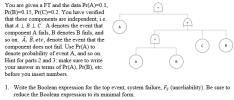 You are given a FT and the data Pr(A)-0.1 Pr(B)-0.15, Pr(C)-0.2. You have verified that these components are independent, i.e. that A L B LC, A denotes the event that component A fails, B denotes B fails, and so on. A, B, etc, denote the event that the component does not fail. Use Pr(A) to denote probability of event A, and so on. Hint for parts 2 and 3: make sure to write your answer in terms of Pr(A), Pr(B),...
For the circuit shown in the figure above: Obtain an expression for H() Vo/Vi in standard form Generate spectral plots for the magnitude and phase of H (w), given that R-100Ω, L-0.1 mH, and C-1 μF De...
 For the circuit shown in the figure above: Obtain an expression for H() Vo/Vi in standard form Generate spectral plots for the magnitude and phase of H (w), given that R-100Ω, L-0.1 mH, and C-1 μF Determine the cutoff frequency we and the slope of the magnitude (in dB) when wwc >1
For the circuit shown in the figure above: Obtain an expression for H() Vo/Vi in standard form Generate spectral plots for the magnitude and phase of H (w),...
For the circuit shown in the figure above: Obtain an expression for H() Vo/Vi in standard form Generate spectral plots for the magnitude and phase of H (w), given that R-100Ω, L-0.1 mH, and C-1 μF Determine the cutoff frequency we and the slope of the magnitude (in dB) when wwc >1
For the circuit shown in the figure above: Obtain an expression for H() Vo/Vi in standard form Generate spectral plots for the magnitude and phase of H (w),...
5 pts D Question 1 A system has the following impulse response: .2 Sample number, n From the choices below, select the frequency response of this system. H (eju)-e(1.5 ) (2 sin( 1.5ώ) +...
 5 pts D Question 1 A system has the following impulse response: .2 Sample number, n From the choices below, select the frequency response of this system. H (eju)-e(1.5 ) (2 sin( 1.5ώ) + 4 sin(0.δώ)) H (ee) = e-j(1.5e-5) (cos( 1.5 ) +2 cos(0.54)) @ H (ee)-e-n1.si) (sin( 1.54) t. 2 sin(0.δώ)) (sin(l.50) +4sin(0.0) H (ee)-e-j(1.5i) (2 cos( 1.5ώ) + 4 cos(0.5a)) H (efo)-e-n1.5u) (cos( 1.50) + 2 cos(0.50)) https://rmitinstructure.comcoursesy 5 pts DQuestion 2 A system has the following...
3. (35 pts) Consider a standard RLC circuit with a resistor R, inductor L and capacitor C all in ...
 3. (35 pts) Consider a standard RLC circuit with a resistor R, inductor L and capacitor C all in series driven by a voltage source v(t). The voltage source gives pulses of 5 volts that last 1 msec every 10 msec, i.e. a square wave with period 10. We are interested in the output y(t) which is the current flowing through the circuit at time t. (a) Find a general expression for the frequency response H(jw) of this system (b)...
Please help me with QUESTION 2. 1. Consider the electrical system shown below, for which the input variable u, the out...
 Please help me with QUESTION 2.
1. Consider the electrical system shown below, for which the input variable u, the output variable y, and the state variables xi and x2 have been specified. R L + C (a) Determine the state-space model of the system (b) Show that the transfer function (from u to y) has the form bis H(s)=2+ajs+ a0 by relating (ao, ai, bi) to (R, L, C) (c) Show that the frequency response function (from u to...
Please help me with QUESTION 2.
1. Consider the electrical system shown below, for which the input variable u, the output variable y, and the state variables xi and x2 have been specified. R L + C (a) Determine the state-space model of the system (b) Show that the transfer function (from u to y) has the form bis H(s)=2+ajs+ a0 by relating (ao, ai, bi) to (R, L, C) (c) Show that the frequency response function (from u to...
 Pre-Laboratory Task 4: Derive an expression for the magnitude of the transfer function, H(Go)Vout(jo)/Wn(j, and the phase of the transfer function LH (ja) for the LCR circuit in Figure 4. Plot H(ja)l and H(jo) vs. frequency (o) in the form of a Bode plot indicating the damping frequency and the value of |H(jo)| at the damping frequency. Also determine the 3dB frequency and the roll off rate for Ir(ja)1 when ω > ω3dB. Vounlius R 470Ω C 100 nF Figure...
 please solve #3
2. Given the error in measuring H and L to be equal to propagated error in py , derive an expression for the block, mass M mass m Now the block is tied to string that passes over a frictionless pulley. The other end of the string is tied to a mass m. Mass m is increased until the block slides at constant speed. 3. Derive a new expression for pue in terms of m and M...
please solve #3
2. Given the error in measuring H and L to be equal to propagated error in py , derive an expression for the block, mass M mass m Now the block is tied to string that passes over a frictionless pulley. The other end of the string is tied to a mass m. Mass m is increased until the block slides at constant speed. 3. Derive a new expression for pue in terms of m and M...
 2. Given the following circuit RL Do where C = inF, L = 1 mH and R1 = į00kf2. (a) Derive the expression for the transfer functionH(s)0 in erms of R, Ri and C. (b) At what frequency will the magnitude of Hju) be maximum? Write down the maxi- mum value (c) At what frequency w will the magnitude of H(jw) equal its maximum value divided by V2 (the half power)? (d) Derive the expression for the phase e(ju) both...
 Could you please help with the following parts:
a.
b.
c.
A system has the impulse response of. If the following signal is input into this system: Enter the output of this system (y[지) into the blank space provided (use π = pi in equations, eg. 1 +2cos(0.5pin) = 12 cos(0.5Tn)) The magnitude response of a discrete-time filter is plotted between the range-4T ώ +6x and is shown below. 10 -2 0 Normalised Radian frequency x Tm What type of...
Could you please help with the following parts:
a.
b.
c.
A system has the impulse response of. If the following signal is input into this system: Enter the output of this system (y[지) into the blank space provided (use π = pi in equations, eg. 1 +2cos(0.5pin) = 12 cos(0.5Tn)) The magnitude response of a discrete-time filter is plotted between the range-4T ώ +6x and is shown below. 10 -2 0 Normalised Radian frequency x Tm What type of...
 Please explain every step as clearly and detailed as
possible.
B Frequency Response Modeling Frequency response modeling of a linear system is based on the premise that the dynamics of a linear system can be recovered from a knowledge of how the system responds to sinusoidal inputs. (This will be made mathematically precise in Theorem 13.) In other words, to determine (or iden- tify) a linear system, all one has to do is observe how the system reacts to sinusoidal...
Please explain every step as clearly and detailed as
possible.
B Frequency Response Modeling Frequency response modeling of a linear system is based on the premise that the dynamics of a linear system can be recovered from a knowledge of how the system responds to sinusoidal inputs. (This will be made mathematically precise in Theorem 13.) In other words, to determine (or iden- tify) a linear system, all one has to do is observe how the system reacts to sinusoidal...
 You are given a FT and the data Pr(A)-0.1 Pr(B)-0.15, Pr(C)-0.2. You have verified that these components are independent, i.e. that A L B LC, A denotes the event that component A fails, B denotes B fails, and so on. A, B, etc, denote the event that the component does not fail. Use Pr(A) to denote probability of event A, and so on. Hint for parts 2 and 3: make sure to write your answer in terms of Pr(A), Pr(B),...
 For the circuit shown in the figure above: Obtain an expression for H() Vo/Vi in standard form Generate spectral plots for the magnitude and phase of H (w), given that R-100Ω, L-0.1 mH, and C-1 μF Determine the cutoff frequency we and the slope of the magnitude (in dB) when wwc >1
For the circuit shown in the figure above: Obtain an expression for H() Vo/Vi in standard form Generate spectral plots for the magnitude and phase of H (w),...
For the circuit shown in the figure above: Obtain an expression for H() Vo/Vi in standard form Generate spectral plots for the magnitude and phase of H (w), given that R-100Ω, L-0.1 mH, and C-1 μF Determine the cutoff frequency we and the slope of the magnitude (in dB) when wwc >1
For the circuit shown in the figure above: Obtain an expression for H() Vo/Vi in standard form Generate spectral plots for the magnitude and phase of H (w),...
 5 pts D Question 1 A system has the following impulse response: .2 Sample number, n From the choices below, select the frequency response of this system. H (eju)-e(1.5 ) (2 sin( 1.5ώ) + 4 sin(0.δώ)) H (ee) = e-j(1.5e-5) (cos( 1.5 ) +2 cos(0.54)) @ H (ee)-e-n1.si) (sin( 1.54) t. 2 sin(0.δώ)) (sin(l.50) +4sin(0.0) H (ee)-e-j(1.5i) (2 cos( 1.5ώ) + 4 cos(0.5a)) H (efo)-e-n1.5u) (cos( 1.50) + 2 cos(0.50)) https://rmitinstructure.comcoursesy 5 pts DQuestion 2 A system has the following...
 3. (35 pts) Consider a standard RLC circuit with a resistor R, inductor L and capacitor C all in series driven by a voltage source v(t). The voltage source gives pulses of 5 volts that last 1 msec every 10 msec, i.e. a square wave with period 10. We are interested in the output y(t) which is the current flowing through the circuit at time t. (a) Find a general expression for the frequency response H(jw) of this system (b)...
 Please help me with QUESTION 2.
1. Consider the electrical system shown below, for which the input variable u, the output variable y, and the state variables xi and x2 have been specified. R L + C (a) Determine the state-space model of the system (b) Show that the transfer function (from u to y) has the form bis H(s)=2+ajs+ a0 by relating (ao, ai, bi) to (R, L, C) (c) Show that the frequency response function (from u to...
Please help me with QUESTION 2.
1. Consider the electrical system shown below, for which the input variable u, the output variable y, and the state variables xi and x2 have been specified. R L + C (a) Determine the state-space model of the system (b) Show that the transfer function (from u to y) has the form bis H(s)=2+ajs+ a0 by relating (ao, ai, bi) to (R, L, C) (c) Show that the frequency response function (from u to...
Most questions answered within 3 hours.
-
Where is the error in this code sequence?
String s1 = "Hello";
String s2 = "ello";...
asked 10 months ago -
Financial data for Joel de Paris, Inc., for last year
follow:
Joel de Paris, Inc.
Balance...
asked 10 months ago -
Consider this reaction:
Al2(SO4)3 (aq)+ BaCl3
(aq) Al2Cl6 (aq)- +
3BaSO4(s) . What is the...
asked 10 months ago -
Suppose that Savneet is considering increasing her
recent random sample from 20 car rentals to 40...
asked 10 months ago -
Trucks arrive at an unloading terminal at an average rate of 120
per hour.
Trucks arrive...
asked 10 months ago -
Why are methanol and ethanol completely soluble in water while
octanol is not very little soluble....
asked 10 months ago -
A facilities manager at a university reads in a research report
that the mean amount of...
asked 10 months ago -
When the CuSO4 is rehydrated by adding water to the anhydrous
compound, is this an endothermic...
asked 10 months ago -
A ray of sunlight is passing from diamond into crown glass; the
angle of incidence is...
asked 10 months ago -
A block of mass 0.249 kg is placed on top of a light, vertical
spring of...
asked 10 months ago -
how do the kidneys compensate in the presences of acidosis
a) trigger hyperventilate
b) reserve acid...
asked 10 months ago -
Question 501 pts
The rental rate of capital to the firm increases. Which of the
following...
asked 10 months ago