
Homework Answers

Add Answer to:
sketch ? xit) the carrect onsweris -2 Couol ynu show the delols? o to utt.)-1 t20...
Kindly provide calculation and show each step. Thanks (a) Given the signal x(t) in Figure 2,...
 Kindly provide calculation and show each step. Thanks
(a) Given the signal x(t) in Figure 2, sketch the signal for: xit) 12 10 - 2- 0.2 0.4 0.6 2 14 1.6 1.8 2 0.8 Figure 2 i. x(t+2) [4 Marks] ii. x(t/3) [4 Marks] iii. x(2t) [4 Marks] iv. -X(t) [4 Marks] (b) Given the signal x(t) in Figure 3, sketch the signal for x-(2t-2): xit 25 2 1.5 1 0.5 -0.5 0.5 1 1.5 2 2.5 3.5 Figure 3...
Kindly provide calculation and show each step. Thanks
(a) Given the signal x(t) in Figure 2, sketch the signal for: xit) 12 10 - 2- 0.2 0.4 0.6 2 14 1.6 1.8 2 0.8 Figure 2 i. x(t+2) [4 Marks] ii. x(t/3) [4 Marks] iii. x(2t) [4 Marks] iv. -X(t) [4 Marks] (b) Given the signal x(t) in Figure 3, sketch the signal for x-(2t-2): xit 25 2 1.5 1 0.5 -0.5 0.5 1 1.5 2 2.5 3.5 Figure 3...
2- Solve the wave equation on a semi-infinite domain 1 > 0,t > 0 Utt 24.11...
 2- Solve the wave equation on a semi-infinite domain 1 > 0,t > 0 Utt 24.11 u(a,0) = sin r, 4(7,0) = cos 2 4,(0,t) = 0 ho
Let u(x, t) be the solution to utt = 9uxx for 0 ≤ x ≤ 2...
Let u(x, t) be the solution to utt = 9uxx for 0 ≤ x ≤ 2 and t ≥ 0, where: u(0, t) = 0, u(2, t) = 0, and u(x, 0) = f(x) = 1 − |x − 1|. Use D’Alembert’s solution to find u(1, 0.1) and u(1, 0.8). Be careful to consider that D’Alembert’s solution uses the odd periodic extension of f(x).
Consider the partial differential equation together with the boundary conditions u(0, t) 0 and u(1,t)0 for t20 and the initial condition u(z,0) = z(1-2) for 0 < x < 1. (a) If n is a positive in...
 Consider the partial differential equation together with the boundary conditions u(0, t) 0 and u(1,t)0 for t20 and the initial condition u(z,0) = z(1-2) for 0 < x < 1. (a) If n is a positive integer, show that the function , sin(x), satisfies the given partial differential equation and boundary conditions. (b) The general solution of the partial differential equation that satisfies the boundary conditions is Write down (but do not evaluate) an integral that can be used to...
1.8 k2 400 Ω 900 Ω luFuo(1) 1). Determine the transfer function G,(o)o) 2). Sketch the...
 1.8 k2 400 Ω 900 Ω luFuo(1) 1). Determine the transfer function G,(o)o) 2). Sketch the magnitude characteristic of the transfer function. (No need to use a bode plot paper. Sketch it in the booklet and label the break frequency, magnitude in dB and any slopes in dB/dec) 3). What is the actual magnitude (in dB) of the transfer function at the break frequency?
Problem 2. Solve the following wave equation. Utt = Ucx + x for t > 0...
 Problem 2. Solve the following wave equation. Utt = Ucx + x for t > 0 and 0 < x < 1 Boundary Conditions: u(0,t) = 0 AND u(1,t) = 1 Inital Condition: u(x,0) = $(x) AND u1(x,0) = 0
4. (35 pts) Consider the system defined by: xit 5x1-2x2-R (1) #2-2x, +2x2 F) a) Compute the natural frequencies and the mode shapes. /dland -JS -2N5 b) Calculate the response for F(t)-F(t)-0 and...
 4. (35 pts) Consider the system defined by: xit 5x1-2x2-R (1) #2-2x, +2x2 F) a) Compute the natural frequencies and the mode shapes. /dland -JS -2N5 b) Calculate the response for F(t)-F(t)-0 and initial conditions xo- e) Calculate the response for F-cosr, F,(o)-0 and initial conditions and -0. 0 d) Calculate Bi and B2 such that the system: -2x1 + 2x2-B2cos/6t does not experience resonance.
4. (35 pts) Consider the system defined by: xit 5x1-2x2-R (1) #2-2x, +2x2 F) a)...
4. (35 pts) Consider the system defined by: xit 5x1-2x2-R (1) #2-2x, +2x2 F) a) Compute the natural frequencies and the mode shapes. /dland -JS -2N5 b) Calculate the response for F(t)-F(t)-0 and initial conditions xo- e) Calculate the response for F-cosr, F,(o)-0 and initial conditions and -0. 0 d) Calculate Bi and B2 such that the system: -2x1 + 2x2-B2cos/6t does not experience resonance.
4. (35 pts) Consider the system defined by: xit 5x1-2x2-R (1) #2-2x, +2x2 F) a)...
1. Consider the following inhomogeneous wave equation on (0,7) : utt - 4uxx = (1 -...
 1. Consider the following inhomogeneous wave equation on (0,7) : utt - 4uxx = (1 - x) cost Uz(0,t) = cost-1, uz(7,t) = cost u(3,0) = 2(7,0) = cos 3x (a) Convert the PDE to an equation with homogeneous boundary conditions by making an appropriate substitution u(x, t) = u(x, t) - p(x, t), implying u(,t) = v(x, t) + p(2,t) for an appropriate function p(x, t). (b) Finish solving the PDE using the Method of Eigenfunction expansion.
Find valt) in the ideal op-amp circuit below for t o. sketch Vodt), show t =...
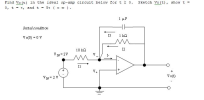 Find valt) in the ideal op-amp circuit below for t o. sketch Vodt), show t = Initial condifion 12 I1 V o)
Show all work on separate paper in order to receive full credit. O SKETCH THESE CURVES...
 Show all work on separate paper in order to receive full credit. O SKETCH THESE CURVES AND FIND AREA OF THE REGION EN CLOSED BY THEM. y : 2x+2, Y = 15-?, x=-1, x=2 2 FINO THE VOLUME OF THE SOLIO FORMED BY ROTATING THE REGION BOUNDLO BY THESE CURVES ABOUT THE X-AXIS y = 5x , y = 5x ,x20 3 FIND THE LENGTH OF THE LING Y = 4x+3 For -25x = 3 FIND THE SUM OF THIS...
 Kindly provide calculation and show each step. Thanks
(a) Given the signal x(t) in Figure 2, sketch the signal for: xit) 12 10 - 2- 0.2 0.4 0.6 2 14 1.6 1.8 2 0.8 Figure 2 i. x(t+2) [4 Marks] ii. x(t/3) [4 Marks] iii. x(2t) [4 Marks] iv. -X(t) [4 Marks] (b) Given the signal x(t) in Figure 3, sketch the signal for x-(2t-2): xit 25 2 1.5 1 0.5 -0.5 0.5 1 1.5 2 2.5 3.5 Figure 3...
Kindly provide calculation and show each step. Thanks
(a) Given the signal x(t) in Figure 2, sketch the signal for: xit) 12 10 - 2- 0.2 0.4 0.6 2 14 1.6 1.8 2 0.8 Figure 2 i. x(t+2) [4 Marks] ii. x(t/3) [4 Marks] iii. x(2t) [4 Marks] iv. -X(t) [4 Marks] (b) Given the signal x(t) in Figure 3, sketch the signal for x-(2t-2): xit 25 2 1.5 1 0.5 -0.5 0.5 1 1.5 2 2.5 3.5 Figure 3...
 2- Solve the wave equation on a semi-infinite domain 1 > 0,t > 0 Utt 24.11 u(a,0) = sin r, 4(7,0) = cos 2 4,(0,t) = 0 ho
 Consider the partial differential equation together with the boundary conditions u(0, t) 0 and u(1,t)0 for t20 and the initial condition u(z,0) = z(1-2) for 0 < x < 1. (a) If n is a positive integer, show that the function , sin(x), satisfies the given partial differential equation and boundary conditions. (b) The general solution of the partial differential equation that satisfies the boundary conditions is Write down (but do not evaluate) an integral that can be used to...
 1.8 k2 400 Ω 900 Ω luFuo(1) 1). Determine the transfer function G,(o)o) 2). Sketch the magnitude characteristic of the transfer function. (No need to use a bode plot paper. Sketch it in the booklet and label the break frequency, magnitude in dB and any slopes in dB/dec) 3). What is the actual magnitude (in dB) of the transfer function at the break frequency?
 Problem 2. Solve the following wave equation. Utt = Ucx + x for t > 0 and 0 < x < 1 Boundary Conditions: u(0,t) = 0 AND u(1,t) = 1 Inital Condition: u(x,0) = $(x) AND u1(x,0) = 0
 4. (35 pts) Consider the system defined by: xit 5x1-2x2-R (1) #2-2x, +2x2 F) a) Compute the natural frequencies and the mode shapes. /dland -JS -2N5 b) Calculate the response for F(t)-F(t)-0 and initial conditions xo- e) Calculate the response for F-cosr, F,(o)-0 and initial conditions and -0. 0 d) Calculate Bi and B2 such that the system: -2x1 + 2x2-B2cos/6t does not experience resonance.
4. (35 pts) Consider the system defined by: xit 5x1-2x2-R (1) #2-2x, +2x2 F) a)...
4. (35 pts) Consider the system defined by: xit 5x1-2x2-R (1) #2-2x, +2x2 F) a) Compute the natural frequencies and the mode shapes. /dland -JS -2N5 b) Calculate the response for F(t)-F(t)-0 and initial conditions xo- e) Calculate the response for F-cosr, F,(o)-0 and initial conditions and -0. 0 d) Calculate Bi and B2 such that the system: -2x1 + 2x2-B2cos/6t does not experience resonance.
4. (35 pts) Consider the system defined by: xit 5x1-2x2-R (1) #2-2x, +2x2 F) a)...
 1. Consider the following inhomogeneous wave equation on (0,7) : utt - 4uxx = (1 - x) cost Uz(0,t) = cost-1, uz(7,t) = cost u(3,0) = 2(7,0) = cos 3x (a) Convert the PDE to an equation with homogeneous boundary conditions by making an appropriate substitution u(x, t) = u(x, t) - p(x, t), implying u(,t) = v(x, t) + p(2,t) for an appropriate function p(x, t). (b) Finish solving the PDE using the Method of Eigenfunction expansion.
 Find valt) in the ideal op-amp circuit below for t o. sketch Vodt), show t = Initial condifion 12 I1 V o)
 Show all work on separate paper in order to receive full credit. O SKETCH THESE CURVES AND FIND AREA OF THE REGION EN CLOSED BY THEM. y : 2x+2, Y = 15-?, x=-1, x=2 2 FINO THE VOLUME OF THE SOLIO FORMED BY ROTATING THE REGION BOUNDLO BY THESE CURVES ABOUT THE X-AXIS y = 5x , y = 5x ,x20 3 FIND THE LENGTH OF THE LING Y = 4x+3 For -25x = 3 FIND THE SUM OF THIS...
Most questions answered within 3 hours.
-
Where is the error in this code sequence?
String s1 = "Hello";
String s2 = "ello";...
asked 10 months ago -
Financial data for Joel de Paris, Inc., for last year
follow:
Joel de Paris, Inc.
Balance...
asked 10 months ago -
Consider this reaction:
Al2(SO4)3 (aq)+ BaCl3
(aq) Al2Cl6 (aq)- +
3BaSO4(s) . What is the...
asked 10 months ago -
Suppose that Savneet is considering increasing her
recent random sample from 20 car rentals to 40...
asked 10 months ago -
Trucks arrive at an unloading terminal at an average rate of 120
per hour.
Trucks arrive...
asked 10 months ago -
Why are methanol and ethanol completely soluble in water while
octanol is not very little soluble....
asked 10 months ago -
A facilities manager at a university reads in a research report
that the mean amount of...
asked 10 months ago -
When the CuSO4 is rehydrated by adding water to the anhydrous
compound, is this an endothermic...
asked 10 months ago -
A ray of sunlight is passing from diamond into crown glass; the
angle of incidence is...
asked 10 months ago -
A block of mass 0.249 kg is placed on top of a light, vertical
spring of...
asked 10 months ago -
how do the kidneys compensate in the presences of acidosis
a) trigger hyperventilate
b) reserve acid...
asked 10 months ago -
Question 501 pts
The rental rate of capital to the firm increases. Which of the
following...
asked 10 months ago