
Homework Answers
![A gcu.ce is record and defined as utch e cxid) ( 1 [o cx tedt F(x-cl)] + 2c / grejde; is xacte act x + ct -[(x + (l) + Fled-s](http://img.homeworklib.com/questions/614f55b0-1176-11eb-b9f7-1976d7ea42c8.png?x-oss-process=image/resize,w_560)
![2 sin x. cas et + - - [[ Sinz Trice -C)] dinn. Cosat + &c [lin (x+cd) - din cx-ci ac - Linn-Cas cl + 20 2 Cosx. Sinct I Cosno](http://img.homeworklib.com/questions/623f7aa0-1176-11eb-8660-43bd2b4ac1e3.png?x-oss-process=image/resize,w_560)
Add Answer to:
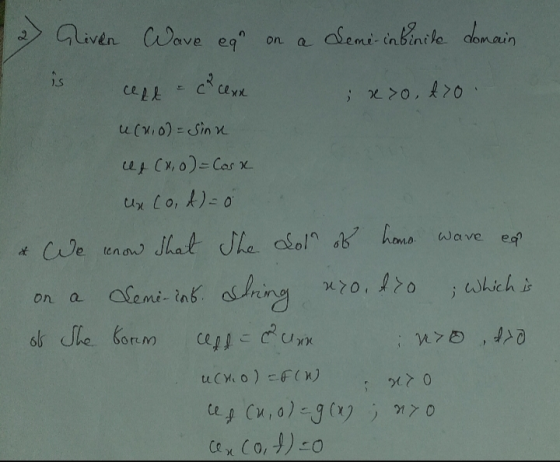
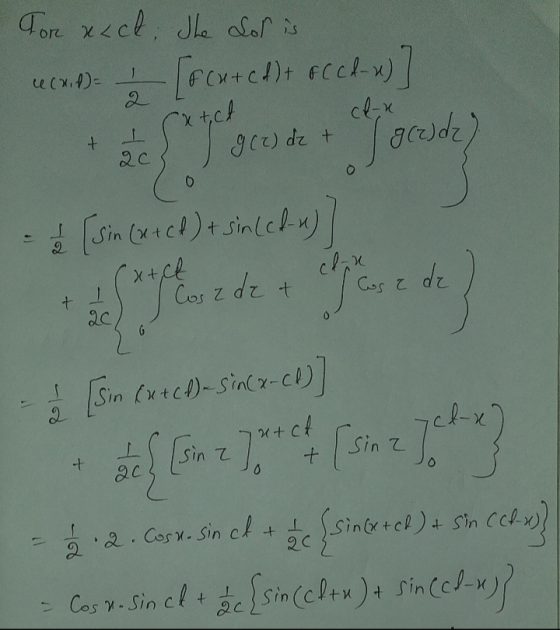
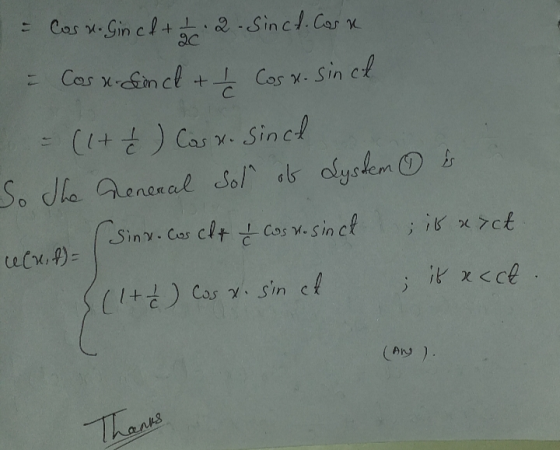
2- Solve the wave equation on a semi-infinite domain 1 > 0,t > 0 Utt 24.11...
Solve the wave equation on the domain 0 < x < , t > 0 ?...
 Solve the wave equation on the domain 0 < x < , t > 0 ? uxx Utt = with the boundary condition u (0, t) = 0 and the initial conditions u (x,0) = x2 u (x,0) = x
Show that the solution to the following 1-D wave equation on a semi-infinite domain = 36 , y(0, t...
 Please show all work and answer all parts of the question.
Show that the solution to the following 1-D wave equation on a semi-infinite domain = 36 , y(0, t) = 0, t2 0, y(, 0 (r,0) 0 in(2 cos(w is given by y(x,t) =- r) cos(6w t) d
Show that the solution to the following 1-D wave equation on a semi-infinite domain = 36 , y(0, t) = 0, t2 0, y(, 0 (r,0) 0 in(2 cos(w is given...
Please show all work and answer all parts of the question.
Show that the solution to the following 1-D wave equation on a semi-infinite domain = 36 , y(0, t) = 0, t2 0, y(, 0 (r,0) 0 in(2 cos(w is given by y(x,t) =- r) cos(6w t) d
Show that the solution to the following 1-D wave equation on a semi-infinite domain = 36 , y(0, t) = 0, t2 0, y(, 0 (r,0) 0 in(2 cos(w is given...
9. Solve the wave problem: 0 < x < T, t> 0; Utt: t2 0; u(T,...
 9. Solve the wave problem: 0 < x < T, t> 0; Utt: t2 0; u(T, t) = 0, u(0, t) = 0, 0 SST. u(x,0) = sin(10r), u(x, 0) = sin(4æ) + 2 sin(6x), Answer: sin(10r) sin(10t). 10 sin(4r) cos(4t) + 2 sin(6x) cos(6t) + u(x, t) =
Problem 2. Solve the following wave equation. Utt = Ucx + x for t > 0...
 Problem 2. Solve the following wave equation. Utt = Ucx + x for t > 0 and 0 < x < 1 Boundary Conditions: u(0,t) = 0 AND u(1,t) = 1 Inital Condition: u(x,0) = $(x) AND u1(x,0) = 0
If you were to solve the variant of wave equation utt=uxx+u for 0<x<6 and t>0 with...
If you were to solve the variant of wave equation utt=uxx+u for 0<x<6 and t>0 with u(0,t)=u(2 ,t)=0, u(x,0)=2x, ut(x,0)=0 using separation of variables, what would be the correct form of Xn (x)? Xn (x)=cosh( nπ 4 Xn (x)=sin( nπ 2 Xn (x)=sin( n2 π2 4 Xn (x)=cos nπ 2 None of these
4. Consider the semi-infinite string problem given by Utt = cʻuza, 0<x< 0,> 0 u(x,0) =...
 4. Consider the semi-infinite string problem given by Utt = cʻuza, 0<x< 0,> 0 u(x,0) = f(x), 0<x< ~ ut(2,0) = g(2), 0 < x < 0 u(0,t) = 0, t> 0 Suppose that c=1, f(0) = (x - 1) - h(2 – 3) and g(C) = 0. (a) Write out the appropriate semi-infinite d'Alembert's solution for this problem and simplify. (b) Plot the solution surface and enough time snapshots to demostrate the dynam- ics of the solution.
2. Use separation of variables to solve the IBVP: utt (z, y, t) u(0, y, t)...
 2. Use separation of variables to solve the IBVP: utt (z, y, t) u(0, y, t) u (x, y,0) uzz(z, y, t) + un, (x, y, t) = 0, 0 < x < 1, 0 < y < 1, 0, u(1,y,t)=0, u(z,0,t)=0, u(z, l,t) = 0 sin(r) sin (2my), ue (r, y,02 sin(2mx) sin(ry) t > 0, = =
1. Consider the following inhomogeneous wave equation on (0,7) : utt - 4uxx = (1 -...
 1. Consider the following inhomogeneous wave equation on (0,7) : utt - 4uxx = (1 - x) cost Uz(0,t) = cost-1, uz(7,t) = cost u(3,0) = 2(7,0) = cos 3x (a) Convert the PDE to an equation with homogeneous boundary conditions by making an appropriate substitution u(x, t) = u(x, t) - p(x, t), implying u(,t) = v(x, t) + p(2,t) for an appropriate function p(x, t). (b) Finish solving the PDE using the Method of Eigenfunction expansion.
PDE question Consider the one dimensional wave equation on the half line: Ut(x,0) = g(x) Utt...
 PDE
question
Consider the one dimensional wave equation on the half line: Ut(x,0) = g(x) Utt - Uzx= 0 0 < < u(0,t) = 0 u(x,0) = f(x) (a) What is the solution? (b) For the particular initial conditions 12 - 2 25254 f(x) = { 6- 4<r<6 otherwise g(x) = 0 sketch the solution u(x, t) for t = 0, 2, 4, 6.
PDE
question
Consider the one dimensional wave equation on the half line: Ut(x,0) = g(x) Utt - Uzx= 0 0 < < u(0,t) = 0 u(x,0) = f(x) (a) What is the solution? (b) For the particular initial conditions 12 - 2 25254 f(x) = { 6- 4<r<6 otherwise g(x) = 0 sketch the solution u(x, t) for t = 0, 2, 4, 6.
5. Consider the following IBVP (initial boundary value problem utt - Curr = 0, 0<x<1, t>0,...
 5. Consider the following IBVP (initial boundary value problem utt - Curr = 0, 0<x<1, t>0, with boundary conditions u(0,t) = u(1, t) = 0, > 0 and initial conditions (7,0) = x(1 – 2), 14(2,0) = 0, 0<x< 1. Use separation of variables method to find an infinite series solution of this problem. Do a complete calculation for this problem.
 Solve the wave equation on the domain 0 < x < , t > 0 ? uxx Utt = with the boundary condition u (0, t) = 0 and the initial conditions u (x,0) = x2 u (x,0) = x
 Please show all work and answer all parts of the question.
Show that the solution to the following 1-D wave equation on a semi-infinite domain = 36 , y(0, t) = 0, t2 0, y(, 0 (r,0) 0 in(2 cos(w is given by y(x,t) =- r) cos(6w t) d
Show that the solution to the following 1-D wave equation on a semi-infinite domain = 36 , y(0, t) = 0, t2 0, y(, 0 (r,0) 0 in(2 cos(w is given...
Please show all work and answer all parts of the question.
Show that the solution to the following 1-D wave equation on a semi-infinite domain = 36 , y(0, t) = 0, t2 0, y(, 0 (r,0) 0 in(2 cos(w is given by y(x,t) =- r) cos(6w t) d
Show that the solution to the following 1-D wave equation on a semi-infinite domain = 36 , y(0, t) = 0, t2 0, y(, 0 (r,0) 0 in(2 cos(w is given...
 9. Solve the wave problem: 0 < x < T, t> 0; Utt: t2 0; u(T, t) = 0, u(0, t) = 0, 0 SST. u(x,0) = sin(10r), u(x, 0) = sin(4æ) + 2 sin(6x), Answer: sin(10r) sin(10t). 10 sin(4r) cos(4t) + 2 sin(6x) cos(6t) + u(x, t) =
 Problem 2. Solve the following wave equation. Utt = Ucx + x for t > 0 and 0 < x < 1 Boundary Conditions: u(0,t) = 0 AND u(1,t) = 1 Inital Condition: u(x,0) = $(x) AND u1(x,0) = 0
 4. Consider the semi-infinite string problem given by Utt = cʻuza, 0<x< 0,> 0 u(x,0) = f(x), 0<x< ~ ut(2,0) = g(2), 0 < x < 0 u(0,t) = 0, t> 0 Suppose that c=1, f(0) = (x - 1) - h(2 – 3) and g(C) = 0. (a) Write out the appropriate semi-infinite d'Alembert's solution for this problem and simplify. (b) Plot the solution surface and enough time snapshots to demostrate the dynam- ics of the solution.
 2. Use separation of variables to solve the IBVP: utt (z, y, t) u(0, y, t) u (x, y,0) uzz(z, y, t) + un, (x, y, t) = 0, 0 < x < 1, 0 < y < 1, 0, u(1,y,t)=0, u(z,0,t)=0, u(z, l,t) = 0 sin(r) sin (2my), ue (r, y,02 sin(2mx) sin(ry) t > 0, = =
 1. Consider the following inhomogeneous wave equation on (0,7) : utt - 4uxx = (1 - x) cost Uz(0,t) = cost-1, uz(7,t) = cost u(3,0) = 2(7,0) = cos 3x (a) Convert the PDE to an equation with homogeneous boundary conditions by making an appropriate substitution u(x, t) = u(x, t) - p(x, t), implying u(,t) = v(x, t) + p(2,t) for an appropriate function p(x, t). (b) Finish solving the PDE using the Method of Eigenfunction expansion.
 PDE
question
Consider the one dimensional wave equation on the half line: Ut(x,0) = g(x) Utt - Uzx= 0 0 < < u(0,t) = 0 u(x,0) = f(x) (a) What is the solution? (b) For the particular initial conditions 12 - 2 25254 f(x) = { 6- 4<r<6 otherwise g(x) = 0 sketch the solution u(x, t) for t = 0, 2, 4, 6.
PDE
question
Consider the one dimensional wave equation on the half line: Ut(x,0) = g(x) Utt - Uzx= 0 0 < < u(0,t) = 0 u(x,0) = f(x) (a) What is the solution? (b) For the particular initial conditions 12 - 2 25254 f(x) = { 6- 4<r<6 otherwise g(x) = 0 sketch the solution u(x, t) for t = 0, 2, 4, 6.
 5. Consider the following IBVP (initial boundary value problem utt - Curr = 0, 0<x<1, t>0, with boundary conditions u(0,t) = u(1, t) = 0, > 0 and initial conditions (7,0) = x(1 – 2), 14(2,0) = 0, 0<x< 1. Use separation of variables method to find an infinite series solution of this problem. Do a complete calculation for this problem.
Most questions answered within 3 hours.
-
Where is the error in this code sequence?
String s1 = "Hello";
String s2 = "ello";...
asked 10 months ago -
Financial data for Joel de Paris, Inc., for last year
follow:
Joel de Paris, Inc.
Balance...
asked 10 months ago -
Consider this reaction:
Al2(SO4)3 (aq)+ BaCl3
(aq) Al2Cl6 (aq)- +
3BaSO4(s) . What is the...
asked 10 months ago -
Suppose that Savneet is considering increasing her
recent random sample from 20 car rentals to 40...
asked 10 months ago -
Trucks arrive at an unloading terminal at an average rate of 120
per hour.
Trucks arrive...
asked 10 months ago -
Why are methanol and ethanol completely soluble in water while
octanol is not very little soluble....
asked 10 months ago -
A facilities manager at a university reads in a research report
that the mean amount of...
asked 10 months ago -
When the CuSO4 is rehydrated by adding water to the anhydrous
compound, is this an endothermic...
asked 10 months ago -
A ray of sunlight is passing from diamond into crown glass; the
angle of incidence is...
asked 10 months ago -
A block of mass 0.249 kg is placed on top of a light, vertical
spring of...
asked 10 months ago -
how do the kidneys compensate in the presences of acidosis
a) trigger hyperventilate
b) reserve acid...
asked 10 months ago -
Question 501 pts
The rental rate of capital to the firm increases. Which of the
following...
asked 10 months ago