Homework Answers
Request Answer!
We need at least 10 more requests to produce the answer.
0 / 10 have requested this problem solution
The more requests, the faster the answer.
We wish to implement an IIR filter with poles at z = +1,- and zeros at...
 We wish to implement an IIR filter with poles at z = +1,- and zeros at z = 2.-3. Assume that each real multiplier takes Tm = 2 ns and each 2-input real adder takes Ta = 1 ns to complete. In the following, no complex multipliers or adders are to be used. (a) Write down the transfer function H() of this IIR filter in terms of first and second order terms with real-valued coefficients. (b) Sketch the block diagrams...
5) For the Bode-Diagram shown below, assume none of the poles or zeros are on the...
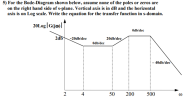 5) For the Bode-Diagram shown below, assume none of the poles or zeros are on the right hand side of s-plane. Vertical axis is in dB and the horizontal axis is on Log scale. Write the equation for the transfer function in s-domain. 20Log| GGo Odb/dec 2db -20db/dec 20db/dec Odb/dec -40db/dec 4 50 200 500
4. Determine the transfer function, poles and zeros, and stability of the system represented by the...
4. Determine the transfer function, poles and zeros, and stability of the system represented by the following difference equation: y[n] = -1.5y[n-1] + y[n-2] + x[n] Answers:H[z]= 1/(1+(1.5z^-1) - (z^-2)); poles at z = -2, 0, 5; zeros at z=0; unstable
3. (10 pts) Find the poles and zeros of the following function and sketch them in...
 3. (10 pts) Find the poles and zeros of the following function
and sketch them in an s-plane.
?(?) = 6?? + 7? + 2
6(?? + 9? + 14)(2? + 1)
3. (10 pts) Find the poles and zeros of the following function and sketch them in an s-plane. 6s2 + 7s + 2 H(S) 6(52 + 9 + 14)(2s + 1)
3. (10 pts) Find the poles and zeros of the following function
and sketch them in an s-plane.
?(?) = 6?? + 7? + 2
6(?? + 9? + 14)(2? + 1)
3. (10 pts) Find the poles and zeros of the following function and sketch them in an s-plane. 6s2 + 7s + 2 H(S) 6(52 + 9 + 14)(2s + 1)
2. [30%] For the following function, classify the poles and zeros, and draw the magnitude Bode...
 2. [30%] For the following function, classify the poles and zeros, and draw the magnitude Bode plot based on the asymptotes. (S+6) ($+3)(2 +63 +18)
Please solve clearly and understandably. a. Find the poles and zeros of the impedance seen looking...
 Please solve clearly and understandably.
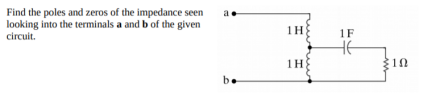
a. Find the poles and zeros of the impedance seen looking into the terminals a and b of the given circuit. 1H
Please solve clearly and understandably.
a. Find the poles and zeros of the impedance seen looking into the terminals a and b of the given circuit. 1H
. [20%] Using the definition, compute the z-Transform, and find and sketch the poles and zeros...
 . [20%] Using the definition, compute the z-Transform, and find and sketch the poles and zeros of X/e] in the z-plane for the following signal. atul-(o2)+(09)
1. What are the poles and zeros of G(s) ? Is the system stable? Explain. -flu...
 1. What are the poles and zeros of G(s) ? Is the system stable? Explain. -flu 10. What are the poles of the following state space system? dt 15. G()(in(3t); what is system steady state response yss )-? x(s) (s+3)
(1) Plot the poles and zeros of the following transfer functions. Also, identify if the transfer...
 (1) Plot the poles and zeros of the following transfer functions. Also, identify if the transfer function represents a stable system. (15) (s+2)(s-5) (s-4)(s²+6s)(s²+9) a. s(s+4)(s+7) b. (s+1)(s+7)(s+9) (s+2)(s+3)(s²+25) (s3+13s2+42s)(s+1)(s²+8s+16) C. (2) Draw the fre meney raenoncafor the Cllawing tane fnetiene
Compute the poles and zeros of each of the filters given in problem 4. Which filters...
Compute the poles and zeros of each of the filters given in problem 4. Which filters are stable? 4a) H(z) = 1/1 + z-3 4b) H(z) = (1+3z-1+2z-2)/(1-z-1) *I understand that a system is stable if all poles are strictly inside the unit circle, and unstable if any are outside the unit circle. If a pole is ON the unit circle or the boundary of the unit circle like 1 or -1, would that make it stable or unstable? *I...
 We wish to implement an IIR filter with poles at z = +1,- and zeros at z = 2.-3. Assume that each real multiplier takes Tm = 2 ns and each 2-input real adder takes Ta = 1 ns to complete. In the following, no complex multipliers or adders are to be used. (a) Write down the transfer function H() of this IIR filter in terms of first and second order terms with real-valued coefficients. (b) Sketch the block diagrams...
 5) For the Bode-Diagram shown below, assume none of the poles or zeros are on the right hand side of s-plane. Vertical axis is in dB and the horizontal axis is on Log scale. Write the equation for the transfer function in s-domain. 20Log| GGo Odb/dec 2db -20db/dec 20db/dec Odb/dec -40db/dec 4 50 200 500
 3. (10 pts) Find the poles and zeros of the following function
and sketch them in an s-plane.
?(?) = 6?? + 7? + 2
6(?? + 9? + 14)(2? + 1)
3. (10 pts) Find the poles and zeros of the following function and sketch them in an s-plane. 6s2 + 7s + 2 H(S) 6(52 + 9 + 14)(2s + 1)
3. (10 pts) Find the poles and zeros of the following function
and sketch them in an s-plane.
?(?) = 6?? + 7? + 2
6(?? + 9? + 14)(2? + 1)
3. (10 pts) Find the poles and zeros of the following function and sketch them in an s-plane. 6s2 + 7s + 2 H(S) 6(52 + 9 + 14)(2s + 1)
 2. [30%] For the following function, classify the poles and zeros, and draw the magnitude Bode plot based on the asymptotes. (S+6) ($+3)(2 +63 +18)
 Please solve clearly and understandably.
a. Find the poles and zeros of the impedance seen looking into the terminals a and b of the given circuit. 1H
Please solve clearly and understandably.
a. Find the poles and zeros of the impedance seen looking into the terminals a and b of the given circuit. 1H
 . [20%] Using the definition, compute the z-Transform, and find and sketch the poles and zeros of X/e] in the z-plane for the following signal. atul-(o2)+(09)
 1. What are the poles and zeros of G(s) ? Is the system stable? Explain. -flu 10. What are the poles of the following state space system? dt 15. G()(in(3t); what is system steady state response yss )-? x(s) (s+3)
 (1) Plot the poles and zeros of the following transfer functions. Also, identify if the transfer function represents a stable system. (15) (s+2)(s-5) (s-4)(s²+6s)(s²+9) a. s(s+4)(s+7) b. (s+1)(s+7)(s+9) (s+2)(s+3)(s²+25) (s3+13s2+42s)(s+1)(s²+8s+16) C. (2) Draw the fre meney raenoncafor the Cllawing tane fnetiene
Most questions answered within 3 hours.
-
Where is the error in this code sequence?
String s1 = "Hello";
String s2 = "ello";...
asked 10 months ago -
Financial data for Joel de Paris, Inc., for last year
follow:
Joel de Paris, Inc.
Balance...
asked 10 months ago -
Consider this reaction:
Al2(SO4)3 (aq)+ BaCl3
(aq) Al2Cl6 (aq)- +
3BaSO4(s) . What is the...
asked 10 months ago -
Suppose that Savneet is considering increasing her
recent random sample from 20 car rentals to 40...
asked 10 months ago -
Trucks arrive at an unloading terminal at an average rate of 120
per hour.
Trucks arrive...
asked 10 months ago -
Why are methanol and ethanol completely soluble in water while
octanol is not very little soluble....
asked 10 months ago -
A facilities manager at a university reads in a research report
that the mean amount of...
asked 10 months ago -
When the CuSO4 is rehydrated by adding water to the anhydrous
compound, is this an endothermic...
asked 10 months ago -
A ray of sunlight is passing from diamond into crown glass; the
angle of incidence is...
asked 10 months ago -
A block of mass 0.249 kg is placed on top of a light, vertical
spring of...
asked 10 months ago -
how do the kidneys compensate in the presences of acidosis
a) trigger hyperventilate
b) reserve acid...
asked 10 months ago -
Question 501 pts
The rental rate of capital to the firm increases. Which of the
following...
asked 10 months ago