
Homework Answers
Add Answer to:
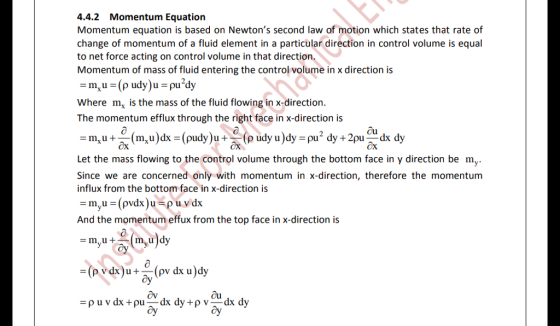
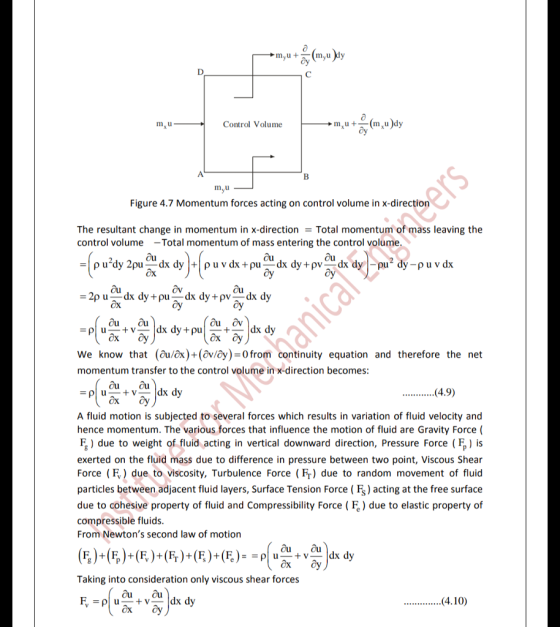
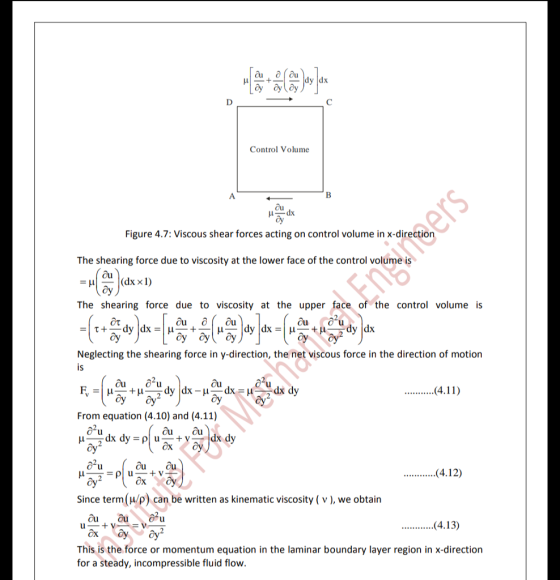
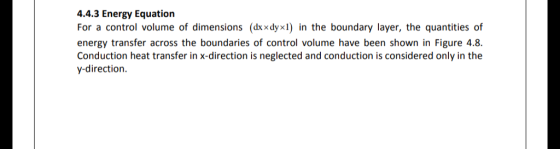
2. Use the scale analysis to derive momentum equation and energy equation of boundary layer under...
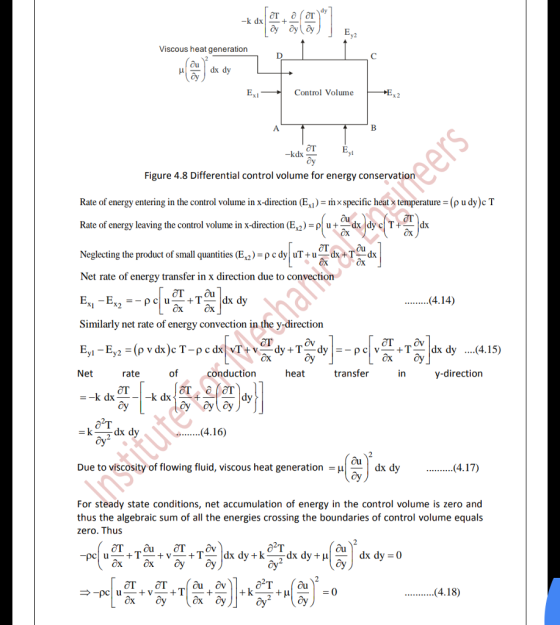
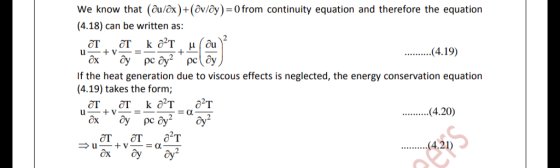
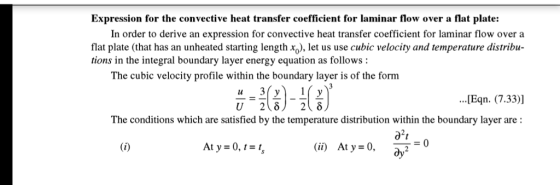
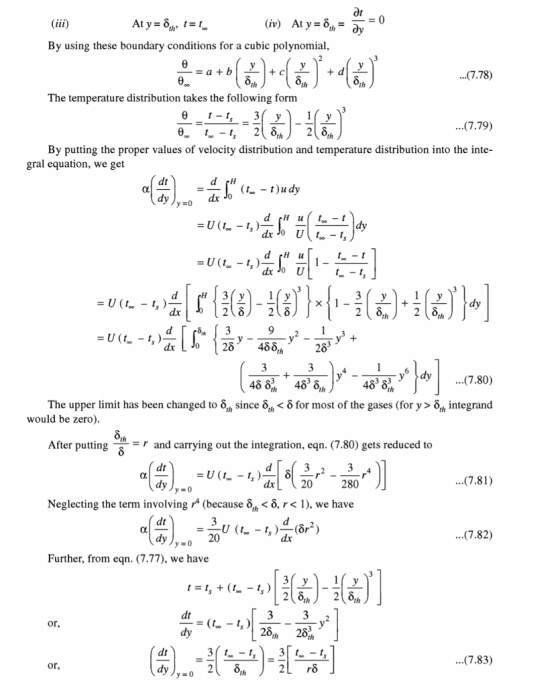
Using the Energy Integral Equation (EIE), derive an expression for the average Nusselt number (in terms...
 Using the Energy Integral Equation (EIE), derive an expression for the average Nusselt number (in terms of Reynolds and Prandtl numbers) for laminar flow of a fluid over a surface with a free stream velocity of U. (which is a constant). Assume the fluid velocity in the momentum boundary layer is the same as the free stream velocity and (T-Tw)/(To-Tw)=(y/St), where T is the fluid temperature field in the thermal boundary layer, To is the free stream temperature, Twis the...
Deduce a set of boundary-layer differential equations (continuity, momentum, energy) for steady f...
 Deduce a set of boundary-layer differential equations
(continuity, momentum, energy) for steady flow of a
constant-property fluid without body forces, and with negligible
viscous dissipation, in a coordinate system suitable for analysis
of the boundary layer on the surface of a rotating disk
Problem # 6 Deduce a set of boundary-layer differential equations (continuity, momentum, energy) for steady flow of a constant-property fluid without body forces, and with negligible viscous dissipation, in a coordinate system suitable for analysis of the...
Deduce a set of boundary-layer differential equations
(continuity, momentum, energy) for steady flow of a
constant-property fluid without body forces, and with negligible
viscous dissipation, in a coordinate system suitable for analysis
of the boundary layer on the surface of a rotating disk
Problem # 6 Deduce a set of boundary-layer differential equations (continuity, momentum, energy) for steady flow of a constant-property fluid without body forces, and with negligible viscous dissipation, in a coordinate system suitable for analysis of the...
2. For a boundary layer flow with U suction velocity Vo (0 is introduced at the...
 2. For a boundary layer flow with U suction velocity Vo (0 is introduced at the wall to delay flow separation. (a) By integrating the boundary layer equations from porous wall across the boundary layer, show that the integral momentum equation is given by -constant over a porous plate as shown in Figure 1, a Ou where τνν-μ w- 1 оу y-o and (b) obtain the integral energy equation. (c) Perform the dimensionless analysis on the integral equations and discuss...
Use the integral method for boundary layer flow and convective heat transfer over a flat plate he...
 Use the integral method for boundary layer flow and convective heat transfer over a flat plate heated by maintaining a constant heat flux q"w, for the case of very low Prandtl number, Pr0. Assume that the free stream velocity of the fluid, U, and free stream temperature, T-do not vary with x. Using the integral form of energy equation, show that under these conditions: (a) the temperature profile, (T- T) is given by, 41 2 CT-T oa (b) the wall...
22. Consider the momentum integral equation turbulent boundary layer on an isothermal flat plate. The boundary...
 22. Consider the momentum integral equation turbulent boundary layer on an isothermal flat plate. The boundary layer is tripped at x-0. Assume constant properties and velocity. An experiment conducted to measure u and τ showed that for a steady, and τ= 0.0228 ρu® a) Determine the local friction coefficient, Cf/2 b) Using Colburn analogy, obtain an expression for the local Nusselt number.
d chapter o, pp. 62-66 Starting with the time dependent 2-D laminar boundary layer momentum equation...
 d chapter o, pp. 62-66 Starting with the time dependent 2-D laminar boundary layer momentum equation in conservative form, develop the Reynolds averaged momentum equation for a turbulent boundary layer.
(2 pts) Heat is transferred from a hot fluid (temperature T1 and heat transfer coefficient h2)...
 (2 pts) Heat is transferred from a hot fluid (temperature T1 and heat transfer coefficient h2) through a plane wall of thickness 8, surface area A and the thermal conductivity k. The thermal resistance for the set up is + (a) AC ) (b) A (i + + ) (c) 2 (na + + n2) (d) A (na + b +h2) (2 pts) An increase in convective heat transfer coefficient over a fin will (a) increase effectiveness (b) decrease effectiveness...
A fluid flow over a solid surface with a laminar boundary layer velocity profile is approximated...
 A fluid flow over a solid surface with a laminar boundary layer velocity profile is approximated by the following equation: Ý = 2 () – ()* for y so and, 4 = 0 for y> 8 i). Show that this velocity profile satisfies the appropriate boundary conditions. ii) Determine the boundary layer thickness, 8 = 8(x) by using the momentum integral equation for the equation in Question 3(b)(i).
2. Perform the integral method in the case of natural convection on an isothermal vertical wall. Present an momentum equation and boundary conditions. Do not solve the equation. (30 pt) 2. Perfo...
 2. Perform the integral method in the case of natural convection on an isothermal vertical wall. Present an momentum equation and boundary conditions. Do not solve the equation. (30 pt)
2. Perform the integral method in the case of natural convection on an isothermal vertical wall. Present an momentum equation and boundary conditions. Do not solve the equation. (30 pt)
2. Perform the integral method in the case of natural convection on an isothermal vertical wall. Present an momentum equation and boundary conditions. Do not solve the equation. (30 pt)
Explain Convection 1. Describe the factors that affect the value of the convection coefficient 2. Explain why and how velocity and thermal boundary layers form 3. Explain how turbulence enhances c...
 Explain
Convection 1. Describe the factors that affect the value of the convection coefficient 2. Explain why and how velocity and thermal boundary layers form 3. Explain how turbulence enhances convection heat transfer 4. Describe the significance of the Reynold's number, Nusselt number, and the Prandtl number 5. List common situations where external convection occurs 6. Explain the importance of the film temperature and use it to specify thermophysical properties of a fluid 7. Explain the significance of boundary layer...
Explain
Convection 1. Describe the factors that affect the value of the convection coefficient 2. Explain why and how velocity and thermal boundary layers form 3. Explain how turbulence enhances convection heat transfer 4. Describe the significance of the Reynold's number, Nusselt number, and the Prandtl number 5. List common situations where external convection occurs 6. Explain the importance of the film temperature and use it to specify thermophysical properties of a fluid 7. Explain the significance of boundary layer...
 Using the Energy Integral Equation (EIE), derive an expression for the average Nusselt number (in terms of Reynolds and Prandtl numbers) for laminar flow of a fluid over a surface with a free stream velocity of U. (which is a constant). Assume the fluid velocity in the momentum boundary layer is the same as the free stream velocity and (T-Tw)/(To-Tw)=(y/St), where T is the fluid temperature field in the thermal boundary layer, To is the free stream temperature, Twis the...
 Deduce a set of boundary-layer differential equations
(continuity, momentum, energy) for steady flow of a
constant-property fluid without body forces, and with negligible
viscous dissipation, in a coordinate system suitable for analysis
of the boundary layer on the surface of a rotating disk
Problem # 6 Deduce a set of boundary-layer differential equations (continuity, momentum, energy) for steady flow of a constant-property fluid without body forces, and with negligible viscous dissipation, in a coordinate system suitable for analysis of the...
Deduce a set of boundary-layer differential equations
(continuity, momentum, energy) for steady flow of a
constant-property fluid without body forces, and with negligible
viscous dissipation, in a coordinate system suitable for analysis
of the boundary layer on the surface of a rotating disk
Problem # 6 Deduce a set of boundary-layer differential equations (continuity, momentum, energy) for steady flow of a constant-property fluid without body forces, and with negligible viscous dissipation, in a coordinate system suitable for analysis of the...
 2. For a boundary layer flow with U suction velocity Vo (0 is introduced at the wall to delay flow separation. (a) By integrating the boundary layer equations from porous wall across the boundary layer, show that the integral momentum equation is given by -constant over a porous plate as shown in Figure 1, a Ou where τνν-μ w- 1 оу y-o and (b) obtain the integral energy equation. (c) Perform the dimensionless analysis on the integral equations and discuss...
 Use the integral method for boundary layer flow and convective heat transfer over a flat plate heated by maintaining a constant heat flux q"w, for the case of very low Prandtl number, Pr0. Assume that the free stream velocity of the fluid, U, and free stream temperature, T-do not vary with x. Using the integral form of energy equation, show that under these conditions: (a) the temperature profile, (T- T) is given by, 41 2 CT-T oa (b) the wall...
 22. Consider the momentum integral equation turbulent boundary layer on an isothermal flat plate. The boundary layer is tripped at x-0. Assume constant properties and velocity. An experiment conducted to measure u and τ showed that for a steady, and τ= 0.0228 ρu® a) Determine the local friction coefficient, Cf/2 b) Using Colburn analogy, obtain an expression for the local Nusselt number.
 d chapter o, pp. 62-66 Starting with the time dependent 2-D laminar boundary layer momentum equation in conservative form, develop the Reynolds averaged momentum equation for a turbulent boundary layer.
 (2 pts) Heat is transferred from a hot fluid (temperature T1 and heat transfer coefficient h2) through a plane wall of thickness 8, surface area A and the thermal conductivity k. The thermal resistance for the set up is + (a) AC ) (b) A (i + + ) (c) 2 (na + + n2) (d) A (na + b +h2) (2 pts) An increase in convective heat transfer coefficient over a fin will (a) increase effectiveness (b) decrease effectiveness...
 A fluid flow over a solid surface with a laminar boundary layer velocity profile is approximated by the following equation: Ý = 2 () – ()* for y so and, 4 = 0 for y> 8 i). Show that this velocity profile satisfies the appropriate boundary conditions. ii) Determine the boundary layer thickness, 8 = 8(x) by using the momentum integral equation for the equation in Question 3(b)(i).
 2. Perform the integral method in the case of natural convection on an isothermal vertical wall. Present an momentum equation and boundary conditions. Do not solve the equation. (30 pt)
2. Perform the integral method in the case of natural convection on an isothermal vertical wall. Present an momentum equation and boundary conditions. Do not solve the equation. (30 pt)
2. Perform the integral method in the case of natural convection on an isothermal vertical wall. Present an momentum equation and boundary conditions. Do not solve the equation. (30 pt)
 Explain
Convection 1. Describe the factors that affect the value of the convection coefficient 2. Explain why and how velocity and thermal boundary layers form 3. Explain how turbulence enhances convection heat transfer 4. Describe the significance of the Reynold's number, Nusselt number, and the Prandtl number 5. List common situations where external convection occurs 6. Explain the importance of the film temperature and use it to specify thermophysical properties of a fluid 7. Explain the significance of boundary layer...
Explain
Convection 1. Describe the factors that affect the value of the convection coefficient 2. Explain why and how velocity and thermal boundary layers form 3. Explain how turbulence enhances convection heat transfer 4. Describe the significance of the Reynold's number, Nusselt number, and the Prandtl number 5. List common situations where external convection occurs 6. Explain the importance of the film temperature and use it to specify thermophysical properties of a fluid 7. Explain the significance of boundary layer...
Most questions answered within 3 hours.
-
Where is the error in this code sequence?
String s1 = "Hello";
String s2 = "ello";...
asked 10 months ago -
Financial data for Joel de Paris, Inc., for last year
follow:
Joel de Paris, Inc.
Balance...
asked 10 months ago -
Consider this reaction:
Al2(SO4)3 (aq)+ BaCl3
(aq) Al2Cl6 (aq)- +
3BaSO4(s) . What is the...
asked 10 months ago -
Suppose that Savneet is considering increasing her
recent random sample from 20 car rentals to 40...
asked 10 months ago -
Trucks arrive at an unloading terminal at an average rate of 120
per hour.
Trucks arrive...
asked 10 months ago -
Why are methanol and ethanol completely soluble in water while
octanol is not very little soluble....
asked 10 months ago -
A facilities manager at a university reads in a research report
that the mean amount of...
asked 10 months ago -
When the CuSO4 is rehydrated by adding water to the anhydrous
compound, is this an endothermic...
asked 10 months ago -
A ray of sunlight is passing from diamond into crown glass; the
angle of incidence is...
asked 10 months ago -
A block of mass 0.249 kg is placed on top of a light, vertical
spring of...
asked 10 months ago -
how do the kidneys compensate in the presences of acidosis
a) trigger hyperventilate
b) reserve acid...
asked 10 months ago -
Question 501 pts
The rental rate of capital to the firm increases. Which of the
following...
asked 10 months ago