
Homework Answers
Add Answer to:
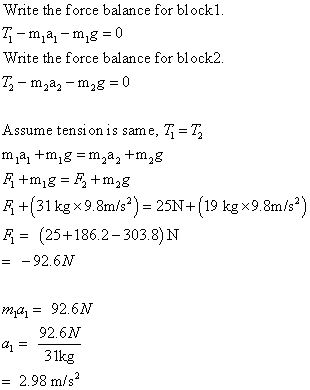
In the modified Atwood machine shown, mass 1 has a mass of 31 kg and mass...
What is the magnitude of the acceleration of a modified Atwood machine if the mass of...
What is the magnitude of the acceleration of a modified Atwood machine if the mass of the cart is 3 kg and the hanging mass is 16 kg? (Use g = 9.8 m/s2. Express your answer to one decimal point.)
What is the magnitude of the acceleration of a modified Atwood machine if the mass of...
What is the magnitude of the acceleration of a modified Atwood machine if the mass of the cart is 5 kg and the hanging mass is 7 kg? (Use g = 9.8 m/s2. Express your answer to one decimal point.)
In the Atwood machine shown below, m1 = 2.00 kg and m2 = 6.00 kg. The...
In the Atwood machine shown below, m1 = 2.00 kg and m2 = 6.00 kg. The masses of the pulley and string are negligible by comparison. The pulley turns without friction and the string does not stretch. The lighter object is released with a sharp push that sets it into motion at vi = 2.20 m/s downward. (a) How far will m1 descend below its initial level? 1 m In the Atwood machine shown below, m1 = 2.00 kg and...
An Atwood Machine is used to accelerate a 1 kg block upward, using a 10000 kg...
An Atwood Machine is used to accelerate a 1 kg block upward, using a 10000 kg block, as shown in the left- hand caption of Figure 1. The pulley and string is ideal. What is the acceleration of the block? After the 1kg block travels upward 1 meter, it disconnects from the Atwood Machine and flies upward. As depicted in the right-hand caption of Figure 1. How high does the block travel? How long is the block in the air?
An Atwood machine is constructed using a hoop with spokes of negligible mass. The 2.3 kg...
 An Atwood machine is constructed using a hoop with spokes of negligible mass. The 2.3 kg mass of the pulley is concentrated on its rim, which is a distance 23.5 cm from the axle. The mass on the right is 1 kg and on the left is 1.65 kg. The acceleration of gravity is 9.8 m/s^2. What is the magnitude of the linear acceleration a of the hanging masses?
In the atwood machine shown below l, m1= 2.00 kg and m2= 7.70 kg. the masses...
 In
the atwood machine shown below l, m1= 2.00 kg and m2= 7.70 kg. the
masses of the pulley and string are negligible by comparison. The
pulley turns without friction and the string does not stretch. The
lighter object is released with a sharp push that sets it into
motion at v -initial= 2.60 m/s downward.
Figure and question are in diagram ( picture below)
In the AtwOOdl motion at n = 2.60 m/s downward. mi 2 (a) How far...
In
the atwood machine shown below l, m1= 2.00 kg and m2= 7.70 kg. the
masses of the pulley and string are negligible by comparison. The
pulley turns without friction and the string does not stretch. The
lighter object is released with a sharp push that sets it into
motion at v -initial= 2.60 m/s downward.
Figure and question are in diagram ( picture below)
In the AtwOOdl motion at n = 2.60 m/s downward. mi 2 (a) How far...
Consider the Atwood machine shown in the nigure, wherem -2.00 kg and m-6.00 kg. The system...
 Consider the Atwood machine shown in the nigure, wherem -2.00 kg and m-6.00 kg. The system starts at rest, then the sphere is given a quick push downward, giving it an initial speed of 2.65 m/s Assume the pulley and cord are massless, and the cord is inextensible. Noglect friction. e Through what distance (in m) wil descend? 0.587 write Newton's second law for each mass, and solve the system of equations for』·Then use your result in a kinematics equation...
An Atwood machine consists of a mass of 3.5 kg connected by a light string to...
An Atwood machine consists of a mass of 3.5 kg connected by a light string to a mass of 6.0 kg over a frictionless pulley with a moment of inertia of 0.0352 kg ∙ m2 and a radius of 12.5 cm. If the system is released from rest, what is the speed of the masses after they have moved through 1.25 m if the string does not slip on the pulley? Please note: the professor has told us that the...
An Atwood machine is made from a mass of 0.5 kg and a heavier unknown mass....
An Atwood machine is made from a mass of 0.5 kg and a heavier unknown mass. When both masses are located at a height of 0.45 m above the ground, they have a speed of 1.75 m/s. What is the unknown mass?
Problem 9.38 10 of 19 > Review Constants Periodic Table In an Atwood machine, block 1 with mass mi and a loss ma...
 Problem 9.38 10 of 19 > Review Constants Periodic Table In an Atwood machine, block 1 with mass mi and a loss massive block 2 with mass are connected by a string that passes over a solid cylindrical pulley of mass M and radius R. Usemi 0.20 k m 0.16 kg. M = 0.50 kg, and R-0.10 m. (Figure 1) Determine the rotational inertia of the pulley Express your answer with the appropriate units. 1. Value Units Figure Submit Rest...
 An Atwood machine is constructed using a hoop with spokes of negligible mass. The 2.3 kg mass of the pulley is concentrated on its rim, which is a distance 23.5 cm from the axle. The mass on the right is 1 kg and on the left is 1.65 kg. The acceleration of gravity is 9.8 m/s^2. What is the magnitude of the linear acceleration a of the hanging masses?
 In
the atwood machine shown below l, m1= 2.00 kg and m2= 7.70 kg. the
masses of the pulley and string are negligible by comparison. The
pulley turns without friction and the string does not stretch. The
lighter object is released with a sharp push that sets it into
motion at v -initial= 2.60 m/s downward.
Figure and question are in diagram ( picture below)
In the AtwOOdl motion at n = 2.60 m/s downward. mi 2 (a) How far...
In
the atwood machine shown below l, m1= 2.00 kg and m2= 7.70 kg. the
masses of the pulley and string are negligible by comparison. The
pulley turns without friction and the string does not stretch. The
lighter object is released with a sharp push that sets it into
motion at v -initial= 2.60 m/s downward.
Figure and question are in diagram ( picture below)
In the AtwOOdl motion at n = 2.60 m/s downward. mi 2 (a) How far...
 Consider the Atwood machine shown in the nigure, wherem -2.00 kg and m-6.00 kg. The system starts at rest, then the sphere is given a quick push downward, giving it an initial speed of 2.65 m/s Assume the pulley and cord are massless, and the cord is inextensible. Noglect friction. e Through what distance (in m) wil descend? 0.587 write Newton's second law for each mass, and solve the system of equations for』·Then use your result in a kinematics equation...
 Problem 9.38 10 of 19 > Review Constants Periodic Table In an Atwood machine, block 1 with mass mi and a loss massive block 2 with mass are connected by a string that passes over a solid cylindrical pulley of mass M and radius R. Usemi 0.20 k m 0.16 kg. M = 0.50 kg, and R-0.10 m. (Figure 1) Determine the rotational inertia of the pulley Express your answer with the appropriate units. 1. Value Units Figure Submit Rest...
Most questions answered within 3 hours.
-
Where is the error in this code sequence?
String s1 = "Hello";
String s2 = "ello";...
asked 10 months ago -
Financial data for Joel de Paris, Inc., for last year
follow:
Joel de Paris, Inc.
Balance...
asked 10 months ago -
Consider this reaction:
Al2(SO4)3 (aq)+ BaCl3
(aq) Al2Cl6 (aq)- +
3BaSO4(s) . What is the...
asked 10 months ago -
Suppose that Savneet is considering increasing her
recent random sample from 20 car rentals to 40...
asked 10 months ago -
Trucks arrive at an unloading terminal at an average rate of 120
per hour.
Trucks arrive...
asked 10 months ago -
Why are methanol and ethanol completely soluble in water while
octanol is not very little soluble....
asked 10 months ago -
A facilities manager at a university reads in a research report
that the mean amount of...
asked 10 months ago -
When the CuSO4 is rehydrated by adding water to the anhydrous
compound, is this an endothermic...
asked 10 months ago -
A ray of sunlight is passing from diamond into crown glass; the
angle of incidence is...
asked 10 months ago -
A block of mass 0.249 kg is placed on top of a light, vertical
spring of...
asked 10 months ago -
how do the kidneys compensate in the presences of acidosis
a) trigger hyperventilate
b) reserve acid...
asked 10 months ago -
Question 501 pts
The rental rate of capital to the firm increases. Which of the
following...
asked 10 months ago