Let α = {1 + 2t, t − t 2 , t + t 2}
(a) Show that α is a basis for P2(R).
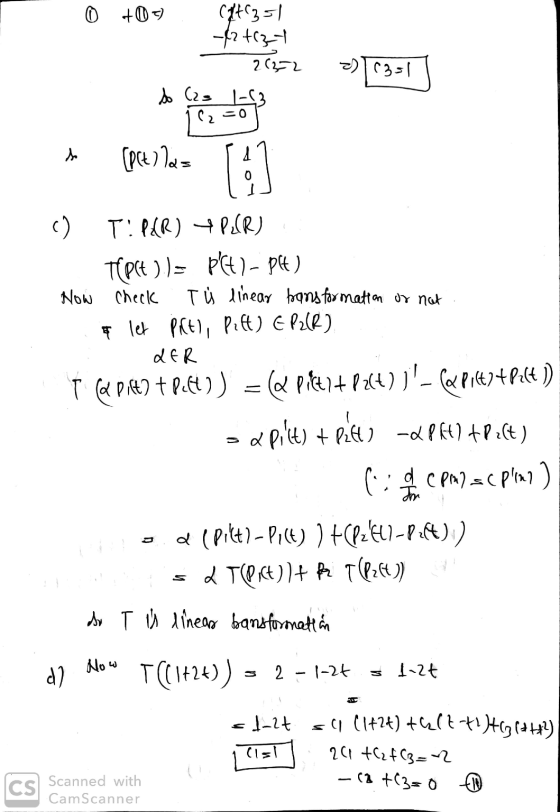
(b) Let p(t) = 1 + 3t + t 2 . Find [p(t)]α.
(c) Define the transformation T : P2(R) → P2(R) as T (p(t)) = p 0 (t) − p(t) i.e., the difference of p(t) and its first derivative. Determine whether this transformation is a linear transformation.
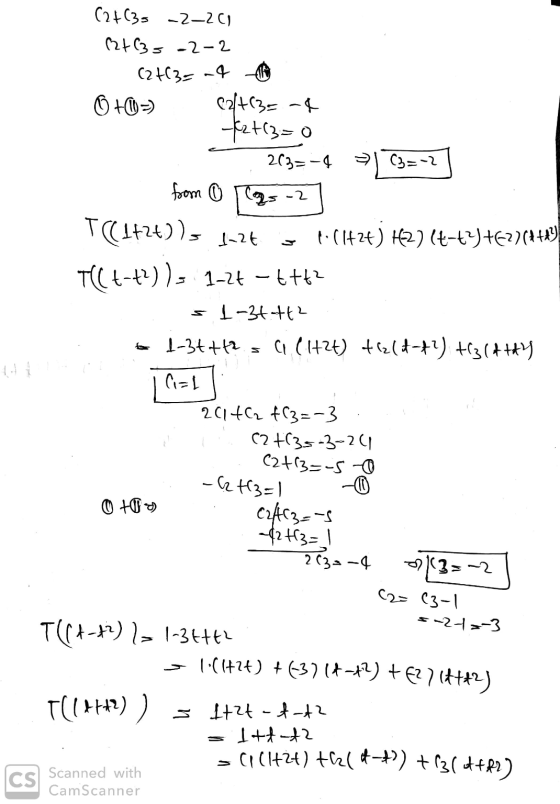
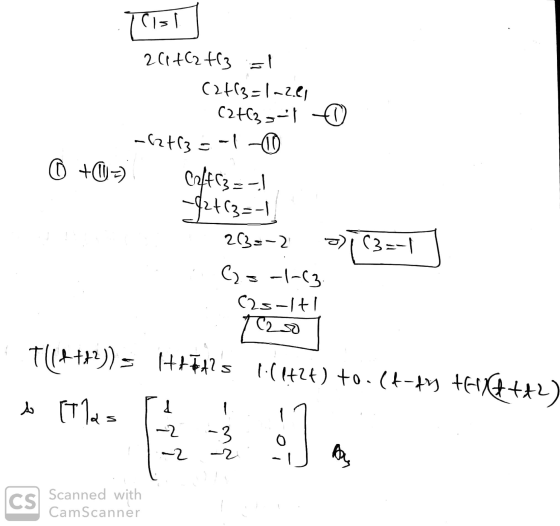
(d) Find [T]α![Problem 4. Let a = {1 + 2t, t – t?,t+t²} [ 4 pts] (a) Show that a is a basis for P2 (R). (b) Let p(t) = 1 + 3t + t2. Find [p(](http://img.homeworklib.com/questions/440440f0-bc4a-11eb-a46d-45de42f08eac.png?x-oss-process=image/resize,w_560)
Homework Answers
![4) 9). d = { H2t, t-42 +62] Now show d is basis for PalR) (1+2+) +2 (t-t?) + 3 (H1750 (1+261 +62 +6372 +612 +(3) ť? 50 ci bru](http://img.homeworklib.com/questions/449a7680-bc4a-11eb-b68a-35a87706ab24.png?x-oss-process=image/resize,w_560)
: 2: Let T : P1 → P2 be the linear map taking a polynomial p(t)...
 : 2: Let T : P1 → P2 be the linear map taking a polynomial p(t) to its antiderivative P(t) satisfying P(0) = 0 (e.g. T(5 + 2t) 5t + t2). Find two matrices A, B representing the corresponding linear map R2 + R3, the first with respect to the standard bases of P2 and P3, and the second with respect to the bases B = {1,1+t} B' = {1,1 +t, 1+t+t2}
1. Let B { 1, х, хг} et S {x2 +x, 2-1, x+1 } be two...
 1. Let B { 1, х, хг} et S {x2 +x, 2-1, x+1 } be two basis of P2. Let T : P2 P2 be a linear transformation such that 3,S 2 2 -2 Find a basis of Ker(T), a basis of Im(T) and T^b 2. Let Let : P1 → P1 be a linear transformation such that 4 -3 where B-[1, x,} et S - {2c - 1,x - 1} be two basis of P1. Find A2 and T2....
Let T : P2 --> P4 be the transformation that maps a polynomial p(t) into the...
Let T : P2 --> P4 be the transformation that maps a polynomial p(t) into the polynomial p(t) + t2p(t). (a) Find the image of p(t) = 2 - t + t2 (b) Show that T is a linear transformation. (c) Find the matrix for T relative to the bases {1, t, t2} and {1, t, t2, t3, t4}
Problem 2 [25 pts.] Let T: P2 → P4 be the transformation that maps a polynomial...
 Problem 2 [25 pts.] Let T: P2 → P4 be the transformation that maps a polynomial p(t) into the polynomial p(t) + tap(t). a. Find the image of p(t) 2 - t+t2. b. Show that T is a linear transformation. c. Find the matrix for T relative to the bases {1, t, ta} and {1, t, t2, t3, +4}.
7. Let V be the space generated by the basis B = {sin(t), cos(t), et}. i.e....
 7. Let V be the space generated by the basis B = {sin(t), cos(t), et}. i.e. V = span(B). Consider the linear transformation T:V + V defined by T(f(t)) = f"(t) – 2f'(t) – f(t). Find the standard matrix of the transformation. (Hint: Associate sin(t) with the vector (0), and so forth.) 8. Show that B = {t2 – 2, 3t2 +t, t+t+8} is a basis for P2, and find the change of coordinates matrix P which goes from B...
2. Let T: P2 P2 be given by T (p(x)) = x2p"(x) – S p(x)dx a....
 2. Let T: P2 P2 be given by T (p(x)) = x2p"(x) – S p(x)dx a. Show that T is a linear transformation b. Find Ker(T) and its basis. Is T one-to-one? c. Find Range(T) and its basis. Is T onto? Verify the dimension theorem.
Let p, (t) 6+t, P2(t) =t-3t, p3 (t) = 1 +t-2t. Complete parts (a) and (b) below. Use coordinate vectors to show that th...
 Let p, (t) 6+t, P2(t) =t-3t, p3 (t) = 1 +t-2t. Complete parts (a) and (b) below. Use coordinate vectors to show that these polynomials form a basis for P2. What are the coordinate vectors corresponding to p, p2, and pa? P- Place these coordinate vectors into the columns fa matrix A. What can be said about the matrix A? O A. The matrix A forms a basis for R3 by the Invertible Matrix Theorem because all square matrices are...
Consider a linear space P2(R) with the standard basis S- {1,t,t, t 3). a. Describe the...
 Consider a linear space P2(R) with the standard basis S- {1,t,t, t 3). a. Describe the isomorphism P R sending p(t) ps b. Show that B [t - 1,t + 1,t2 +t, t3) is another basis for P3 (R). c. Let p(t) 32t4t3. Find p. d. Show that the map P R4 sending p(t)-, рв is an isomorphism.
let T: P2 --> R be the linear transformation defined by T(p(x))=p(2) a) What is the...
let T: P2 --> R be the linear transformation defined by T(p(x))=p(2) a) What is the rank of T? b)what is the nullity of T? c)find a basis for Ker(T)
15 5. Let P2 and Pz denote the vector space of polynomials of degrees atmost 2...
 15 5. Let P2 and Pz denote the vector space of polynomials of degrees atmost 2 and 3 respectively. Let T:P2 P3 be the transformation that maps a polynomial p(t) to the polynomial (t - 2)p(t). (a) Find the image of p(t) = t2, that is, find T(t2). (b) Show that T is a linear transformation. (c) Find the matrix of T relative to the bases B = {1,t, tº} and C = {1,t, t², tº}. (d) Is T onto?...
 : 2: Let T : P1 → P2 be the linear map taking a polynomial p(t) to its antiderivative P(t) satisfying P(0) = 0 (e.g. T(5 + 2t) 5t + t2). Find two matrices A, B representing the corresponding linear map R2 + R3, the first with respect to the standard bases of P2 and P3, and the second with respect to the bases B = {1,1+t} B' = {1,1 +t, 1+t+t2}
 1. Let B { 1, х, хг} et S {x2 +x, 2-1, x+1 } be two basis of P2. Let T : P2 P2 be a linear transformation such that 3,S 2 2 -2 Find a basis of Ker(T), a basis of Im(T) and T^b 2. Let Let : P1 → P1 be a linear transformation such that 4 -3 where B-[1, x,} et S - {2c - 1,x - 1} be two basis of P1. Find A2 and T2....
 Problem 2 [25 pts.] Let T: P2 → P4 be the transformation that maps a polynomial p(t) into the polynomial p(t) + tap(t). a. Find the image of p(t) 2 - t+t2. b. Show that T is a linear transformation. c. Find the matrix for T relative to the bases {1, t, ta} and {1, t, t2, t3, +4}.
 7. Let V be the space generated by the basis B = {sin(t), cos(t), et}. i.e. V = span(B). Consider the linear transformation T:V + V defined by T(f(t)) = f"(t) – 2f'(t) – f(t). Find the standard matrix of the transformation. (Hint: Associate sin(t) with the vector (0), and so forth.) 8. Show that B = {t2 – 2, 3t2 +t, t+t+8} is a basis for P2, and find the change of coordinates matrix P which goes from B...
 2. Let T: P2 P2 be given by T (p(x)) = x2p"(x) – S p(x)dx a. Show that T is a linear transformation b. Find Ker(T) and its basis. Is T one-to-one? c. Find Range(T) and its basis. Is T onto? Verify the dimension theorem.
 Let p, (t) 6+t, P2(t) =t-3t, p3 (t) = 1 +t-2t. Complete parts (a) and (b) below. Use coordinate vectors to show that these polynomials form a basis for P2. What are the coordinate vectors corresponding to p, p2, and pa? P- Place these coordinate vectors into the columns fa matrix A. What can be said about the matrix A? O A. The matrix A forms a basis for R3 by the Invertible Matrix Theorem because all square matrices are...
 Consider a linear space P2(R) with the standard basis S- {1,t,t, t 3). a. Describe the isomorphism P R sending p(t) ps b. Show that B [t - 1,t + 1,t2 +t, t3) is another basis for P3 (R). c. Let p(t) 32t4t3. Find p. d. Show that the map P R4 sending p(t)-, рв is an isomorphism.
 15 5. Let P2 and Pz denote the vector space of polynomials of degrees atmost 2 and 3 respectively. Let T:P2 P3 be the transformation that maps a polynomial p(t) to the polynomial (t - 2)p(t). (a) Find the image of p(t) = t2, that is, find T(t2). (b) Show that T is a linear transformation. (c) Find the matrix of T relative to the bases B = {1,t, tº} and C = {1,t, t², tº}. (d) Is T onto?...
Most questions answered within 3 hours.
-
Where is the error in this code sequence?
String s1 = "Hello";
String s2 = "ello";...
asked 10 months ago -
Financial data for Joel de Paris, Inc., for last year
follow:
Joel de Paris, Inc.
Balance...
asked 10 months ago -
Consider this reaction:
Al2(SO4)3 (aq)+ BaCl3
(aq) Al2Cl6 (aq)- +
3BaSO4(s) . What is the...
asked 10 months ago -
Suppose that Savneet is considering increasing her
recent random sample from 20 car rentals to 40...
asked 10 months ago -
Trucks arrive at an unloading terminal at an average rate of 120
per hour.
Trucks arrive...
asked 10 months ago -
Why are methanol and ethanol completely soluble in water while
octanol is not very little soluble....
asked 10 months ago -
A facilities manager at a university reads in a research report
that the mean amount of...
asked 10 months ago -
When the CuSO4 is rehydrated by adding water to the anhydrous
compound, is this an endothermic...
asked 10 months ago -
A ray of sunlight is passing from diamond into crown glass; the
angle of incidence is...
asked 10 months ago -
A block of mass 0.249 kg is placed on top of a light, vertical
spring of...
asked 10 months ago -
how do the kidneys compensate in the presences of acidosis
a) trigger hyperventilate
b) reserve acid...
asked 10 months ago -
Question 501 pts
The rental rate of capital to the firm increases. Which of the
following...
asked 10 months ago