ethane at 10 MPa and 100 C is heated at constant pressure until its volume has...
Homework Answers

Add Answer to:
ethane at 10 MPa and 100 C is heated at constant pressure until its
volume has...
2. NH3, initially at 25°C and 1 bar, is heated at constant pressure until the volume...
 2. NH3, initially at 25°C and 1 bar, is heated at constant pressure until the volume increases 4 times. The heat capacity of NH3 can be modeled by the expression CP.m (NH3 (g))/J mol-'K' = 25.9+(33 x 10-3K-T a) Determine the final temperature and pressure of the system. b) Calculate the heat per mole for this process, work per mole, AHm, AU, for this process. c) Calculate ASm for the system. d) Calculate AStor for the process and comment on...
4. 50 mol of nitrogen gas initially at 10°C and 100 bar are heated at constant...
 4. 50 mol of nitrogen gas initially at 10°C and 100 bar are heated at constant pressure to a final temperature of 300°C. Using an appropriate generalized correlation calculate the amount of heat required for the process. Note that nitrogen is not an ideal gas under these conditions. Over this temperature range you may assume Cp of nitrogen to be constant equal to 30 J/mol K
A sample of carbon monoxide gas is heated at constant pressure until its temperature increases by...
 A sample of carbon monoxide gas is heated at constant pressure until its temperature increases by 62.3 degree C. A sample of neon gas is heated at constant volume until its temperature increases by 22 degree C. If each sample of gas absorbs the same amount of heat, what is the ratio of the number of moles of neon to the number of moles of carbon monoxide?
Superheated vapor at 1.4 MPa and 250 o C is allowed to cool at constant volume...
Superheated vapor at 1.4 MPa and 250 o C is allowed to cool at constant volume until the temperature drops to 120 o C. At the final state, determine (a) the pressure, (b) the quality and (c) the enthalpy. Also, show the process on T‐v diagram with respect to saturation lines
Saturated water vapor at 90 C is heated at constant pressure until its temperature is 120...
Saturated water vapor at 90 C is heated at constant pressure until its temperature is 120 C. Show the process on a a T-s state diagram.
The initial temperature of three moles of oxygen gas is 28.0°C, and its pressure is 6.70...
The initial temperature of three moles of oxygen gas is 28.0°C, and its pressure is 6.70 atm. (a) What will its final temperature be when heated at constant volume so the pressure is five times its initial value? (b) Now the volume of the gas is also allowed to change. Determine the final temperature if the gas is heated until the pressure and the volume are tripled.
50 mol of nitrogen gas initially at 10°C and 100 bar Hirogen gas initially at 10°C...
 50 mol of nitrogen gas initially at 10°C and 100 bar Hirogen gas initially at 10°C and 100 bar are heated at constant pressure to a final temperature of 300°C. Using an approp ature of 300°C. Using an appropriate generalized correlation calculate the armount or heat required for the process. Note that nitrogen is not an ideal gas under conditions. Over this temperature range you may assume Cple of nitrogen to be constant equal to 30 J/mol K.
Af constant volume, the temperature of 40 atom of gas was 190°c. The temperature is increased...
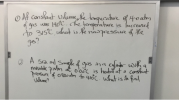 Af constant volume, the temperature of 40 atom of gas was 190°c. The temperature is increased to 315c, what is the new pressure of the gas? 2 A 510 ml Sample of gas na cylinder with a movable piston at oooc is heated at a constant pressure of 0.800 atm to 410c. what is its find sheme?
Please be eligible. Thank You 9. Check out the error map for water vapor when treating...
 Please be eligible. Thank You
9. Check out the error map for water vapor when treating the steam as ideal gas and give comments 10. Solve this problem using Ideal Gas equation: Determine the specific volume of refrigerant R134a at 1 MPa and 50°C. The R of R-134a is 0.0815 (kPa.m3)/(kg.K), Per 4.059 MPa, Ter 374.2 K. The actual specific volume is 0.021796 m3/kg. 11. Solve the above problem using the generalized compressibility chart (meaning, use the Z factor) 12....
Please be eligible. Thank You
9. Check out the error map for water vapor when treating the steam as ideal gas and give comments 10. Solve this problem using Ideal Gas equation: Determine the specific volume of refrigerant R134a at 1 MPa and 50°C. The R of R-134a is 0.0815 (kPa.m3)/(kg.K), Per 4.059 MPa, Ter 374.2 K. The actual specific volume is 0.021796 m3/kg. 11. Solve the above problem using the generalized compressibility chart (meaning, use the Z factor) 12....
1.Argon contained in a closed, rigid tank, initially at 62.3°C, 3.9 bar, and a volume of...
1.Argon contained in a closed, rigid tank, initially at 62.3°C, 3.9 bar, and a volume of 4.2 m3, is heated to a final pressure of 9.4 bar. Assuming the ideal gas model with k = 1.6 for the argon, determine the heat transfer, in kJ. 2.Water vapor contained in a piston–cylinder assembly undergoes an isothermal expansion at 223°C from a pressure of 5.4 bar to a pressure of 1.9 bar. Evaluate the work, in kJ/kg. 3.A mass of 4 kilograms...
 2. NH3, initially at 25°C and 1 bar, is heated at constant pressure until the volume increases 4 times. The heat capacity of NH3 can be modeled by the expression CP.m (NH3 (g))/J mol-'K' = 25.9+(33 x 10-3K-T a) Determine the final temperature and pressure of the system. b) Calculate the heat per mole for this process, work per mole, AHm, AU, for this process. c) Calculate ASm for the system. d) Calculate AStor for the process and comment on...
 4. 50 mol of nitrogen gas initially at 10°C and 100 bar are heated at constant pressure to a final temperature of 300°C. Using an appropriate generalized correlation calculate the amount of heat required for the process. Note that nitrogen is not an ideal gas under these conditions. Over this temperature range you may assume Cp of nitrogen to be constant equal to 30 J/mol K
 A sample of carbon monoxide gas is heated at constant pressure until its temperature increases by 62.3 degree C. A sample of neon gas is heated at constant volume until its temperature increases by 22 degree C. If each sample of gas absorbs the same amount of heat, what is the ratio of the number of moles of neon to the number of moles of carbon monoxide?
 50 mol of nitrogen gas initially at 10°C and 100 bar Hirogen gas initially at 10°C and 100 bar are heated at constant pressure to a final temperature of 300°C. Using an approp ature of 300°C. Using an appropriate generalized correlation calculate the armount or heat required for the process. Note that nitrogen is not an ideal gas under conditions. Over this temperature range you may assume Cple of nitrogen to be constant equal to 30 J/mol K.
 Af constant volume, the temperature of 40 atom of gas was 190°c. The temperature is increased to 315c, what is the new pressure of the gas? 2 A 510 ml Sample of gas na cylinder with a movable piston at oooc is heated at a constant pressure of 0.800 atm to 410c. what is its find sheme?
 Please be eligible. Thank You
9. Check out the error map for water vapor when treating the steam as ideal gas and give comments 10. Solve this problem using Ideal Gas equation: Determine the specific volume of refrigerant R134a at 1 MPa and 50°C. The R of R-134a is 0.0815 (kPa.m3)/(kg.K), Per 4.059 MPa, Ter 374.2 K. The actual specific volume is 0.021796 m3/kg. 11. Solve the above problem using the generalized compressibility chart (meaning, use the Z factor) 12....
Please be eligible. Thank You
9. Check out the error map for water vapor when treating the steam as ideal gas and give comments 10. Solve this problem using Ideal Gas equation: Determine the specific volume of refrigerant R134a at 1 MPa and 50°C. The R of R-134a is 0.0815 (kPa.m3)/(kg.K), Per 4.059 MPa, Ter 374.2 K. The actual specific volume is 0.021796 m3/kg. 11. Solve the above problem using the generalized compressibility chart (meaning, use the Z factor) 12....
Most questions answered within 3 hours.
-
Where is the error in this code sequence?
String s1 = "Hello";
String s2 = "ello";...
asked 10 months ago -
Financial data for Joel de Paris, Inc., for last year
follow:
Joel de Paris, Inc.
Balance...
asked 10 months ago -
Consider this reaction:
Al2(SO4)3 (aq)+ BaCl3
(aq) Al2Cl6 (aq)- +
3BaSO4(s) . What is the...
asked 10 months ago -
Suppose that Savneet is considering increasing her
recent random sample from 20 car rentals to 40...
asked 10 months ago -
Trucks arrive at an unloading terminal at an average rate of 120
per hour.
Trucks arrive...
asked 10 months ago -
Why are methanol and ethanol completely soluble in water while
octanol is not very little soluble....
asked 10 months ago -
A facilities manager at a university reads in a research report
that the mean amount of...
asked 10 months ago -
When the CuSO4 is rehydrated by adding water to the anhydrous
compound, is this an endothermic...
asked 10 months ago -
A ray of sunlight is passing from diamond into crown glass; the
angle of incidence is...
asked 10 months ago -
A block of mass 0.249 kg is placed on top of a light, vertical
spring of...
asked 10 months ago -
how do the kidneys compensate in the presences of acidosis
a) trigger hyperventilate
b) reserve acid...
asked 10 months ago -
Question 501 pts
The rental rate of capital to the firm increases. Which of the
following...
asked 10 months ago