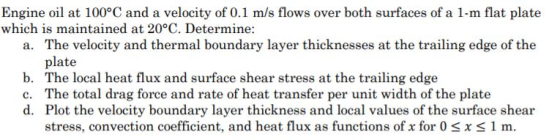
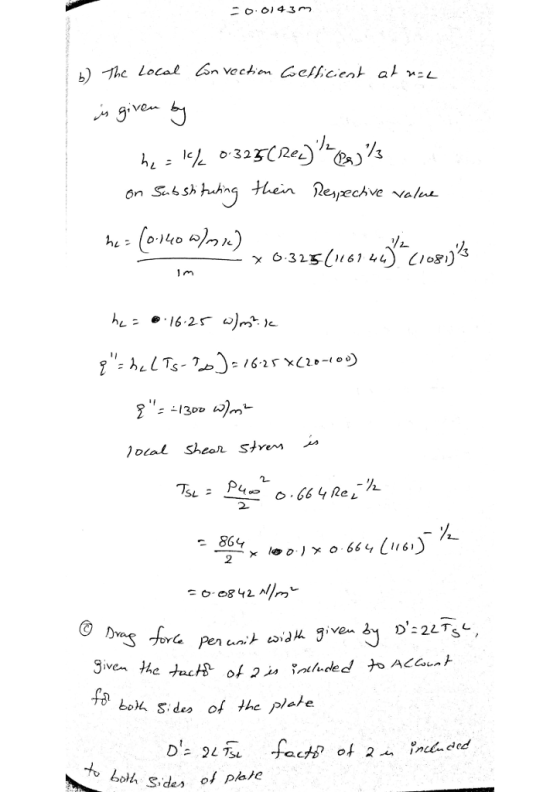
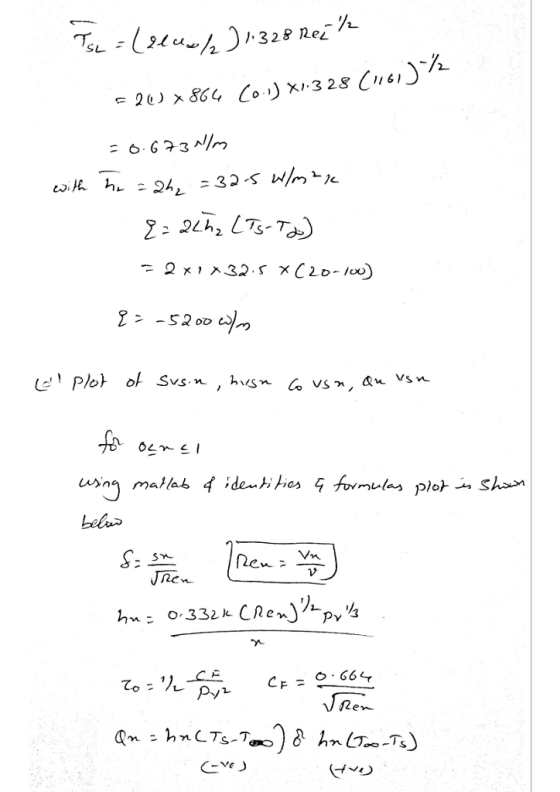
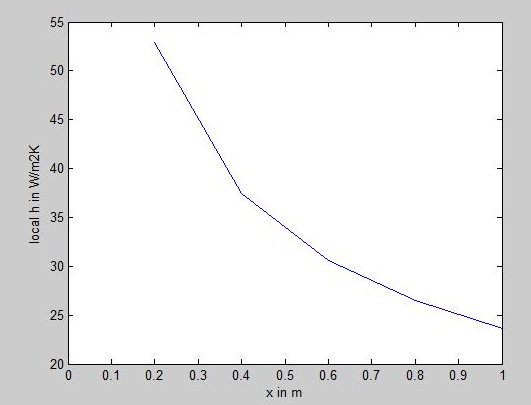
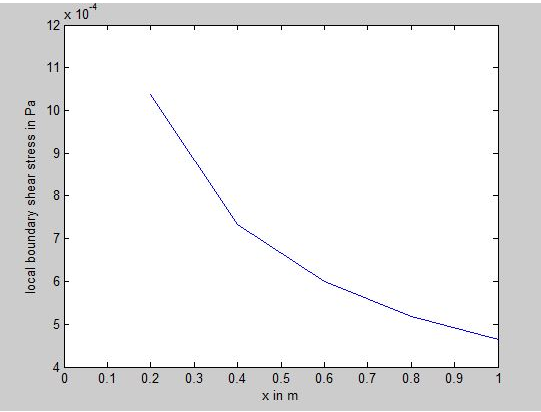
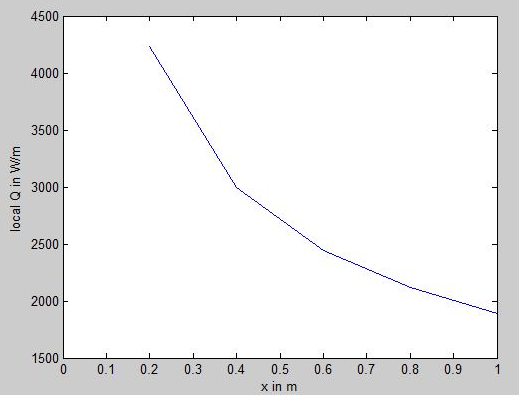
Start by checking your Reynolds number (Re) at the end of the plate, where it will be at a maximum. This will determine if your boundary layer is simply laminar along the length of the plate or if it becomes turbulent (the "mixed BL" condition). Once you know the conditions of the flow, you can solve for the velocity BL thickness directly with an equation from the list of external flow correlations (posted). Your properties should be looked up at the film temperature. Use the determined flow correlations to determine the LOCAL transfer coefficient, the shear and force (from the skin friction coefficient, C_f) and the heat flux. Don't forget that BOTH sides of the flat plate are exposed to the flow. You should find the heat flux at the trailing edge to be about 1300 W/m^2, and the total heat transfer from the plate to be about 5200 W. Plot the functions, which are only functions of x, in a software and print them.
Homework Answers


Add Answer to:
Start by checking your Reynolds number (Re) at the end of the
plate, where it will...
RCES Problem 7.002 Engine oil at 100°C and a velocity of 0.20 m/s flows over both...
 RCES Problem 7.002 Engine oil at 100°C and a velocity of 0.20 m/s flows over both surfaces of a 1-m-long flat plate maintained at 20°C 001 Determine: (a) The velocity and thermal boundary layer thicknesses at the trailing edge. (b) The local heat flux and surface shear stress at the trailing edge. (c) The total drag force and heat transfer per unit width of the plate. 02 Determine the velocity boundary layer thickness 6 at the trailing edge, in m....
Q1. A flat plate is immersed in a uniform stream voo that moves parallel with the...
 Q1. A flat plate is immersed in a uniform stream voo that moves parallel with the flat plate. A boundary layer thickness δ is formed close to the plate surface. Using the control volume analysis of the boundary layer (the von Karman equation) determine relationships of the a. boundary layer displacement thickness, δ* b. momentum thickness, θ c. shear stress on the flat plate surface, Tu as a function of the velocity deficit 1- Then use the approximation that the...
Consider laminar flow of an incompressible fluid past a flat plate. The boundary layer velocity profile...
 Consider laminar flow of an incompressible fluid past a flat plate. The boundary layer velocity profile is given as u = U sin () a. Determine the boundary layer thicknesses 8, 8, as a function of x. Express in terms of Reynolds number. b. Using momentum integral theory, determine the wall shear stress tw, as a func. of x. Express in terms of Reynolds number. C. Determine the friction drag coefficient, Cof-
QUESTION 2A (11 marks) [Allow 13 minutes] Water flows over a stationary, smooth, flat rectangular plate with dimensions 0.4 x 0.25m as shown in the figure below. The plate has its long axis parallel...
 QUESTION 2A (11 marks) [Allow 13 minutes] Water flows over a stationary, smooth, flat rectangular plate with dimensions 0.4 x 0.25m as shown in the figure below. The plate has its long axis parallel to the direction of flow 0.4 m U1 m/s 0.25 m Answer the questions below where the properties of the water are (p 1000 kg/m, v 106 m2/s): a) Determine the nature of the boundary layer over the plate if the approach velocity of the water,...
Air with a dynamic viscosity of 18.1 x 10 N m/s, a density of 1.2 kg/m'...
 Air with a dynamic viscosity of 18.1 x 10 N m/s, a density of 1.2 kg/m' and a free stream velocity of 20 m/s flows over a 0.8 m long by 0.3 m wide flat plate. 20 m/s -0.5 m - -0.8 m a. Find the type of flow on flat plate based on Reynolds number b. Find the boundary layer thickness at distance of 0.5 m from the leading edge c. Find the wall shear stress at a horizontal...
Consider water at 25°C in parallel flow over an isothermal flat plate with a velocity of...
 Consider water at 25°C in parallel flow over an isothermal flat plate with a velocity of 0.5 m/s. (a) Calculate the boundary layer thickness : at x = 3 m. What would be the value of 8, if the flow velocity was 0.05 m/s? (b) Calculate the average heat transfer coefficient over the length x.
Problem 1: In an experiment, Mercury at film temperature of 127 C flows over a flat...
 Problem 1: In an experiment, Mercury at film temperature of 127 C flows over a flat plate of length 500 mm and width of 20 mm. Results reveal that the velocity boundary layer thickness at the distance of 5 mm from the leading edge is 0.4 pim, and also th convection heat transfer coefficients in the laminar and turbulent regions (Rex.-2 x 10) take the form of GX İsit where x is measured in meters from the leading edge of...
Use the integral method for boundary layer flow and convective heat transfer over a flat plate he...
 Use the integral method for boundary layer flow and convective heat transfer over a flat plate heated by maintaining a constant heat flux q"w, for the case of very low Prandtl number, Pr0. Assume that the free stream velocity of the fluid, U, and free stream temperature, T-do not vary with x. Using the integral form of energy equation, show that under these conditions: (a) the temperature profile, (T- T) is given by, 41 2 CT-T oa (b) the wall...
Air at a temperature of 300 K flows over one side of a flat plate of...
Air at a temperature of 300 K flows over one side of a flat plate of width 1 m at a velocity of 20 m/s. The plate has a constant surface temperature of 350 K. Assume Re(x,c)=5x10^5. a) What is the velocity boundary layer thickness at the end of the plate if L=0.25 m? What if L=1 m? b) Calculate the drag on the plate if L=0.25 m. What is the drag if L=1 m? c) Find the heat transfer...
Air at T=25°C and pressure P=1 bar flows over a square plate with a velocity V=1...
Air at T=25°C and pressure P=1 bar flows over a square plate with a velocity V=1 m/s. This plate has a length L= 1 m and it is heated over its entire length; the plate temperature is constant Tp=100°C. The following data are given. For air: dynamic viscosity: mu = 1.9*10–5 kg/(m.s); density: rho = 1.05 kg/m3; conductivity k = 0.03 W/(m K); Specific heat Cp = 1.007 kJ/(kg K); Prandtl number Pr = 0.7 For laminar flow over a...
 RCES Problem 7.002 Engine oil at 100°C and a velocity of 0.20 m/s flows over both surfaces of a 1-m-long flat plate maintained at 20°C 001 Determine: (a) The velocity and thermal boundary layer thicknesses at the trailing edge. (b) The local heat flux and surface shear stress at the trailing edge. (c) The total drag force and heat transfer per unit width of the plate. 02 Determine the velocity boundary layer thickness 6 at the trailing edge, in m....
 Q1. A flat plate is immersed in a uniform stream voo that moves parallel with the flat plate. A boundary layer thickness δ is formed close to the plate surface. Using the control volume analysis of the boundary layer (the von Karman equation) determine relationships of the a. boundary layer displacement thickness, δ* b. momentum thickness, θ c. shear stress on the flat plate surface, Tu as a function of the velocity deficit 1- Then use the approximation that the...
 Consider laminar flow of an incompressible fluid past a flat plate. The boundary layer velocity profile is given as u = U sin () a. Determine the boundary layer thicknesses 8, 8, as a function of x. Express in terms of Reynolds number. b. Using momentum integral theory, determine the wall shear stress tw, as a func. of x. Express in terms of Reynolds number. C. Determine the friction drag coefficient, Cof-
 QUESTION 2A (11 marks) [Allow 13 minutes] Water flows over a stationary, smooth, flat rectangular plate with dimensions 0.4 x 0.25m as shown in the figure below. The plate has its long axis parallel to the direction of flow 0.4 m U1 m/s 0.25 m Answer the questions below where the properties of the water are (p 1000 kg/m, v 106 m2/s): a) Determine the nature of the boundary layer over the plate if the approach velocity of the water,...
 Air with a dynamic viscosity of 18.1 x 10 N m/s, a density of 1.2 kg/m' and a free stream velocity of 20 m/s flows over a 0.8 m long by 0.3 m wide flat plate. 20 m/s -0.5 m - -0.8 m a. Find the type of flow on flat plate based on Reynolds number b. Find the boundary layer thickness at distance of 0.5 m from the leading edge c. Find the wall shear stress at a horizontal...
 Consider water at 25°C in parallel flow over an isothermal flat plate with a velocity of 0.5 m/s. (a) Calculate the boundary layer thickness : at x = 3 m. What would be the value of 8, if the flow velocity was 0.05 m/s? (b) Calculate the average heat transfer coefficient over the length x.
 Problem 1: In an experiment, Mercury at film temperature of 127 C flows over a flat plate of length 500 mm and width of 20 mm. Results reveal that the velocity boundary layer thickness at the distance of 5 mm from the leading edge is 0.4 pim, and also th convection heat transfer coefficients in the laminar and turbulent regions (Rex.-2 x 10) take the form of GX İsit where x is measured in meters from the leading edge of...
 Use the integral method for boundary layer flow and convective heat transfer over a flat plate heated by maintaining a constant heat flux q"w, for the case of very low Prandtl number, Pr0. Assume that the free stream velocity of the fluid, U, and free stream temperature, T-do not vary with x. Using the integral form of energy equation, show that under these conditions: (a) the temperature profile, (T- T) is given by, 41 2 CT-T oa (b) the wall...
Most questions answered within 3 hours.
-
Where is the error in this code sequence?
String s1 = "Hello";
String s2 = "ello";...
asked 10 months ago -
Financial data for Joel de Paris, Inc., for last year
follow:
Joel de Paris, Inc.
Balance...
asked 10 months ago -
Consider this reaction:
Al2(SO4)3 (aq)+ BaCl3
(aq) Al2Cl6 (aq)- +
3BaSO4(s) . What is the...
asked 10 months ago -
Suppose that Savneet is considering increasing her
recent random sample from 20 car rentals to 40...
asked 10 months ago -
Trucks arrive at an unloading terminal at an average rate of 120
per hour.
Trucks arrive...
asked 10 months ago -
Why are methanol and ethanol completely soluble in water while
octanol is not very little soluble....
asked 10 months ago -
A facilities manager at a university reads in a research report
that the mean amount of...
asked 10 months ago -
When the CuSO4 is rehydrated by adding water to the anhydrous
compound, is this an endothermic...
asked 10 months ago -
A ray of sunlight is passing from diamond into crown glass; the
angle of incidence is...
asked 10 months ago -
A block of mass 0.249 kg is placed on top of a light, vertical
spring of...
asked 10 months ago -
how do the kidneys compensate in the presences of acidosis
a) trigger hyperventilate
b) reserve acid...
asked 10 months ago -
Question 501 pts
The rental rate of capital to the firm increases. Which of the
following...
asked 10 months ago