
Homework Answers
![-solution - When ethane mixed with ain G46 + Z 7102 + 70 M ] - 2002 + 3H₂O + 4 BN Whin 10% excurs ain mixed with ethane Cho t](http://img.homeworklib.com/questions/13babc00-bd03-11eb-bdd0-b3dd164b85e6.png?x-oss-process=image/resize,w_560)
Add Answer to:
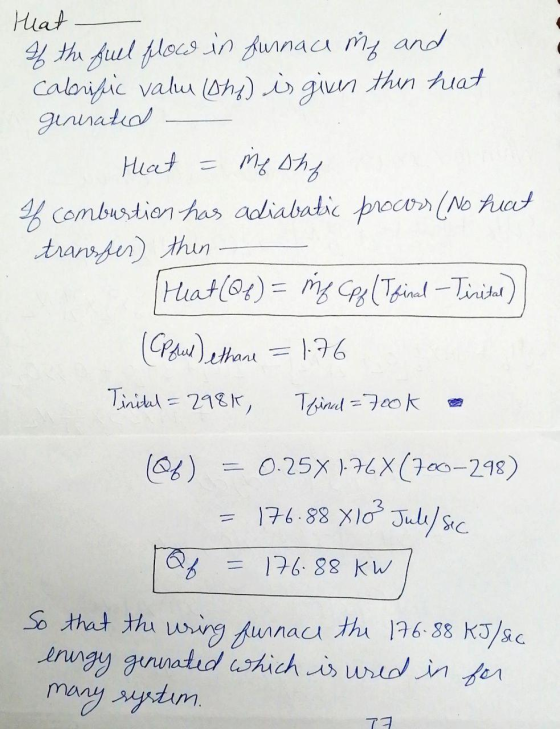
please use assumptions and energy balance equations
Ethane enters at furnace at a volumetric flow rate...
Incorrect Question 19 0/8 pts Methane (CH4) at 298 K, 1 atm enters a furnace operating...
 Incorrect Question 19 0/8 pts Methane (CH4) at 298 K, 1 atm enters a furnace operating at steady state and burns completely with 220% of theoretical air entering at 400 K, 1 atm. The products of combustion exit at 500 K, 1 atm. The flow rate of the methane is 1.2 kg/min. Kinetic and potential energy effects are negligible and air can be modeled as 21% O2 and 79% N2 on a molar basis. Determine the rate of heat transfer...
Gasoline enters a combustion chamber, at 1 atm, 298 K and a rate of 0.08 kg/min, where it burns s...
Gasoline enters a combustion chamber, at 1 atm, 298 K and a rate of 0.08 kg/min, where it burns steadily and completely, with 70% excess air that enters the chamber at 1 atm, 200 K. The exit temperature of the combustion products is 800 K. Use the IG mixture model for gases. Represent gasoline with liquid octane. a. Determine the mass flow rate, [kg of air/min], of air. b. Determine the rate of heat transfer, . c. What is the...
Air enters the compressor of an air-standard Brayton cycle with a volumetric flow rate of 60...
Air enters the compressor of an air-standard Brayton cycle with a volumetric flow rate of 60 m3/s at 0.8 bar, 280 K. The compressor pressure ratio is 17.5, and the maximum cycle temperature is 2100 K. For the compressor, the isentropic efficiency is 92% and for the turbine the isentropic efficiency is 95%. Determine: (a) the net power developed, in kW. (b) the rate of heat addition in the combustor, in kW. (c) the percent thermal efficiency of the cycle.
Air enters the compressor of a regenerative air-standard Brayton cycle with a volumetric flow rate of...
Air enters the compressor of a regenerative air-standard Brayton cycle with a volumetric flow rate of 100 m3/s at 0.8 bar, 280 K. The compressor pressure ratio is 20, and the maximum cycle temperature is 2100 K. For the compressor, the isentropic efficiency is 92% and for the turbine the isentropic efficiency is 95%. For a regenerator effectiveness of 86%, determine: (a) the net power developed, in MW. (b) the rate of heat addition in the combustor, in MW. (c)...
Moist air enters a duct at 10 °C, 80% relative humidity, and a volumetric flow rate...
Moist air enters a duct at 10 °C, 80% relative humidity, and a volumetric flow rate of 150 m3/min. The mixture is heated as it flows through the duct and exits at 30 °C. No moisture is added or removed and the mixture stays at 1 atm. Determine the rate of heat transfer and the relative humidity at the exit.
Air enters the compressor of a regenerative air-standard Brayton cycle with a volumetric flow rate of...
 Air enters the compressor of a regenerative air-standard Brayton cycle with a volumetric flow rate of 20 m3/s at 0.8 bar, 280 K. The compressor pressure ratio is 20, and the maximum cycle temperature is 1950 K. For the compressor, the isentropic efficiency is 92% and for the turbine the isentropic efficiency is 95%. For a regenerator effectiveness of 86%, determine: (a) the net power developed, in MW. (b) the rate of heat addition in the combustor, in MW. (c)...
4. Propylene (C,H) enters a combustion chamber at 25 C, 1 bar, with a volumetric flow...
 4. Propylene (C,H) enters a combustion chamber at 25 C, 1 bar, with a volumetric flow rate of 10m3/min. 150% oftheoretical air enters the chamber at 47°C, 1 bar. Combustion products exit the chamber at 327C, 1 bar. For this system find: a. the air-fuel ratio on a mass basis b. the rate of heat transfer from the chamber, kJ/min c. the dew point of the combustion products,C
Liquid propane (C_3H_8) enters a steady-flow combustion chamber at 25 Degree C, and 6 atm at...
 Liquid propane (C_3H_8) enters a steady-flow combustion chamber at 25 Degree C, and 6 atm at a rate of 0.8 kg/min. It is burned with 150 percent excess air that is compressed and preheated to 400 K and 6 atm before entering the combustion chamber. The products of the combustion enter a gas turbine at 1200 K and 6 tam and leave at 700 K and 1 atm. The adiabatic efficiency of the turbine is 80%. The combustion process is...
Problem 15.10: Liquid octane (CsHis) enters a steady-flow combustion chamber at 25°C and 1 atm at...
 Problem 15.10: Liquid octane (CsHis) enters a steady-flow combustion chamber at 25°C and 1 atm at a rate of 0.35 kg/min. It is burned with 50 percent excess air that also enters at 25°C and 1 atm. After combustion, the products are allowed to cool to 25°C. Assuming complete combustion and that all the H2O in the products is in liquid form, determine (a) the heat transfer rate from the combustion chamber, (b) the entropy generation rate, and (c) the...
 Incorrect Question 19 0/8 pts Methane (CH4) at 298 K, 1 atm enters a furnace operating at steady state and burns completely with 220% of theoretical air entering at 400 K, 1 atm. The products of combustion exit at 500 K, 1 atm. The flow rate of the methane is 1.2 kg/min. Kinetic and potential energy effects are negligible and air can be modeled as 21% O2 and 79% N2 on a molar basis. Determine the rate of heat transfer...
 Air enters the compressor of a regenerative air-standard Brayton cycle with a volumetric flow rate of 20 m3/s at 0.8 bar, 280 K. The compressor pressure ratio is 20, and the maximum cycle temperature is 1950 K. For the compressor, the isentropic efficiency is 92% and for the turbine the isentropic efficiency is 95%. For a regenerator effectiveness of 86%, determine: (a) the net power developed, in MW. (b) the rate of heat addition in the combustor, in MW. (c)...
 4. Propylene (C,H) enters a combustion chamber at 25 C, 1 bar, with a volumetric flow rate of 10m3/min. 150% oftheoretical air enters the chamber at 47°C, 1 bar. Combustion products exit the chamber at 327C, 1 bar. For this system find: a. the air-fuel ratio on a mass basis b. the rate of heat transfer from the chamber, kJ/min c. the dew point of the combustion products,C
 Liquid propane (C_3H_8) enters a steady-flow combustion chamber at 25 Degree C, and 6 atm at a rate of 0.8 kg/min. It is burned with 150 percent excess air that is compressed and preheated to 400 K and 6 atm before entering the combustion chamber. The products of the combustion enter a gas turbine at 1200 K and 6 tam and leave at 700 K and 1 atm. The adiabatic efficiency of the turbine is 80%. The combustion process is...
 Problem 15.10: Liquid octane (CsHis) enters a steady-flow combustion chamber at 25°C and 1 atm at a rate of 0.35 kg/min. It is burned with 50 percent excess air that also enters at 25°C and 1 atm. After combustion, the products are allowed to cool to 25°C. Assuming complete combustion and that all the H2O in the products is in liquid form, determine (a) the heat transfer rate from the combustion chamber, (b) the entropy generation rate, and (c) the...
Most questions answered within 3 hours.
-
Where is the error in this code sequence?
String s1 = "Hello";
String s2 = "ello";...
asked 10 months ago -
Financial data for Joel de Paris, Inc., for last year
follow:
Joel de Paris, Inc.
Balance...
asked 10 months ago -
Consider this reaction:
Al2(SO4)3 (aq)+ BaCl3
(aq) Al2Cl6 (aq)- +
3BaSO4(s) . What is the...
asked 10 months ago -
Suppose that Savneet is considering increasing her
recent random sample from 20 car rentals to 40...
asked 10 months ago -
Trucks arrive at an unloading terminal at an average rate of 120
per hour.
Trucks arrive...
asked 10 months ago -
Why are methanol and ethanol completely soluble in water while
octanol is not very little soluble....
asked 10 months ago -
A facilities manager at a university reads in a research report
that the mean amount of...
asked 10 months ago -
When the CuSO4 is rehydrated by adding water to the anhydrous
compound, is this an endothermic...
asked 10 months ago -
A ray of sunlight is passing from diamond into crown glass; the
angle of incidence is...
asked 10 months ago -
A block of mass 0.249 kg is placed on top of a light, vertical
spring of...
asked 10 months ago -
how do the kidneys compensate in the presences of acidosis
a) trigger hyperventilate
b) reserve acid...
asked 10 months ago -
Question 501 pts
The rental rate of capital to the firm increases. Which of the
following...
asked 10 months ago