1.Suppose an economy experiences a 4% increase in each of the following variables: N, K, and...
1.Suppose an economy experiences a 4% increase in each of the following variables: N, K, and H (human capital). If the production function is Y=KαN(1-α)Hβ, where α<1 and β<1, we know with certainty that
Y will increase by less than 4%.
none of the other answers is correct
Y will increase by less than 12% but by more than 4%.
Y will increase by exactly 4%.
Y will increase by more than 4%.
2. Why do banks maintain a certain level of bank capital?
These funds are reserved as salary bonuses for top management.
These are funds to be invested in emerging market economies.
These precautionary funds are held against the illiquidity risks of loans and bonds.
These funds are required to satisfy shareholders in annual statements.
These funds are set aside for taxation purposes
3. For this question, assume that equilibrium output is determined in the ZZ-Y diagram. Further assume that policy makers' goals are: (1) to achieve balanced trade (i.e., NX = 0); and (2) to achieve the natural level of output, say Yn. Now suppose that the initial level of equilibrium output is equal to Yn (i.e., Y = Yn) and that a trade deficit exists at this initial level of output. Which of the following policy actions would most likely enable the policy makers to achieve their two goals simultaneously?
A decrease in government spending.
A decrease in taxes and increase in the real exchange rate.
Convince the country's trading partners to pursue policies that will cause an increase in foreign income.
A decrease in the real exchange rate.
None of the other answers is correct.
4. In Solow model where it is assumed that the state of technology does not change, what parameters and/or variables cause changes in steady state output per worker?
all of other answers are correct
savings rate
human capital per worker
production function parameters
depreciation rate
5. Suppose there are two countries that are identical with the following exception: the saving rate in country A is greater than the saving rate in country B. Given this information, according to Solow model without technological progress, we know that in the long run:
economic growth will be higher in A than in B.
output per capita will be greater in A than in B.
output per capita will be the same in the two countries.
output per capita will be greater in B than in A.
economic growth will be higher in B than in A.
Homework Answers
Q1) option A)
Returns to scale = 1+1-a+b
= 2+b-a > 1
So if all variables rise by 4%, Y will rise by more than 4%
Q2) option 5)
As nominal GDP = Price level*Real GDP
So as nominal GDP rises, so both P or real GDP could rise
Q3) option 2)
As NCO : net capital outflow = Net exports NX
As Budget deficit decrease, so NX rises
Q.5) 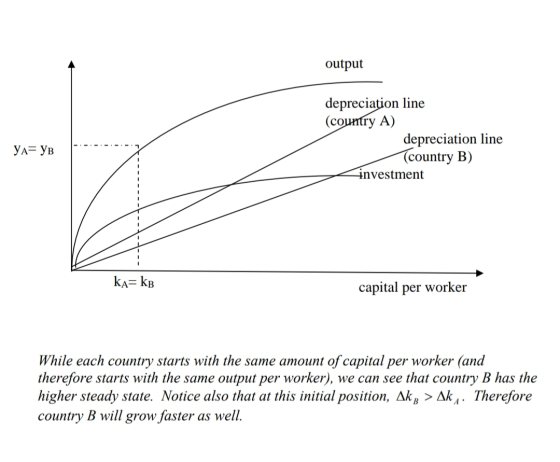
Add Answer to:
1.Suppose an economy experiences a 4% increase in each of the
following variables: N, K, and...
1. Consider a country that is initially in steady state. Suppose the saving rate increases. Moreover,...
1. Consider a country that is initially in steady state. Suppose the saving rate increases. Moreover, the population growth rate increases by 1% but the capital depreciation rate falls by 1%. According to the Solow–Swan model, the per capita capital stock increases, and the country moves to a new, higher steady state level of per capita income. Answer true, false, or uncertain. Please briefly explain your answer. 2. Consider the country of Solow, which is described by the Solow–Swan model....
the domestic interest rate would leduction in E C) an increase in E D) an increase...
 the domestic interest rate would leduction in E C) an increase in E D) an increase in investment E) none of the above Answer Questions (30 points, 20 questions, 1.5 points for cach question) 1. For this question this question, assume that the economy is initially operating at the natural level of output. A monetary expansion will cause in the real wage in the medium run. con will cause (increase/decrease/no change) 2. Use the following information to answer the questions...
15. Consider an economy, with a production function given by Y-AK03L07. This economy's annual GDP growth...
 15. Consider an economy, with a production function given by Y-AK03L07. This economy's annual GDP growth rate is 5%. Also assume that L and Kare both growing at annual rates of 2%. Calculate the growth rate of total factor productivity for this economy. a. 2.0% b. 3.0% 4.0% c. d. 5.0% 16. Suppose output is determined by a Cobb-Douglas production function Y=AK L1 Where 0ca<1. If total factor productivity (A) remains constant, but labour (L) and capital (K) inputs both...
4. Which of the following will cause an increase in output per worker in the long...
 4. Which of the following will cause an increase in output per worker in the long run? A. an increase in the saving rate ( B. a reduction in the depreciation rate C. an increase in the stock of human capital D. an improvement of technology 5. Suppose, due to a military conflict, that a country experiences a large reduction in its capital stock. Assume no other effects of this event on the economy. Which of the following will tend...
Question 12 0.2 pts Suppose there is a permanent increase in a country's saving rate. This...
 Question 12 0.2 pts Suppose there is a permanent increase in a country's saving rate. This increase in the saving rate will cause: O a permanently higher level of capital per worker. a permanently higher level of output per capita. a permanently faster growth rate of output. both of the first two answers above O none of the above.
Consider the Solow growth model with depreciation rate and population growth rate n. The equation of...
 Consider the Solow growth model with depreciation rate and population growth rate n. The equation of motion for the capital stock and the per worker production function in this economy are given by: Ak= s(f(k) - (8 + n) k y= f(k) = k1/4 a). Suppose adoption of modern birth control methods in a developing country causes the population growth rate to decrease. What happens in the main Solow diagram: what curve(s) shin, what happens to the steady- state level...
Consider an economy described by the following production function: Y=K0.2L0.8 Suppose the depreciation rate is 10%....
Consider an economy described by the following production function: Y=K0.2L0.8 Suppose the depreciation rate is 10%. Explain what the golden rule level of capital is. For this economy, calculate the golden rule level of capital per worker, output per worker, depreciation per worker and consumption per worker. Plot the results obtained in (b) above. Calculate the saving rate that would give the golden rule level. Explain what happens to the consumption level if the saving rate departs from the one...
Consider an economy described by the following Cobb-Douglas, constant-returns-to-scale, aggregate production function: Y (K, L)...
Consider an economy described by the following Cobb-Douglas, constant-returns-to-scale, aggregate production function: Y (K, L) = ?.??.? i.) Derive the per-capita/worker production function. ii.) Assume the depreciation rate (ɖ) is 1.5 percent, the population growth (n) is 4 percent, and the savings rate (s) is 8 percent; derive the discrete fundamental Solow Growth equation, and finally find the steady-state capital stock per-capita/worker (k*) and output per-capita/worker (y*). iii.) Assume the savings rate (s) rises to 16 percent, all else...
pls solve parts g,h,i, j Suppose Country X's production function is given by F(K, A,N) =...
 pls solve parts g,h,i, j
Suppose Country X's production function is given by F(K, A,N) = 206,05(A, N,905 where K, is the capital and A, N, is the effective worker. The evolution of the capital stock is given by K +1 = 0.74K, +1 where the depreciation rate is 26%. Additionally, the saving rate is 36%, the population growth rate is 4% and the technological growth rate is 10% (a) Derive and show that in the Solow growth model, the...
pls solve parts g,h,i, j
Suppose Country X's production function is given by F(K, A,N) = 206,05(A, N,905 where K, is the capital and A, N, is the effective worker. The evolution of the capital stock is given by K +1 = 0.74K, +1 where the depreciation rate is 26%. Additionally, the saving rate is 36%, the population growth rate is 4% and the technological growth rate is 10% (a) Derive and show that in the Solow growth model, the...
Q.2 Consider the Solow growth model. Suppose that F(K,N)=RºS No5 with d=0.1, s=0.2, n=0.01, and z=1...
 Q.2 Consider the Solow growth model. Suppose that F(K,N)=RºS No5 with d=0.1, s=0.2, n=0.01, and z=1 and take a period to be one year. (15 marks) a. Determine capital per worker, income per capita, and consumption per capita in the steady state. Show the theoretical derivation and numerical solution. (7 marks) b. Now suppose that the economy is initially in the steady state that you calculated in part a, and savings increases to s=0.4. Determine capital per worker, income per...
 the domestic interest rate would leduction in E C) an increase in E D) an increase in investment E) none of the above Answer Questions (30 points, 20 questions, 1.5 points for cach question) 1. For this question this question, assume that the economy is initially operating at the natural level of output. A monetary expansion will cause in the real wage in the medium run. con will cause (increase/decrease/no change) 2. Use the following information to answer the questions...
 15. Consider an economy, with a production function given by Y-AK03L07. This economy's annual GDP growth rate is 5%. Also assume that L and Kare both growing at annual rates of 2%. Calculate the growth rate of total factor productivity for this economy. a. 2.0% b. 3.0% 4.0% c. d. 5.0% 16. Suppose output is determined by a Cobb-Douglas production function Y=AK L1 Where 0ca<1. If total factor productivity (A) remains constant, but labour (L) and capital (K) inputs both...
 4. Which of the following will cause an increase in output per worker in the long run? A. an increase in the saving rate ( B. a reduction in the depreciation rate C. an increase in the stock of human capital D. an improvement of technology 5. Suppose, due to a military conflict, that a country experiences a large reduction in its capital stock. Assume no other effects of this event on the economy. Which of the following will tend...
 Question 12 0.2 pts Suppose there is a permanent increase in a country's saving rate. This increase in the saving rate will cause: O a permanently higher level of capital per worker. a permanently higher level of output per capita. a permanently faster growth rate of output. both of the first two answers above O none of the above.
 Consider the Solow growth model with depreciation rate and population growth rate n. The equation of motion for the capital stock and the per worker production function in this economy are given by: Ak= s(f(k) - (8 + n) k y= f(k) = k1/4 a). Suppose adoption of modern birth control methods in a developing country causes the population growth rate to decrease. What happens in the main Solow diagram: what curve(s) shin, what happens to the steady- state level...
 pls solve parts g,h,i, j
Suppose Country X's production function is given by F(K, A,N) = 206,05(A, N,905 where K, is the capital and A, N, is the effective worker. The evolution of the capital stock is given by K +1 = 0.74K, +1 where the depreciation rate is 26%. Additionally, the saving rate is 36%, the population growth rate is 4% and the technological growth rate is 10% (a) Derive and show that in the Solow growth model, the...
pls solve parts g,h,i, j
Suppose Country X's production function is given by F(K, A,N) = 206,05(A, N,905 where K, is the capital and A, N, is the effective worker. The evolution of the capital stock is given by K +1 = 0.74K, +1 where the depreciation rate is 26%. Additionally, the saving rate is 36%, the population growth rate is 4% and the technological growth rate is 10% (a) Derive and show that in the Solow growth model, the...
 Q.2 Consider the Solow growth model. Suppose that F(K,N)=RºS No5 with d=0.1, s=0.2, n=0.01, and z=1 and take a period to be one year. (15 marks) a. Determine capital per worker, income per capita, and consumption per capita in the steady state. Show the theoretical derivation and numerical solution. (7 marks) b. Now suppose that the economy is initially in the steady state that you calculated in part a, and savings increases to s=0.4. Determine capital per worker, income per...
Most questions answered within 3 hours.
-
Where is the error in this code sequence?
String s1 = "Hello";
String s2 = "ello";...
asked 10 months ago -
Financial data for Joel de Paris, Inc., for last year
follow:
Joel de Paris, Inc.
Balance...
asked 10 months ago -
Consider this reaction:
Al2(SO4)3 (aq)+ BaCl3
(aq) Al2Cl6 (aq)- +
3BaSO4(s) . What is the...
asked 10 months ago -
Suppose that Savneet is considering increasing her
recent random sample from 20 car rentals to 40...
asked 10 months ago -
Trucks arrive at an unloading terminal at an average rate of 120
per hour.
Trucks arrive...
asked 10 months ago -
Why are methanol and ethanol completely soluble in water while
octanol is not very little soluble....
asked 10 months ago -
A facilities manager at a university reads in a research report
that the mean amount of...
asked 10 months ago -
When the CuSO4 is rehydrated by adding water to the anhydrous
compound, is this an endothermic...
asked 10 months ago -
A ray of sunlight is passing from diamond into crown glass; the
angle of incidence is...
asked 10 months ago -
A block of mass 0.249 kg is placed on top of a light, vertical
spring of...
asked 10 months ago -
how do the kidneys compensate in the presences of acidosis
a) trigger hyperventilate
b) reserve acid...
asked 10 months ago -
Question 501 pts
The rental rate of capital to the firm increases. Which of the
following...
asked 10 months ago